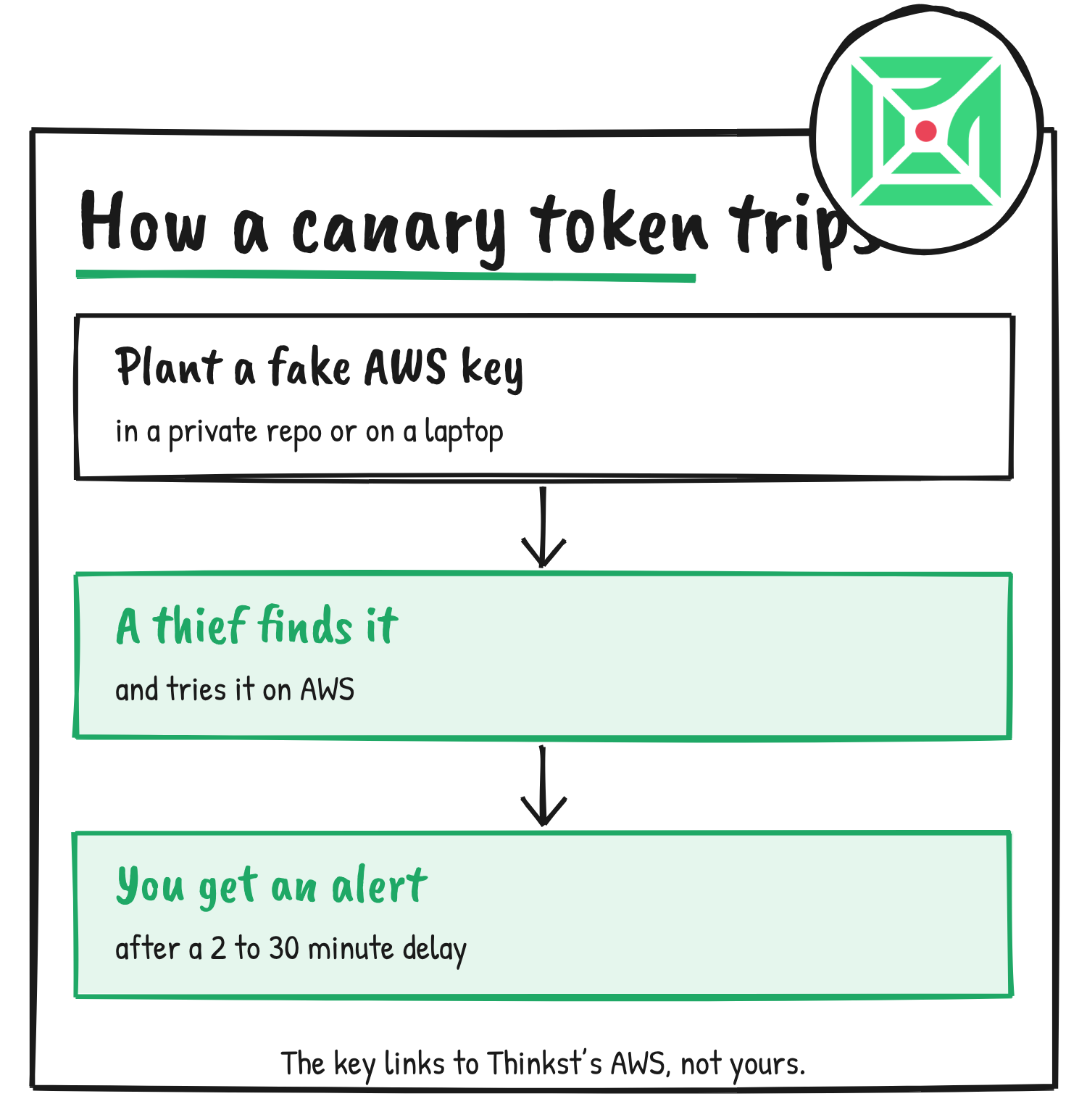
Canary tokens, the free decoy credentials Thinkst Applied Research hands out at canarytokens.org, are the newest form of a trick that mapmakers, dictionary editors, spy agencies and sysadmins have used for decades: plant something false, then watch who touches it. A fake AWS key left in a private repository raises an alert when anyone uses it, according to Thinkst’s documentation.
Seven versions of the trick follow, each tied to the source that documents it, along with what each one can’t prove.
How a canary token works
A typical token is a unique URL or hostname. Thinkst’s getting-started guide says you pick a token type at canarytokens.org, give it an email address for alerts and a memo that says where you plan to put it, then place it somewhere an intruder would look. If someone trips it, you get an email. The tokens are free, and Thinkst’s docs list them as working on documents, URLs, DNS names, QR codes and cloud credentials.
The AWS version is the one that matches an intruder hunting for keys. Thinkst’s help centre says the token links to an AWS account that belongs to Thinkst, so the credentials aren’t connected to your own AWS account. It also says each token should sit in a single location.
Grafana Labs says one of its thousands of canary tokens fired on Saturday 26 April 2025, which led its security team to a vulnerable GitHub Action. In a later post, Grafana says the attacker ran TruffleHog, an open source secrets scanner, against the stolen secrets, and its sts:GetCallerIdentity call on a planted AWS key triggered the alert. Grafana found no code modifications, no access to production systems and no exposed customer data.
The pre-digital decoys: fake towns, people and words
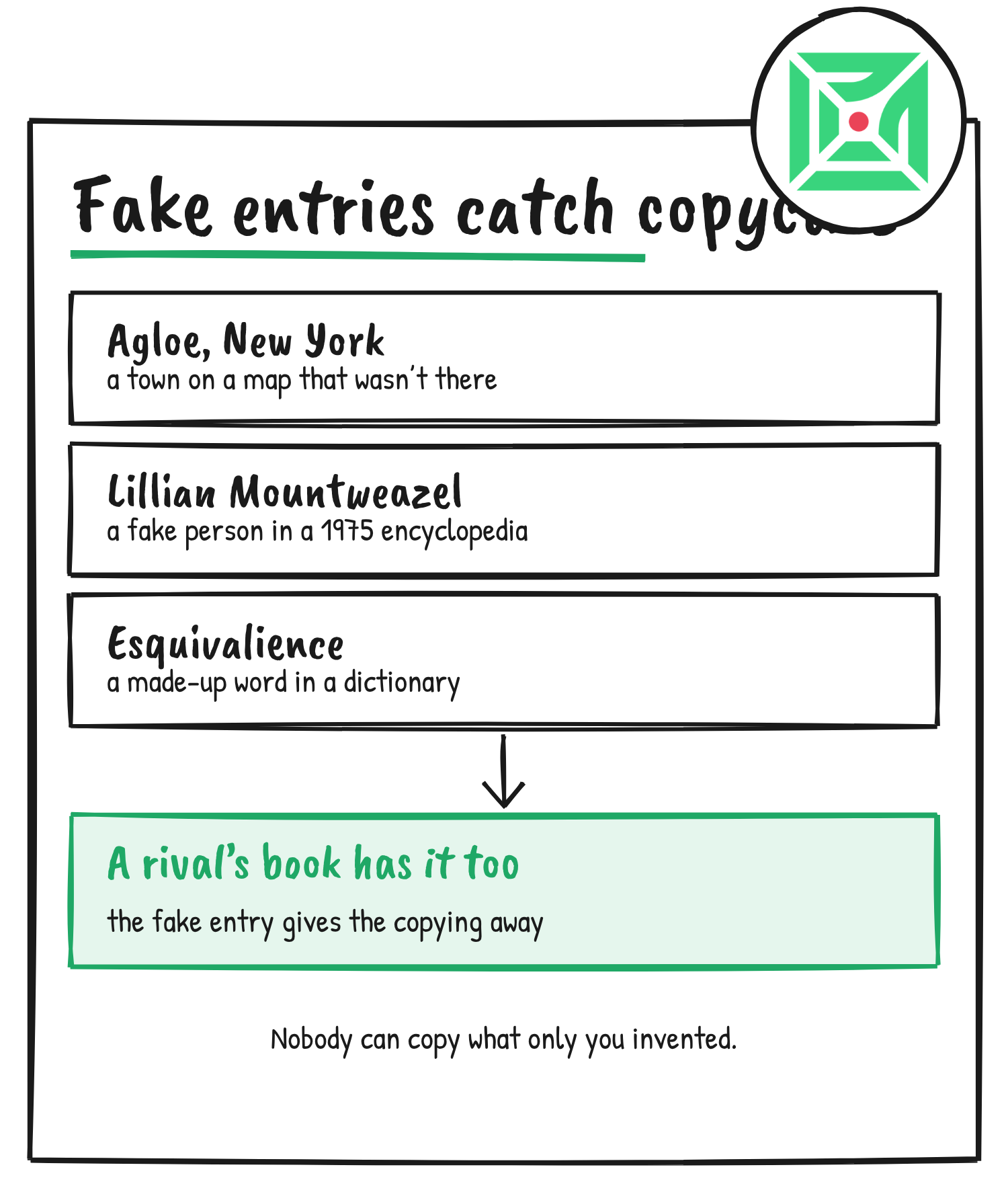
Mapmakers got there first. NPR reports that Otto G. Lindberg, director of the General Drafting Co., and his assistant Ernest Alpers put a made-up place called Agloe on a New York state road map, built from their initials. A Case Western Reserve Law Review article says Agloe later appeared on a Rand McNally map, Rand McNally said the place was real, and a general store opened at the spot after the name showed up on a third map.
Michigan’s state highway map from the late 1970s carried two fake towns, Goblu and Beatosu, named after the University of Michigan cheer “Go blue!” and “Beat OSU!”, the Grammarphobia blog says. The Goethe-Institut notes that in the United States such trap streets aren’t protected by copyright and are “one proof among many” of copying.
Reference books use fake entries too, and the name for them comes from one. Humorist Henry Alford coined “mountweazel” in a 2005 New Yorker piece after Lillian Virginia Mountweazel, a fountain designer turned photographer in the 1975 New Columbia Encyclopedia who died at 31 in an explosion while on assignment for Combustibles magazine. One of the encyclopedia’s editors told Alford, “It was an old tradition in encyclopedias to put in a fake entry to protect your copyright.”
The New Oxford American Dictionary’s made-up word was “esquivalience”, defined as “the willful avoidance of one’s official responsibilities.” Its editor in chief, Erin McKean, confirmed to the New Yorker that it was invented. The law review article says she compared the practice to “tagging and releasing giant turtles” and that the word was later spotted in other reference works.
Spy craft: the canary trap
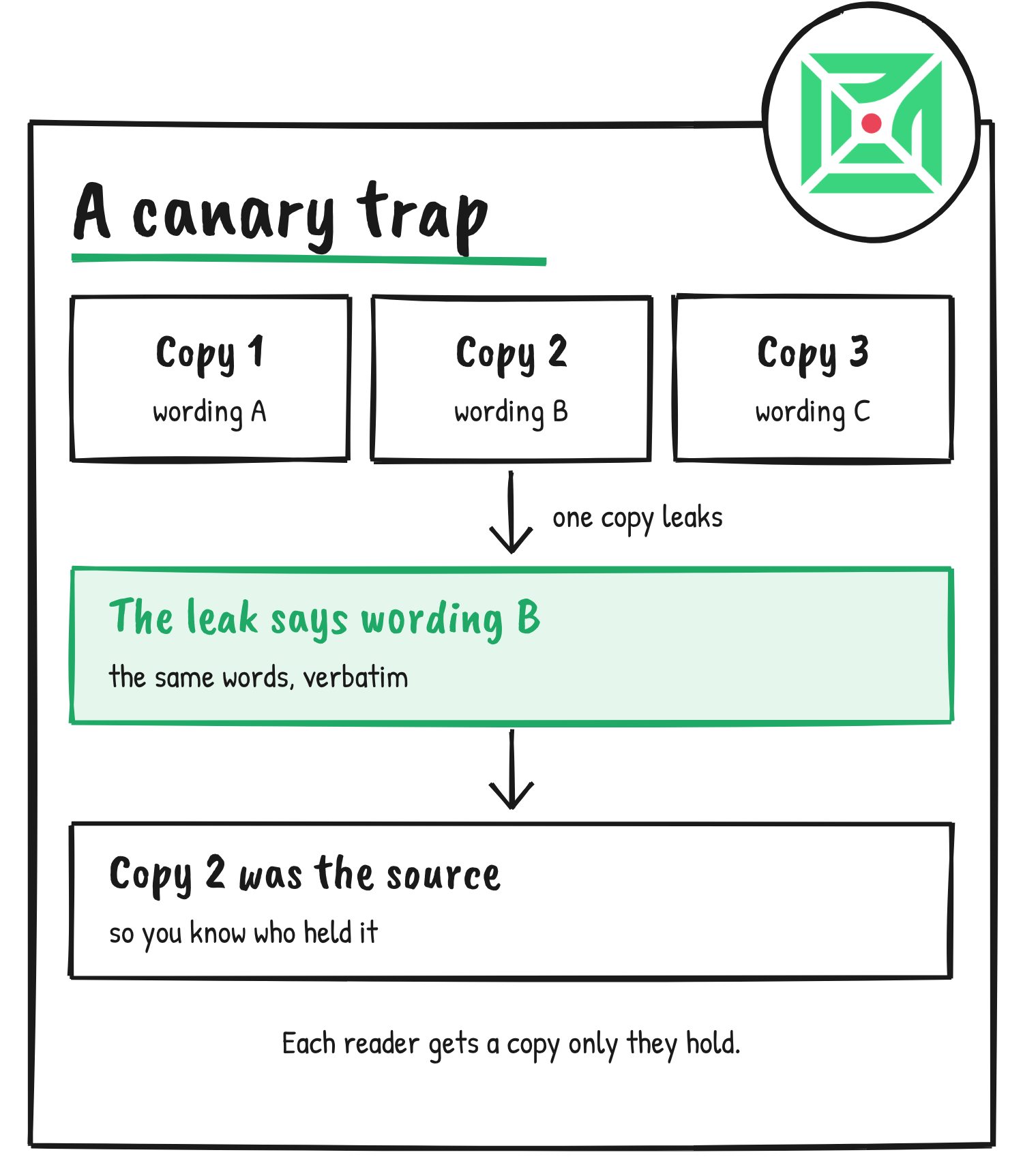
A canary trap gives each suspect a slightly different version of a sensitive document and waits to see which version leaks. Wikipedia’s summary says Tom Clancy coined the term in his 1987 novel Patriot Games, where analyst Jack Ryan describes six versions of each summary paragraph, a mix unique to each of 96 numbered copies, so a reporter who quotes two or three paragraphs identifies the copy. The same page says Clancy didn’t invent the method, and that Peter Wright’s 1987 book Spycatcher describes MI5 using it for years under the name “barium meal test”.
Decoys inside networks and password files
Thinkst’s 2016 44CON slides trace the honeytoken, a decoy that alerts its owner when touched, to Clifford Stoll’s book The Cuckoo’s Egg. Stoll, working as a system administrator at Lawrence Berkeley Lab, wrote fake emails about military affairs to suit an intruder’s interests and listed a postal address for requests. The slides say the intruder passed the address on and a letter was posted to it.
Ari Juels of RSA Laboratories and MIT’s Ronald Rivest proposed the password version in a 2013 ACM paper. Each account keeps several false passwords, called honeywords, beside the real one. An attacker who steals the hashed password file and cracks it can’t tell which is real, and a login with a honeyword sets off an alarm through a separate server the authors call the honeychecker. They credit the earlier Kamouflage system of Bojinov and colleagues with the closest related idea.
The canary that works by going quiet
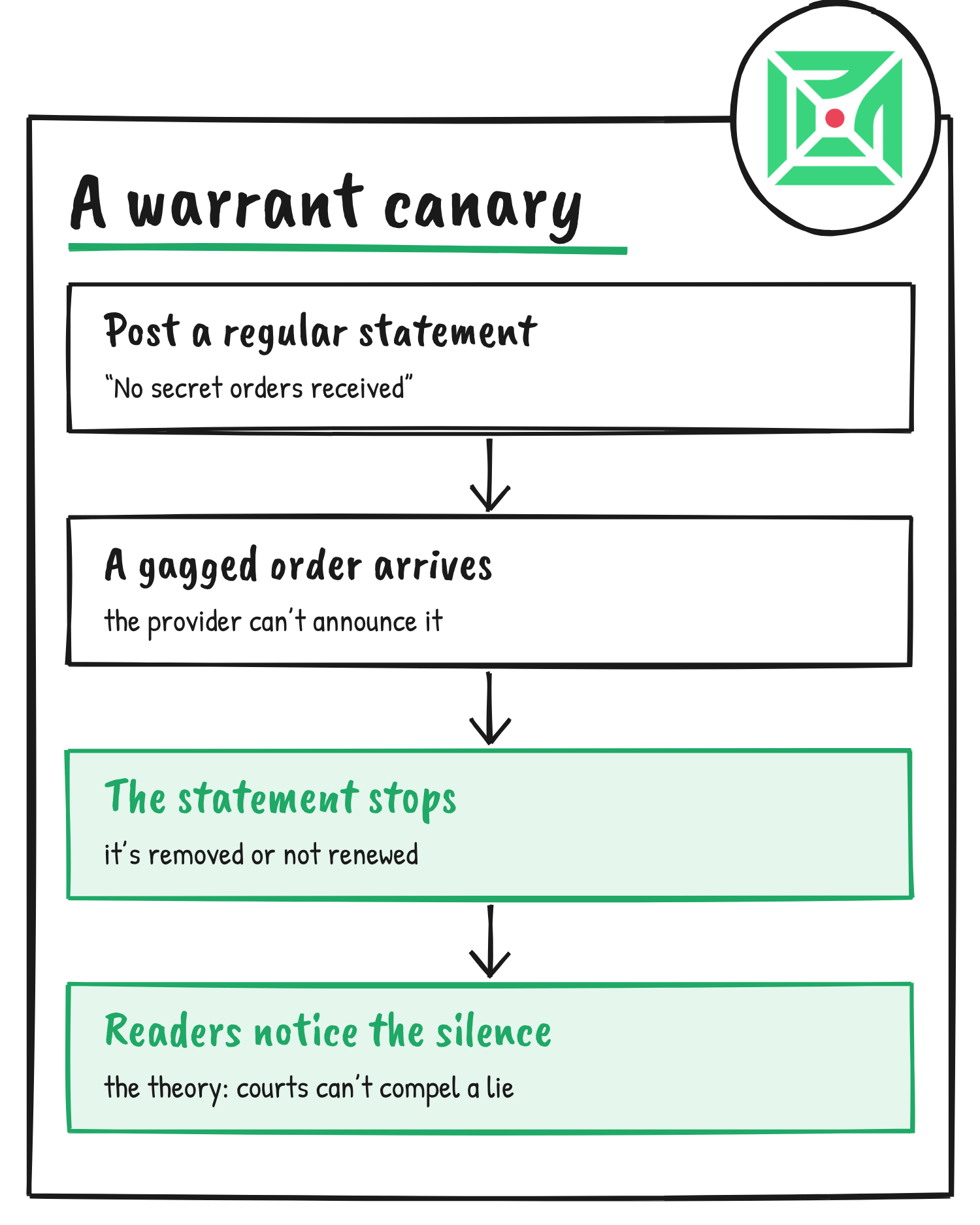
A warrant canary is a regularly published statement that a provider hasn’t received legal process it would be barred from disclosing, the Electronic Frontier Foundation’s Kurt Opsahl writes. When the process arrives and the gag takes hold, the provider stops publishing the statement. EFF’s legal theory is that a court can compel silence but may not compel a lie.
Wikipedia credits the US storage company rsync.net with the first commercial canary, published since 2006. Its notice is a signed message that carries news headlines and sports scores to show it was written on its stated date. Apple’s 5 November 2013 transparency report said “Apple has never received an order under Section 215 of the USA Patriot Act”. The Verge reported in September 2014 that Apple’s next two reports dropped or changed the line to “To date, Apple has not received any orders for bulk data.” The ACLU noted in June 2016 that Reddit’s canary had disappeared from its transparency report.
Seven decoys side by side
| Decoy | What’s false | Who it catches | Documented by |
|---|---|---|---|
| Canary token | An AWS key, file or URL | Anyone who uses or opens it | Thinkst docs, Grafana Labs |
| Honeytoken | Fake emails and a postal address | An intruder reading mail | Thinkst slides on Stoll |
| Honeyword | Extra false passwords per account | Someone who cracks a stolen password file | Juels and Rivest, 2013 |
| Trap street, paper town | A street or town on a map | A rival mapmaker | NPR, Goethe-Institut |
| Mountweazel | A person or word in a reference book | A rival publisher | The New Yorker, 2005 |
| Canary trap | Unique wording in each copy | A leaker | Wikipedia summary of Clancy and Wright |
| Warrant canary | A “nothing received” statement | Nobody; readers notice it vanish | EFF, rsync.net |
What these tricks don’t prove
Thinkst’s AWS-key documentation says alerts first pass through Amazon’s logging, which can add a delay of 2 to 30 minutes. Grafana’s post says TruffleHog detects free canary tokens automatically “without calling the AWS API”, and the tokens that fired in its incident were ones where Thinkst was watching Grafana’s AWS accounts. That means TruffleHog’s validation step doesn’t trigger a free token the way it triggered Grafana’s.
Fake entries are evidence of copying, not a legal shield. The Goethe-Institut says trap streets aren’t copyright-protected in the United States. EFF’s FAQ says no court has upheld a warrant canary, and rsync.net’s own notice says its process “is not infallible” and can’t stop someone coercing a false declaration. EFF’s Canary Watch project ended in May 2016 after tracking almost 70 canaries, and said canaries give “interesting, but not definitive information.”
rsync.net’s current canary, signed on 2 November 2026, lists no warrants or subpoenas at its Silicon Valley, Denver, Zurich or Hong Kong locations.
Discover more from Sulat AI & Tech News
Subscribe to get the latest posts sent to your email.