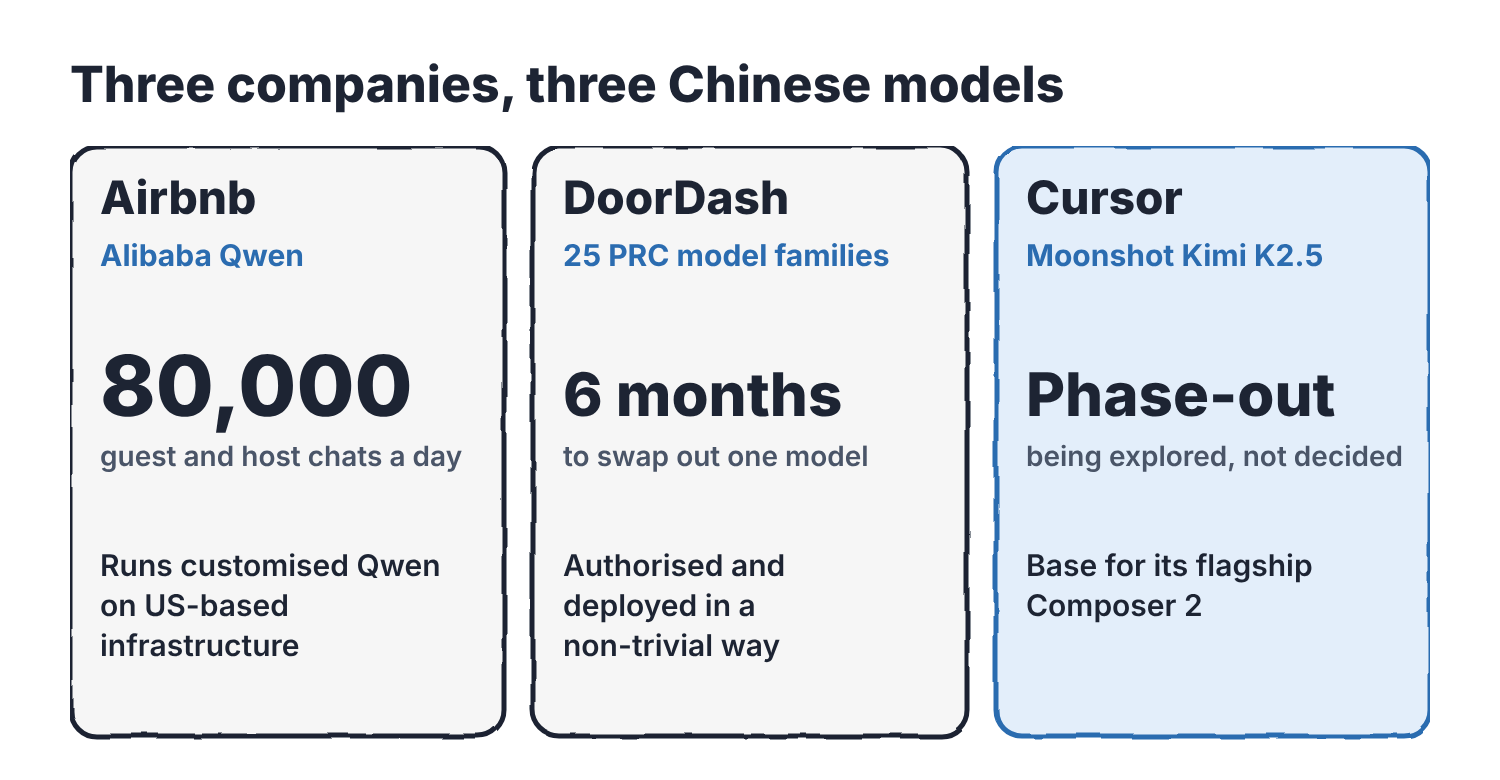
Cursor has told two House committees that it plans to explore phasing out Chinese-developed open-weight AI models because of geopolitical risk. The committees put that in a joint report published on 20 November US time, which CNBC saw ahead of release. It comes from the House Committee on Homeland Security and the House Select Committee on China after a seven-month investigation.
Cursor’s developer, Anysphere, built Composer 2, the flagship proprietary model in Cursor, on a Moonshot AI base model. The report’s table lists that base as Kimi K2.5. SpaceX finished buying Cursor in August at an implied US$60 billion equity value, CNBC reports. Cursor, SpaceX and DoorDash didn’t respond to CNBC’s requests for comment, and Airbnb declined. I couldn’t find a public Cursor statement.
What the report says about Cursor
Anysphere gave the committees the news in a briefing to majority staff, according to the report’s footnotes. The report sets that against Airbnb, which kept Alibaba models on its approved list after the Department of War named Alibaba a Chinese military company. The designation didn’t bar US companies from using Alibaba’s models.
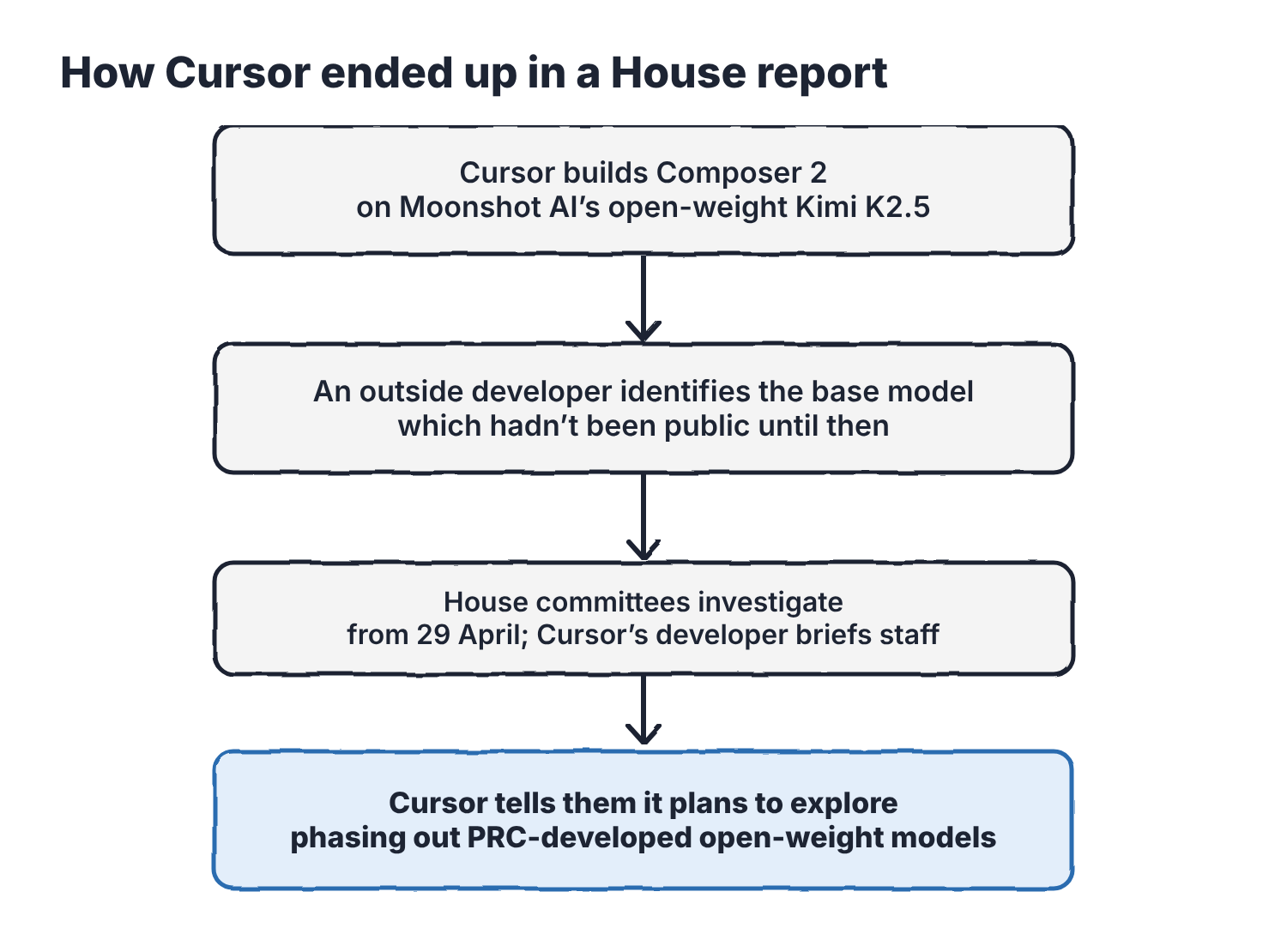
The report adds that the Composer 2 base model became public only after an independent developer identified it, and that no standard requires developers to disclose a model’s lineage. One of its 12 recommendations is a model provenance standard and an AI bill of materials. Cursor hasn’t said when it would move off Kimi or what it would use instead.
Why companies use the models
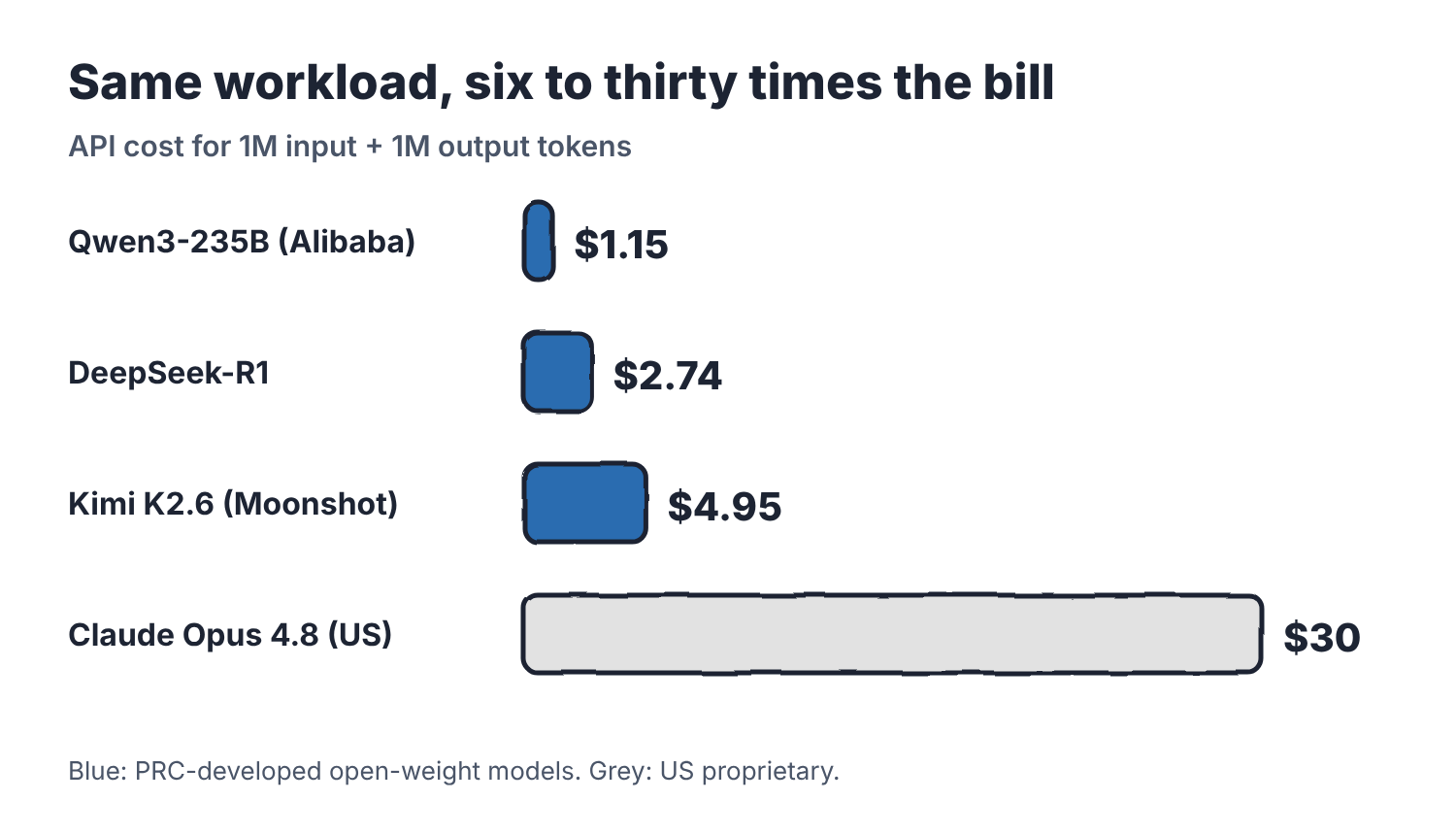
The report says cost, flexibility and near-frontier performance drive the adoption. It priced one million input and one million output tokens at about US$1.15 on Alibaba’s Qwen3-235B, US$2.74 on DeepSeek-R1 and US$4.95 on Moonshot’s Kimi K2.6, against about US$30 on Anthropic’s Claude Opus 4.8. That’s roughly six to thirty times more for an American company using a US model.
DoorDash’s internal code-review benchmark scored a pairing of Kimi K2.6 and an American frontier model highest of every configuration it tested. The report also says the best American open-weight model in the September Artificial Analysis ranking, Thinking Machines Lab’s Inkling, placed behind six Chinese models.
Airbnb runs customised Alibaba Qwen models on US-based infrastructure, including an assistant that handles about 80,000 guest and host interactions a day. DoorDash told the committees it had authorised and deployed 25 Chinese model families in a non-trivial way, and that replacing one model embedded in a larger system could take up to six months. Neither company had paid a Chinese developer or held a commercial agreement with one.
What the committees want
The 12 recommendations start with a national American open-weight AI initiative, so US companies have a competitive alternative. They also build on the Department of Homeland Security’s order excluding DeepSeek from federal civilian systems. The committees want Chinese-developed models barred from federal systems and federal contract work, removed from high-risk functions of critical infrastructure, and kept out of purchases made with federal cybersecurity grant funds.
These are recommendations, not rules. The report doesn’t change what any company can use today. Reuters reported this week that the Trump administration is weighing a rule that would make US companies publicly disclose their use of Chinese AI models.
Sources: House Homeland Security and Select Committee on China joint report; CNBC; Reuters via MarketScreener.
Discover more from Sulat AI & Tech News
Subscribe to get the latest posts sent to your email.