AMD shares fell as much as 11% on Thursday in the US after Hunterbrook Media published a report saying IEIT Systems, a Chinese server maker the US Commerce Department blacklisted in March 2025, kept getting newer versions of AMD’s server firmware. Hunterbrook’s affiliated fund, Hunterbrook Capital, disclosed it’s short AMD and long a basket of comparable stocks.
Bloomberg put the intraday low at US$470.56. An AMD spokesperson told CNBC that Hunterbrook’s “claims misrepresent AMD’s business practices and relationships” and that AMD “complies with applicable US export control laws and regulations and maintains rigorous processes to ensure compliance across our global operations.” AMD closed at US$489.28, down 7.7% from Wednesday’s US$530.14, on volume of about 70.6 million shares.
Hunterbrook doesn’t accuse AMD of illegally selling chips to China. It says its records don’t establish an export violation, and that it doesn’t know how IEIT got the code or whether a licence covered the supply.
What Hunterbrook found
IEIT belongs to Inspur Group. Commerce added it to the Entity List effective 25 March 2025, which means sending it software or other items covered by US export rules needs a licence. Hunterbrook says Commerce’s stated policy is to deny those licences. On 19 October 2026, it says, IEIT posted a BIOS update, the server’s startup software, containing AMD code labelled TurinPI 1.0.0.B, a version AMD released on 10 July 2026. Hunterbrook counts at least six newer AMD firmware versions built into IEIT updates since the listing.
Three other sellers post the same firmware, and none is on the list. Maginfra, a company registered in Jinan in February 2025, posted its BIOS file on 15 October, four days before IEIT. Hunterbrook compared the two files block by block and found all but five of 8,192 blocks identical, a 99.94% match, and Maginfra’s file still contains IEIT’s name. Kaytus in Singapore and Aivres in California post firmware for one AMD server design that matches IEIT’s to the same degree.
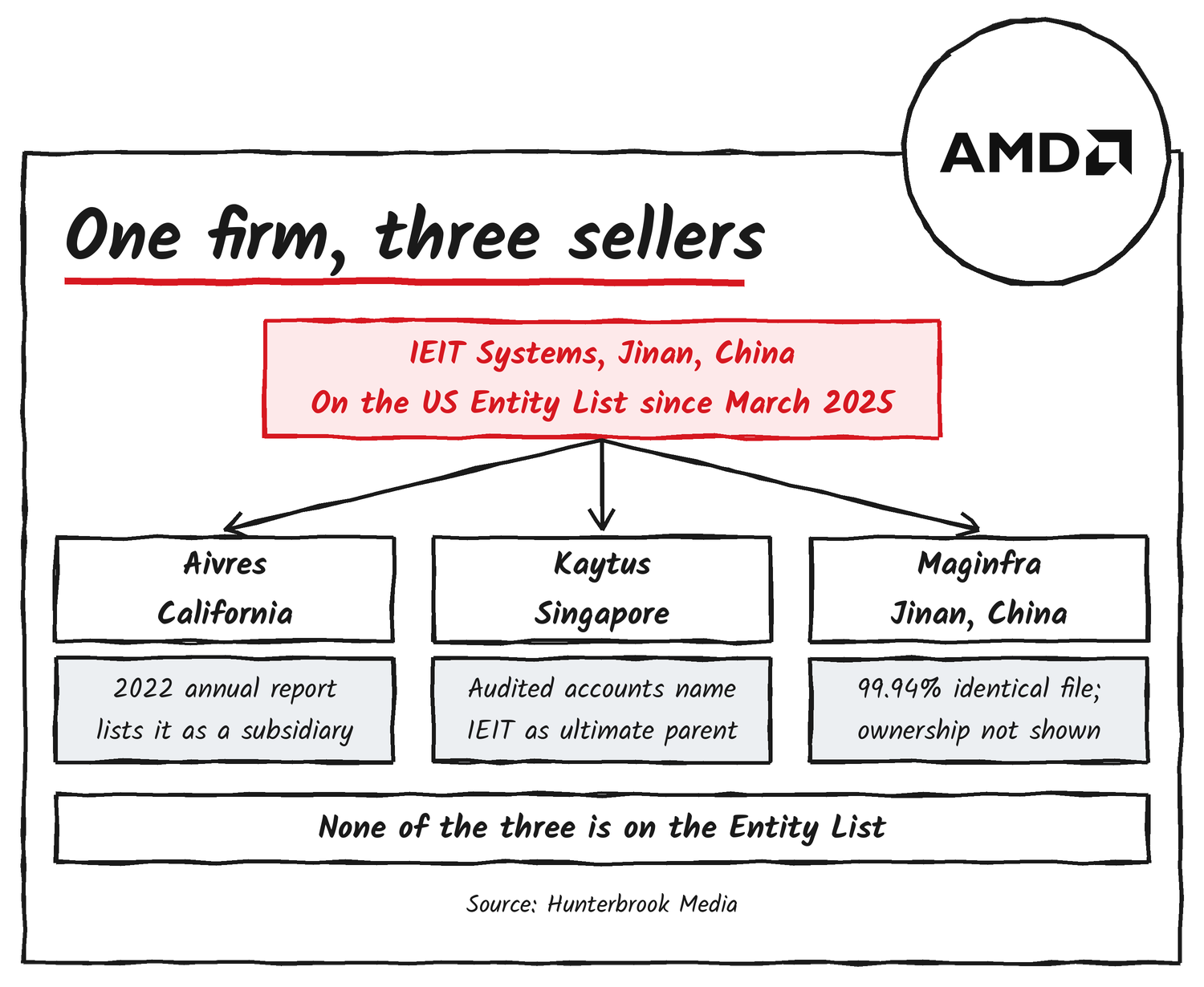
Filings tie two of the three to IEIT. Aivres was called Inspur Systems until May 2023, and IEIT’s 2022 annual report lists it as a subsidiary. Kaytus’s audited accounts name IEIT as its ultimate holding company and show Kaytus paid IEIT US$164 million in referral fees in 2025. Maginfra’s link rests on the files, not on ownership records.
AMD’s website lists Aivres among the makers of servers built on its Instinct AI chips, Hunterbrook says. The New York Times reported in September that Aivres exported at least US$5.6 billion of advanced technology to Southeast Asia between April 2024 and February, more than US$3 billion of it computers built with Nvidia chips.
What the records don’t show
Hunterbrook says the records don’t show who supplied the firmware or whether a licence covered it. William Reinsch, a former Commerce undersecretary for export administration now at the Center for Strategic and International Studies, told Hunterbrook not to rule out that AMD held one, because Commerce keeps licence information private. “The fact that you have to get a license does not mean automatically that the license will be denied,” he said.
Hunterbrook also points to Commerce’s October settlement with Lambda Research, a Massachusetts software company that kept sending automatic updates to SiCarrier after it joined the Entity List in December 2024. The settlement counts seven updates as seven violations, although the software needed no licence before the listing.
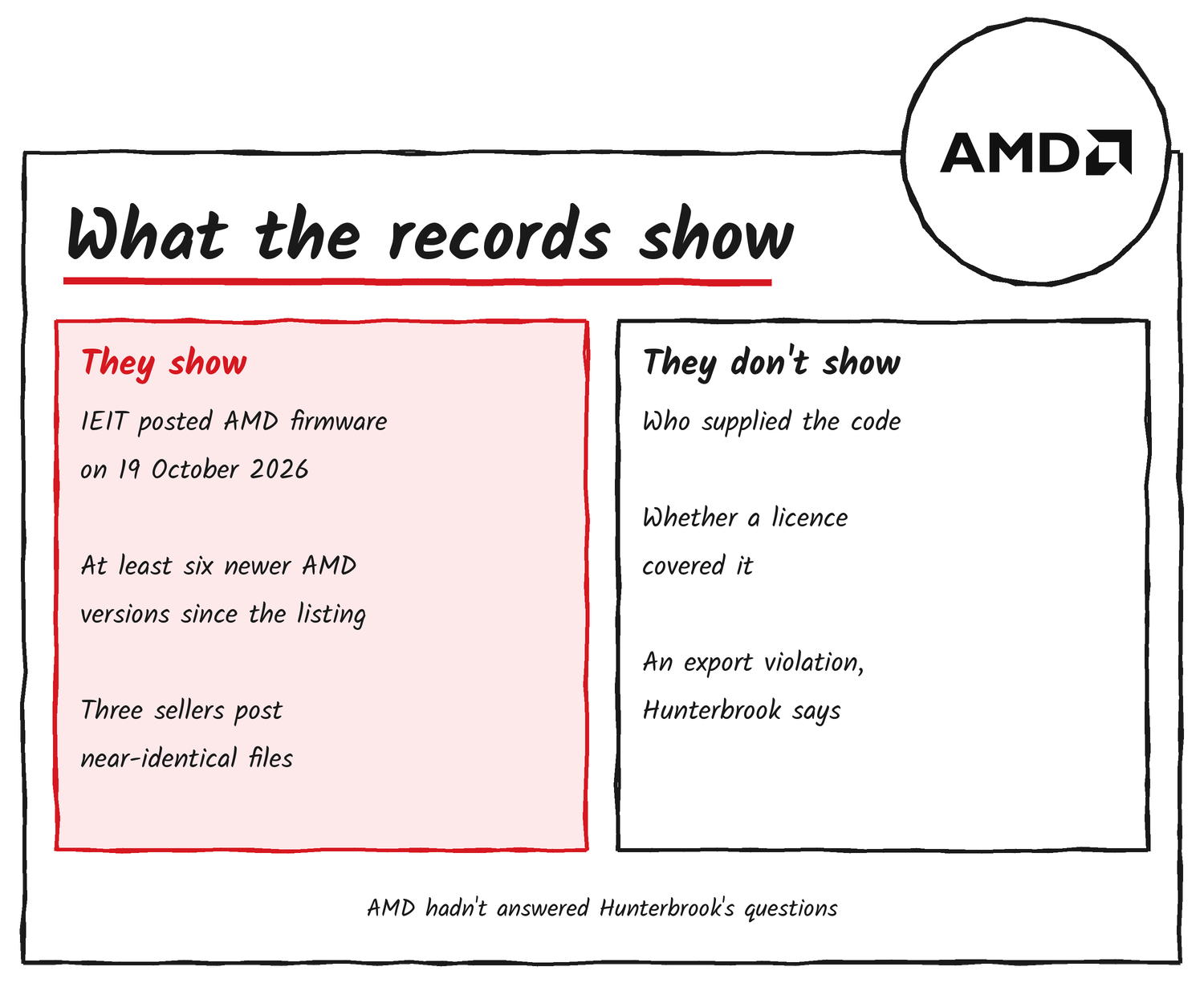
AMD didn’t answer Hunterbrook’s questions about whether it or any distributor or firmware partner supplied IEIT after the blacklisting. It asked for more time, was given until the next day and didn’t come back. IEIT, Maginfra, Kaytus, Aivres, Hygon, Tongfu and Commerce’s Bureau of Industry and Security didn’t respond to Hunterbrook either.
AMD’s other China ties
Hunterbrook traced US$67 million of AMD’s 2025 licensing income to two Chinese chip ventures, in which AMD holds 51% and 30%, that Commerce blacklisted in 2019 along with their Chinese co-owner Hygon. It says the payments don’t establish a violation and could be royalties for technology licensed before the listing, because the Entity List restricts exports to listed companies, not payments from them. It also found a server from Cancon, an alias of listed company Suma Technology, in AMD’s February 2026 Instinct catalogue, and says a catalogue entry doesn’t establish a sale.
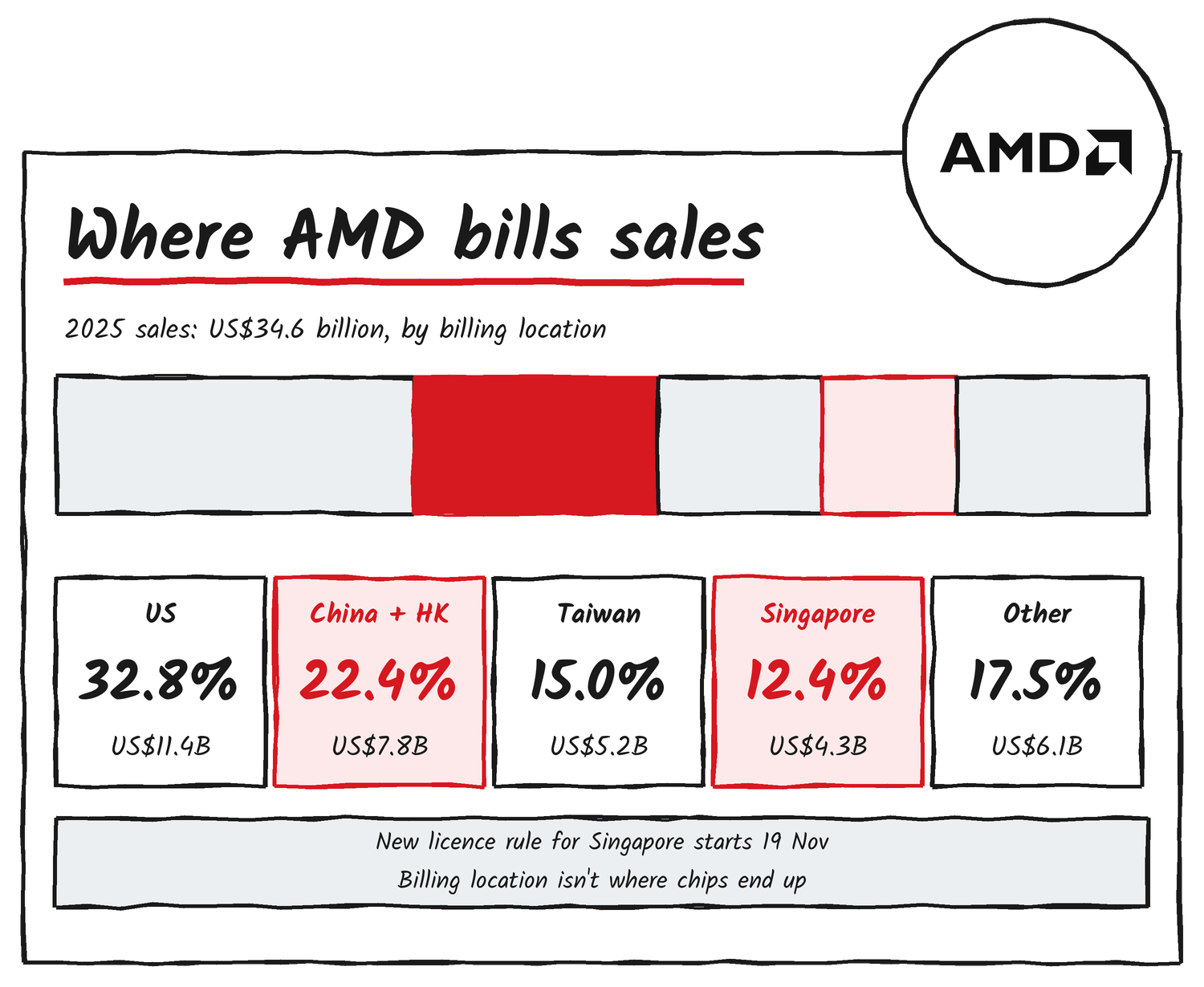
AMD’s 2025 annual report shows US$7.751 billion of US$34.639 billion in sales, 22.4%, was billed to customers in China and Hong Kong, and US$4.284 billion, 12.4%, to Singapore. Billing location isn’t where the chips end up. The same filing says AMD took about US$800 million in inventory and related charges in the second quarter of 2025 after Washington required a licence to ship its MI308 chip to China, and that it was granted some licences to ship it.
The rules landing now
A Commerce interim final rule, which Hunterbrook says took effect on Thursday, requires licences for advanced chips going to Singapore, Malaysia, Indonesia, Thailand and Brazil, countries Commerce says carry a higher-than-normal risk of diversion. Chips going to US-headquartered companies, or companies with a US parent, are exempt as long as reporting requirements are met.
A separate rule that would extend Entity List restrictions to foreign companies at least 50% owned by listed entities is suspended until 10 January 2027. Hunterbrook says IEIT’s 2023 interim report describes Kaytus as a 100%-owned subsidiary, so the rule would reach Kaytus if it takes effect.
The second report
Hunterbrook’s Bear Cave newsletter published a second report the same morning, saying AMD finances its customers much the way Nvidia does. It puts AMD’s commitments through guarantees, partner leases and cloud-capacity agreements at about US$28 billion, plus US$5.1 billion in equity investments, against US$15.8 billion in cash and short-term investments. AMD’s purchase commitments rose to US$48.8 billion in September from US$12.2 billion at the end of 2025, Hunterbrook says.
CEO Lisa Su told investors on this month’s earnings call that China is an important market and that AMD wants to be fully compliant with US export controls, CNBC reported. AMD’s statement to CNBC doesn’t address whether it holds a licence to supply IEIT, and the suspended affiliates rule is due to lapse on 10 January 2027.
Discover more from Sulat AI & Tech News
Subscribe to get the latest posts sent to your email.