Ahrefs’ Tim Soulo says Adobe never called his company before agreeing to buy Semrush for US$1.9 billion. He said so on X on 19 November, a year after the deal was announced, while promoting an Ahrefs Podcast episode with Eugene Levin, Semrush’s former president.
Semrush’s merger proxy, filed with the US Securities and Exchange Commission, backs Levin’s account that Adobe came to Semrush unprompted. It can’t settle whether Ahrefs was ever in the frame, because it names none of the companies Semrush later asked.
Adobe acquired @Semrush for $1.9 billion… Adobe never called us.
— Tim Soulo (@timsoulo) 19 November 2026
The episode runs just over an hour. PPC Land also wrote it up on 19 November. The quotes here come from the episode, and the deal figures come from Semrush’s and Adobe’s filings.
What Soulo and Levin said about Ahrefs
On the podcast Soulo was less flat than his post. He said he doesn’t think Adobe even reached out, that Ahrefs’ founder, Dmitry, famously doesn’t want to sell, and that Dmitry might have got an email and not mentioned it. Soulo put Ahrefs at slightly over 100 people, bootstrapped, and about three times smaller than Semrush.
Levin said he doesn’t know for sure whether Adobe approached Ahrefs, but he’s sure Ahrefs “was one of the players that were considered.” By his count, perhaps three or four companies really stood out in the space, and Semrush was one. His list included newer players built around generative engine optimisation, or GEO.
He gave two reasons Adobe chose Semrush. It didn’t want to miss the party, he said, and a larger company carries less key-person risk. Semrush needed five years to build its professional management layer, and he said a smaller firm usually hasn’t.
What the filing shows
Adobe’s approach began in early June 2025, when its head of corporate development, David Popowitz, asked Semrush director Stephen Aldrich for an introduction to chief executive Bill Wagner. Wagner then spoke with Anil Chakravarthy, president of Adobe’s Digital Experience business. Semrush’s bankers at Centerview began talks that month, and the two companies signed a confidentiality agreement on 20 June.
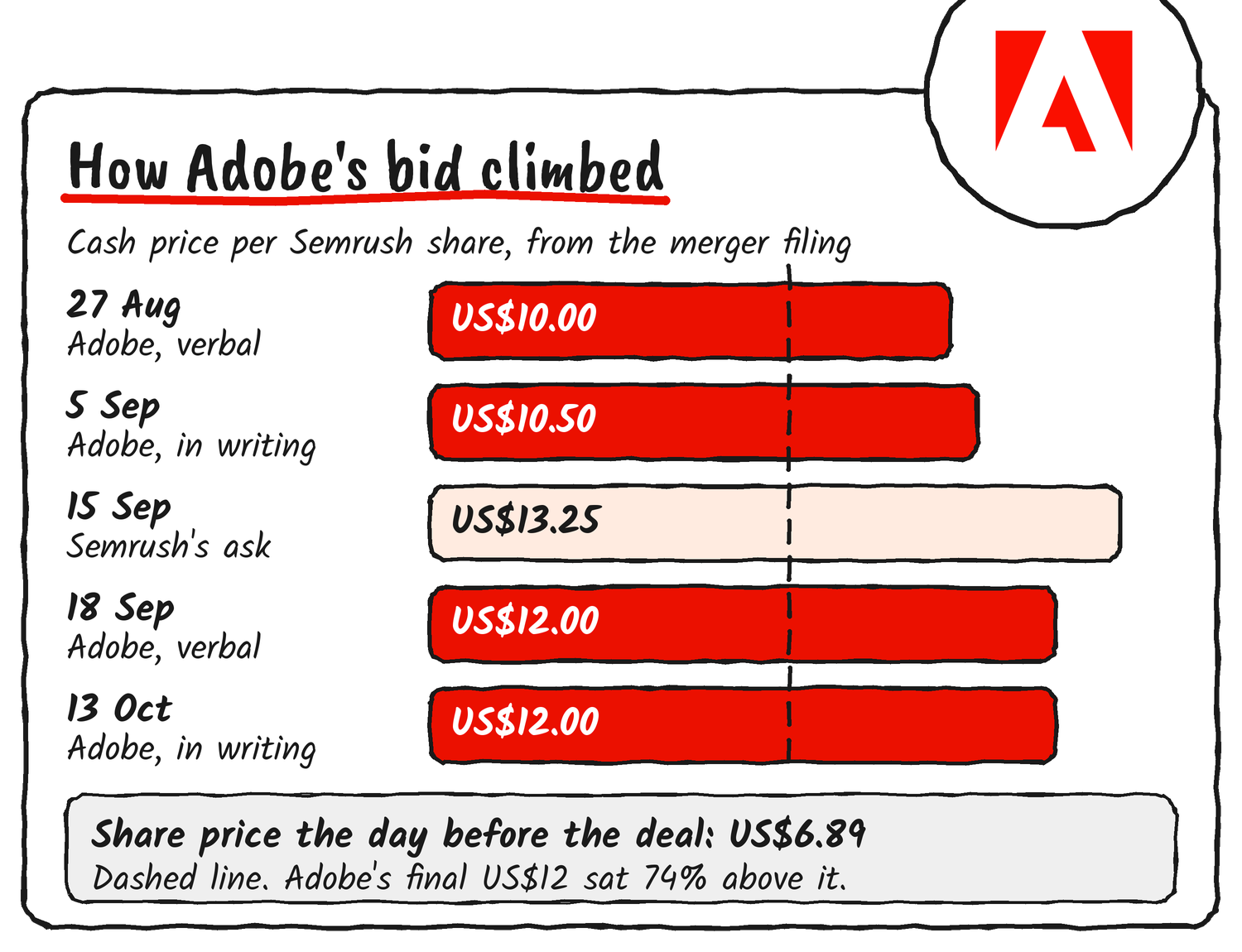
Adobe’s first verbal price came on 27 August, at US$10.00 a share when Semrush stock closed at US$7.86. Wagner told Adobe the next day it wasn’t enough. A written US$10.50 followed on 5 September. On 15 September Semrush’s transaction committee said it would engage at US$13.25, and Adobe declined. Three days later Adobe offered US$12.00 verbally.
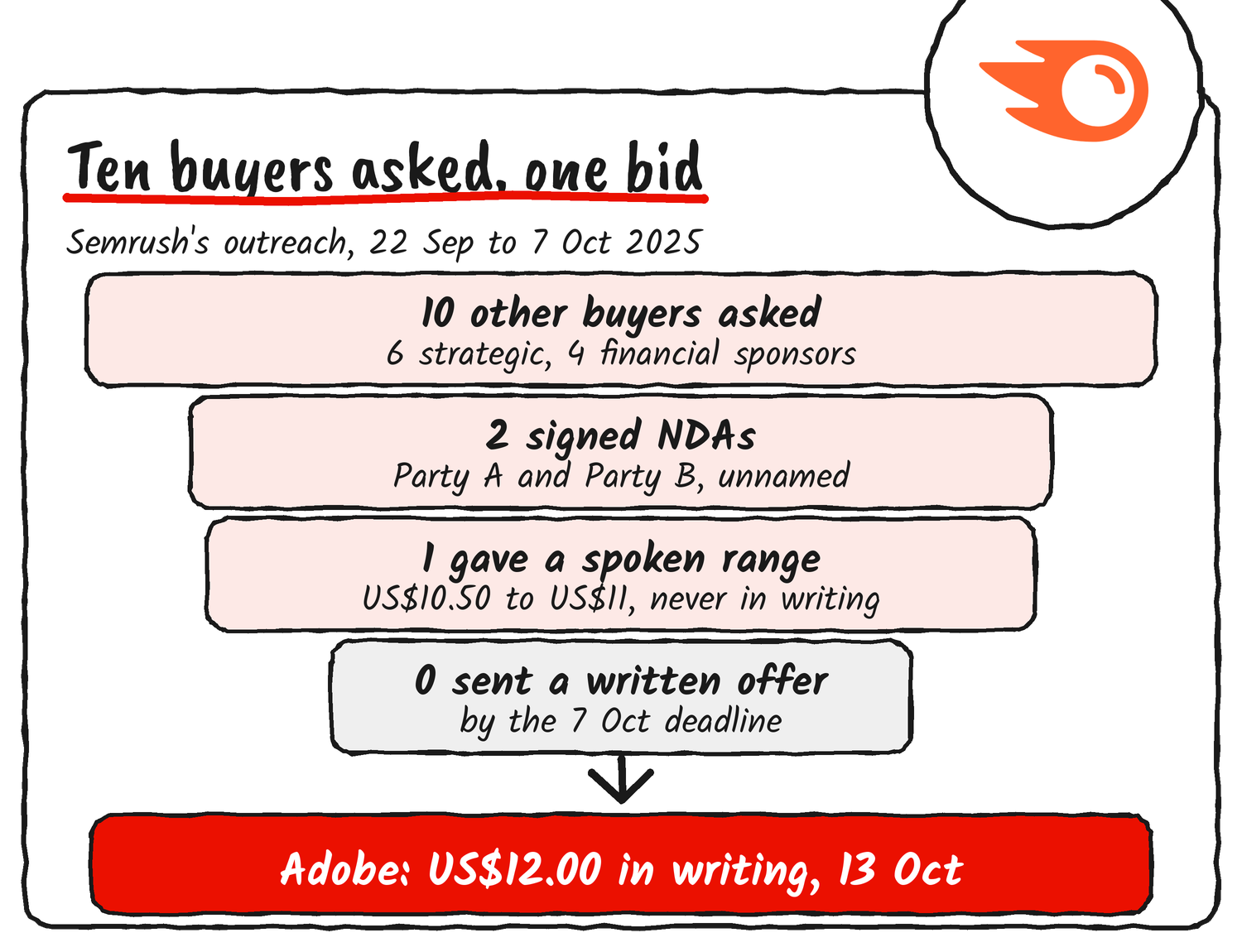
Semrush then tested the market. On 22 and 23 September Centerview contacted six strategic buyers and four financial sponsors, among them a sponsor the filing calls Party A, which had made its own inquiry in early September. All are unnamed. Only Party A and a Party B signed NDAs, on 27 September. The other eight declined.
On 3 October Party A floated a verbal range of US$10.50 to US$11.00 and never put it in writing. Party B declined. The 7 October bid deadline passed with no written offers, and the committee ended the outreach the next day. Adobe’s written offer of US$12.00 arrived on 13 October with a request for 45 days of exclusivity, when the stock stood at US$7.10. Semrush’s board agreed on 17 October. Levin, then Semrush’s president, sat in Adobe’s diligence sessions in Boston on 24 and 25 September.
The board approved the deal unanimously and Centerview gave its fairness opinion on 18 November 2025. The agreement carried a US$63 million termination fee. Centerview’s fee was about US$33 million, US$5 million of it for the opinion and US$28 million contingent on the deal closing. The filing never mentions Ahrefs.
What Adobe paid
Adobe agreed to pay US$12.00 in cash per share, about US$1.9 billion in equity value and a 74% premium to the US$6.89 close before the announcement. The deal completed on 28 April 2026. Adobe’s quarterly filing puts the total purchase price at US$1.874 billion, and two-thirds of it, US$1.251 billion, went to goodwill.
| Item | US$ million |
|---|---|
| Total purchase price | 1,874 |
| Goodwill | 1,251 |
| Identifiable intangibles | 582 |
| Cash acquired | 262 |
| Other net liabilities assumed | 221 |
Semrush’s management plan in the proxy forecast annual recurring revenue of US$480 million for 2025. Our own division of Adobe’s price by that figure gives about 3.9 times. Levin said small software businesses now sell for two to three times recurring revenue, and that Semrush paid 7 times for the one weak deal of its ten acquisitions, in 2021.
How Semrush bought, and what Levin wants now
Levin said Semrush bought seven software companies and three media businesses and treated each as capital allocation. Soulo guessed the total at US$50 million to US$70 million. Levin gave no figure. He said nine of the ten worked. One example was Ryte, a crawler with about 40% of the German market, which Semrush planned to quadruple by cross-selling.
Levin is now building what he calls an applied-AI holding company. He wants targets with US$3 million to US$10 million in recurring revenue, at least 10% growth and anonymised billing data up front. Break-even is fine. He’d take bootstrapped or venture-backed sellers, and expects plenty of the latter as funds from 2021 and 2022 have to return capital. He’d skip traditional earn-outs for the whole cap table and use growth incentive packages instead.
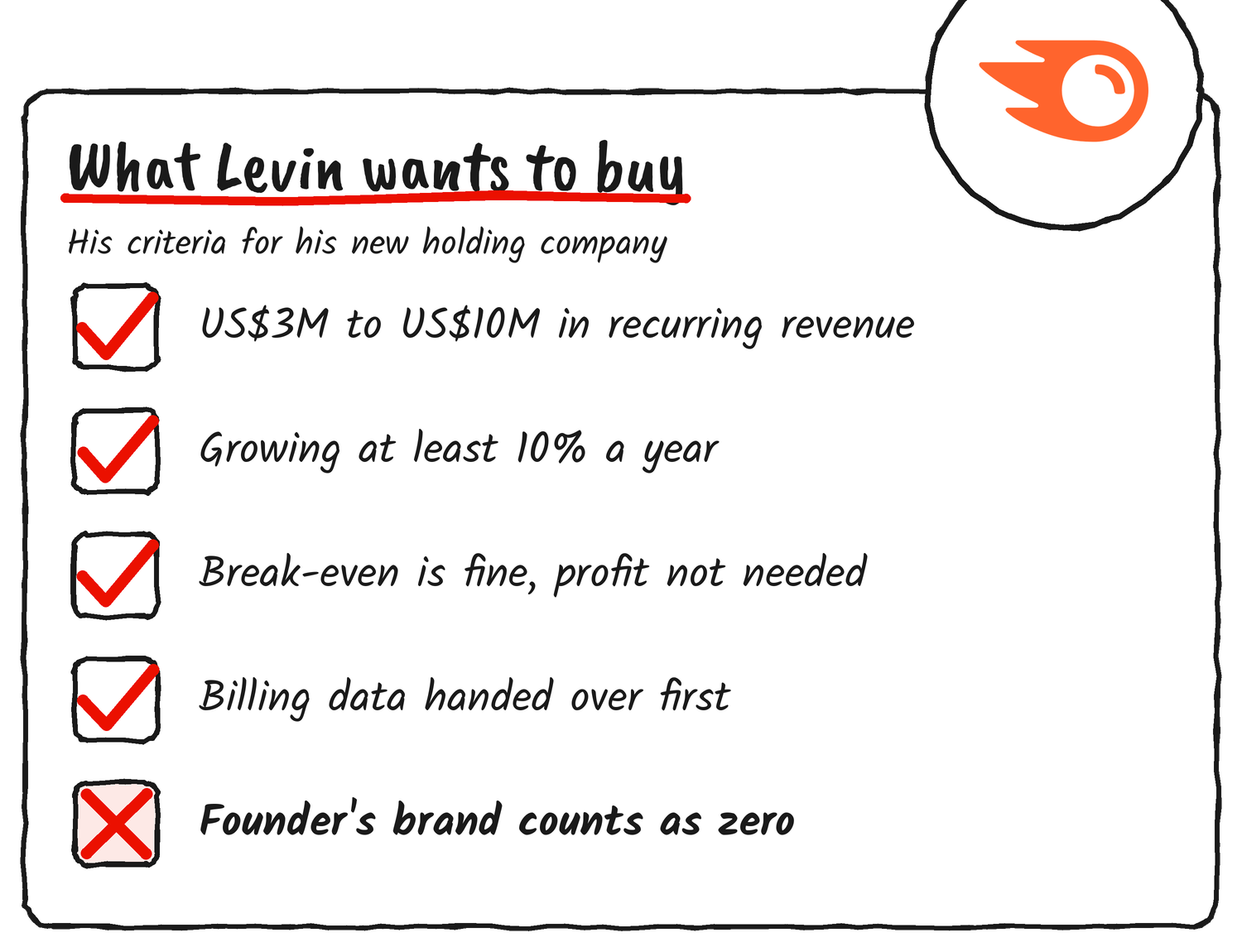
Backlinko was his example of why a founder’s brand counts as zero. Semrush valued it on traffic and expected assisted conversions, he said, and the brand was “multiplied by zero,” so its founder, Brian Dean, shot videos for a year after the sale. Levin said Dean, who sold two companies to Semrush, built Exploding Topics to be independent of his own face.
Soulo’s thread boiled the episode down to five points: never be looking to sell, transformative acquisitions mostly fail, multiply founder-brand value by zero, 10% growth is the floor, and bad M&A lawyers wreck exits, with Levin’s example centred on fights over representations and warranties. His own takeaway was shorter: “So we have to stay competitive.”
What Semrush customers were told
Semrush’s customer FAQ, dated 28 April 2026, says there are no immediate changes to services, agreements, billing, support or pricing. Customers can keep both their Semrush and Adobe contracts, and Adobe’s LLM Optimizer runs alongside Semrush’s AIO product.
Two gaps remain. The filing doesn’t say who the six strategic buyers were, and nothing Adobe has published mentions Ahrefs. Levin has no website. He says to reach him on LinkedIn.
Discover more from Sulat AI & Tech News
Subscribe to get the latest posts sent to your email.