President Ferdinand Marcos Jr. said on 20 November that the planned Philippine development under the US-led Pax Silica initiative won’t host data centres. He also said the government hasn’t signed anything.
Marcos spoke at a press conference in Shenzhen, China, after the 33rd APEC Economic Leaders’ Meeting, according to the Philippine News Agency (PNA). SunStar carried the report. Reporters had asked about public protests over concerns that the project could cause severe environmental damage.
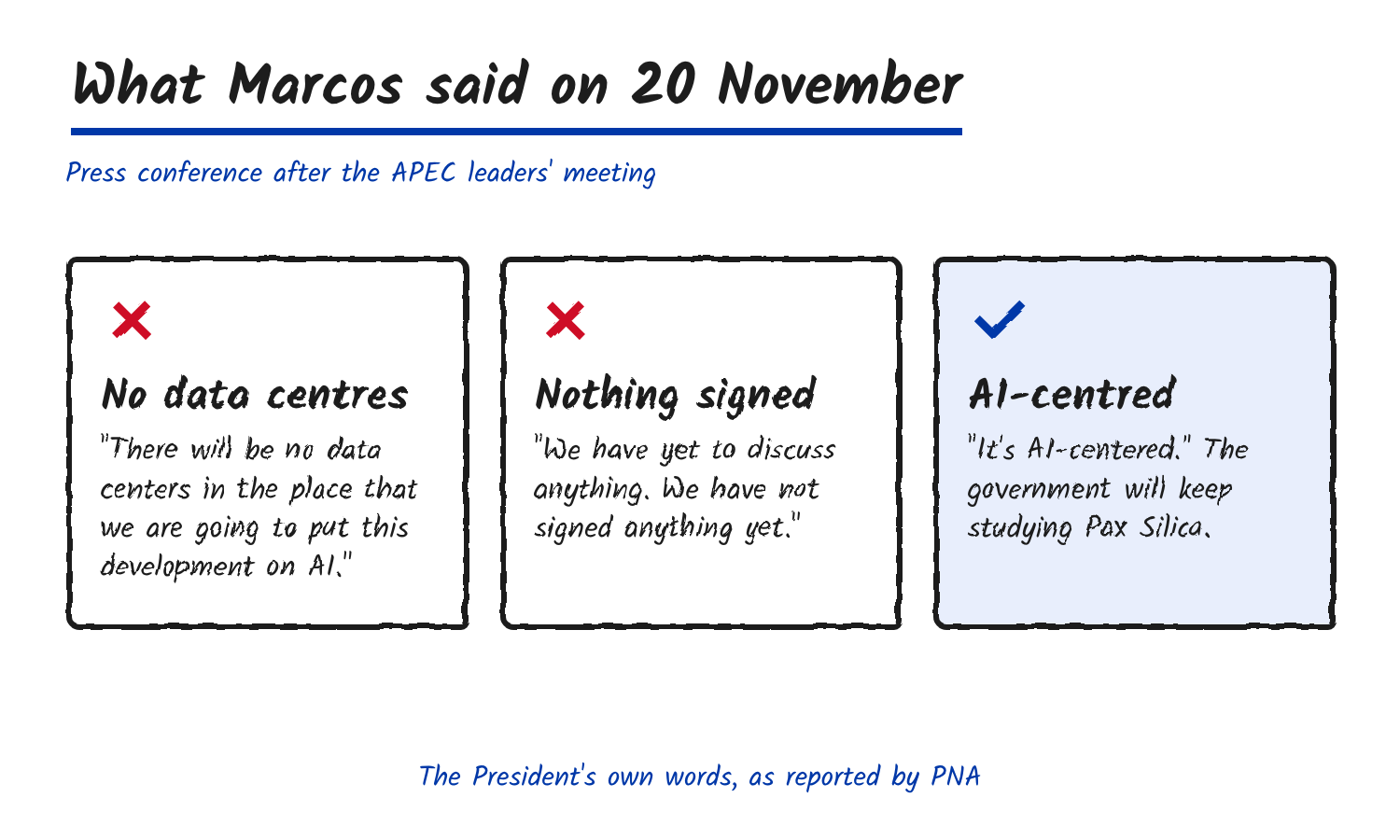
There will be no data centers in the place that we are going to put this development on AI. It’s AI-centered.
Ferdinand Marcos Jr., 20 November 2026
He then said the government hasn’t finalised any agreement under the initiative. No specific provisions have been discussed or signed, he said, and he wasn’t sure why some groups were already protesting terms nobody has negotiated.
Wala pa tayong pinag-usapan. Wala pa tayong pinirmahan (We have yet to discuss anything. We have not signed anything yet).
Ferdinand Marcos Jr., 20 November 2026
What Pax Silica is
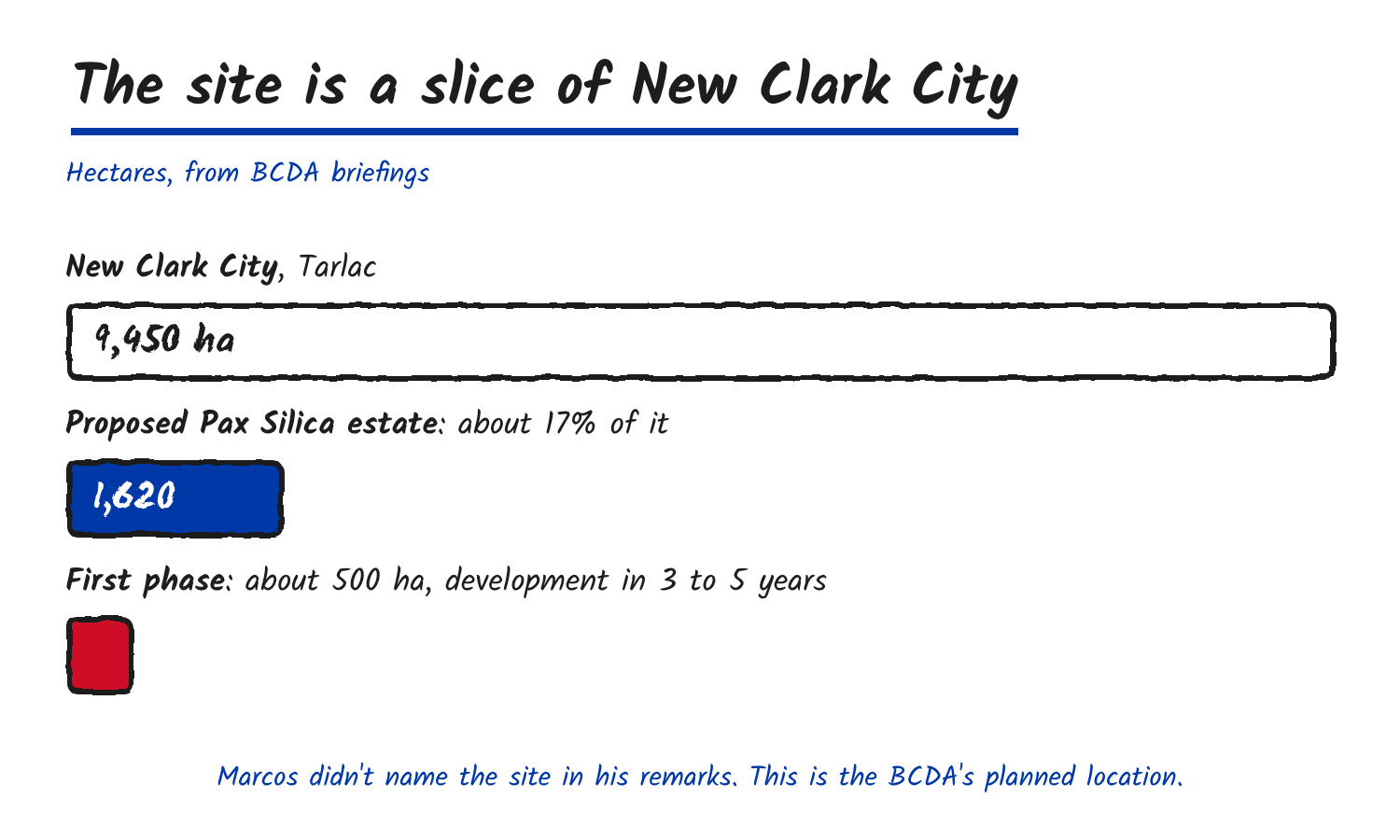
Pax Silica is a US-led initiative to build secure supply chains for critical minerals, semiconductors, AI and advanced manufacturing. The Philippines formally joined the Pax Silica Declaration in April 2026. The Bases Conversion and Development Authority (BCDA) allocated a 4,000-acre lot in New Clark City, Tarlac, for the Philippine project and described it as an AI hub.
The proposed estate covers about 1,620 hectares of the 9,450-hectare city. The BCDA says the first phase, about 500 hectares, would start development in three to five years. In his State of the Nation Address on 27 July, Marcos called the hub a strategic part of the Luzon Economic Corridor, an advanced manufacturing and logistics centre in the global AI and technology value chain, the Presidential Communications Office reported.
US$40-70 billion
Investment the BCDA says the site could attract once fully developed
130,000+
High-quality jobs the BCDA says it could generate
1,620 ha
Proposed estate, within the 9,450-hectare New Clark City
Why data centres were in question
Earlier reports described Pax Silica as energy-intensive because of data centres. The BCDA answered in August with a list of what it called misconceptions: a massive data centre, environmental harm and displaced communities. It said the site would host semiconductor and advanced manufacturing plants, would draw water from harvesting, treatment and recycling instead of the community’s supply, and would run on dedicated off-grid power.
Officials have ruled data centres out several times since July, with some differences in wording.
| Date | Who | What was said |
|---|---|---|
| 23 July | BCDA chief Joshua Bingcang | Pax Silica is a manufacturing ecosystem, not a large data centre complex. Only one or two of at least 30 interested companies are data centre operators. PCO |
| 6 August | Bingcang | “This project is not about data centers.” GMA News |
| 7 August | Bingcang | No data centres at the site. Any built for tenants would serve the semiconductor firms, not hyperscalers. PNA |
| 1 September | Palace Press Officer Claire Castro | “On the Clark Advanced Manufacturing Park, there will be no data centers.” PNA |
| 20 November | President Marcos | No data centres at the development site, and nothing signed. |
Castro’s briefing came after a Department of Trade and Industry statement that plans were being explored for AI data centres under Pax Silica at locations outside New Clark City, where power and water are more viable. Castro said no proposal existed yet for any other location.
What’s still open
Marcos didn’t name the site in the remarks PNA and SunStar reported, and he didn’t address data centres elsewhere in the Philippines. The Philippine project is planned for New Clark City.
No agreement is signed. A University of the Philippines Center for Integrative and Development Studies paper from October says that as of September, the binding instrument would be a commercial framework agreement between the BCDA and a US government agency, with a November 2026 signing target the BCDA describes as not fixed. Marcos said the government will keep studying Pax Silica, which he called a chance for the Philippines to take part in the global AI discussion rather than only adopt what others decide.
Discover more from Sulat AI & Tech News
Subscribe to get the latest posts sent to your email.