Dylan Patel, the founder of the research firm SemiAnalysis, told CNBC on 13 November that Google is “begging for more capacity from the whole supply chain” now that Jensen Huang has left Nvidia. In a 20 November report, Electronics Weekly says Google is also changing how it buys parts for its TPUs, the tensor processing units it designs for AI workloads.
Nvidia said on 12 November that Huang had resigned as president, chief executive and board member, effective immediately. Chief financial officer Colette Kress is interim CEO while the board searches for a permanent one. Harvey Jones, the board’s new chair, said the board expects “operations, customer commitments and product roadmap to continue without interruption”.
What Patel said on CNBC
Patel said Huang went to the heads of small suppliers himself, “even of tiny companies where they only generate a few hundred million dollars of revenue but they have an important subcomponent”, and “convinced them to let him buy the supply and build it all out”, per Ctech’s account of the interview. CNBC reports that Patel said this helped Nvidia secure “the majority of supply chain capacity”. Without Huang, Patel said, “these companies are looking around the market and it’s like, well, Google’s begging for more capacity from the whole supply chain.”
CNBC adds that Patel sees Google and Amazon as already gaining ground in securing capacity against Nvidia, and able to move faster without Huang’s influence over suppliers. If Nvidia can’t muster the supply chain, he said, technology is its only advantage, and it’s “only a year ahead of their biggest competitors”.
Elon Musk wrote on X on 14 November that “many of those deals were a handshake with Jensen, not a written contract”, per Ctech. Electronics Weekly repeats the handshake point without naming Musk. Nvidia’s largest supply lines are in writing: TIKR, citing Nvidia’s latest quarterly report, puts its supply and capacity commitments, mostly for memory, at US$279 billion on 26 July.
How Google buys its chips
Google designs TPUs with Broadcom. Broadcom’s 6 April filing says it has a long-term agreement to develop and supply Google’s future TPUs, plus a deal to supply networking and other components for Google’s next-generation AI racks through up to 2031.
Broadcom isn’t the only designer. On its 2 September earnings call, chief executive Hock Tan said Broadcom was shipping the TPU 8i “ahead of the MediaTek version v8t, which in fact was initiated earlier”. Counterpoint Research says Google designs the 8t’s compute die and MediaTek supplies the I/O die, the part that moves data in and out of the chip.
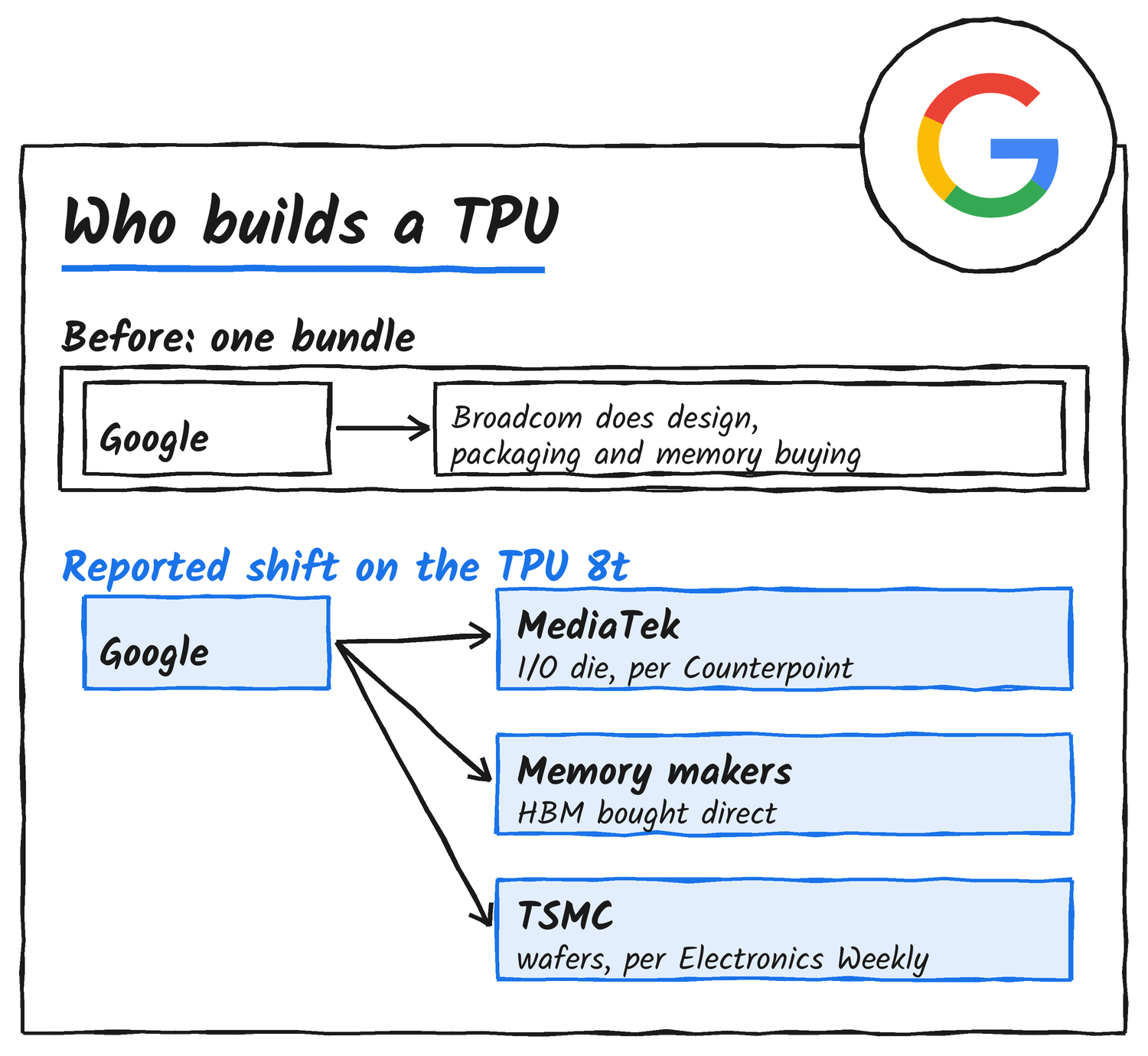
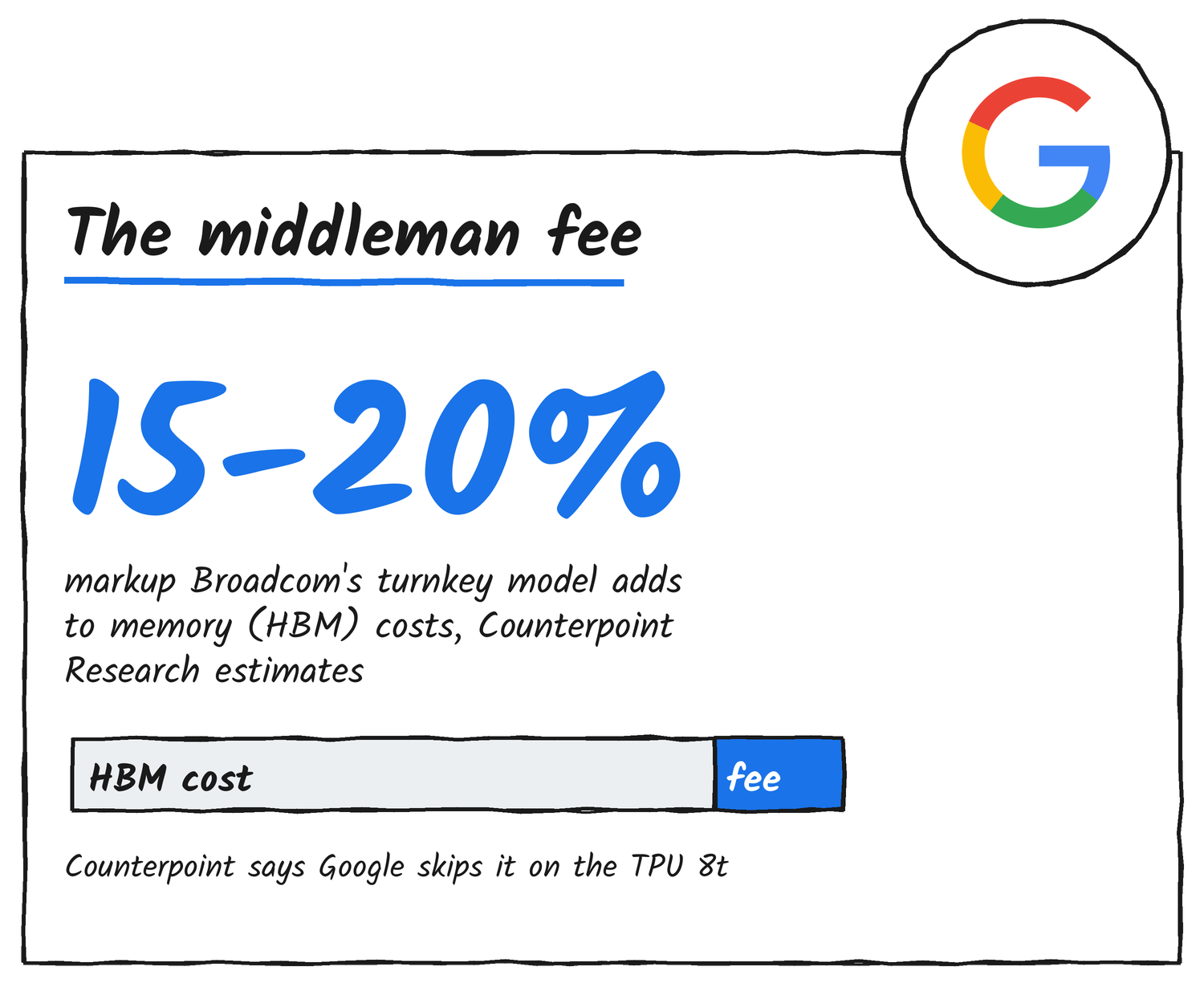
HBM, the high-bandwidth memory stacked beside the processor, is a growing share of a TPU’s cost, Counterpoint says. Under Broadcom’s turnkey model the design partner buys it and adds a 15% to 20% markup. Counterpoint’s David Wu told the Korea Herald that Google eliminates the fee by taking chip design and memory buying in-house on the 8t.
TrendForce reports that Chosun Biz says Google is moving to buy HBM directly, and Chosun cites a Bernstein estimate of about US$50 billion in savings over the TPU’s product lifecycle. DigiTimes followed on 19 November, MLQ reports. Electronics Weekly says Google is also going direct to TSMC to negotiate wafer deals, and that SK hynix has proposed jointly designing customised HBM for future TPUs.
The Korea Herald dates the SK hynix proposal to after a February meeting between SK Group chairman Chey Tae-won and Google CEO Sundar Pichai. It says Samsung is pursuing TPU memory business through Broadcom, with which it signed a memorandum of understanding in July covering memory, foundry and packaging. The research firm ToAlpha said in an October note that its supply-chain checks show Google buys the 8t’s compute-die wafers and HBM itself.
| Piece | Who handles it | Source |
|---|---|---|
| TPU 8i design and supply | Broadcom | Hock Tan, 2 September call |
| TPU 8t design | Google, with MediaTek on the I/O die | Counterpoint; Hock Tan |
| TPU 8t memory (HBM) | Google buys direct | Chosun Biz; Counterpoint |
| TPU 8t wafers | Google buys direct | Electronics Weekly; ToAlpha |
| Future TPU supply | Broadcom, through up to 2031 | Broadcom filing, 6 April |
What the volume looks like
Google says it has nearly 100 TPU customers, the Korea Herald reports. Alphabet’s latest 10-Q says it began recognising revenue from TPU system supply agreements in the second quarter of 2026, with the significant majority to come in 2027.
Analyst Ming-Chi Kuo projects Google TPU shipments of 8 to 9 million units in 2027 and 14 to 15 million in 2028, Electronics Weekly reports. Counterpoint’s separate forecast has the MediaTek-built TPU 8t and its successor approaching 5 million units in 2028, about 26% of AI ASIC server compute shipments and second to Broadcom.
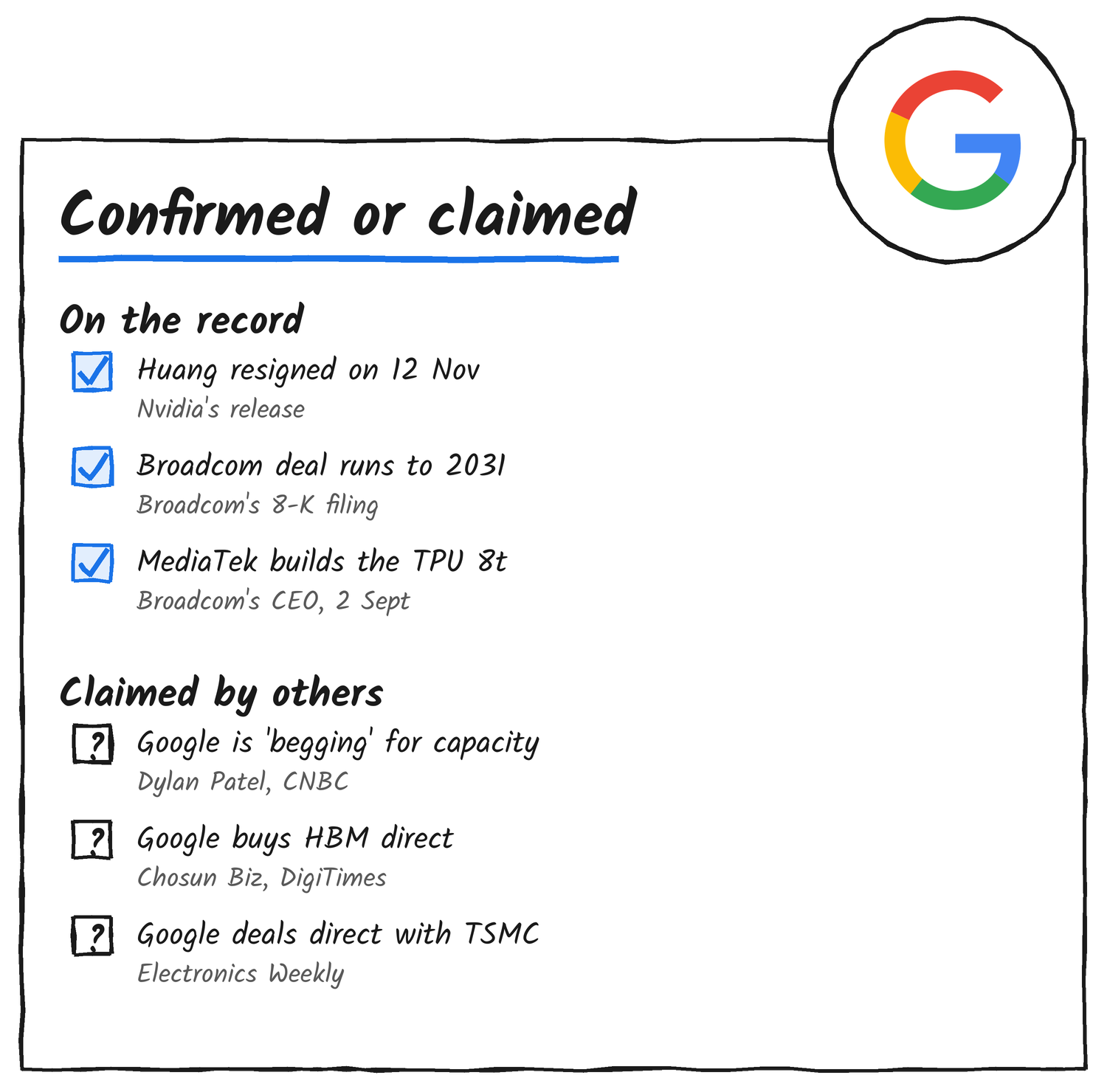
Google, Broadcom and MediaTek haven’t confirmed the direct memory and wafer purchases. Nvidia says its operations and customer commitments continue without interruption, and its board is searching for a permanent CEO.
Discover more from Sulat AI & Tech News
Subscribe to get the latest posts sent to your email.