Thinking Machines released Inkling 2 Mini on 20 November, an open-weights model with 26.4 billion parameters that runs the middle of its network three times for every token. Artificial Analysis said on X that the model scores 20 on its Intelligence Index, level with Alibaba’s Qwen3.8 27B (xhigh) and Nanbeige4.3-33B, which have about five and six times as many active parameters. The weights are on Hugging Face under the Apache 2.0 licence.
Inkling 2 Mini is the second model in the Inkling 2 family. Inkling 2 Small, a 594 billion parameter model, came out on 5 November, and Thinking Machines said at launch that it scores 31 on the same index. Mini is the version the company says is small enough to run on a laptop.
What’s in the model
Inkling 2 Mini is a mixture-of-experts model, one that routes each token to a few specialist sub-networks instead of running the whole network. Thinking Machines lists 26.4 billion parameters in total and 3.4 billion active per token. Each extra pass through the looped layers adds about 1.0 billion effective active parameters, so the model card counts 5.4 billion for the three passes, and Artificial Analysis uses that 5.4 billion figure. Every layer sends a token to eight of 128 experts, and the model takes text and image input with a context window of 1 million tokens.
Thinking Machines began training with 384 experts per layer. Partway through, it pruned two-thirds of them and kept the 128 most used in each layer, to cut the model’s size. It then trained on one trillion tokens distilled from a larger internal Inkling model to recover what the pruning cost, followed by supervised fine-tuning and a reinforcement learning run of 2.2 trillion tokens over 2,000 steps.
How the looping works
The model has 24 layers in four blocks of six. The first and last blocks run once. The two middle blocks run three times with shared weights, so each token passes through 48 layer applications from 24 layers of stored weights. Thinking Machines says looping the middle 12 layers gave bigger gains than looping the last 12 on 27 of 28 evaluations.
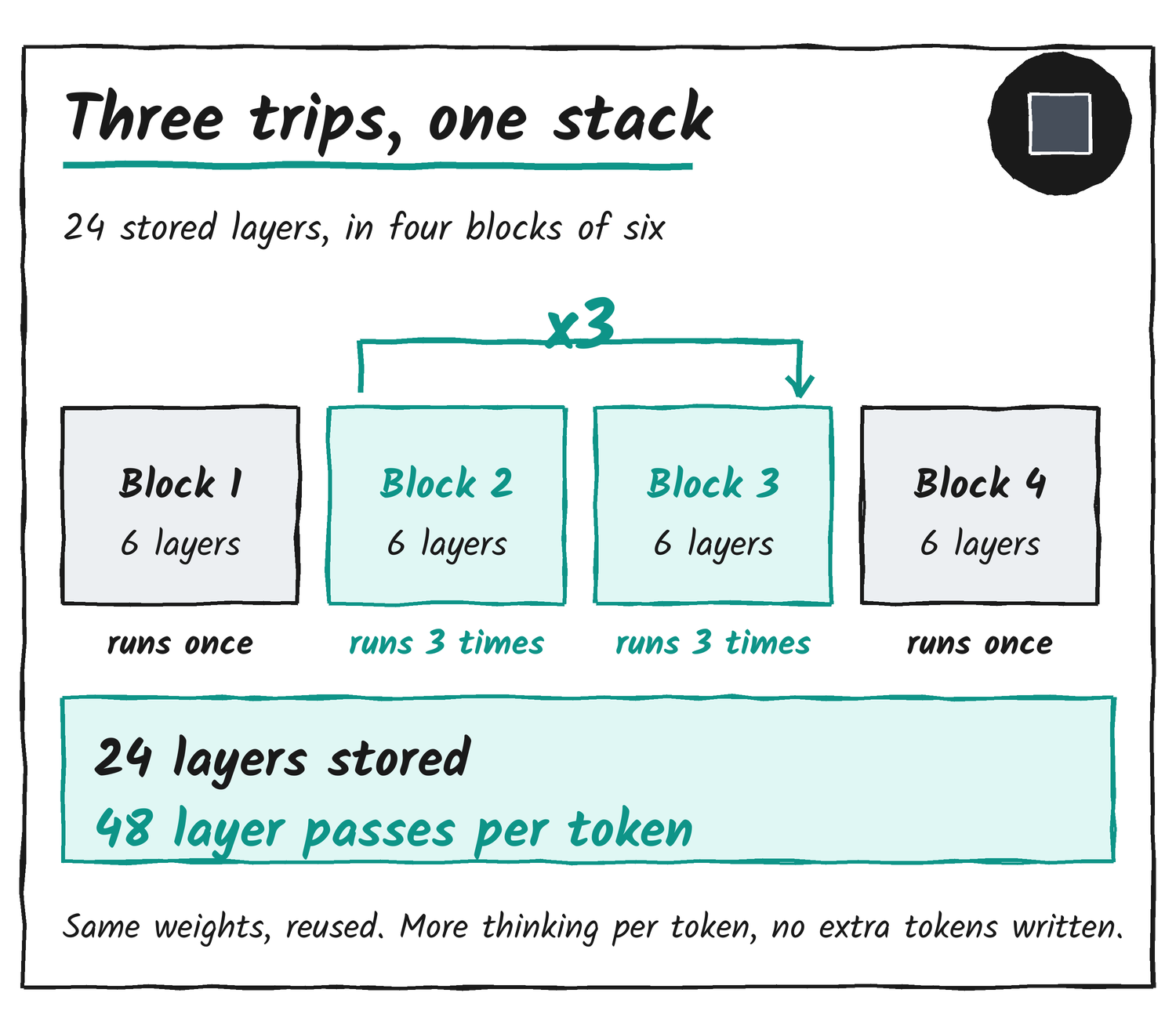
In an unpruned comparison on its scaling ladder, the non-looping model cost 7.5% less compute to train but needed 140% more inference compute to match the looped model’s loss on 512,000-token agentic traces. Looping lets the model apply more reasoning per token, Thinking Machines says, but it doesn’t give the weights room to store more facts. The company says knowledge is mostly a function of total parameter count.
What Artificial Analysis measured
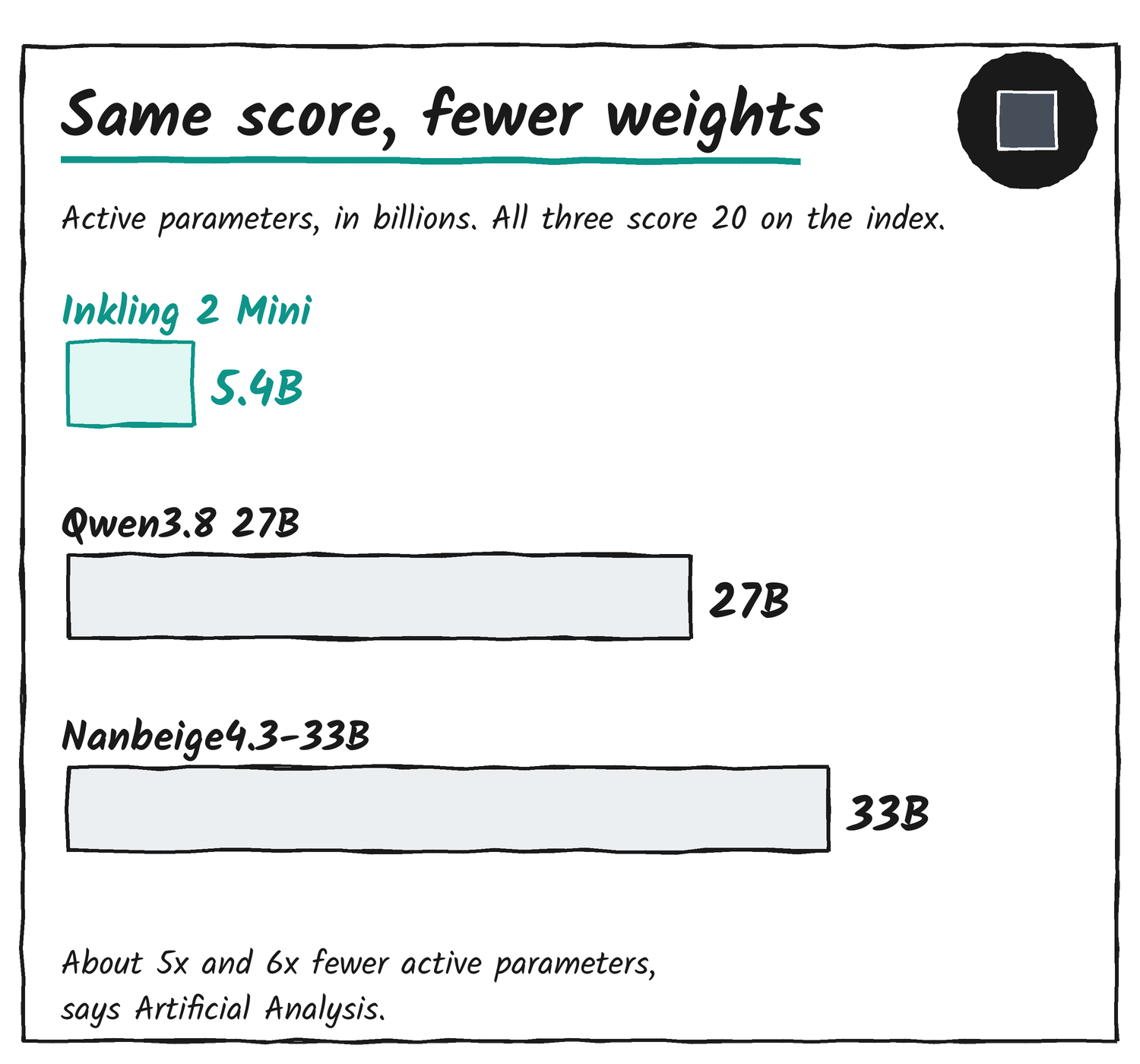
Artificial Analysis places Inkling 2 Mini on the Pareto frontier of Intelligence Index score against both active and total parameters, meaning no other model beats it on both axes at once. Its score of 20 matches Qwen3.8 27B and Nanbeige4.3-33B, which run about five and six times as many active parameters.
Per Intelligence Index task, Artificial Analysis puts Inkling 2 Mini at US$0.59 and 9.0 minutes, against US$3.53 and 38.2 minutes for Qwen3.8 27B. That’s roughly six times cheaper and four times faster. The cost comes from Thinking Machines’ own pricing of US$0.15 per million input tokens, US$0.50 per million output tokens and US$0.015 per million cache-hit tokens. Full results are on the Artificial Analysis model page.
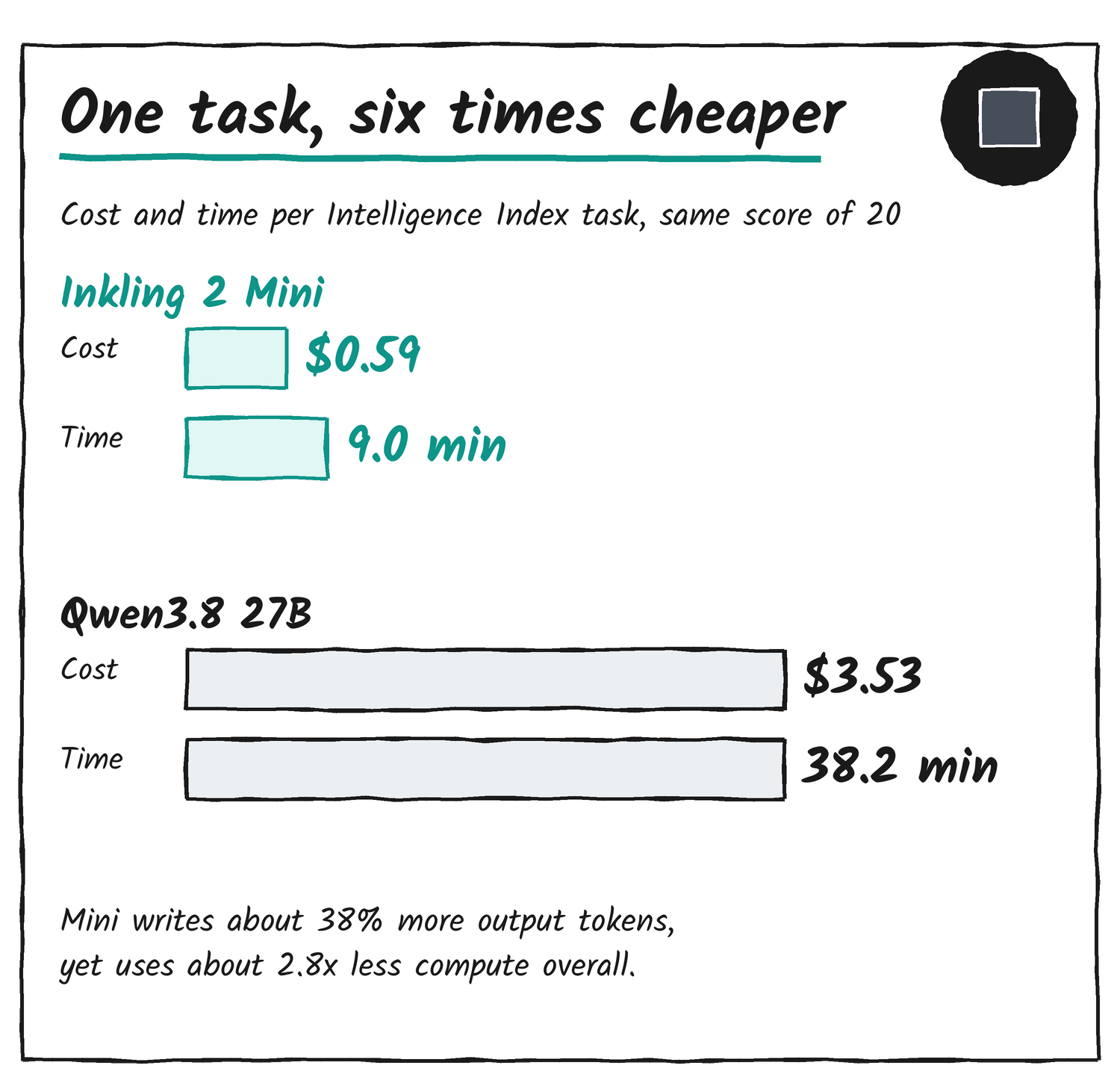
Looping does cost tokens. Mini averages about 152,000 output tokens per task, roughly 38% more than Qwen3.8 27B for the same score. Twelve of its 24 layers run three times per token, which adds compute without adding output tokens, and Artificial Analysis still puts the model’s total compute about 2.8 times below Qwen3.8 27B’s.
What Thinking Machines claims
Thinking Machines says Mini leads every open-weights model under 100 billion total parameters on DeepSWE v1.1, at 48.2%, and on the Vals Index v2.2, at 46.5%. On SWE-bench Pro v2 Hard it reports 77.9% against 73.8% for Qwen3.8-27B, and on BrowseComp it reports 79.0% against 61.6%. The comparison table also covers Gemma 4 31B, Muse Glimmer and Nemotron 3.5 Super VL. Qwen3.8-27B comes out ahead on Terminal Bench v2.1 (73.0% against 71.6%), AA-Briefcase, GDPVal-AA and AutomationBench-AA.
Vals AI, which runs the Vals Index, ranks Mini 38th of 43 models on that index at 46.46%, and 10th of 49 on its CyberBench at 74.58%.
Running it locally
The checkpoint is about 20GB in mixed NVFP4 and MXFP8, the precisions the model was trained in, so no quantisation step stands between the weights and what Thinking Machines measured. At launch it supports Macs with 32GB or more of memory through Ollama, and a single NVIDIA DGX Spark. Quantised GGUF builds are available through Unsloth and llama.cpp, and SGLang, vLLM, NVIDIA Dynamo and TokenSpeed serve it. It’s also on Tinker, Thinking Machines’ platform for inference and fine-tuning. The model card says support for looped models in local runtimes is new and speed varies by runtime and hardware.
Thinking Machines says its researchers ran Mini offline on a MacBook Pro with an M5 Pro chip and 48GB of memory during a flight, and it built a playable flight simulator in a few minutes. Researchers at Stanford’s Hazy Research Lab and Scaling Intelligence Lab, who had early access, measured 0.703 intelligence per watt on a DGX Spark, against 0.430 for Qwen3.6-35B-A3B, 0.159 for Gemma-4-26B-A4B and 0.036 for Qwen3.5-27B, according to Thinking Machines. Mini ran at MXFP8 with low reasoning effort in that test, and the other models ran at NVFP4 or INT4.
Where it’s weaker
Thinking Machines says Mini isn’t the strongest small model for multi-turn chat or for instructions with many constraints. It scores 50.0% on MultiChallenge and 33.4% on ComplexConstraints v1.1, and it trails larger models on CritPt v2 and HLE-Diamond. On AA-Omniscience, a factuality measure, it scores -8.6 against -6.4 for Qwen3.8-27B.
The model card lists more limits. It’s less capable than Inkling 2 Small on most evaluations, with the biggest gaps on factual recall, and it’s more likely than larger models to state wrong information with confidence. In testing it sometimes got stuck in long reasoning loops, especially when debugging code, and Thinking Machines recommends limits on output tokens and agent turns. When it uses tools it can delete or overwrite files without confirmation, so the card advises running agent work in a sandbox.
The oversight question
Looping lets a model do more computation before it writes a token, and Thinking Machines notes that reasoning which never appears in the chain of thought can’t be caught by a chain-of-thought monitor. It released a second model, TML-d24-varloop-research, that can run one to five passes, to study the effect. On the variable-loop model, the no-CoT time horizon, the length of task it can finish at 50% reliability with no written reasoning, rose from 16 seconds at one pass to 37 seconds at three. On GPQA Diamond questions it answered correctly at every pass count, its reasoning at five passes averaged 1,661 tokens against 3,703 at one pass, and its sentence length and dictionary-word share didn’t change.
Thinking Machines reports that Mini follows an instruction to reshape its chain of thought at most 0.1% of the time on chains of 750 to 1,250 tokens, against 1.3% for Qwen3.8-27B, and says it sees no meaningful drop in monitorability at this scale. The interpretability lab Goodfire, which had early access, has published its first findings on the model, and Thinking Machines is working with the National Deep Inference Fabric to give researchers access to the looped models.
Discover more from Sulat AI & Tech News
Subscribe to get the latest posts sent to your email.