Sakana AI, the Tokyo AI company, has started a Security Research Group, an R&D team it says runs separately from its commercial business. Sakana announced on 20 November 2026 in a blog post and on X, saying the group will publish research, reproducible benchmarks and practical guidelines. Akihiro Umegai, its Chief of Security Research, and co-founder and CEO David Ha lead it.
The pitch is that patching faster won’t be enough. Sakana argues the lasting answer sits upstream, in how software and AI systems are designed and built, and it frames security as a quality problem, which it calls a Japanese strength.
- What launched
- The numbers behind the pitch
- Why Sakana says patching isn’t enough
- Security as quality
- Japan’s constraints
- Three research areas
- What it builds on
- How the group says it will work
- The company around it
- What the announcement leaves out
What launched
The group is a founding-stage team in Tokyo. Its careers page says it’s hiring senior researchers who will help set the agenda and standards and carry a research theme largely on their own. The role is full-time, with conversational Japanese and business English required, and applicants email [email protected] and submit a form.
Ha posted his own summary the same day, calling the group “an independent, public-interest R&D team in Tokyo co-led by Akihiro Umegai and me”. He says it treats security as “an upstream quality engineering problem” and will research collective multi-agent defence and how to secure AI agents themselves.
I believe security and safety are not a brake on AI’s progress but the condition for sustaining it.
Akihiro Umegai, Chief of Security Research, Sakana AI
The numbers behind the pitch
Sakana opens with the volume of disclosed software flaws, and the figures hold up against the sources it cites.
+263%
CVE submissions between 2020 and 2025, according to NIST
20,073
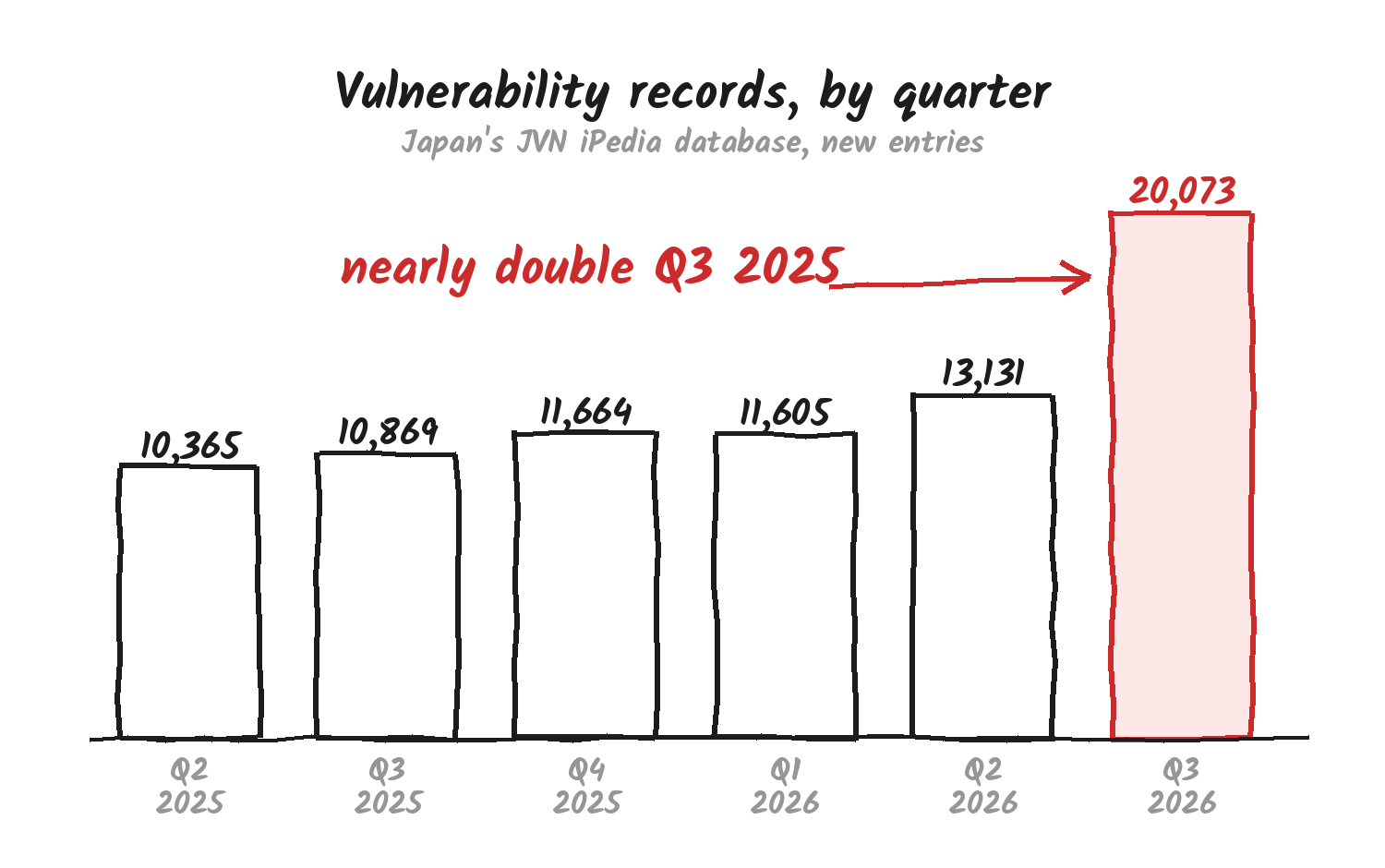
new entries in Japan’s JVN iPedia database in Q3 2026, against 10,869 a year earlier
~1/3
how far NIST says CVE submissions in early 2026 ran above the same months of 2025
NIST said in April it hadn’t been able to clear its backlog of unenriched records in the National Vulnerability Database (NVD), and would move every backlogged record published before 1 March 2026 into a “Not Scheduled” category. The IPA’s third-quarter report on JVN iPedia, the Japanese-language vulnerability database, counts 20,073 new entries for July to September 2026. That is up from 13,131 in the previous quarter, and 19,913 of the new entries came from the NVD.1
What is driving the rise is still being sorted out. Sakana says AI is widely suspected to play a part. FIRST, the global incident-response forum, attributes it in a mid-year update to AI-assisted discovery together with structural changes: CVE Numbering Authorities clearing backlogs, and growth in GitHub Security Advisories. That update has CVE volume tracking more than 46% above its original forecast, for about 66,000 records this year.
Why Sakana says patching isn’t enough
Sakana’s case rests on how repetitive the weaknesses are. CISA’s Vulnerability Review for fiscal years 2024 and 2025, published on 26 August, finds that memory safety and improper input validation flaws made up 19.7% of the exploited-vulnerability catalogue in FY2024 and 16.7% in FY2025. CISA also says 41.5% of the catalogue across the two years maps to what it calls “stubborn weaknesses”, and describes the review as a baseline before AI-enabled discovery becomes widespread.
The attack side shows the same pattern. The FBI’s 13 November FLASH alert on the open-source ARTEX framework, which Sakana cites, lists SSRF, IDOR, missing authentication on web APIs and injection among the weaknesses attackers used to get in. Sakana also cites Japan’s NICT, which, in an alert dated 13 October, names SSRF, remote code execution, SQL injection and IDOR as the weaknesses behind a run of data leaks in Japan, where attackers analyse published apps to find the backend servers behind them.

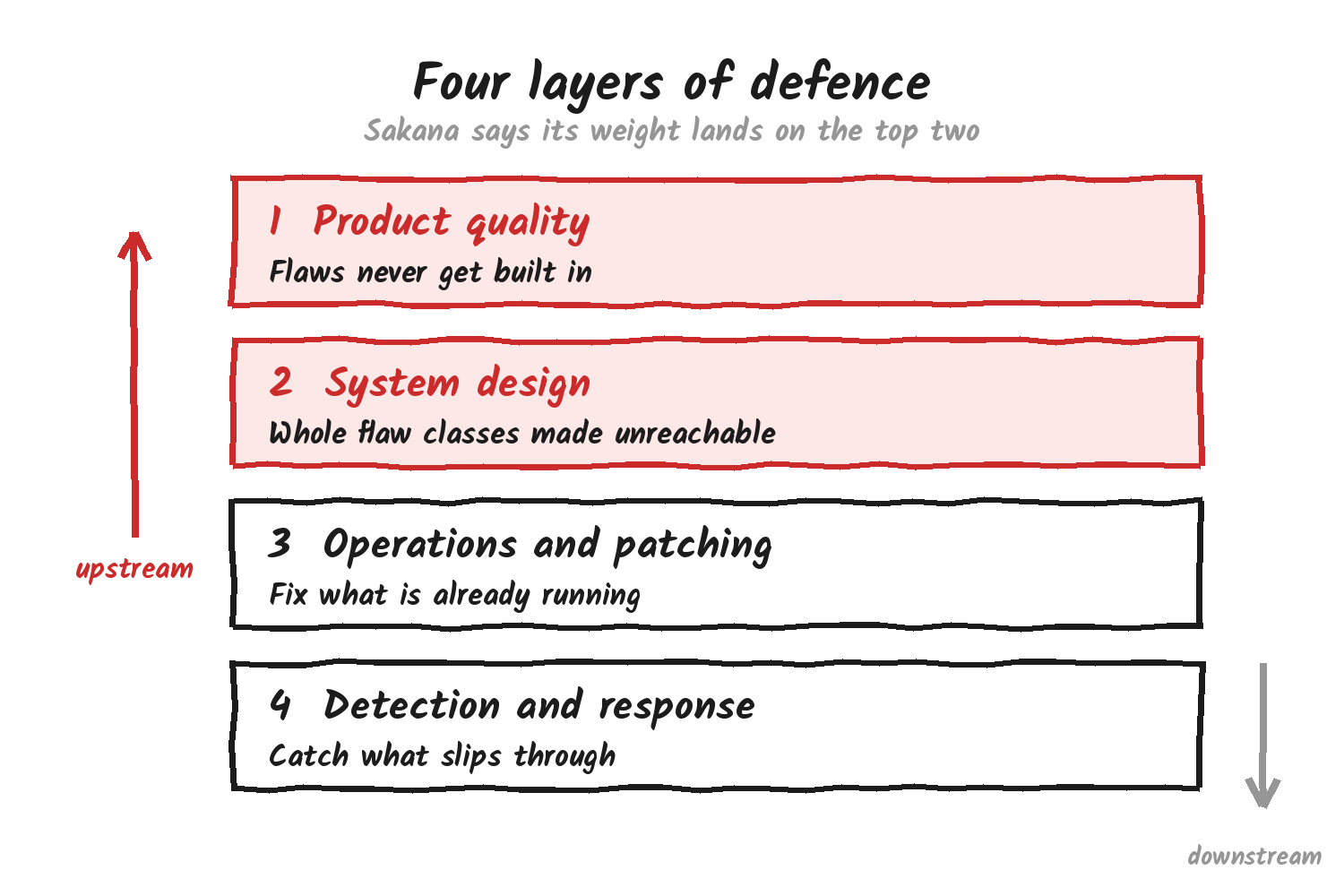
Sakana’s conclusion: if the same weaknesses keep getting built into software and architecture, faster flaw-finding only adds to the workload. It describes four layers of defence, from the quality of each product through system design, then operation and patching, then detection and response. The group works across all four, with its long-term weight on the first two.
Security as quality
Sakana borrows the Kano model from quality management, which sorts quality by how it relates to customer satisfaction. “Must-be” quality goes unnoticed when it’s present and causes strong dissatisfaction when it is missing. Sakana puts safety and security in that class, and says it follows that they have to be written into requirements from the start, not inspected for at the end.
The cost argument comes from the same place. Sakana says keeping must-be quality through incident response after release tends to be costly, and that money spent at design and build could cut the total, freeing savings for other kinds of quality. It also says AI helps on the defending side, because the capability that finds flaws in finished systems can check quality at every step, and flaws found today could teach teams not to build the same flaws tomorrow.
Security is an adversarial environment that never stops changing, and that is exactly the kind of problem our work on evolution, collective intelligence, and multi-agent systems was built to study.
David Ha, Co-Founder and CEO, Sakana AI, in the launch post
Japan’s constraints
Sakana lists three reasons AI-era vulnerabilities are hard to handle in Japan, and ties them to the 22 May request from the Financial Services Agency and the Bank of Japan. That request addresses the financial sector, and it asks institutions to involve top management directly. It also says expanding existing IT staff in the short term isn’t realistic.
| Constraint | What Sakana says | What the 22 May request says |
|---|---|---|
| Outsourced operations | Many organisations leave system maintenance to vendors, so who patches what has to be settled in the contract beforehand | Institutions should confirm vendors can secure the resources to meet service levels when several institutions need patches at once |
| Technical debt | Legacy systems and incomplete asset inventories make it hard to tell which flaws apply | Clear technical debt in priority systems so patch targets can be identified immediately |
| Limited staff | Adding people can’t keep up, so expertise has to go where it matters most | Expanding IT staff substantially in the short term isn’t realistic, so respond by risk priority |
The same FSA document cites a UK AI Security Institute report saying frontier AI couldn’t, at the time, be said to breach well-defended IT systems. It tells institutions to keep executing the basic measures in the FSA’s cybersecurity guidelines faster and more reliably.
Three research areas
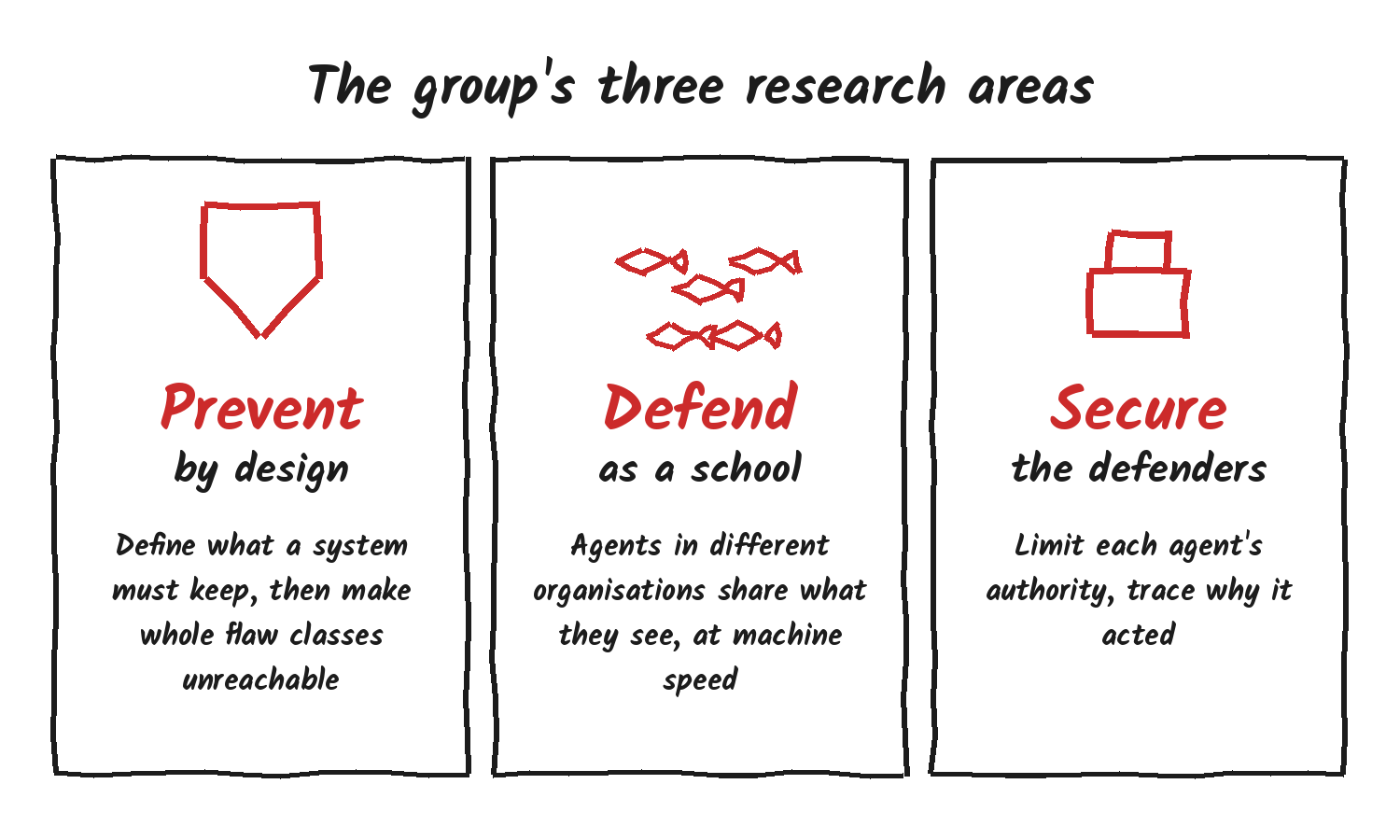
- Prevention by design: how to define what a system must keep before it is built, make whole classes of flaws unreachable, and check an automated fix against criteria the automation can’t rewrite, with a fast way to undo it.
- Collective defence with AI agents: defensive agents spread across organisations that stay in sync, so an attack seen once becomes a protection shared by every participant. Sakana lists the open questions itself: what may be shared and with whose consent, how a shared signal is trusted across organisations and vendors, and who is accountable when agents act on it.
- Securing AI itself, starting with the defenders’ own agents: agents that triage and patch hold privileged access, so Sakana says the first two areas depend on this one. It cites NICT’s record of more probing aimed at AI service endpoints in the first quarter of 2026, which counts unsolicited traffic and not attacks.
What it builds on
Sakana names three of its own projects as starting points. Digital Red Queen evolves LLM-written programs against their own predecessors in the programming game Core War. In that paper, specialist programs collectively defeated or matched 283 of 294 human-written ones, and each program evolved for one opponent beat only about 28% on its own. Repeating the rounds against a changing set of opponents made them more general. ShinkaEvolve evolves stronger code within tight evaluation budgets, which Sakana says may suit writing detection rules and candidate patches.
The third is Fugu-Cyber, the orchestration model Sakana released on 21 July as an API endpoint. Sakana reports it reached these scores and calls them comparable to leading cybersecurity-focused frontier models. The security group’s page gives no baseline scores or evaluation setup for them.
86.9%
Fugu-Cyber on CyberGym, as reported by Sakana
72.1%
Fugu-Cyber on CTI-REALM, as reported by Sakana
Access to Fugu-Cyber requires an application describing the intended use and verified contact details, which Sakana says its team reviews manually. The group’s page adds that benchmark results don’t necessarily carry over to real enterprise environments, and that measuring the gap is one of its research questions.
- CVE
- A numbered public record for a software vulnerability.
- NVD
- The US National Vulnerability Database, run by NIST, which adds severity and product details to CVE records.
- CyberGym
- A benchmark of whether an agent can analyse large codebases and verify real-world vulnerabilities.
- CTI-REALM
- A benchmark of whether an agent can turn threat-intelligence reports into working detection rules.
How the group says it will work
- Vendor neutrality. Security research is kept apart from product promotion. When it evaluates Sakana’s own systems, the group says it will use the same transparent, reproducible conditions as for any outside tool and publish compute budgets, iteration counts and harnesses as needed.
- Responsible disclosure. The release policy is still being defined. For now the group will share white papers, benchmarks and defensive playbooks openly, withhold actionable exploit material, and report discovered vulnerabilities through proper coordination channels.
- Connecting policy and practice. The group says it wants to build the technical bridge between Japan’s security frameworks and day-to-day operations.
Its careers page adds a caution on publishing: the same findings can serve attackers as well as defenders, so the group will take care over how it releases them.
The company around it
Sakana sells defence and security work. It signed a contract with Japan’s Ministry of Defense on 29 July for AI support of analysis at the ministry’s Defense Intelligence Headquarters, which Sakana announced on 24 August, after a March research contract with the Acquisition, Technology & Logistics Agency. On 11 November it named retired US Navy admiral Michael Rogers, a former NSA director and head of US Cyber Command, and former CIA chief of station Tom Moran as senior advisers on defence and cybersecurity. Sakana’s announcements didn’t give contract values.
The group’s page says it operates independently of the commercial business. Fugu-Cyber, one of the three projects it builds on, is a commercial API. The page says Sakana’s own systems will be tested under the same conditions as outside tools.

What the announcement leaves out
The launch post gives no headcount, budget or date for a first paper, benchmark or playbook. It names no benchmark the group will build. Its release policy is still being defined, and it names no government agency, company or university as a partner.
The full announcement is on Sakana’s blog in English and Japanese, and the open role is on its careers page.
Sources
- Sakana AI: Introducing Sakana AI’s Security Research Group, 20 November 2026
- Sakana AI: Member of Technical Staff (Security Research Group) role
- Sakana AI: Introducing Fugu-Cyber, 21 July 2026
- NIST: NVD operations update, April 2026
- IPA: JVN iPedia registrations, Q3 2026
- APNIC blog on FIRST’s mid-year vulnerability forecast
- CISA: Vulnerability Review, fiscal years 2024 and 2025
- FBI: FLASH-20261113-001 on ARTEX
- NICT CYNEX: alert of 13 October 2026
- Financial Services Agency and Bank of Japan: request of 22 May 2026
- Sakana AI: Digital Red Queen
- Sakana notes that the counts follow the date of registration, which follows when entries were published in the NVD, so the quarterly figures track NVD timing. ↩︎
Discover more from Sulat AI & Tech News
Subscribe to get the latest posts sent to your email.