Microsoft AI’s account on X wrapped up Ignite week on 20 November with a list: MAI Code 2 and Code 2 Flash, MAI Cyber 2 Flash, MAI Image 2.7 and 2.7 Flash, MAI Realtime 1, MAI Transcribe 2 (the model behind Dragon Copilot Transcribe) and Decision 1.1. The models themselves landed on 17 November US time, in a launch post titled “Seven new world-class models at scalable price-performance”. This piece goes through each one: what it’s for, what it costs, where you can use it today, and how Microsoft produced the numbers.
The short version
- The pitch: near-frontier quality at a fraction of the price, for agents that run around the clock.
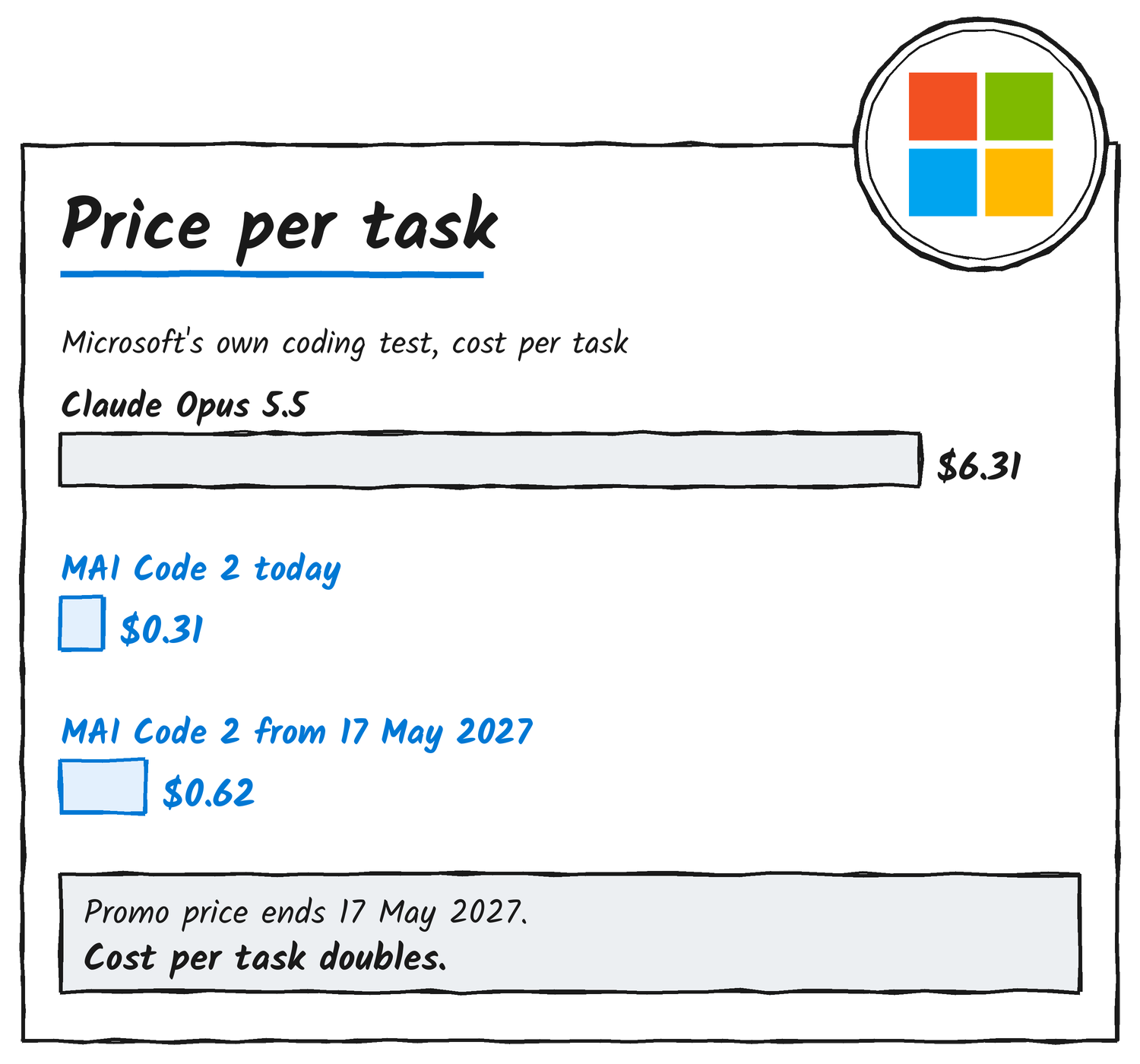
- Coding: Microsoft says MAI Code 2 reaches 96% of Claude Opus 5.5’s coding quality at 5% of the cost. The 5% is at a promotional price that ends on 17 May 2027, when every rate doubles.
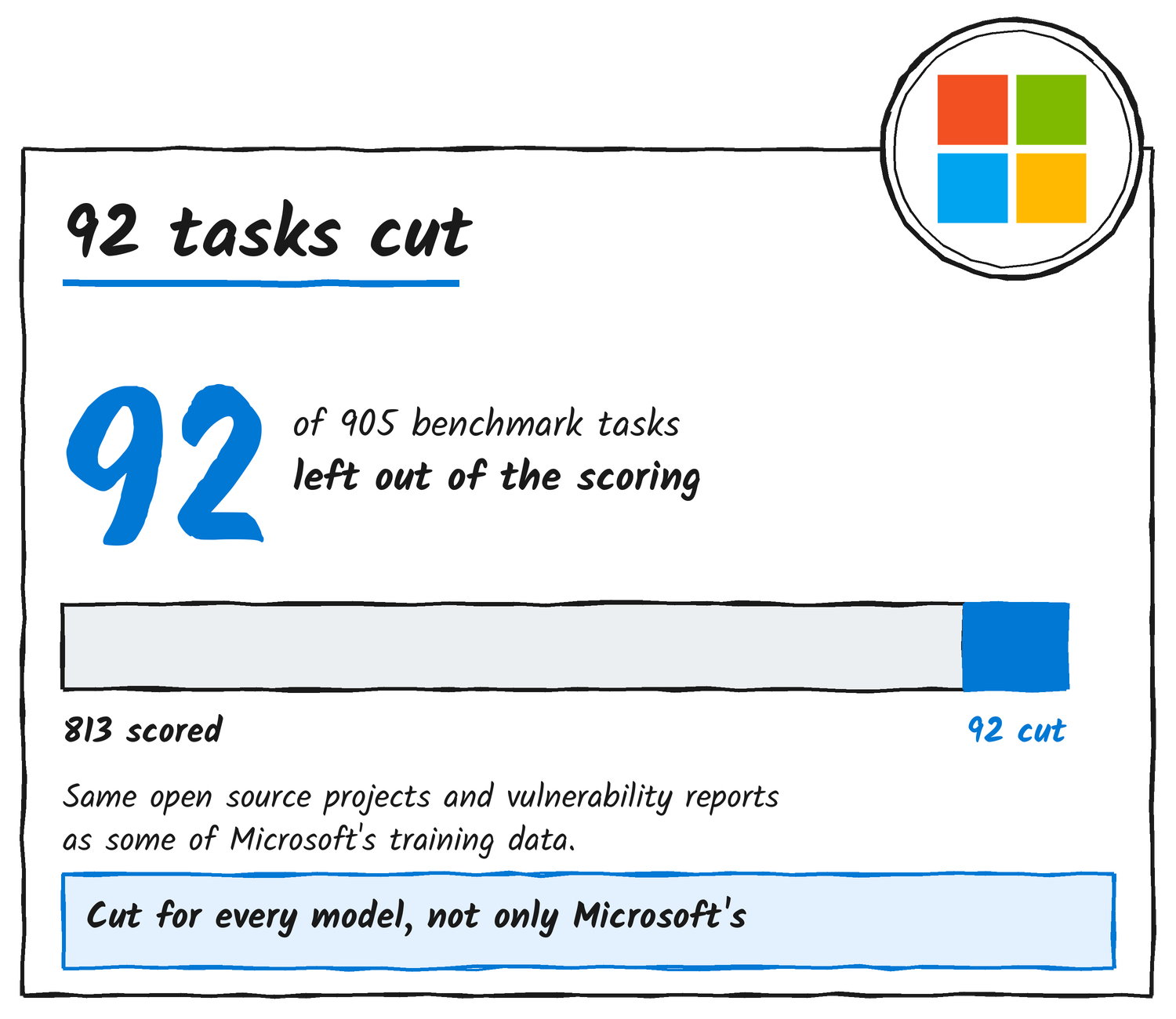
- Security: MAI Cyber 2 Flash scored 92.3% on CyberGym-E2E after Microsoft removed 92 of the benchmark’s 905 tasks because they overlapped its training data. It only ships inside Microsoft’s security products.
- Routing: Decision 1.1 costs US$0.042 per million input tokens, output is free, and it’s built on Google’s Gemma 4 26B A4B.
- Image, voice, transcription: MAI Image 2.7 tops one editing leaderboard by 4 Elo, MAI Realtime 1 starts at US$0.01 an audio minute, and Dragon Copilot Transcribe handles 10 million patient encounters a month.
- Licensed Weights: companies will be able to customise an MAI model and run it in their own Azure. There’s no price or date yet.
Seven models, seven narrow jobs
Microsoft’s framing is that token spend is climbing and customers want models cheap enough to run agents 24/7. So the family is split by task instead of aiming at one do-everything model. Each one below does a single job, and the table shows where to get it and what it costs.
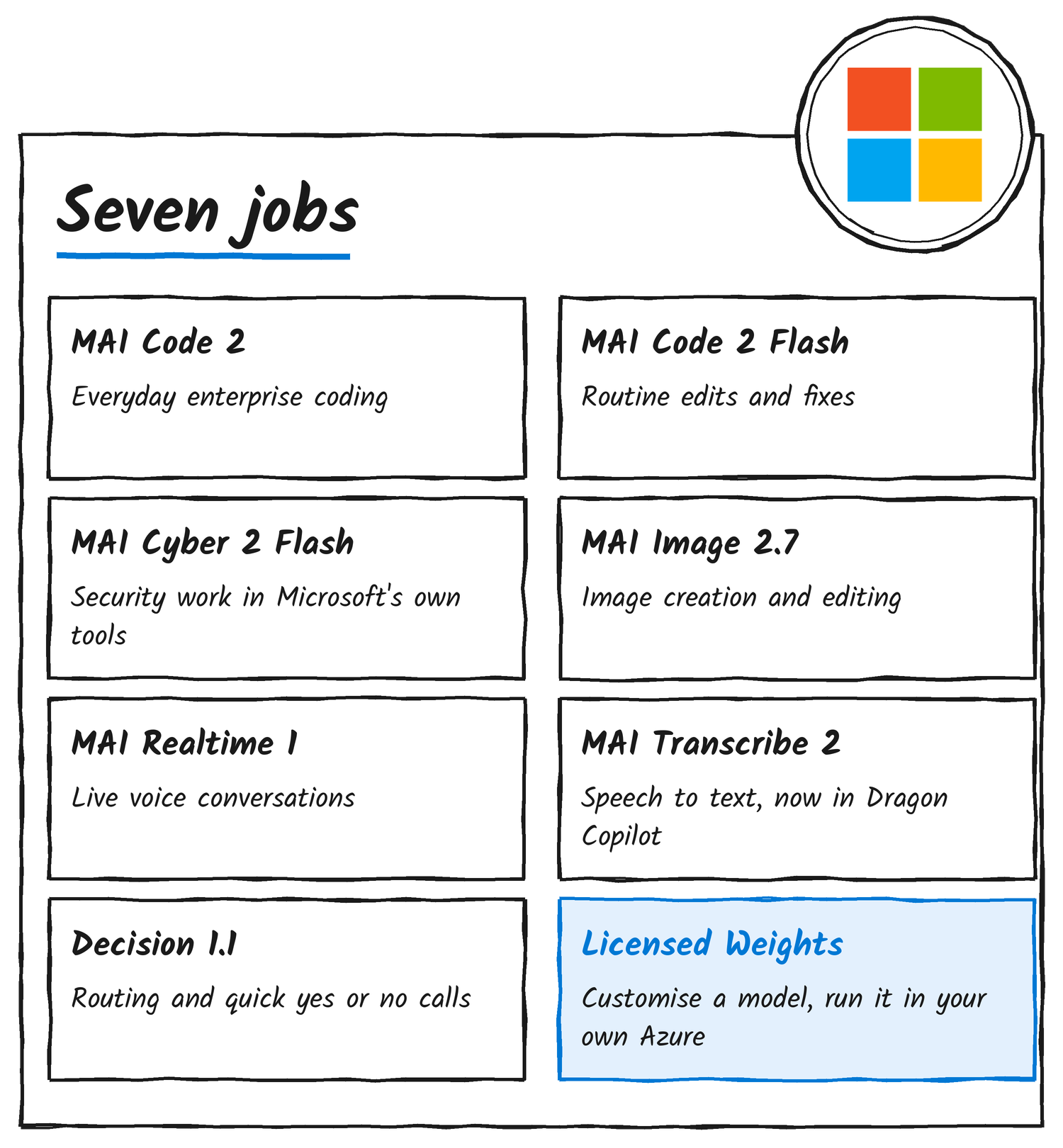
| Model | Job | Where it is | Price |
|---|---|---|---|
| MAI Code 2 | Everyday enterprise coding | GitHub Copilot on Pro, Pro+, Max, Business and Enterprise | US$0.50 in and US$2.50 out per million tokens until 17 May 2027, then US$1 and US$5 |
| MAI Code 2 Flash | Routine edits and fixes | GitHub Copilot on those plans plus Free and Student; limited-access preview in Microsoft Foundry | US$0.05 and US$0.25 until 17 May 2027, then US$0.10 and US$0.50 |
| MAI Cyber 2 Flash | Finding and fixing vulnerabilities | Microsoft security products only, including MDASH from mid-December | US$0.10 in and US$0.50 out per million tokens |
| MAI Image 2.7 and 2.7 Flash | Image creation and editing | Public preview in Foundry, fal, Genspark, OpenRouter and Vercel; MAI Labs | About US$35 and US$10 per 1,000 images |
| MAI Realtime 1 | Live speech-to-speech | MAI Labs, with an interest form for access | From US$0.01 per audio minute; reasoning billed separately |
| MAI Transcribe 2 | Speech to text | Foundry, MAI Playground and OpenRouter; powers Dragon Copilot | US$0.10 per hour of audio, limited-time pricing to the end of the year |
| Decision 1.1 | Routing and classification | Generally available in Foundry, OpenRouter and Vercel AI Gateway | US$0.042 per million input tokens in Global Standard; output free |
MAI Code 2: the 5% has a condition
MAI Code 2 is the flagship. Microsoft built it for the coding work it sees in GitHub Copilot: taking code to production, deep debugging, multi-file implementation, repo-wide reasoning and UI. It says plainly that the coding models aren’t yet tuned for harder problems such as fundamental science research and very long-horizon agentic work. I covered the first claims on 18 November, and the footnotes add detail worth having.
Averaged across four benchmarks (DeepSWE 1.1, Terminal Bench 2.1, SWE-Atlas and FrontierCode v1.1), Microsoft says Code 2 reaches 96% of Claude Opus 5.5’s performance at 5% of the cost. Code 2 Flash is pitched against Claude Haiku 5.5: comparable results at 20% of the cost, measured on three of the four benchmarks.
Here’s the condition. Microsoft’s footnote says Code 2’s cost is shown at its 50% promotional price. GitHub’s pricing page lists that promotion as US$0.50 per million input tokens and US$2.50 per million output tokens until 17 May 2027, then US$1.00 and US$5.00. Every rate doubles on that date. In Microsoft’s cost-per-task chart, as The Decoder reads it, Code 2 costs US$0.31 a task against US$6.31 for Opus 5.5, and averages 63.2% success against 65.3%. At list price Code 2’s cost per task works out to about US$0.62, or roughly 10% of Opus 5.5’s.1 That’s still a large gap, but it’s about 10%, not 5%.
Three of the four benchmarks ran on MSBench, Microsoft’s own evaluation platform, using the GitHub Copilot CLI without subagents. All models ran at maximum reasoning effort. FrontierCode scores and costs came from Artificial Analysis.
Code 2 Flash is the cheaper story. At list price (US$0.10 in, US$0.50 out) it costs half as much on input as its predecessor MAI-Code-1.1-Flash (US$0.20) and well under half on output (US$1.20), per GitHub’s pricing page. GitHub is retiring MAI-Code-1.1-Flash in December. Microsoft also trimmed a single model from Code 2 Flash, MAI Work Flash, to run across Microsoft 365 and FabricIQ. It says Code 2 and Code 2 Flash will reach OpenRouter, Vercel, Hermes, OpenCode and Kilo soon.
MAI Cyber 2 Flash: 92 tasks removed before scoring
Cyber 2 Flash is Microsoft’s specialist security model. Microsoft’s Ignite news page says it has 12 billion active parameters. It has a one-million-token context window, four times that of MAI Cyber 1.1 Flash, and its output tokens are priced 86% lower than the older model’s. MAI Cyber already accounts for almost 40% of scans in MDASH, Microsoft’s multi-model vulnerability scanning harness, and 90% of scans that started on an MAI model stayed on it.
92.3%
of 813 CyberGym-E2E tasks solved, by Microsoft’s count
1M
tokens of context, four times MAI Cyber 1.1 Flash
-86%
output-token price against MAI Cyber 1.1 Flash
The footnote worth reading is the benchmark one. While reviewing its CyberGym-E2E results, Microsoft found that 92 of the benchmark’s 905 tasks are based on the same open source projects and vulnerability reports as some of its training data. The benchmark’s reference solutions weren’t used in training. Microsoft removed the 92 tasks for every model it tested and reports results on the remaining 813. Publishing that correction is the right call, and it means the 92.3% isn’t comparable with CyberGym-E2E scores reported on all 905 tasks.
Cyber 2 Flash isn’t sold on its own. Microsoft says it’s coming exclusively to its security products, and in MDASH it replaces the existing model in the MAI profile for eligible customers from mid-December. By The Decoder’s reading of Microsoft’s chart, the benchmark run cost US$0.45 per task.
Decision 1.1: the cheap model that decides who answers
Agentic systems make many small calls for every task: which tool should handle this, is this ticket urgent, did that step work. Sending each one to a large model is slow and costly. Decision 1.1 is Microsoft’s answer, now generally available after a public preview last month. It handles routing, classification, prioritisation, verification and workflow control, and 4,000 customers have used it so far. This version adds image input, such as photos and screenshots.
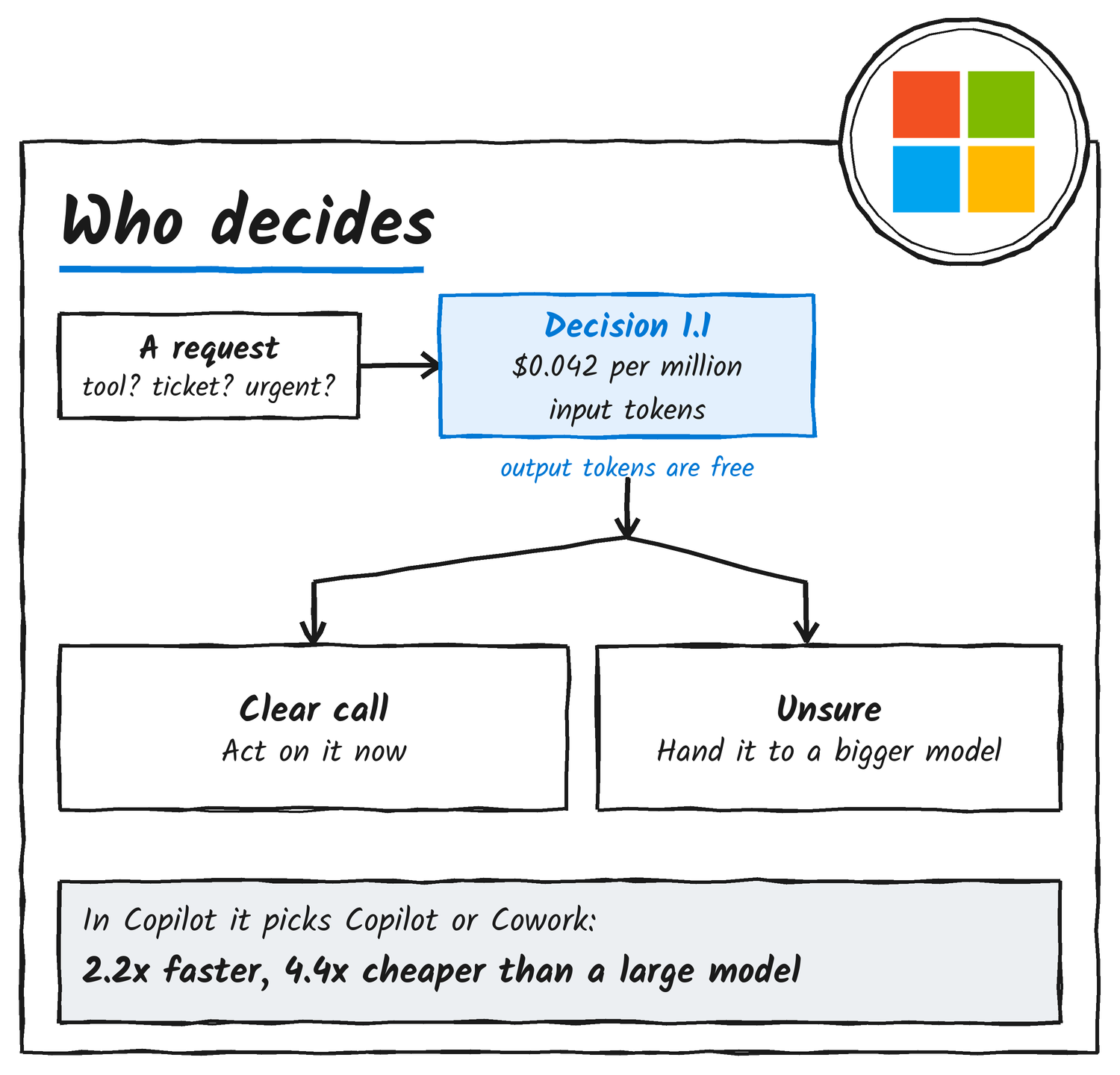
Here’s how it’s built, according to Microsoft’s Command Line blog. It’s based on Google’s Gemma 4 26B A4B, a mid-sized mixture-of-experts model, running on a custom inference engine across A100, H100/H200 and GB200/GB300 GPUs. It scores 68 on the Artificial Analysis Decision Index v2.1, which scores quality, calibration and latency. That’s up six points on Decision 1, and the new model is more than twice as fast at the same cost. Input costs US$0.042 per million tokens in Global Standard, US$0.046 in the US Data Zone and US$0.05 in the EU and APAC Data Zones. Output tokens are free.
Microsoft’s own use is the best evidence it offers. In Copilot, Decision 1.1 decides whether a request goes to Copilot or to Cowork. Microsoft says it makes that call as accurately as a large language model, 2.2 times faster and at 4.4 times lower cost. In Cowork it powers Auto, which sets how much reasoning effort each task gets.
Image, voice and transcription
MAI Image 2.7 ranks first on Artificial Analysis image editing with 1,215 Elo across 5,478 votes, 4 Elo ahead of the rival model Microsoft compares it with, as of 16 November. Four points is a thin lead. For text-to-image it ranks fourth, which Microsoft calls the second-best lab. It costs about US$35 per 1,000 images, and the Flash version about US$10. Both support transparent backgrounds. Canvas, a new editor in MAI Labs, runs on Flash. MAI Image is already the default behind Bing Image Creator, and Microsoft lists Adobe, Figma Weave, Minute (Sports Illustrated), Wirestock and Manus as partners.
MAI Realtime 1 is Microsoft’s first speech-to-speech model. It handles interruptions, backs off while someone’s still talking, and copes with background noise. For harder requests it hands off to a stronger reasoning engine. Base use is US$0.01 per audio minute, with reasoning billed at US$1 per million input tokens and US$5 per million output tokens. Microsoft says it sits on the performance-price frontier for Big Bench Audio and Tau-Voice. You can try it in MAI Labs and register interest through a form.
MAI Transcribe 2 isn’t new. It launched on 3 September with 60 languages, speaker labels, word-level timestamps and about 10 seconds of model time for an hour of audio. The Ignite news is where it’s used: Dragon Copilot Transcribe, built on it, now handles all doctor and patient conversation transcriptions in Dragon Copilot. Microsoft says that’s 10 million encounters a month, with multilingual error rates halved, in the hands of a third of US physicians. One more item from the post: Maia 200, Microsoft’s second-generation AI accelerator, is now in production running its largest models, at 1.7 times more tokens per watt.
Licensed Weights: your own copy, in your own Azure
MAI Licensed Weights lets an organisation take a frontier MAI model, adapt it with proprietary data and run it in its own Azure environment. Microsoft says customers control who can access it and when it’s upgraded, and Microsoft trains on their adaptations only with express agreement. It’s delivered through Microsoft’s Frontier Company engagements, and Microsoft’s post tells readers to contact their account team. It hasn’t published a price or a launch date. The programme has its own write-up.
The customer results Microsoft cites are customised Code 2 and Code 2 Flash. Woven by Toyota produced ready-to-merge code fixes in 44% of cases where its existing frontier models had needed a human, at under a tenth of the cost. Alaska Airlines lifted accuracy on aircraft maintenance report classification from 81.2% to 91.1%. AT&T customised the models for 5G network operations analytics.
Your IQ. Your agents. Your weights.
Microsoft AI, closing its launch post
What it means
The models aren’t just for sale. Microsoft’s own products already run on them: Decision 1.1 routes Copilot requests, Work Flash serves Microsoft 365, MAI Image sits behind Bing Image Creator and Dragon Copilot runs on Transcribe. The Foundry catalogue still carries other companies’ models too. What changed at Ignite is that Microsoft now has an in-house option at most price points, and it’s pricing them to be tried.
If you want to test the claims, the cheapest routes are these:
- Coding: pick MAI Code 2 Flash in the Copilot model picker. It’s on the Free plan.
- Routing: call Decision 1.1 through OpenRouter or Vercel AI Gateway on a sample of your real traffic and compare its calls with your current router.
- Image: try 2.7 Flash and Canvas in MAI Labs.
- Cost checks: price your own workload at the post-May 2027 rates before you commit to Code 2.
How Microsoft ran its numbers
Every comparison in the launch posts is Microsoft’s own run or its own reading of a third-party leaderboard, and Microsoft says results vary by workload, configuration, reasoning effort and pricing assumptions.
- Code: three benchmarks on MSBench with the Copilot CLI and no subagents, FrontierCode from Artificial Analysis, all at maximum reasoning effort, Code costs at the 50% promotional price.
- Cyber: CyberGym-E2E on 813 of 905 tasks, after excluding 92 that overlapped Microsoft’s training data.
- Image: Artificial Analysis AA-Image-Editing v2.1, as of 16 November 2026.
- Realtime: public benchmarks including Big Bench Audio and Tau-Voice, plus Dynamics 365 Contact Center evaluations.
- Decision: Artificial Analysis Decision Index v2.1, which scores quality, calibration and latency.
The terms in plain words
- Token
- A chunk of text, roughly three-quarters of a word, that models read and write. Prices are quoted per million of them.
- Active parameters
- The part of a model that does the work on each request. A mixture-of-experts model has many more parameters in total than it uses at once.
- Elo
- A ranking score built from head-to-head votes. A small gap means the two are close.
- MDASH
- Microsoft’s multi-model system for finding and fixing vulnerabilities.
- Foundry
- Microsoft’s platform for building with AI models on Azure.
- Reasoning effort
- How much thinking a model is allowed to do before it answers. More effort usually costs more.
Primary sources
- The US$0.31 and US$6.31 figures come from the chart as The Decoder reports it. Microsoft’s post gives only the 5% ratio. The US$0.62 figure is my arithmetic: every Code 2 rate doubles on 17 May 2027, so cost per task doubles. ↩︎
Discover more from Sulat AI & Tech News
Subscribe to get the latest posts sent to your email.