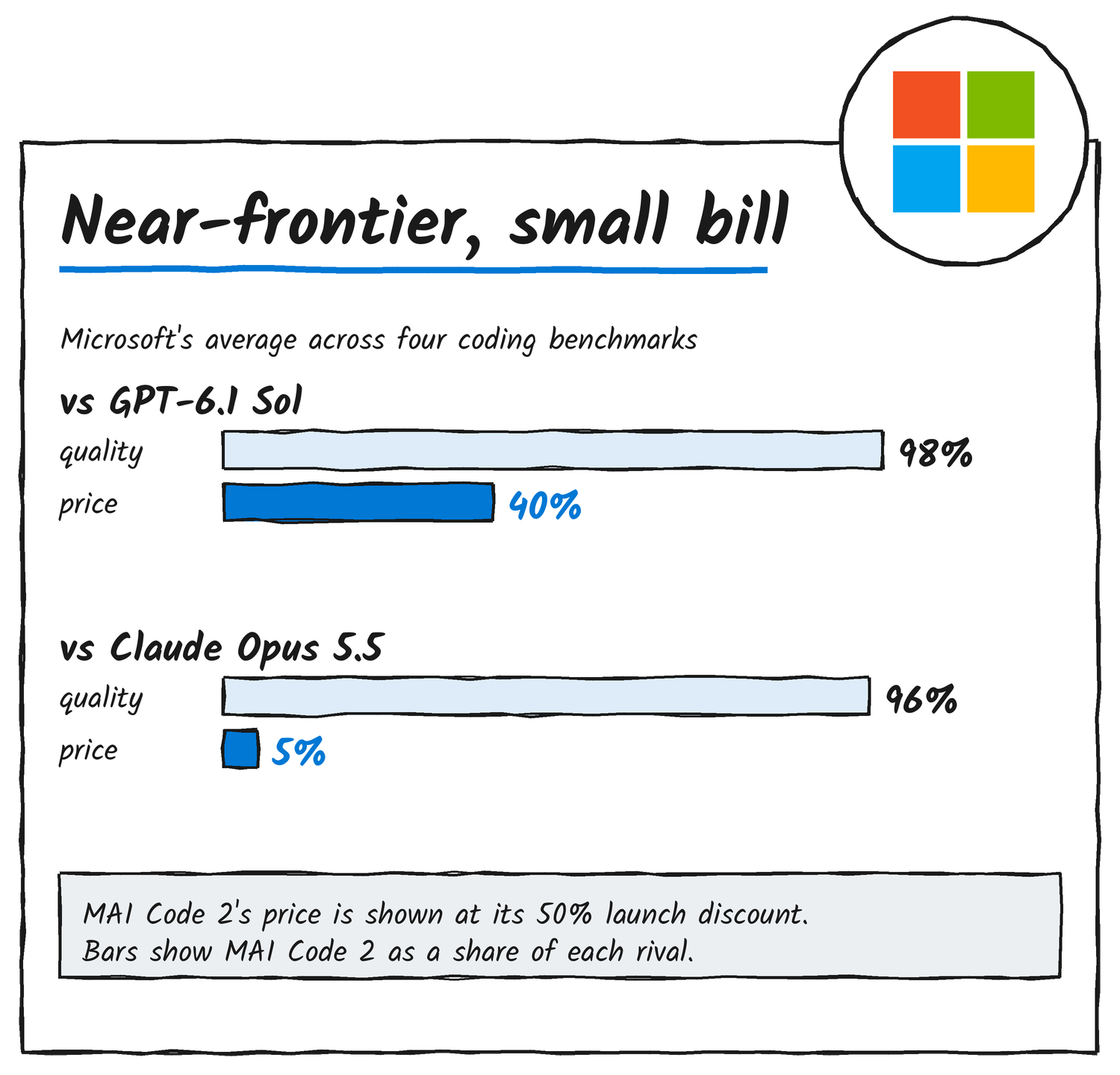
Microsoft says its new coding model MAI Code 2 reaches 98% of the coding quality of GPT-6.1 Sol at about 40% of the price. It puts the figures against Claude Opus 5.5 at 96% of the quality for 5% of the price. Both claims come from Microsoft AI’s launch post, and MAI Code 2 is in GitHub Copilot now.
Microsoft announced it on X on 17 November at Ignite, which was 18 November in New Zealand. The post names three models: Code 2 for repo-wide reasoning, Code 2 Flash for fast, high-volume coding, and Cyber 2 Flash, which Microsoft calls “our most capable security model yet.” They’re three of seven MAI models released the same day.
New models built for coding and cybersecurity, with cost-performance in focus. Meet Code 2 for repo-wide reasoning, Code 2 Flash for fast, high-volume coding, and Cyber 2 Flash, our most capable security model yet. #MSIgnite
— Microsoft (@Microsoft) November 17, 2026
What the coding numbers measure
Microsoft averaged four benchmarks that target everyday enterprise coding: DeepSWE 1.1, Terminal Bench 2.1, SWE-Atlas and FrontierCode v1.1. It ran every model at maximum reasoning effort. The first three ran on MSBench, Microsoft’s internal evaluation platform, through the GitHub Copilot CLI with no subagents. The FrontierCode scores and costs come from Artificial Analysis.
The price side carries a catch. Microsoft shows MAI Code 2’s cost at its 50% promotional price, so the 40% and 5% figures reflect a launch discount. The launch post gives prices as percentages and doesn’t list per-token rates.
MAI Code 2 Flash is the cheaper model. Microsoft says it matches GPT-6 Luna and Claude Haiku 5.5 at 65% and 20% of their cost, across DeepSWE 1.1, Terminal Bench 2.1 and SWE-Atlas. It also uses the 50% promotional price.
Microsoft says both models aim at day-to-day work and aren’t yet tuned for fundamental science research or very long-horizon agentic work. In blind side-by-side tests of frontend work, 258 annotators preferred MAI Code 2 over GPT-6 Sol 67% of the time, the model page says. The Ignite post rounds that to 68%.
Where you can use them
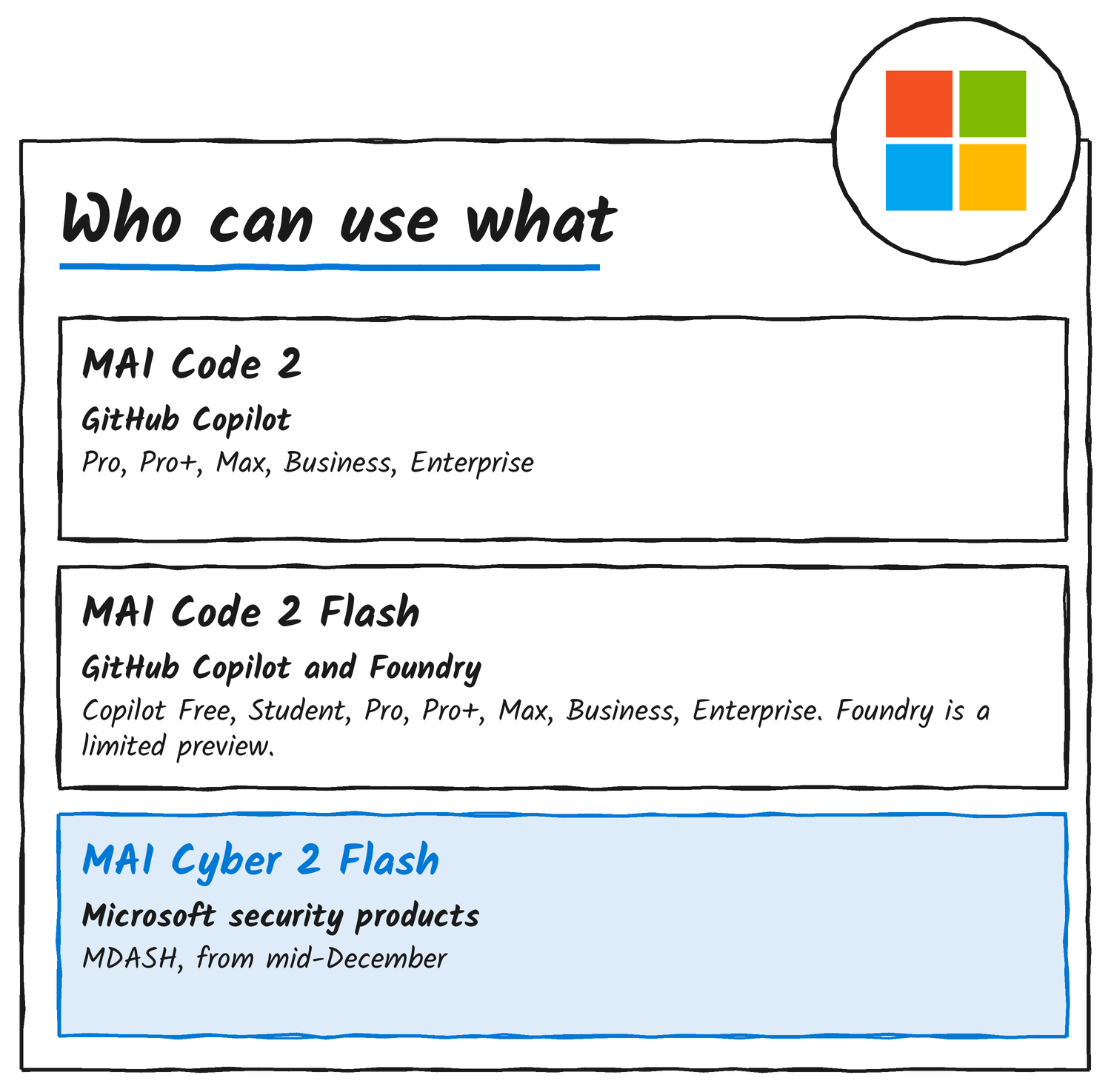
GitHub’s changelog lists MAI Code 2 for Copilot Pro, Pro+, Max, Business and Enterprise. MAI Code 2 Flash adds Copilot Free and Student. Both need an eligible annual plan and are billed under usage-based billing. They appear in the model picker in Visual Studio Code, Visual Studio, Copilot CLI, the Copilot cloud agent, JetBrains, Xcode, Eclipse, github.com and GitHub Mobile.
Business and Enterprise administrators control access through the model policy in Copilot settings. New models switch on by default unless an administrator has turned that off. Code 2 Flash is also in limited-access preview in Microsoft Foundry, and Microsoft says the coding models are coming soon to OpenRouter, Vercel, Hermes, OpenCode and Kilo.
Cyber 2 Flash
Cyber 2 Flash has 12 billion active parameters, Microsoft says in its Ignite live blog, and a one-million-token context window, four times that of MAI Cyber 1.1 Flash. On CyberGym-E2E, a benchmark for finding real vulnerabilities, Microsoft reports 92.3% for Cyber 2 Flash against 91.5% for GPT-6 Astra. It says the cost per task is under 2% of Astra’s, and that Cyber 2 Flash used half the reasoning budget.
That cost figure comes from list prices: US$0.10 input, US$0.01 cached input and US$0.50 output per million tokens for Cyber 2 Flash, against US$10, US$1 and US$50 for Astra on Azure OpenAI. Microsoft says it measures offline evaluation cost, not customer spend.
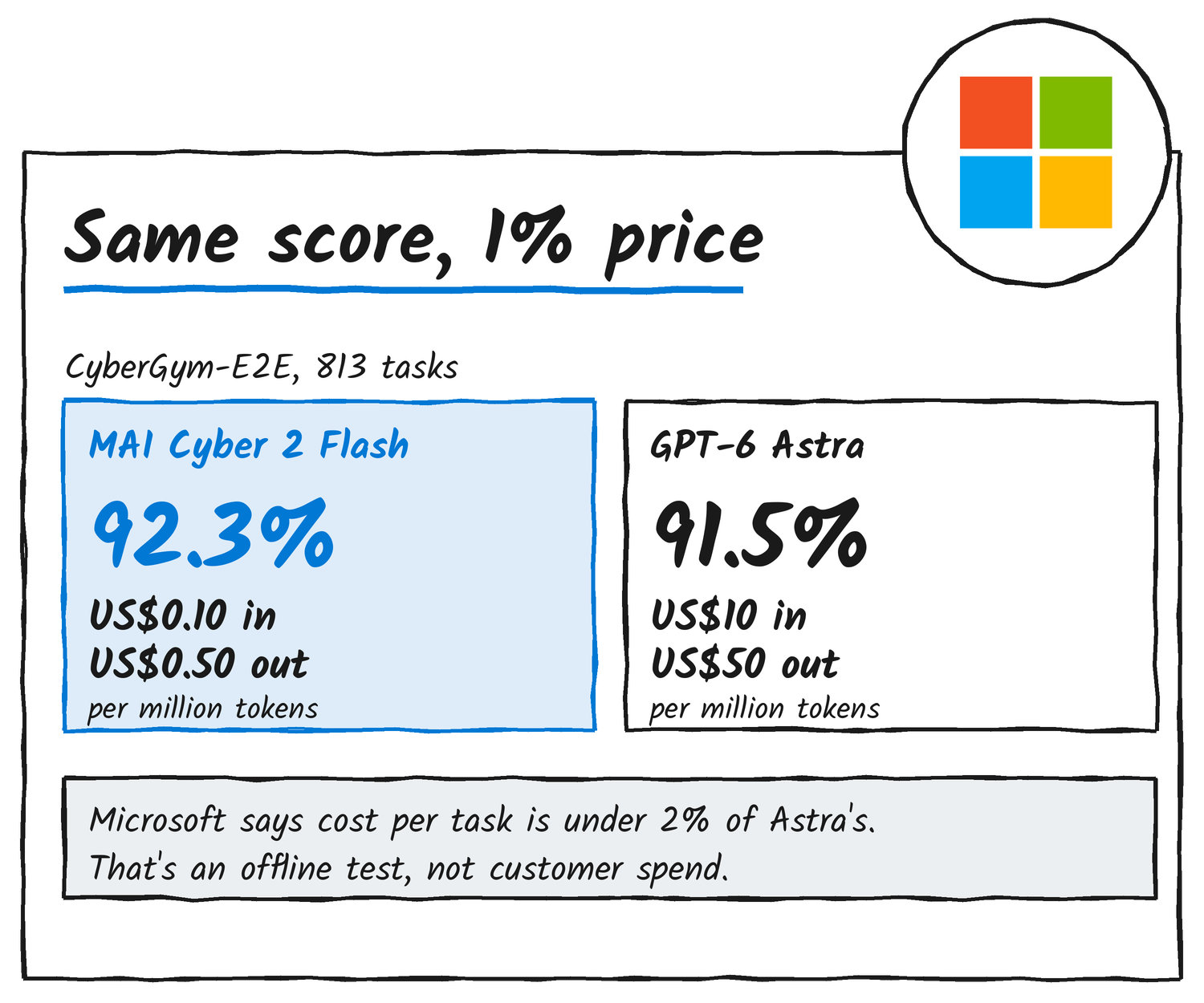
Microsoft found that 92 of CyberGym-E2E’s 905 tasks use the same open-source projects and vulnerability reports as some of its training data. It dropped those tasks for every model, so the scores cover 813. On WebExploitBench, Cyber 2 Flash scored 40.4% to GPT-5.6 Cyber’s 38.4% at the same reasoning budget. Microsoft hasn’t compared it with GPT-6 Cyber, which is limited to select customers, and says it plans to share that in the coming weeks.
Cyber 2 Flash isn’t sold on its own. It’s coming exclusively to Microsoft security products, starting with Codename MDASH, where it replaces the current model in the MAI profile for eligible customers from mid-December. Microsoft says MAI Cyber models account for almost 40% of MDASH scans, and the new model’s output tokens cost 86% less than MAI Cyber 1.1 Flash’s. Reuters reports that Microsoft AI chief Mustafa Suleyman called the lineup “a system, a hill-climbing machine” that tunes performance and price together.
Models you can customise
Microsoft also announced MAI Licensed Weights, which lets a company customise a MAI model on its own data and run it in its own Azure environment. It’s coming soon through Microsoft’s Frontier Company engagements. Microsoft says a customised model at AT&T beat GPT-6.1 Sol on 5G network analytics at one-fiftieth of the cost, and that tuning Code 2 Flash lifted Alaska Airlines’ aircraft maintenance report classification from 81.2% to 91.1%.
Discover more from Sulat AI & Tech News
Subscribe to get the latest posts sent to your email.