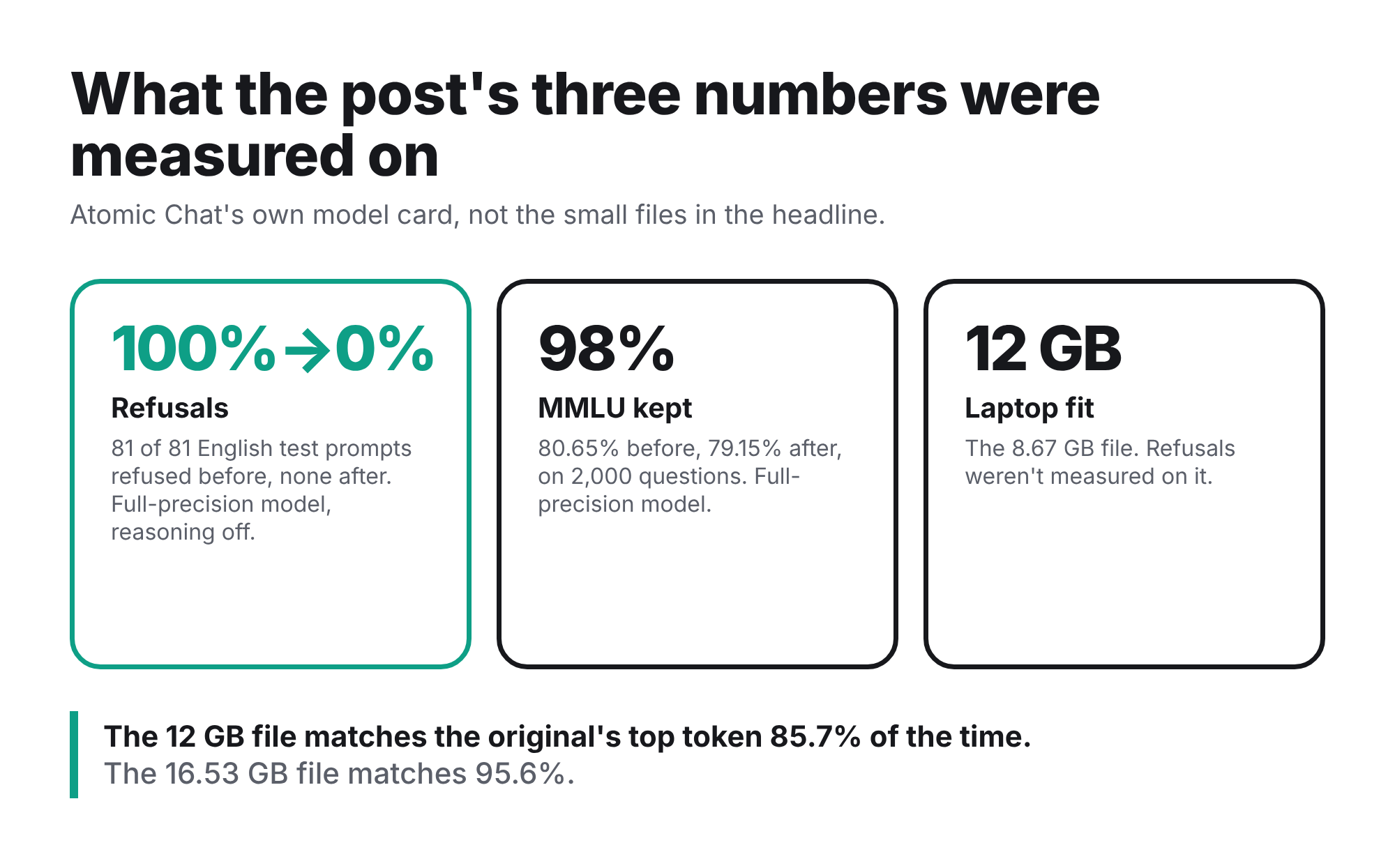
Atomic Chat, the team behind a free local AI app, released three GGUF builds and a LoRA adapter on 21 November that strip the refusal behaviour out of Thinking Machines’ Inkling 2 Mini. Its post on X says refusals fell from 100% to 0% in its test, that the model kept 98% of its MMLU accuracy, and that it runs on a 12 GB laptop. The model card puts a number on every one of those claims. None of them was measured on quite what the headline implies.
What was released
Thinking Machines put out Inkling 2 Mini on 20 November under the Apache 2.0 licence: a 26.4 billion parameter mixture-of-experts model with 3.4 billion active per token and a middle block of layers that runs three times. Atomic Chat built its versions from its own GGUF conversions of those weights and published them a day later, also under Apache 2.0. The repository has three files with the edit merged in, a 44 MB adapter that applies the same edit to the team’s other base files, and the original vision projector, unchanged.
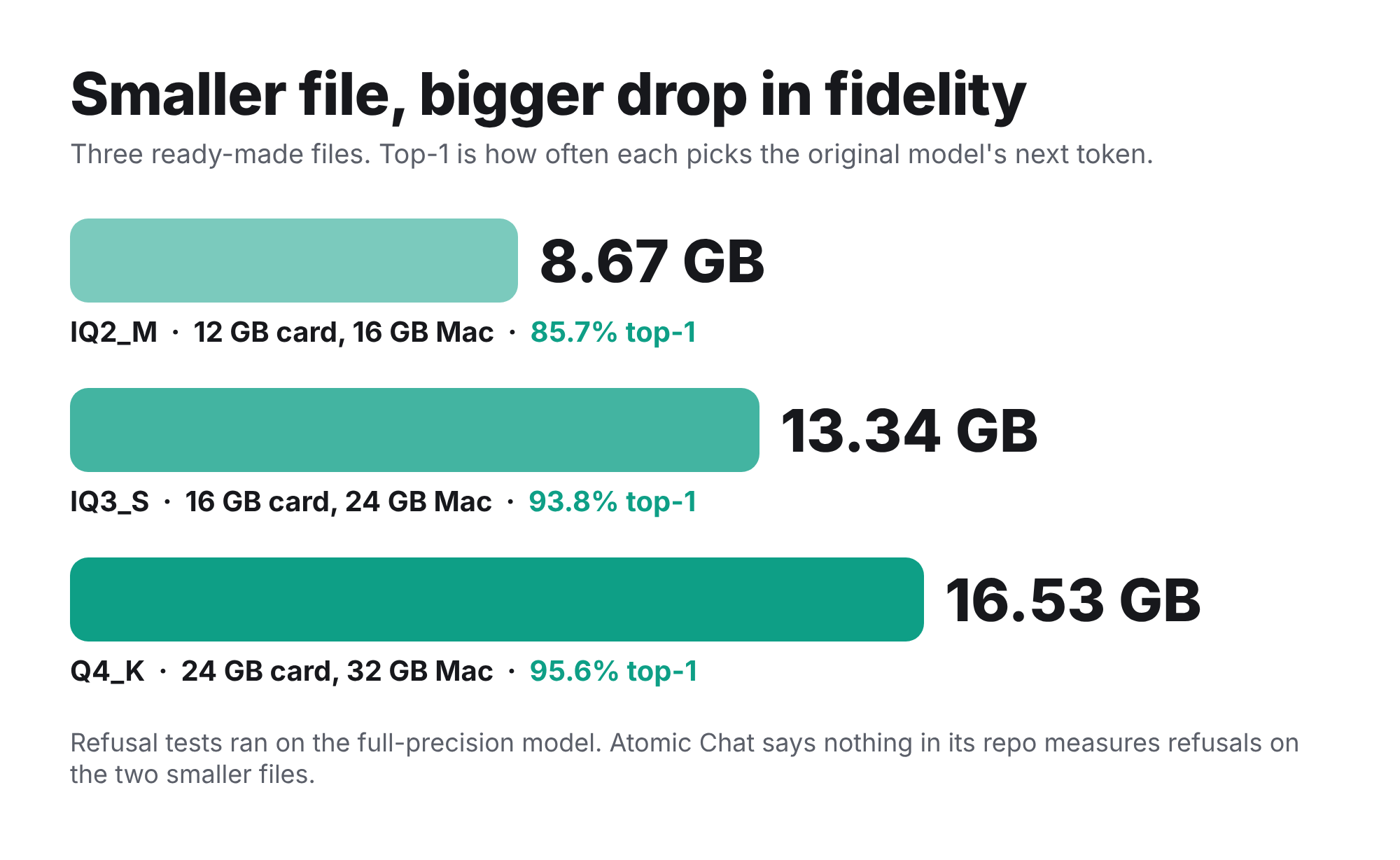
| File | Size | KLD to BF16 | Top-1 match | Same file, unedited |
|---|---|---|---|---|
| AD-Q4_K | 16.53 GB | 0.0115 | 95.6% | 0.0080 and 96.3% |
| AD-IQ3_S | 13.34 GB | 0.0235 | 93.8% | 0.0205 and 94.2% |
| AD-IQ2_M | 8.67 GB | 0.132 | 85.7% | 0.130 and 85.7% |
How the edit works
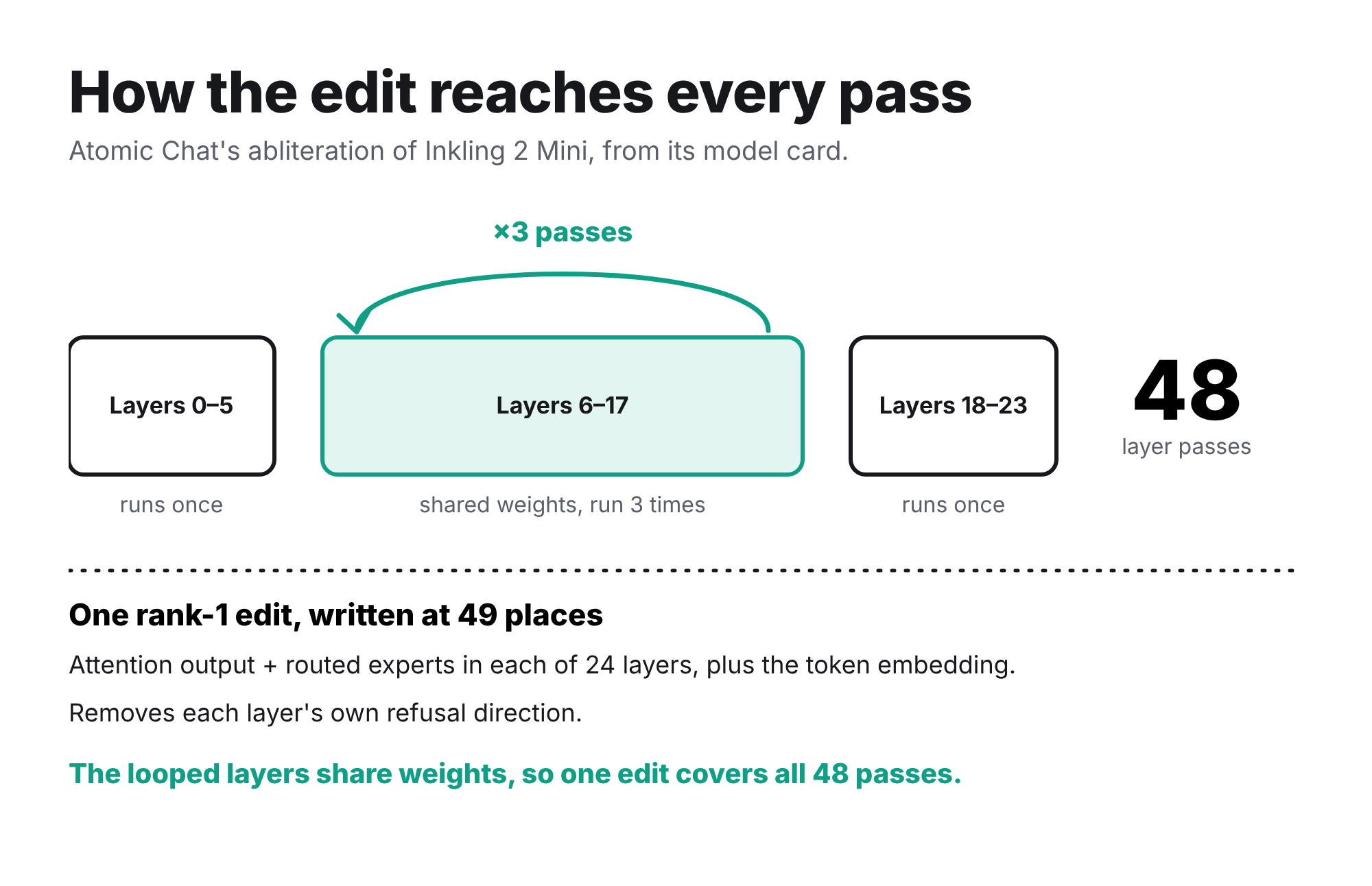
The technique is called abliteration. Atomic Chat applies a rank-1 LoRA, the smallest possible low-rank weight patch, at 49 places that write into the model’s residual stream: the attention output and the routed experts in each of the 24 layers, plus the token embedding. For each layer it takes the difference between the average activations on harmful and harmless prompts, in English and Russian, and subtracts the harmless average. What’s left is that layer’s own refusal direction, and the patch removes it.1
One detail is specific to this model. Inkling 2 Mini reasons even at its lowest effort setting and decides to refuse inside that reasoning, so the team pooled directions from prompts rendered with and without reasoning. A direction taken without reasoning alone still left soft refusals in chat. Because the looped layers share weights across all three passes, one edit covers all 48 layer passes.
What the card measured
Atomic Chat compared the full-precision BF16 model with and without the adapter, using greedy decoding. The harmful prompts come from the public mlabonne/harmful_behaviors set and its Russian translation. The adapter was built from the training split, and the numbers below come from the validation and test splits. Over-refusal was checked on XSTest and general ability on 2,000 MMLU questions.
81 to 0
English test prompts refused, reasoning off
91 to 0
Russian test prompts refused, of 100
−1.50 pts
MMLU, 80.65% to 79.15%
0.94
first-token KL on harmless prompts, against a 0.10 gate
With reasoning on, refusals fell from 28 to 0 of 30 prompts at low effort and from 26 to 0 of 30 at high effort. Of 250 safe XSTest prompts, the original refused 10 and the edited model refused none. Valid tool calls went from 18 to 20 of 20, and the model passed all three needle-in-a-long-context checks, as the original did.
Where the headline outruns the card
The 98% is 79.15% divided by 80.65%, and it was measured on the BF16 model with the adapter. The card lists it as a gate the edit missed. The drop is 1.5 points on 2,000 questions with a p-value of 0.006, against a gate of no significant drop. A random direction applied the same way costs 0.75 points, so about half the loss comes from editing every writer at all. Stronger edits cost more: 2.2 points at strength 1.25.
The second miss is first-token KL on harmless prompts, 0.94 against a 0.10 gate. The card attributes most of that to the 1% to 6% of harmless prompts the original refused and the adapter now answers, where the first token changes completely. On running text, where refusals play no part, KLD stays at 0.008. The card also says some answers still open with a caution line and then answer.
The 12 GB claim rests on the smallest file. AD-IQ2_M is 8.67 GB and, according to Atomic Chat’s guide, leaves room for around 12K tokens of context on a 12 GB card. It also matches the original’s top token 85.7% of the time, against 95.6% for the 16.53 GB file, and its KLD is 0.132 against 0.0115. The refusal tests didn’t run on it. The guide says nothing in the repository measures refusals on AD-IQ3_S or AD-IQ2_M, and that the merged AD-Q4_K passed an 8-prompt chat check.
This model will answer requests that the original refuses. You are responsible for how you use it.
Atomic Chat, model card
Running it today
The files need llama.cpp build b12600 or newer, which added the looped architecture. Atomic Chat’s own app doesn’t load them yet: the guide says the newest llama.cpp build approved for its bundled engine on 21 November is b12532. Until that moves, the route is to start llama-server yourself and connect the app to it as a client through its custom endpoint. The team says the app will pull a newer engine without an app release once it’s approved. Atomic Chat’s follow-up post on X pitches the model as a one-click run, and for this model the guide’s own steps say otherwise for now.
Which file fits which memory, per Atomic Chat
- 12 GB of usable memory: AD-IQ2_M, 8.67 GB, around 12K tokens of context.
- 16 GB: AD-IQ3_S, 13.34 GB, around 8K tokens.
- 24 GB: AD-Q4_K, 16.53 GB, around 40K tokens.
- 32 GB: AD-Q4_K, around 96K tokens.
- 48 GB or more: the 27.74 GB Q8_0 file from the team’s base repository with the adapter applied, around 128K tokens.
Two other builds
Atomic Chat’s guide compares its release with two others and calls its own the best documented. The OpenUncensored build edits only the 20 attention output projections in layers 4 to 23, leaves every expert untouched, and reports no MMLU loss on its card. It ships as roughly 20 GB of safetensors for SGLang. By the guide’s table it reports 0 of 32 refusals in chat, down from 32 of 32, on a prompt set of its own. The JoaoZaokk build uses the Heretic tool and reports 20.0% refusals in chat and 58.3% with thinking, down from 100%. The three prompt sets differ, so the refusal figures can’t be lined up against each other.
The licence and the usage policy
Apache 2.0 lets anyone modify and redistribute the weights, and Atomic Chat’s guide says the uncensored builds inherit it, commercial use included. Thinking Machines also publishes a separate Model Acceptable Use Policy that covers the weights and any modified version. One of its restrictions reads: “Do not attempt to circumvent, disable, or remove measures implemented in the Model Materials or in any system built using them.” The guide points to the policy in its licensing answer without naming that clause. Atomic Chat’s X profile lists California as its location, and the Hugging Face page showed 9,540 downloads in the last month and 199 likes when I checked.
Background on the base model is in our Inkling 2 Mini report, and the exo speed test on Macs covers how fast it runs on Apple hardware.
- KLD is the Kullback-Leibler divergence between the quantised model’s next-token probabilities and the original BF16 model’s, so lower is closer. Top-1 is how often the two models pick the same most-likely next token. ↩︎
Discover more from Sulat AI & Tech News
Subscribe to get the latest posts sent to your email.