
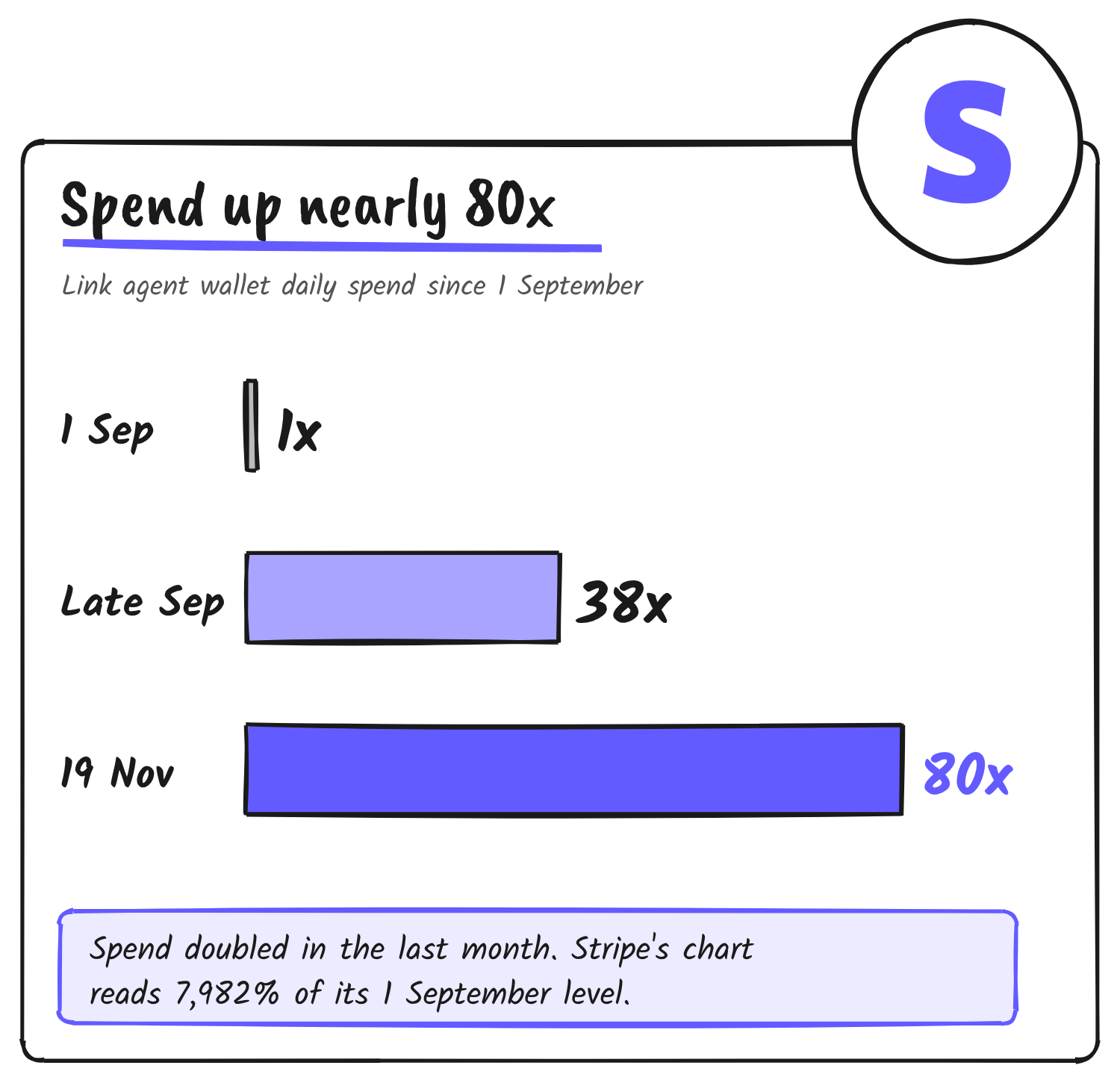
Stripe says daily spend on Link’s agent wallet was nearly 80 times higher in mid-November than on 1 September. Link is the wallet that Meta’s Muse, Grok Bot and Instinct use to pay for things, and Stripe’s chief economist, Ernie Tedeschi, published the figures on 20 November. They show spend doubling in the last month, after Stripe’s chart ran level from late September to early November.
Olivia Moore, a partner at the venture firm a16z, put the numbers next to Muse’s user growth on 21 November and offered four reasons for the jump. I checked each against Stripe’s charts, Link’s documentation and Meta’s own statements. Two of her figures need a correction, and the rest hold up.
- What the 80x counts
- How Link added agents
- Level for five weeks, then double
- Where the dollars went
- Who comes back
- Muse’s part
- What the figure leaves out
What the 80x counts
Link is Stripe’s consumer wallet, and Stripe says it has more than 300 million users. Its agent wallet launched on 29 April. An agent that wants to buy something sends Link a spend request that names the seller, the amount and the reason. The shopper approves it, and Link hands the agent a one-time card for that purchase, so the agent never holds the real card number. Link’s support page says each approval takes Face ID, Touch ID or a passkey, and the shopper has 30 minutes to give it.
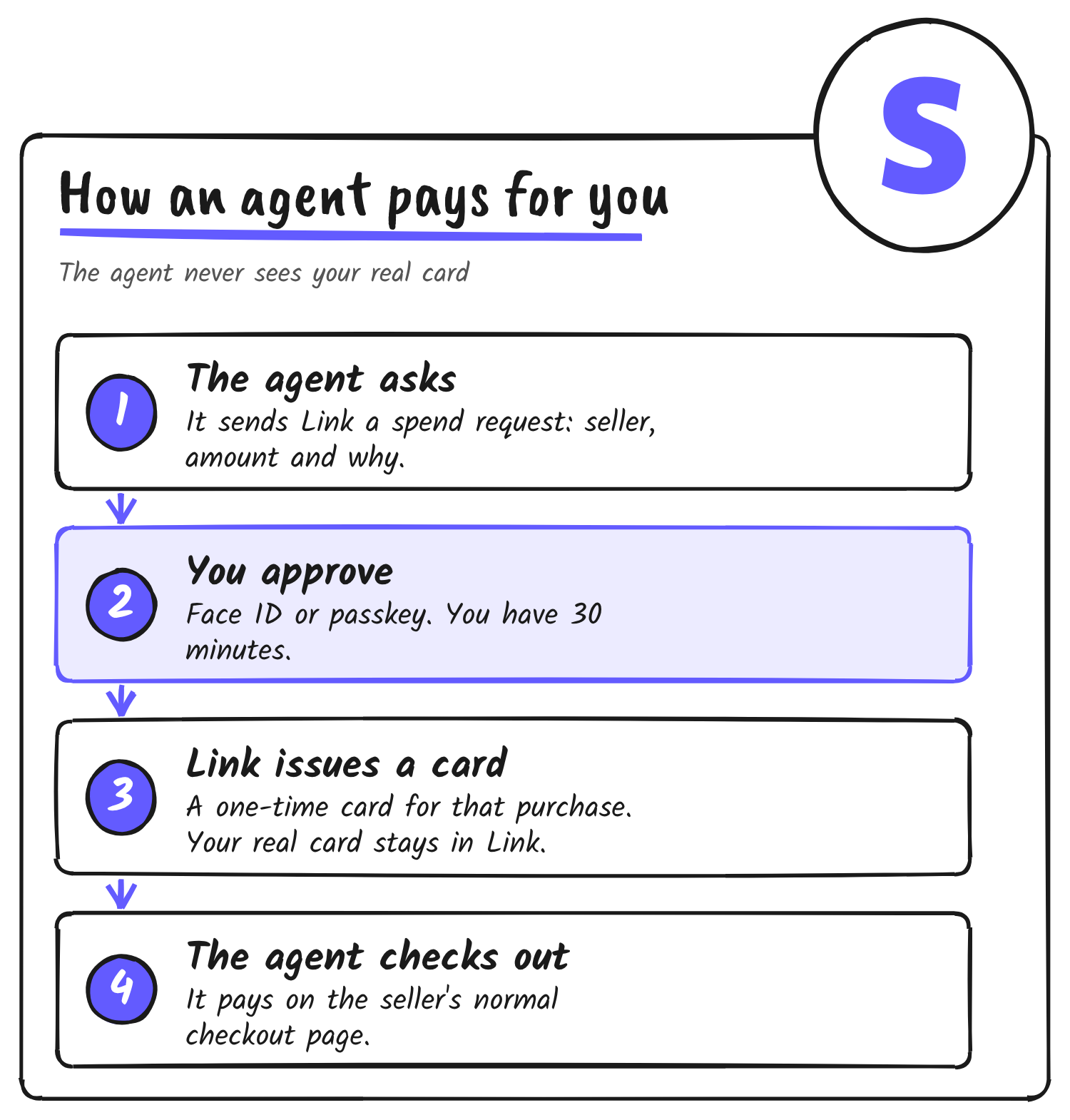
Stripe’s 80x measures that wallet’s daily spend, averaged over seven days and indexed to its 1 September level. The index reached 7,982 on 19 November, where 1 September is 100. Stripe hasn’t published dollar figures, order counts or user numbers, so the multiple has no stated base.
80x
Daily spend on 19 November against 1 September
2x
Growth in the last month
43%
Share of dollars on airfare, travel and lodging
56%
Early buyers who made a second purchase
Terms used here, and where the wallet works
- Spend request
- The record an agent files with Link before a purchase: the seller, the amount and why. The shopper approves it, and Link then issues a credential.
- One-time card
- A virtual card Link issues for a single approved purchase. Link’s docs say it works on standard web checkout forms, including sellers that don’t use Stripe.
- Shared Payment Token
- A scoped credential for sellers that accept Stripe payments through the Machine Payments Protocol.
- Seven-day rolling average
- Each day’s figure is the mean of that day and the six before it, which smooths out weekends.
- Index, 1 September = 100
- Every point on Stripe’s chart is a percentage of the 1 September level, so 7,982 means 79.8 times that level.
Link’s FAQ says agent payments are open to Link users in the US, Canada, Japan, Mexico, Singapore and Australia. Stripe’s Muse announcement covers US consumers. Link’s support page says each shopper’s spending limit varies with their purchase history and the agent they use, resets daily and can’t be raised.
How Link added agents
Stripe added agents one at a time. Grok Bot and Instinct came first, in August, according to Payments Dive. Muse followed on 8 September, and by 21 October Stripe said Link powered more than 200 personal agents.
| Date | What happened | Source |
|---|---|---|
| 29 April | Stripe launches Link’s wallet for agents, built on its Issuing for agents. | Stripe blog |
| August | Grok Bot and Instinct start using the Link wallet. | Payments Dive |
| 8 September | Meta launches Muse, and Stripe says Meta integrated Link’s wallet for agents. | Stripe newsroom, Meta |
| 29 September | Stripe says agentic purchases with Link rose 38x over the past month, and adds purchase protection with Muse first. | Stripe blog |
| 21 October | Stripe and Anthropic announce Link in Claude Duet, and Stripe says Link powers more than 200 personal agents. | Stripe newsroom |
| 19 November | Stripe’s seven-day average reaches 7,982% of its 1 September level. | Stripe chart |
| 20 November | Tedeschi publishes the data. | Tedeschi on X |
| 21 November | Moore posts her explanations and the Muse chart. | Moore on X |
Level for five weeks, then double
Stripe’s 29 September blog post said agentic purchases made with Link had grown 38x over the previous month. On Stripe’s chart the spend line sits near 3,800 at that point, which fits. It then stays between roughly 3,700 and 4,000 until early November before climbing to 7,982. That makes the gain since late September about 2.1 times, in line with Tedeschi’s line that spend doubled in the last month.
Tedeschi’s article gives no reason for the jump. Moore’s explanation is holiday travel, and the chart is consistent with it: the travel band widens from early November, and travel is the largest category in the latest week.
Where the dollars went
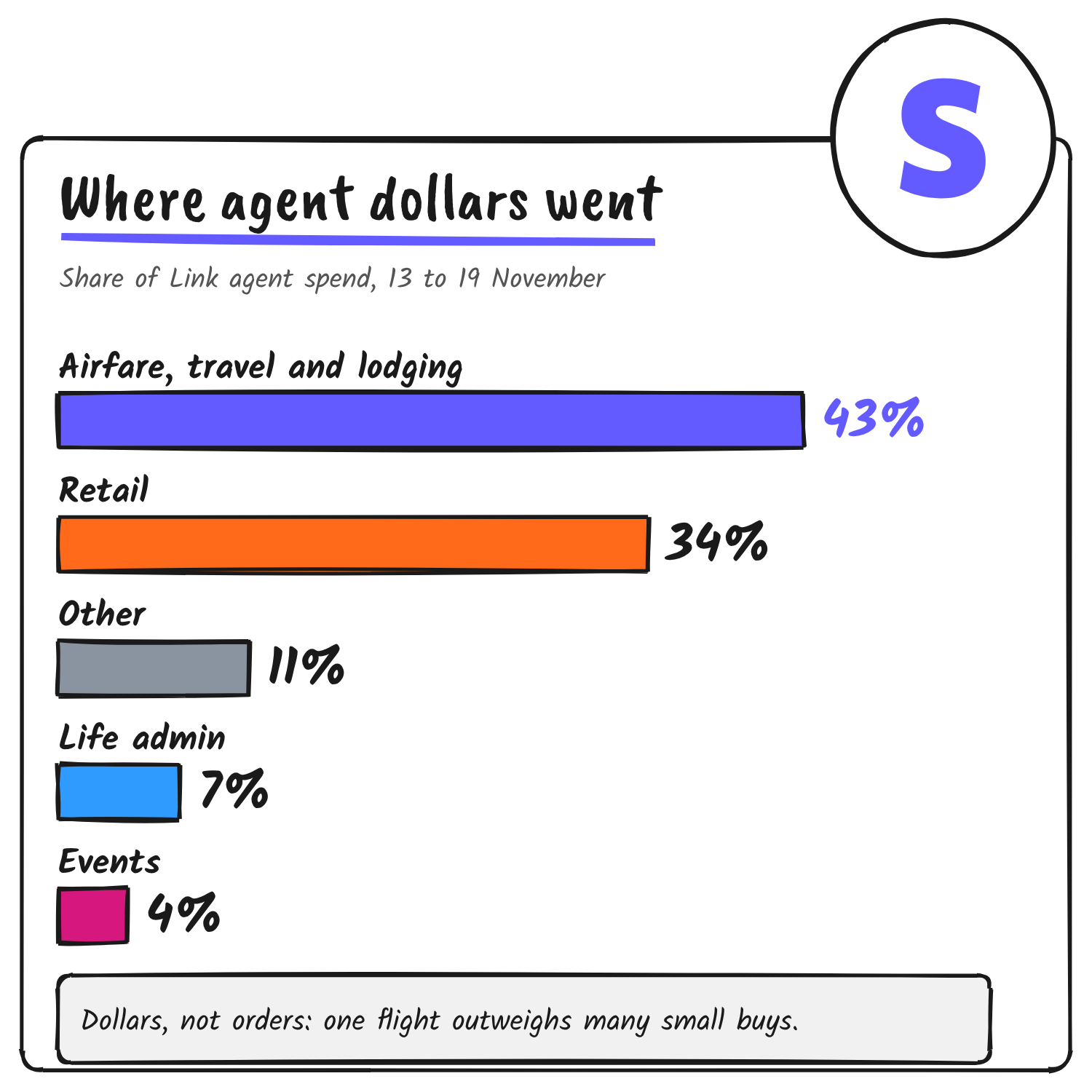
Last week, Stripe’s chart puts airfare, travel and lodging at 43% of agent spend, retail at 34%, life admin at 7%, events at 4% and everything else at 11%. Life admin covers rent and utilities, financial services and government fees. These are shares of dollars, not orders, so one flight ticket weighs more than a basket of small purchases. Tedeschi’s text says a quarter of spend went to other categories, while the three slices outside travel and retail add up to 22%.
Retail is spread across several kinds of shop. Home furnishings, electronics and appliances take 22.9% of retail dollars, ahead of specialty retail and general merchandise at 17.2% each. Groceries and beverages are 3.9% of retail, which works out at about 1.3% of all agent spend by my arithmetic.
| Retail category | Share of retail dollars |
|---|---|
| Home furnishings, electronics and appliances | 22.9% |
| Specialty and miscellaneous retail | 17.2% |
| General merchandise | 17.2% |
| Clothing, shoes and jewellery | 13.7% |
| Other or unclassified | 12.7% |
| Wholesale supplies | 6.5% |
| Vehicles and parts | 5.9% |
| Groceries and beverages | 3.9% |
Who comes back
Tedeschi’s article says more than half of consumers who make one agentic purchase come back for a second. Stripe’s chart sharpens that. Of customers whose first agentic purchase came before 15 October, 56% made a second one by 15 November, and each purchase made the next likelier: 63% after two, 73% after five and 78% after nine.
More than half of consumers who make one agentic purchase come back to make at least a second, typically in the same spending category.
Ernie Tedeschi, Stripe chief economist, on X, 20 November 2026
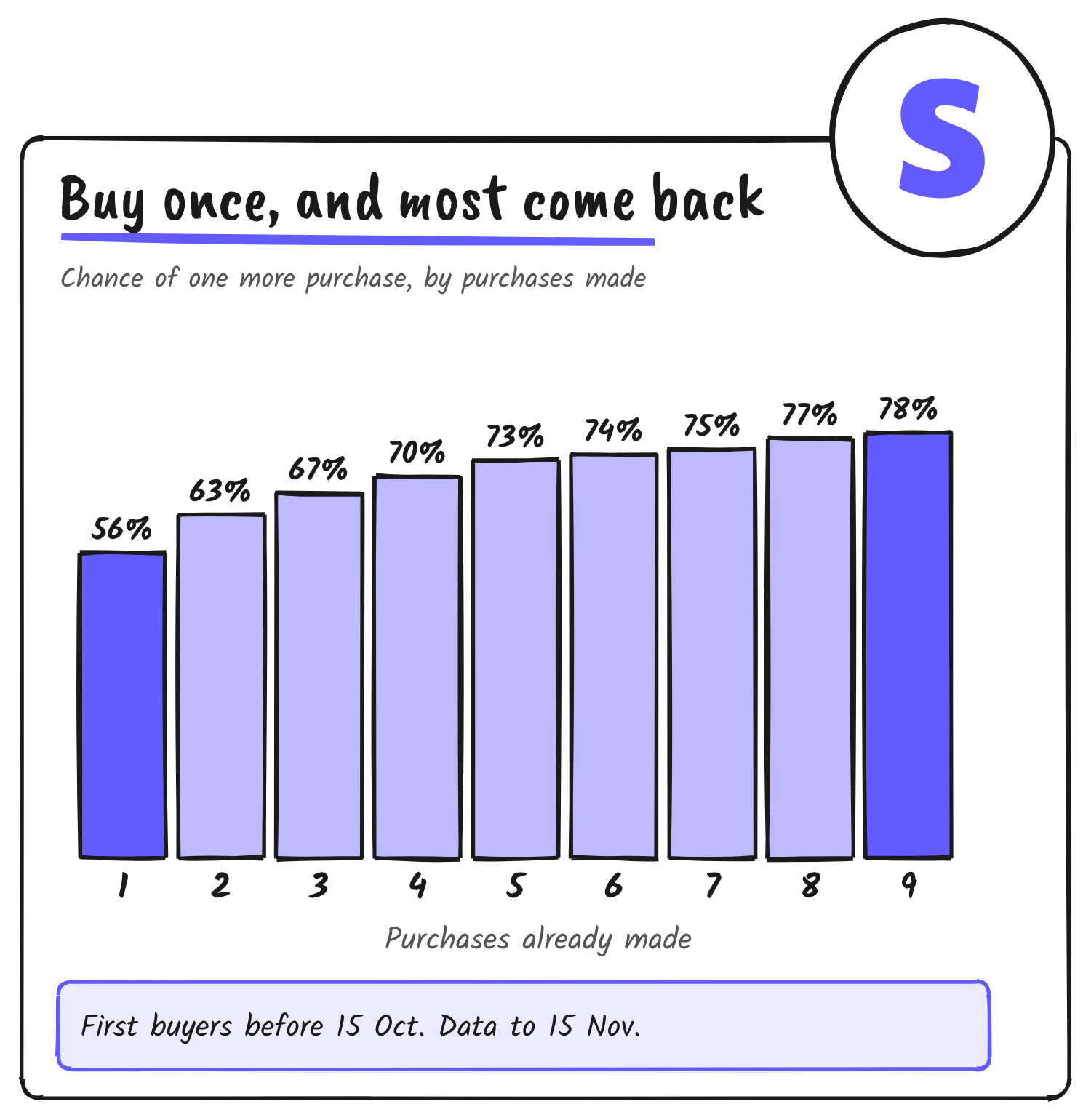
Moore wrote that 56% of spenders have now made more than one purchase and that 17% have made five or more. The 56% is Stripe’s number, but Stripe measures it only for customers whose first purchase came before 15 October, which leaves each of them at least 30 days to buy again. It isn’t a share of all spenders. Her 17% isn’t on the chart. It matches the chain of odds on it: 56% times 63% times 67% times 70% is 16.5%, so about 17% of that early group reached a fifth purchase.
Check the 17% yourself
Reaching a fifth purchase means getting past the first four steps on Stripe’s curve, so multiply the four chances together.
0.56 x 0.63 x 0.67 x 0.70 = 0.165Muse’s part
Moore’s other reason is distribution. Meta launched Muse on 8 September, and it was the first agent to carry Link’s purchase protections, which cover damaged or lost items, price drops and no-fee returns on eligible purchases. On Meta’s 21 October earnings call, Mark Zuckerberg said more than 10 million people in the US and Canada had set up Muse and about 25% use it daily, TechCrunch reported. He also said over a quarter of the engaged users who shopped through Muse had an average purchase size above US$200.
The chart Moore attached comes from Sensor Tower and shows Muse’s daily and weekly users by week from early September. Read against its axes, daily users reach about 4.5 million in the week of 9 November, with a lighter final bar at about 4.8 million, and weekly users pass 10 million. Her caption says daily users are above 5 million and weekly users are nearing 10 million. The chart shows neither. Sensor Tower’s earlier estimate of 2.5 million US daily users on 16 October, reported by TechCrunch, sits where the chart’s October bars do.
Muse’s daily users grew from roughly 2.5 million in mid-October to about 4.8 million in mid-November, close to the doubling in Link spend over the same month. Stripe doesn’t publish spend by agent, so the link between the two is Moore’s reasoning, not Stripe’s data. I covered another Muse shopping connector in Muse’s Walmart connector sends questions to Sparky.
What the figure leaves out
Stripe’s number covers Link’s agent wallet and nothing else, so an agent that pays another way isn’t in it. Hark’s card, which Stripe also runs, is a separate product from the Link wallet.

Each Link purchase today needs the shopper’s approval. Stripe said on 29 September that it plans spending controls that would let an agent finish a task within a budget without a tap for each purchase.
We plan to introduce spending controls that let consumers set an agent’s budget and allow the agent to complete a task on their behalf—without having to approve each individual transaction.
Stripe, “Helping personal agents shop more intelligently and reliably with Link”, 29 September 2026
Link’s agents page already lists approving a budget as an option next to approving each amount. Tedeschi wrote that Stripe will keep tracking the data through Black Friday and Cyber Monday and plans more updates. Those fall on 27 and 30 November in the US.
Sources
- The agentic story on the eve of the 2026 holiday season, Ernie Tedeschi, Stripe, on X
- Olivia Moore, a16z, on X
- Giving agents the ability to pay, Stripe
- Helping personal agents shop more intelligently and reliably with Link, Stripe
- Stripe helps Muse, Meta’s new personal AI agent, shop across the internet with Link, Stripe
- Stripe and Anthropic help entrepreneurs run their business inside Claude Duet, Stripe
- Link agent wallet FAQ and documentation, Link
- Link agent wallet FAQ, Link support
- Introducing Muse, Meta
- Meta says Muse has over 10M users, with shopping a top activity, TechCrunch
- Meta’s Muse hits 10M US downloads in 40 days, TechCrunch
- Stripe’s wallet embraces AI bots, Payments Dive
Discover more from Sulat AI & Tech News
Subscribe to get the latest posts sent to your email.