Hark Labs has launched Hark Card, a prepaid Visa debit card that pays 5% cash back on purchases, including the ones Hark’s AI agent makes for you. Jeff Weinstein, who works on product at Stripe, posted on 16 November that Hark’s cash back is “powered by @stripe”. Hark says the card is limited to 10,000 US members.
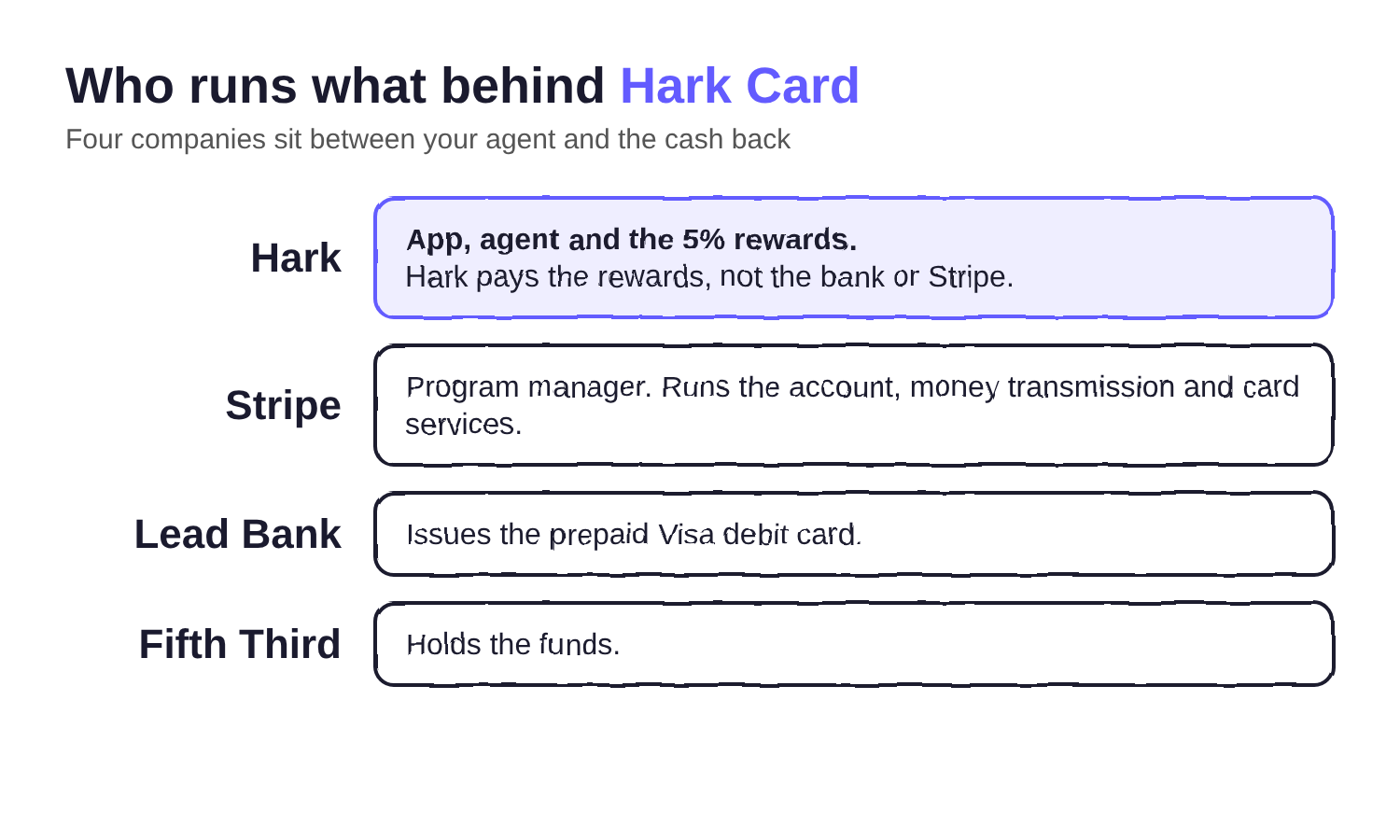
Hark’s own documents show what Stripe’s part is. Stripe is the program manager behind the card and runs the account that holds your money. The 5% is a separate thing: Hark’s rewards terms say Hark offers and pays it, and that neither the card issuer nor Stripe does.
Hark—a fast growing personal assistant agent—now comes with 5% (!!) cash back on agentic purchases, powered by @stripe.
— Jeff Weinstein (@jeff_weinstein) November 16, 2026
What the card is
Hark Card is a prepaid debit card. Lead Bank, a state-chartered bank, issues it under a licence from Visa. The cardholder terms say it’s not a credit card, isn’t linked to any checking or savings account, has no overdraft or credit feature, and that funds in the card account aren’t FDIC insured. Hark’s card page says Hark partners with Stripe for money transmission and account services, with funds held at Fifth Third Bank. The terms name Stripe, LLC as the program manager that processes transactions and handles customer service for Lead Bank.
Hark says the card gives each merchant a unique card number, and that its assistant can use the card to return products, manage subscriptions and hunt for lost or hidden funds. Fees are low. Hark’s fee page lists $0 for monthly, per-purchase, inactivity and customer service charges, and $0 to add money from a bank account or withdraw to one. Foreign transactions cost 1% of the amount, plus any Visa charges. ATM withdrawals and cash reloads aren’t available.
Access is limited. Hark’s post on X says the card is for 10,000 US-based members and tells people to ask Hark for it or join the waitlist. The card page says it’s invitation only.
How the 5% works
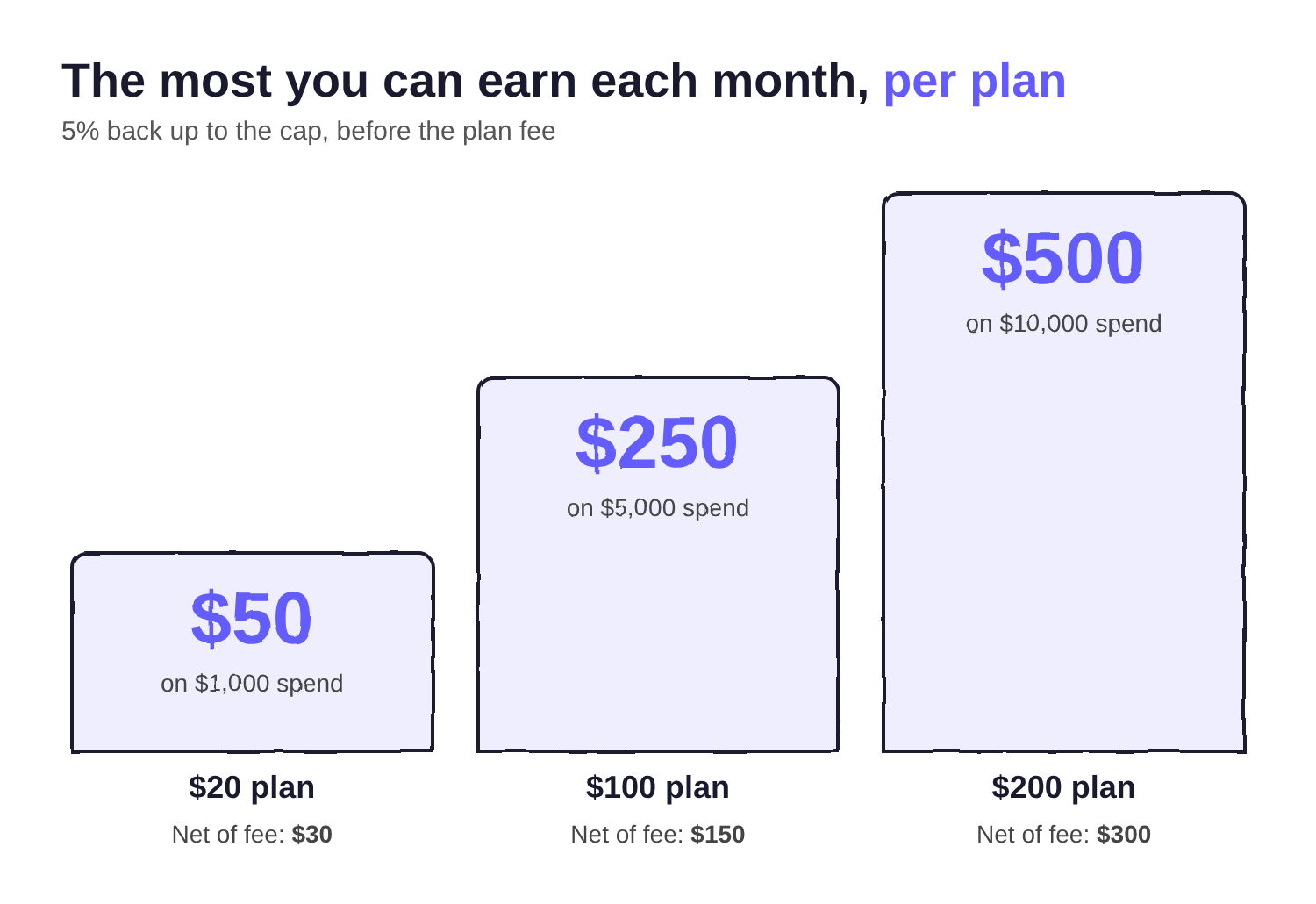
Only paid Hark plans earn cash back, and the free plan earns none. The rewards terms set a monthly cap on the purchases that earn 5%, counted by calendar month on the day each purchase settles. The terms list the $20 and $100 plans. The card page adds a $200 plan with a $10,000 cap, and the last row below comes from there.
| Plan, per month | Purchases that earn 5% | Most cash back | After the plan fee |
|---|---|---|---|
| $20 | $1,000 | $50 | $30 |
| $100 | $5,000 | $250 | $150 |
| $200 | $10,000 | $500 | $300 |
Plan fees earn no cash back, so a plan only pays for itself if you spend enough. On Hark’s published rates, a $20 plan needs $400 of eligible spend a month for 5% to cover the fee, the $100 plan needs $2,000, and the $200 plan needs $4,000.
The rate is a promotion. The rewards terms say the earn rates are promotional through 31 December 2026, and that after that the rate is the one shown in the app when you buy. Hark’s terms don’t give a figure for 2027.
Cash back doesn’t land in your balance by itself. It builds up in a separate rewards balance, becomes available once the purchase settles, and you redeem it into your Hark Wallet in the app. Spending redeemed rewards earns no new cash back. Refunds claw back the cash back they earned, and unredeemed rewards are forfeited if your account closes.
What doesn’t earn cash back
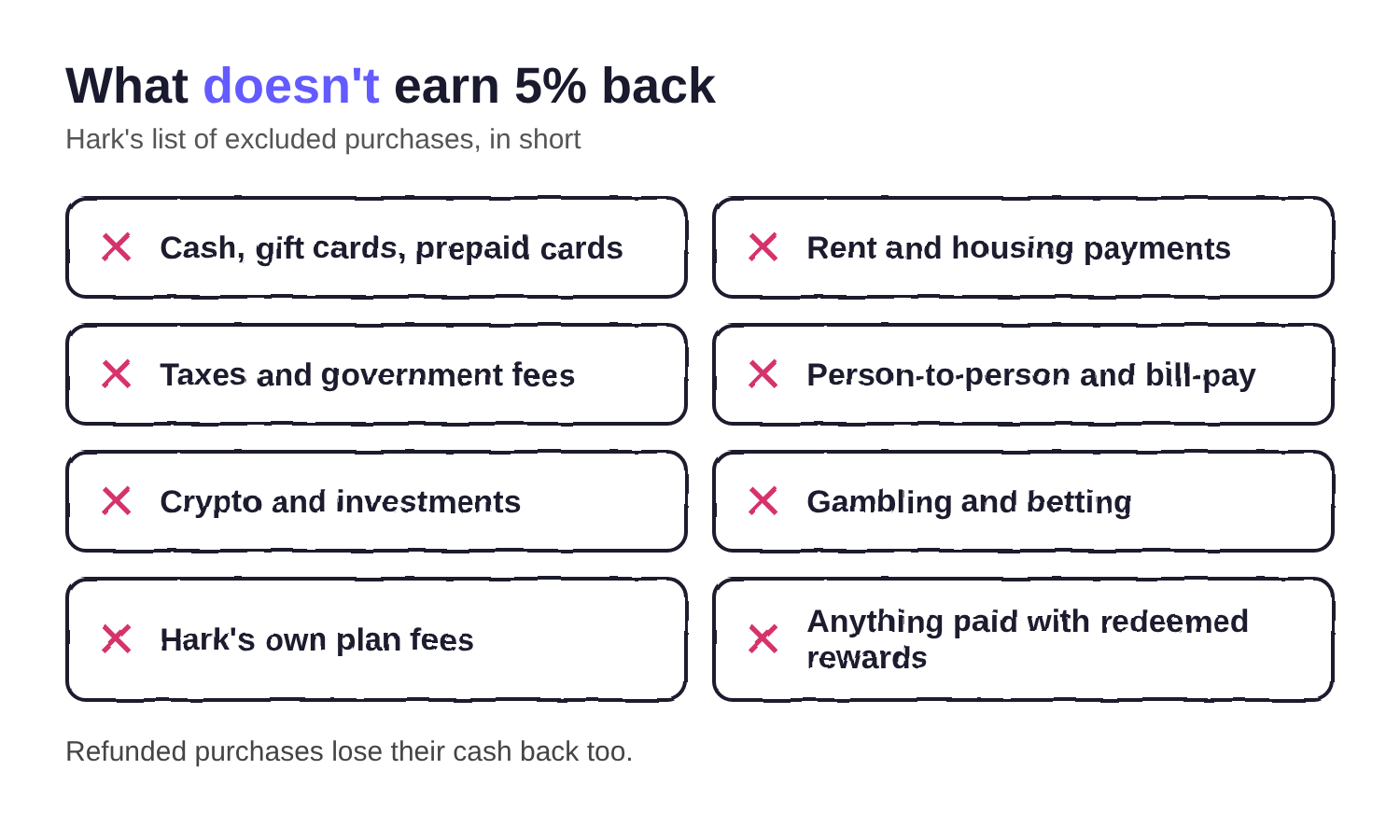
Hark’s terms exclude cash and cash equivalents, including ATM withdrawals, wires, money orders, gift cards, prepaid cards and wallet reloads. They also exclude rent and other housing payments, taxes, fines and government services, person-to-person payments and bill-pay, securities and crypto, gambling, jewellery and precious metals, and the fees you pay Hark.
Hark decides eligibility mostly by the merchant category code that the merchant or its payment processor assigns, which Hark says it doesn’t control. A miscoded merchant can mean a purchase doesn’t earn what you expected, and Hark isn’t required to fix it. Hark can also change rates, caps and excluded categories, and says it gives 30 days’ notice of changes that cut what you earn.
When the agent does the buying
Purchases Hark’s agent makes for you count as eligible purchases and earn the 5%. They also fall under the card’s liability rules. The cardholder terms say you’re responsible for use of the card by anyone you permit, and that this includes “agents”, which the terms define broadly as software or other automated technology acting as your delegate. They add that purchases made by Hark’s own agent are subject to Hark’s terms, and that nothing in the card terms limits any extra protection Hark gives you for them.
For a lost or stolen card, the terms say you can lose no more than $50 if you report it within two business days of learning about it, and up to $500 after that. Hark’s rewards terms add that disputing an agent purchase you authorised, to keep both the goods and the cash back, counts as abuse that can cost you your rewards or your account. Hark says it checks in with you before doing something that needs your approval.
Hark, founded by Brett Adcock, released Hark Pro widely on 6 October. You can request a Hark Card invitation at harkcard.com.
Sources
- Hark Card, Hark
- Hark Card rewards terms, Hark Labs
- Hark prepaid debit card terms, Lead Bank
- Hark Card fees, Hark
- Hark’s launch post on X
- Jeff Weinstein’s post on X
- Hark releases an AI personal assistant with a focus on privacy, TechCrunch
Discover more from Sulat AI & Tech News
Subscribe to get the latest posts sent to your email.