Anthropic’s Applied AI team says many enterprise agents work better as one agent loop with skills and tools than as an orchestrator with specialist subagents, and it names three cases where a subagent still earns its place. Diane Sarkis wrote the guidance, published on 22 October on Claude’s resources site.
A subagent is an agent with its own context window, tools and instructions that a coordinator hands work to. The team says it recently found a pattern of enterprise deployments that benefited from folding routers, planners and domain subagents into the main agent loop. In its comparisons across several enterprise deployments, the post says, a single agent with skills frequently outperformed both a one-prompt-for-everything design and a subagent design on quality, and often at lower cost and latency per task.
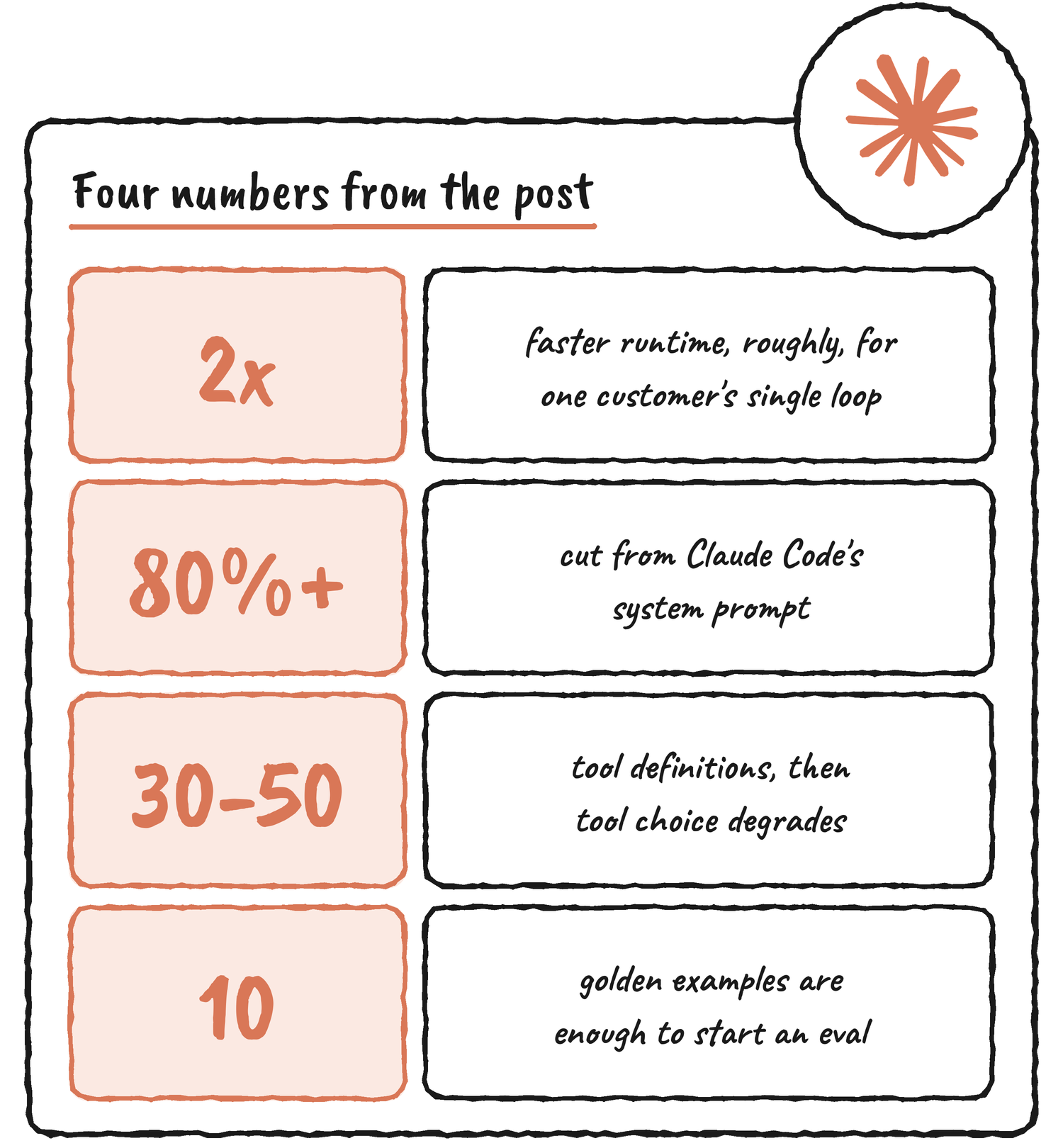
The post gives two examples. One company found that the dozen specialist subagents inside its customer-facing agent made a consistent on-brand experience hard to keep and added latency that hurt users. A customer that compared its multi-agent harness with a single agent loop saw a roughly 2x faster runtime from the loop.
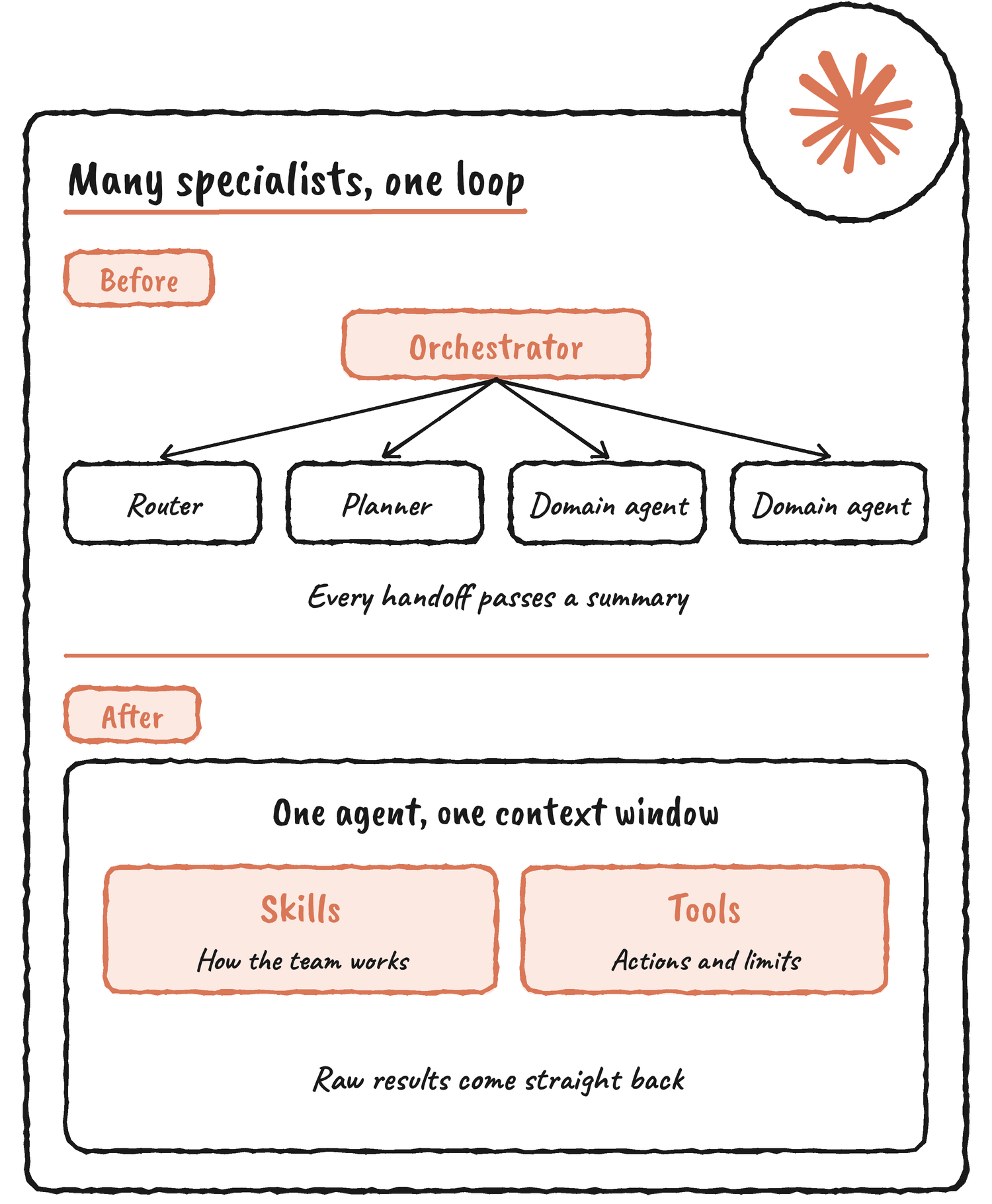
Why teams end up with too many subagents
Anthropic says the usual route is that each team builds its own agent and a central platform team adds an orchestrator on top, so the architecture copies the org chart. It calls that Conway’s law, the idea that a system’s design mirrors the structure of the organisation that built it. The post lists five problems: context lost in the back and forth between agents, subagent sprawl with hundreds of overlapping subagents and no owner, “the Frankenprompt” where every team adds a sentence to the system prompt and the rules start to conflict, local evals that nobody owns end to end, and added latency.
The alternative it recommends is progressive disclosure. The agent sees short descriptions of skills and tools, and each is loaded in full only when it’s needed. Anthropic says it used the same approach to cut Claude Code’s system prompt for more advanced models by over 80%. The post also says that starting with Opus 4.5, models became capable of managing far more in a single loop than most teams expected.
When Anthropic still uses subagents
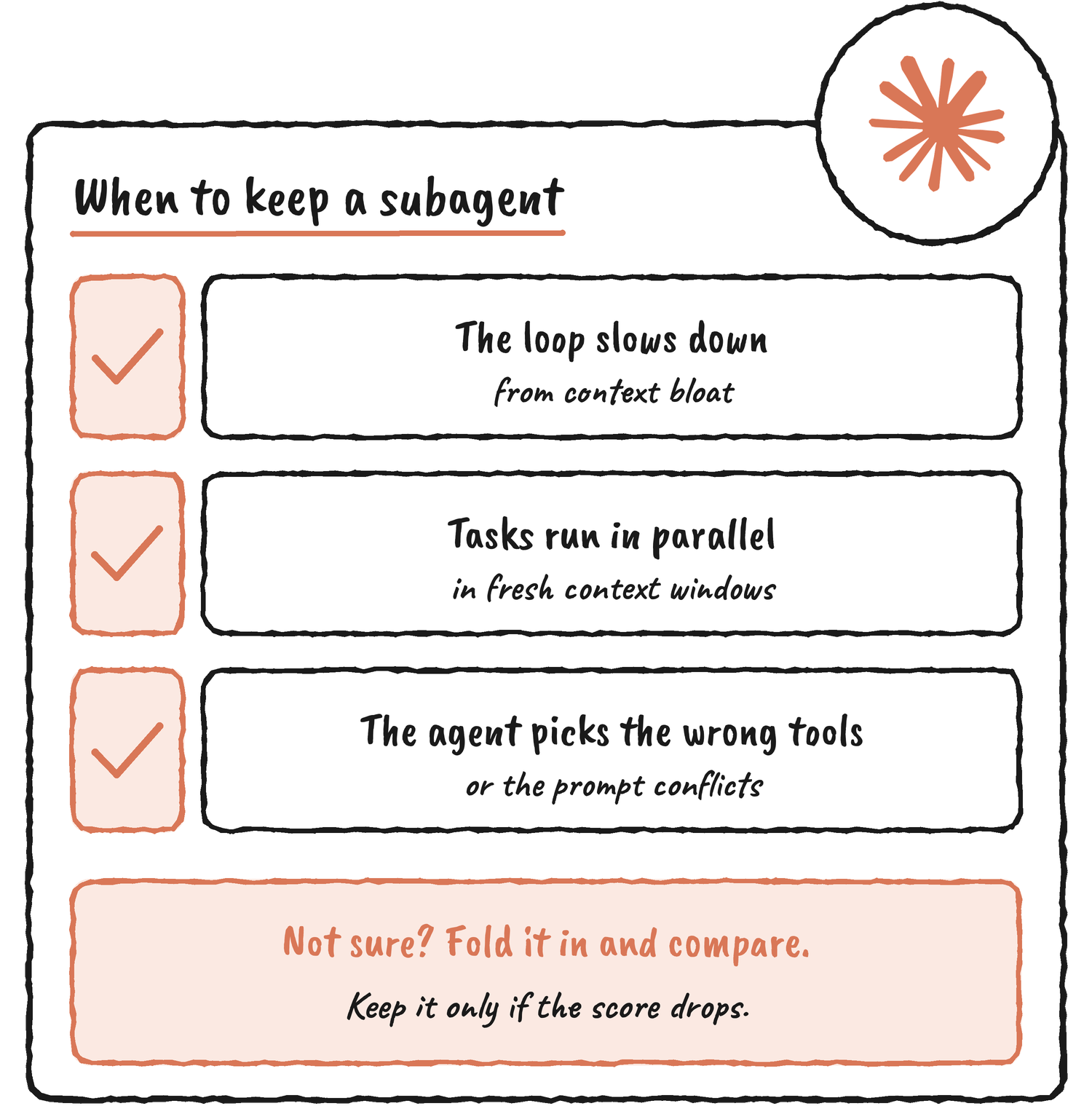
The post says subagents still have their place, including at the research frontier, and gives three conditions for keeping one:
- A single agent loop hits measurable performance degradation from context bloat.
- Multiple tasks need to run in parallel, each with a fresh context window that can be discarded afterwards.
- A single agent struggles to choose the right tools, or the system prompt holds conflicting instructions.
If you do split work between agents, the post says to divide by context. Each subagent gets a piece of work that needs little from the rest of the system and hands back a compact result, such as an independent research path or a black-box verification. Splitting by problem type leads to what the post calls a “telephone game”, with each handoff degrading fidelity.
How to fold subagents in
The target design is one model and one context window running an open-ended tool loop, with limits such as turn and cost budgets and write gates set in the harness, the code that runs the loop. On its first turn the model puts a plan into its own context, then rewrites that plan as tool results come back. Anthropic says that’s the main change from the orchestrator setup, because the model that writes the plan is the one carrying it out.
The post lays the move out in four stages:
- Build an eval first: one shared end-to-end set owned by a central team, plus small sets shipped by the team that owns each skill. The post says even 10 golden examples is enough to start.
- Merge subagents that chain on each other’s output, touch the same data or are often called together, starting with the most used.
- Keep any remaining subagent but call it as a tool, so the main agent keeps the conversation with the user. Anthropic recommends a full handoff only when the subagent needs to talk to the user directly.
- Fold subagents in one at a time, turning each one’s prompts into skills and its API calls into MCP tools, and compare eval results with and without it.
The post warns that a final score hides what changed. When Anthropic tested the approach on a sample support agent, folding one subagent into another cut latency but broke a process that had been passing: the main agent had the order lookup tool and replied alone, so the shipping specialist was never asked for the delivery date. The break showed up in one run out of two, so the post says to run each task more than once and to include a task for every chain of agents that runs together in production.
| Old piece | New home |
|---|---|
| Ordering and domain procedure | Skills |
| Validation, approval gates and mid-conversation lookups such as memory | Tools |
| Per-user permissions | Each tool checks what the calling user may see or do and returns a plain refusal the model can read |
| Policies, metric definitions and product specs | A search or lookup tool, or reference files inside a skill |
| Cheap, almost always relevant steps such as entity resolution | Code that loads them up front |
Who owns the agent after the move
Anthropic says one small central team should own the system prompt and end-to-end quality and vet every new tool and eval before it ships, while other teams own skills and tools. It recommends tools grouped by user intent, not one per API, because tool choice tends to degrade once the system prompt holds more than 30 to 50 tool definitions, and tool search with deferred loading for the rest. For skills, it points to /skill-creator, which writes and audits skills, and /skill-doctor, which shows what each skill costs and how often it’s used.
Anthropic also published a migration kit that chains its Claude API skills into one guided workflow for assessing a multi-agent system and moving it to a single loop, with a demo you can run on a mock system first. The skills are /claude-api build-eval, which helps create the first eval set; prompt-audit, which flags instructions written for older models; hillclimb, which improves an app against an existing eval, including the folded-versus-kept comparison; and cost-optimize, which proposes savings such as prompt caching.
The post doesn’t publish scores from its enterprise comparisons, and the 2x runtime figure comes from one unnamed customer. Anthropic says its advice will keep changing as models do, and puts the principle as “measure, change one thing at a time, and keep what holds up.”
Sources
- Building agents: When to fold subagents into your main agent loop, Claude
- single-agent-loop-kit, Anthropic on GitHub
- The new rules of context engineering for Claude 5 generation models, Claude
Discover more from Sulat AI & Tech News
Subscribe to get the latest posts sent to your email.