WordPress core has pulled the Secrets API out of WordPress 7.2. Peter Wilson committed the revert as changeset 65538 at 1:27 pm NZDT on 17 November (00:27 UTC), which takes out the API that was meant to let plugins store API keys encrypted instead of as plain text. It landed after the WordPress X account had posted, on 16 November, that 7.2 adds it.
That post links the WordPress Developer Blog’s November roundup, published 13 November, where one section is headed “The Secrets API lands in 7.2”.
WordPress 7.2 adds a Secrets API, so plugins can encrypt API keys at rest instead of leaving them in the options table as plain text. The November developer roundup walks through that change and others you can test before the December 8 release. https://t.co/5meylw4S0Q
— WordPress (@WordPress) November 16, 2026
What the revert says
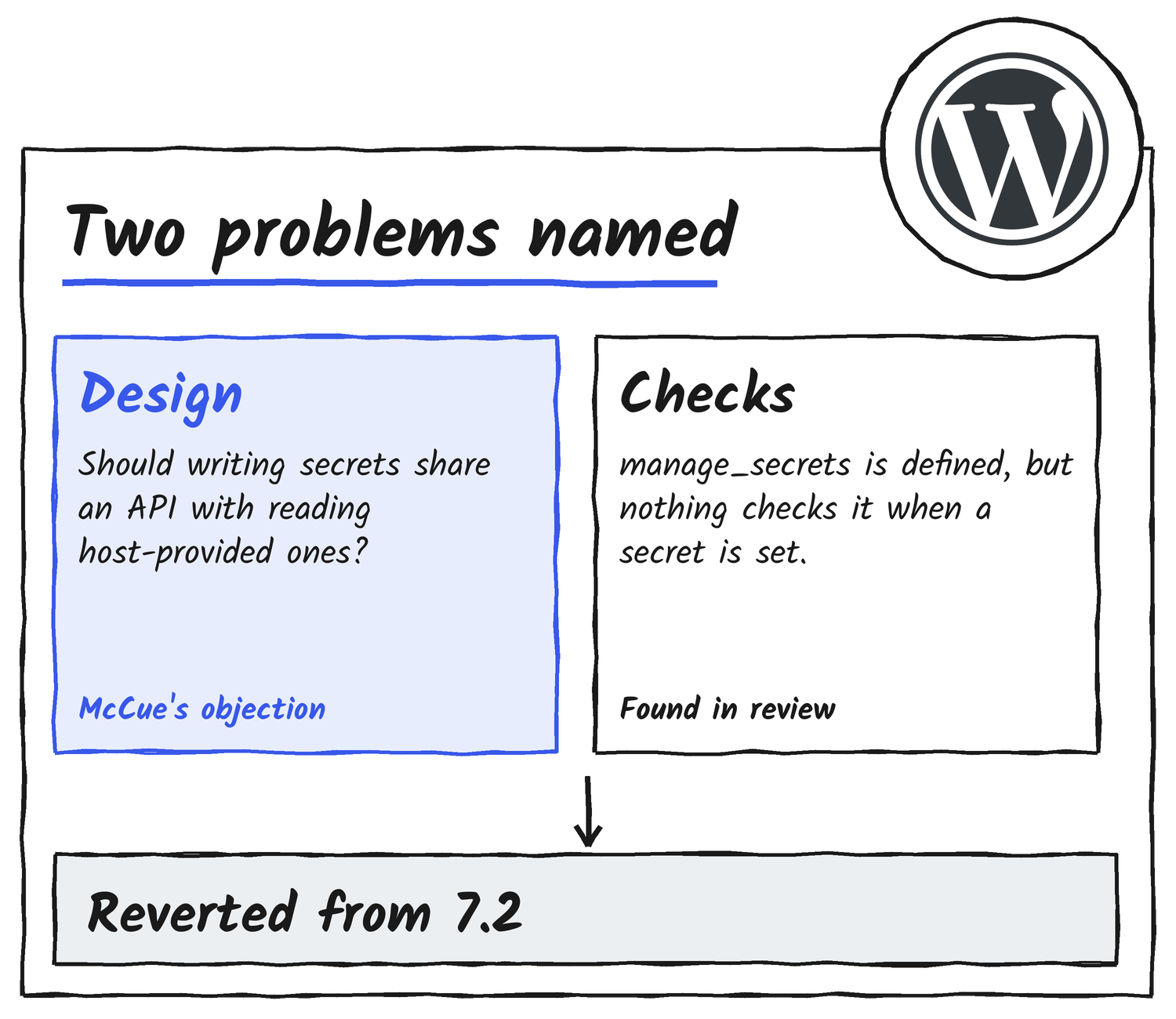
Wilson’s commit message gives two reasons. The first is feedback on the announcement post, which raised questions about the API’s design, including whether writing secrets belongs in the same API as reading secrets a host provides. The second is that further review found the manage_secrets and manage_network_secrets capabilities aren’t checked when secrets are set. Rather than rework the API late in the release cycle, the message says, core reverted it so the design can be revisited. Wilson and Eric Mann, who wrote the API, are both credited.
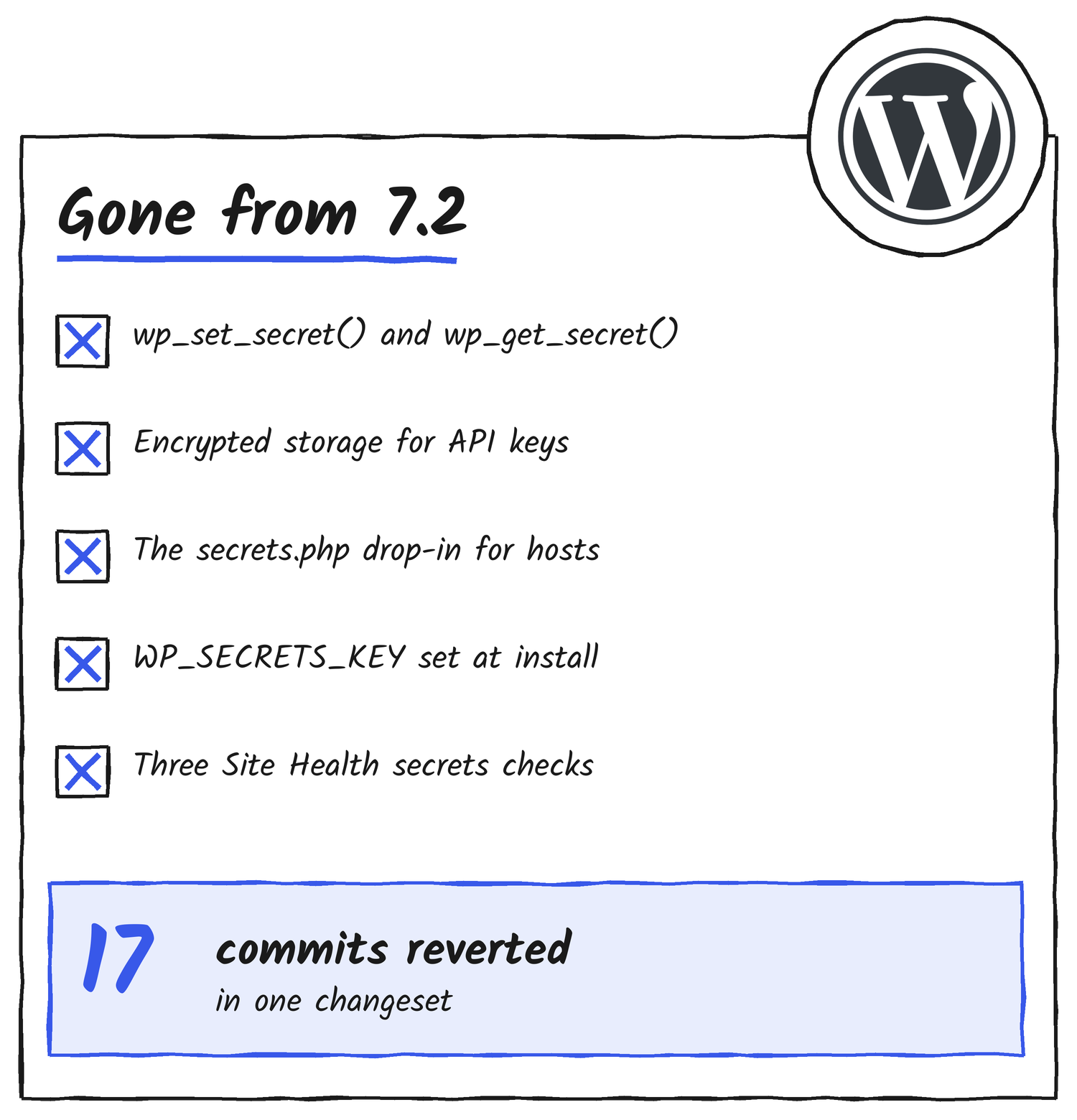
The changeset undoes 17 earlier commits. That takes out the wp_set_secret() and wp_get_secret() functions and the encrypted storage behind them, the secrets.php drop-in that hosts could use to plug in their own storage, the installer step that generated the WP_SECRETS_KEY encryption key, and three Site Health checks.
How the objections built up
Mann published the developer note on 11 November, and the objections came in its comments. Dates here follow the UTC stamps on the posts. On 12 November, Ryan McCue, who created the WordPress REST API, called himself “a strong -1 on this feature” and said it should come out of 7.2 until his concerns were resolved. His case was that secrets belong apart from application data and should be managed outside WordPress, so he proposed two APIs: a read-only one for secrets a host provides, and another for data the application stores itself.
Matt Mullenweg replied the next day, “I agree with @rmccue here.” In a second comment he added that it’s a bad time for WordPress to make itself a target for very sensitive data. Mann asked later that day to keep the API in 7.2. His argument was that credentials already sit in plain text in the options table on sites running payment, SMTP or AI plugins, and that backing the API out leaves them undefended for another cycle.
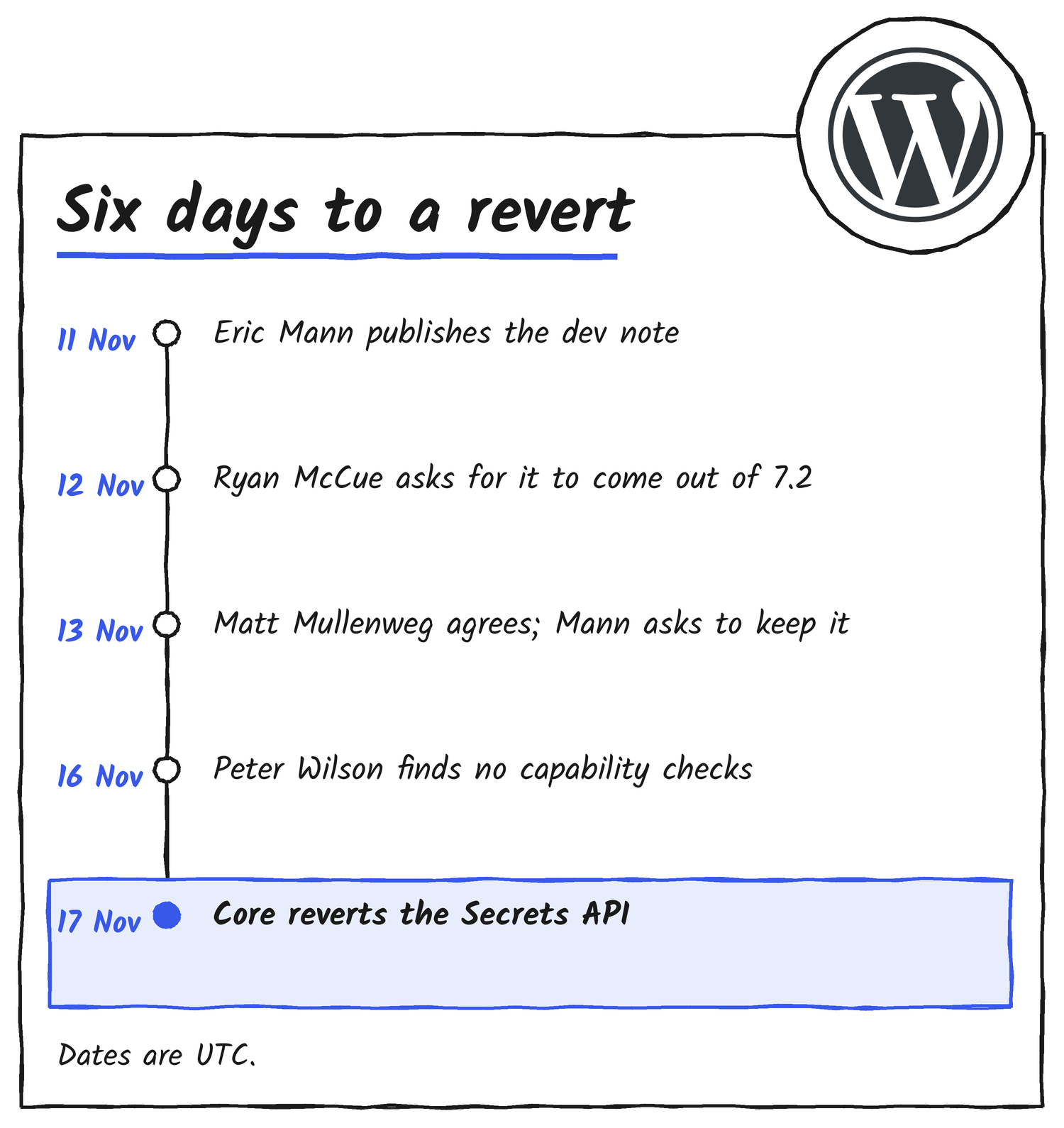
On 16 November, Wilson came back with a specific problem: searching the API’s source for user_can turned up no capability checks. The developer note had said as much, that the functions don’t check capabilities because they have to run from cron and REST requests, and it left the checks to plugins. Wilson’s complaint was that the manage_secrets capability the API added wasn’t used when a secret is set. Mann said more time would help and that he’d still like to target at least 7.3. He had opened a patch to enforce the capabilities, PR 16047, the same day.
What it means for 7.2 and plugins
Release Candidate 1 is due 17 November and the final release 8 December, according to the 7.2 schedule. The rest of the roundup, including SVG admin icons, the new /random/ URL and the end of concatenated admin scripts, isn’t part of the revert.
The revert message doesn’t say what happens to secrets already stored on a 7.2 beta site. Mann’s feature plugin, which the core API was built from, is separate from the commit; in the developer note’s comments he said it has been public since the original proposal, with docs at secretsapi.dev. Core hasn’t named a release for the API, and the history is on Trac ticket 66187.
Discover more from Sulat AI & Tech News
Subscribe to get the latest posts sent to your email.