Alibaba’s QwenWork office agent added 10 models to its model picker on 16 November, including Kimi, GLM, DeepSeek, MiniMax and Step models from outside Alibaba, Leiphone reported. Personal and enterprise standard-edition users can now choose a model for each task, and enterprise administrators can set model access by department, user group or individual member.
The announcement came from QwenWork and was carried the same day by Leiphone, Shanghai Securities News and Times Weekly. Until now QwenWork offered three choices: standard, advanced and Qwen3.8-Max. QwenWork says the change responds to users wanting different models for different jobs, because models differ in quality, speed and cost.
What’s on the menu
The coverage I’ve read names nine of the 10 models: Qwen4-Max, Kimi-K3.1-Pro, GLM-5.3, GLM-5.3-Flash, DeepSeek-V4-Pro, DeepSeek-V4.1-Flash, MiniMax-M3.1-Flash, Step-5-Preview and Qwen3.8-Flash. These are options inside QwenWork. They aren’t a joint release with the companies behind them.
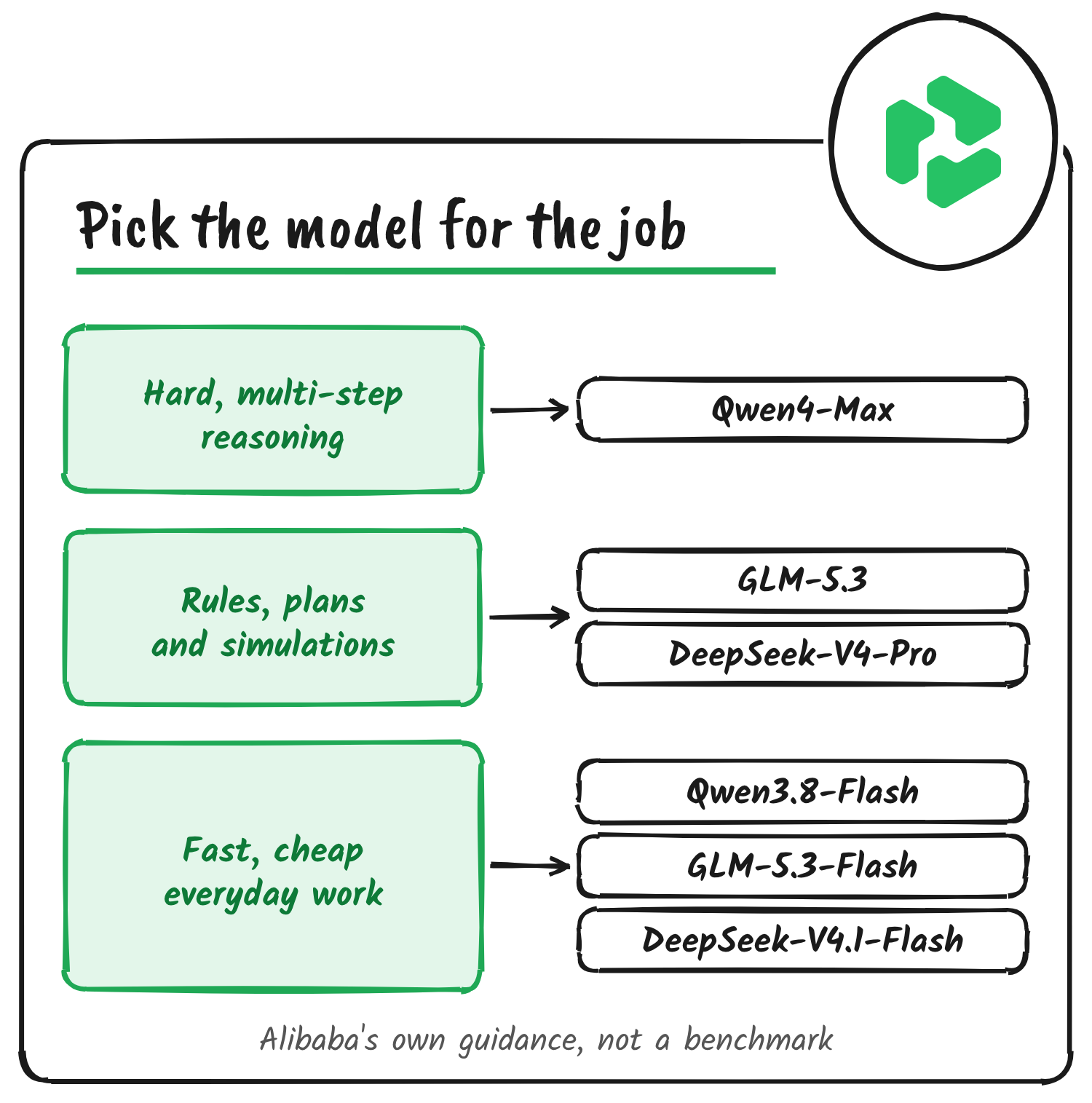
QwenWork also tells users which model to reach for. It recommends Qwen4-Max for tasks that take several steps of complex reasoning, and says the model can produce a usable first version, then expand it as the user gives feedback. Alibaba’s Qwen4-Max release lists QwenWork as one of the places the model is available, and my earlier story on the launch has the specs and pricing.
For rule checking, plan review, simulations and 3D presentations, QwenWork points to GLM-5.3 and DeepSeek-V4-Pro. For fast everyday work such as drafting copy, extracting information and organising content, it suggests the lower-priced Qwen3.8-Flash, GLM-5.3-Flash and DeepSeek-V4.1-Flash. The guidance doesn’t come with a benchmark comparing the models.
QwenWork’s help page says each model uses a different number of credits. The coverage gives no per-model credit costs.
Admins choose who sees what
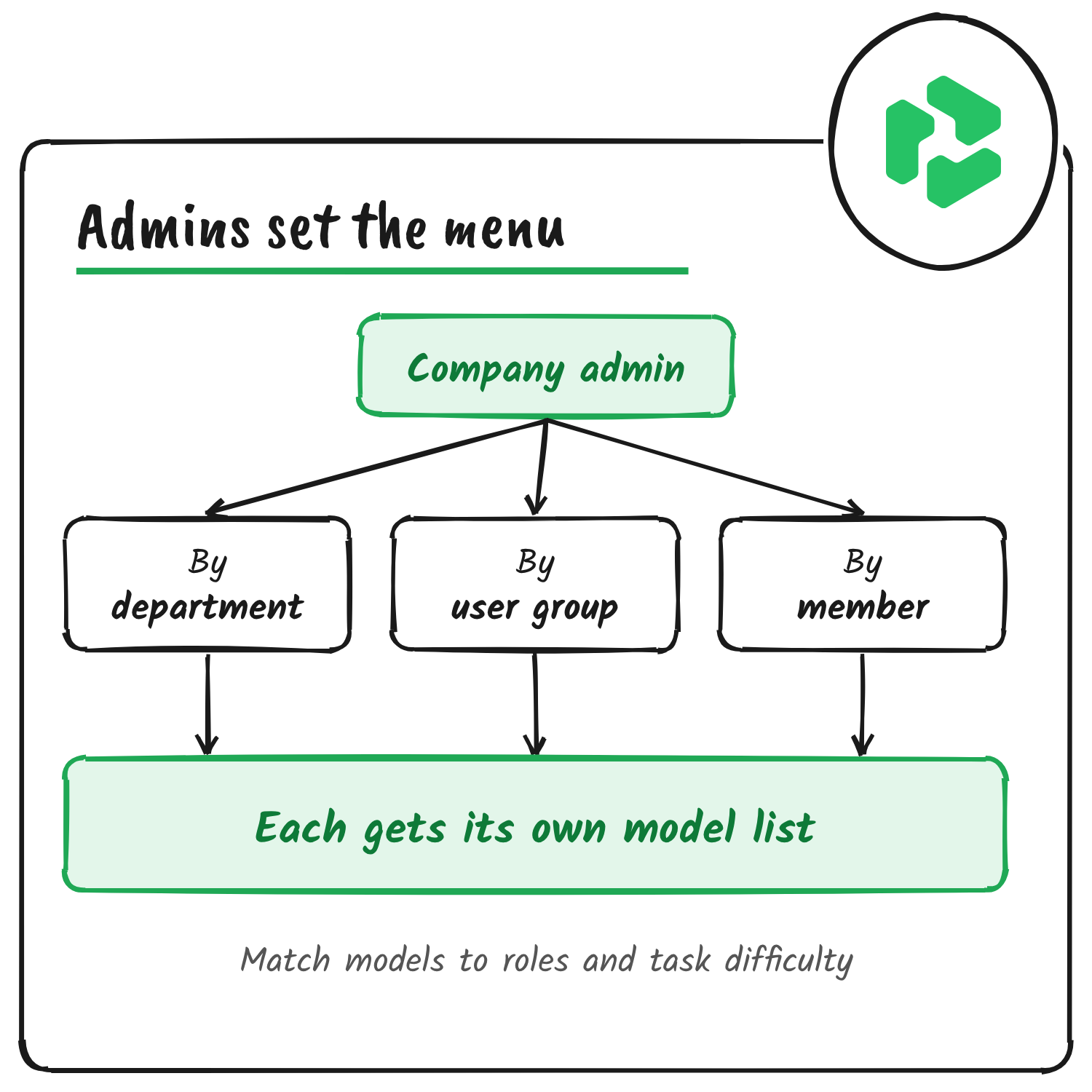
Enterprise administrators can configure model access by department, user group or individual member, QwenWork says. That lets an organisation give different roles different menus, matched to the difficulty of their work, instead of showing every model to everyone.
The second time QwenWork has opened its menu
Wall Street CN reports that QwenWork first added GLM-5.3 and DeepSeek V4 Pro on 14 August. By the evening of 17 August both had disappeared from the product, and the picker was back to Alibaba’s own tiers. Alibaba didn’t explain the removal publicly.
Where it sits among rivals
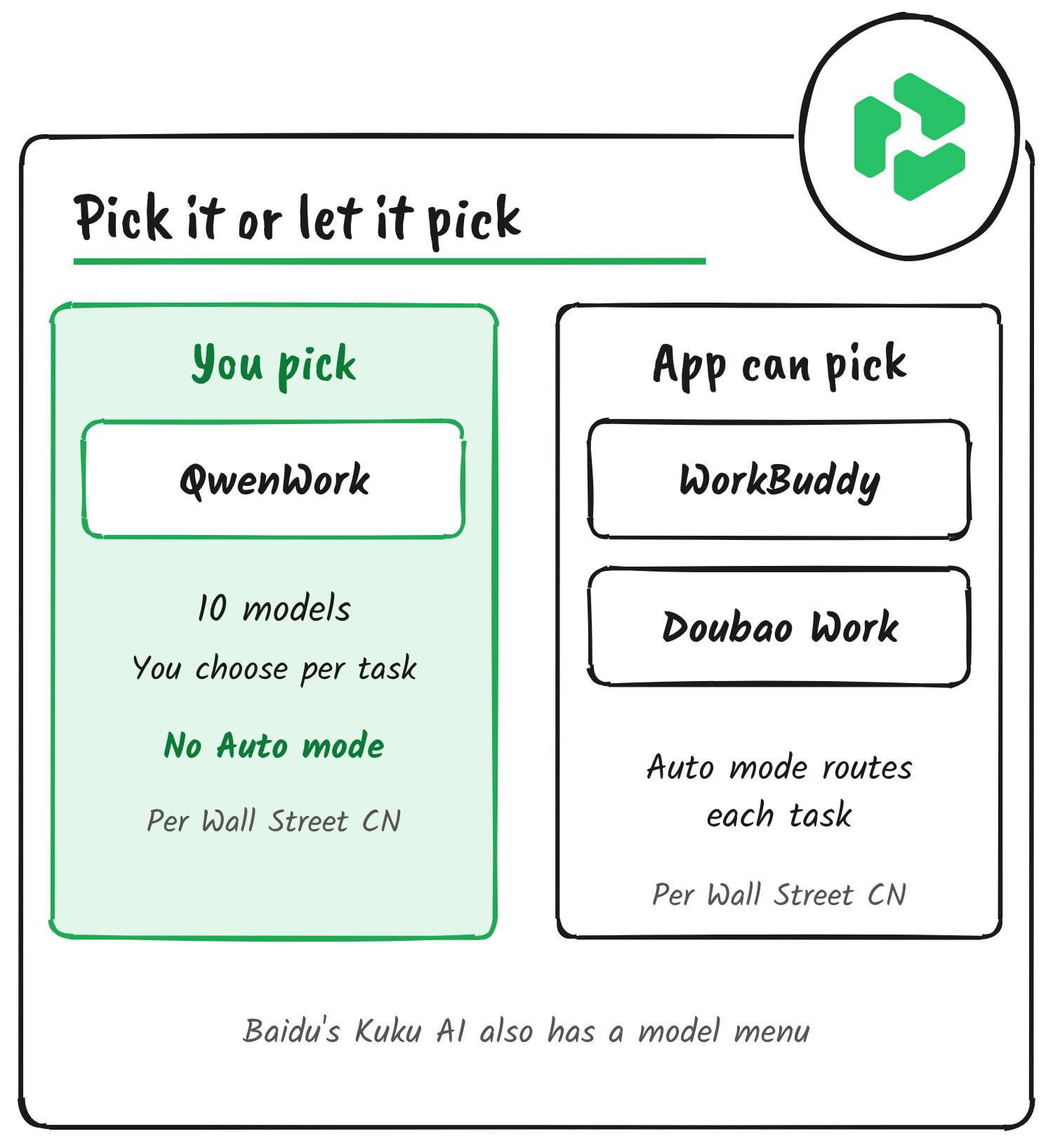
Wall Street CN says ByteDance’s Doubao Work opened third-party models to team and enterprise customers on 29 October and to personal users on 12 November, four days before QwenWork. It also says Tencent’s WorkBuddy already carries Hunyuan, GLM, MiniMax, Kimi and DeepSeek models, and Baidu’s Kuku AI (库库AI) offers Wenxin, DeepSeek, GLM, Kimi and MiniMax. Doubao Work also added 21 profession-specific workbenches this week, which I covered separately.
The same report notes one difference. QwenWork’s announcement stresses that users choose the model themselves and sets no Auto mode, while WorkBuddy and Doubao Work have gone further into Auto modes, where the platform decides which model runs a task.
The update follows QwenWork 2.0, which the client changelog dates to 9 November. The announcement names the personal and enterprise standard editions and doesn’t mention other editions.
Discover more from Sulat AI & Tech News
Subscribe to get the latest posts sent to your email.