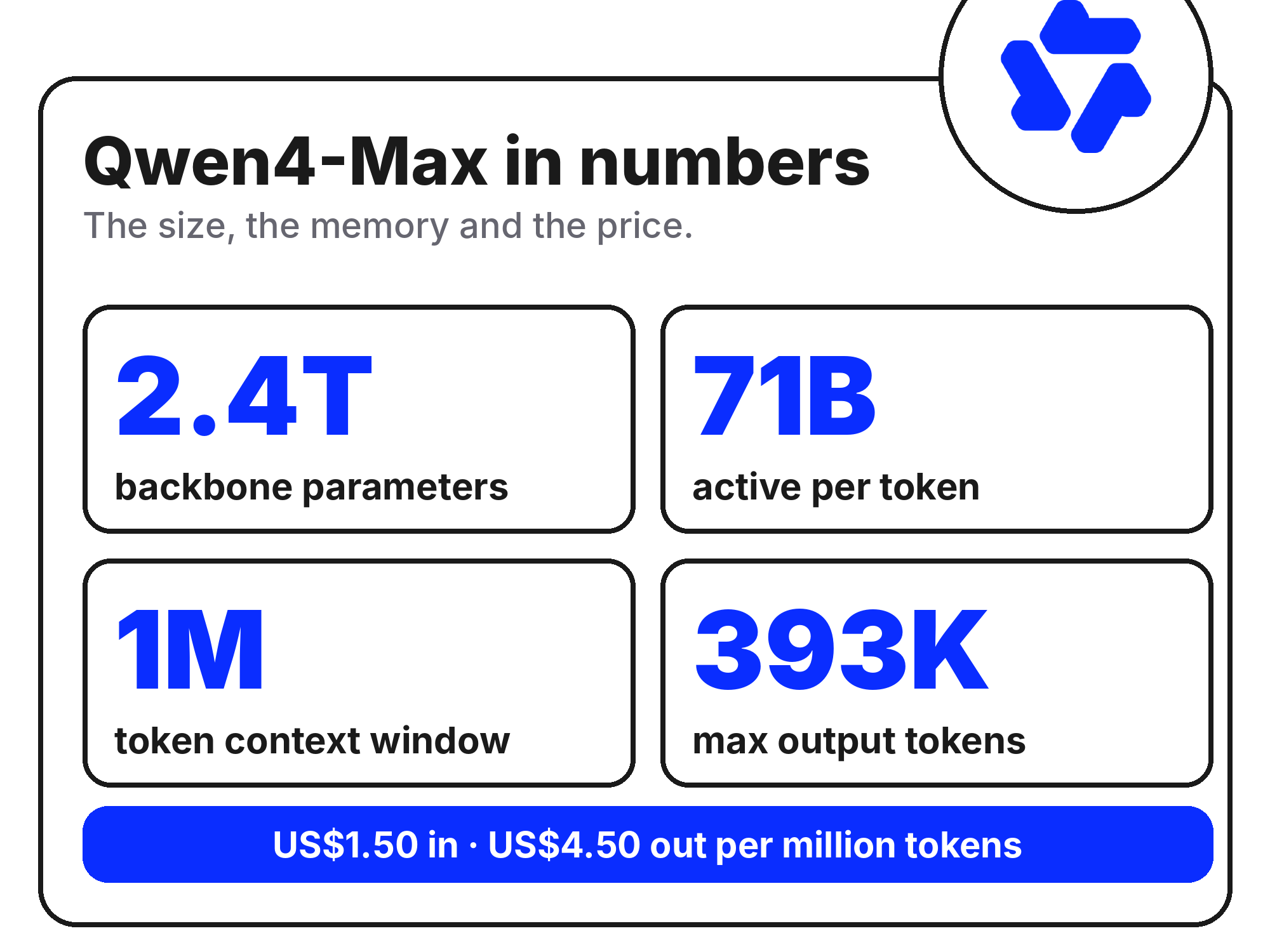
Alibaba’s Qwen team has launched Qwen4-Max, a model with a 2.4-trillion-parameter backbone, native vision and a one-million-token context window, Qwen says in its launch blog. The API is live on QwenCloud at US$1.50 per million input tokens and US$4.50 per million output tokens.
Qwen announced it on X on 16 November. Alibaba opened a preview of Qwen4-Max on 11 November, but only on its Token Plan subscription, with no benchmarks and no per-token price. The launch adds both.
Meet Qwen4-Max, your new AI teammate for work, creativity, and discovery! Qwen4-Max is built on a new MoE architecture with native vision and a 1M-token context window.
— Qwen (@Alibaba_Qwen) November 16, 2026
What’s inside
Qwen4-Max is a mixture-of-experts model. Only part of it runs for each token: 71 billion of the 2.4 trillion backbone parameters, Qwen says. Another 328 billion sit in N-gram embeddings, which are lookups for short runs of tokens.
The attention layers are new. Qwen says it pairs three Gated DeltaNet layers, which compress history into fixed-size states, with every Qwen Sparse Attention layer. The sparse layer uses a small indexer to pick which parts of a long prompt to read. Four parallel residual branches with read and write gates carry information between layers.
Pre-training ran without a loss spike, Qwen says. On its in-house base-model tests, Qwen4-Max-Base scores 5% to 13% lower bits per byte than Qwen3.8-Max-Base, with 25% fewer active parameters. Bits per byte measures how well a model predicts text. Lower is better.
Fewer tokens, lower cost
Qwen says Qwen4-Max beats Qwen3.8-Max while using fewer tokens. On Work360, token use drops about 24% at xhigh effort and 35% at high. On Terminal-Bench 4.0 it drops about 48% and 49%.
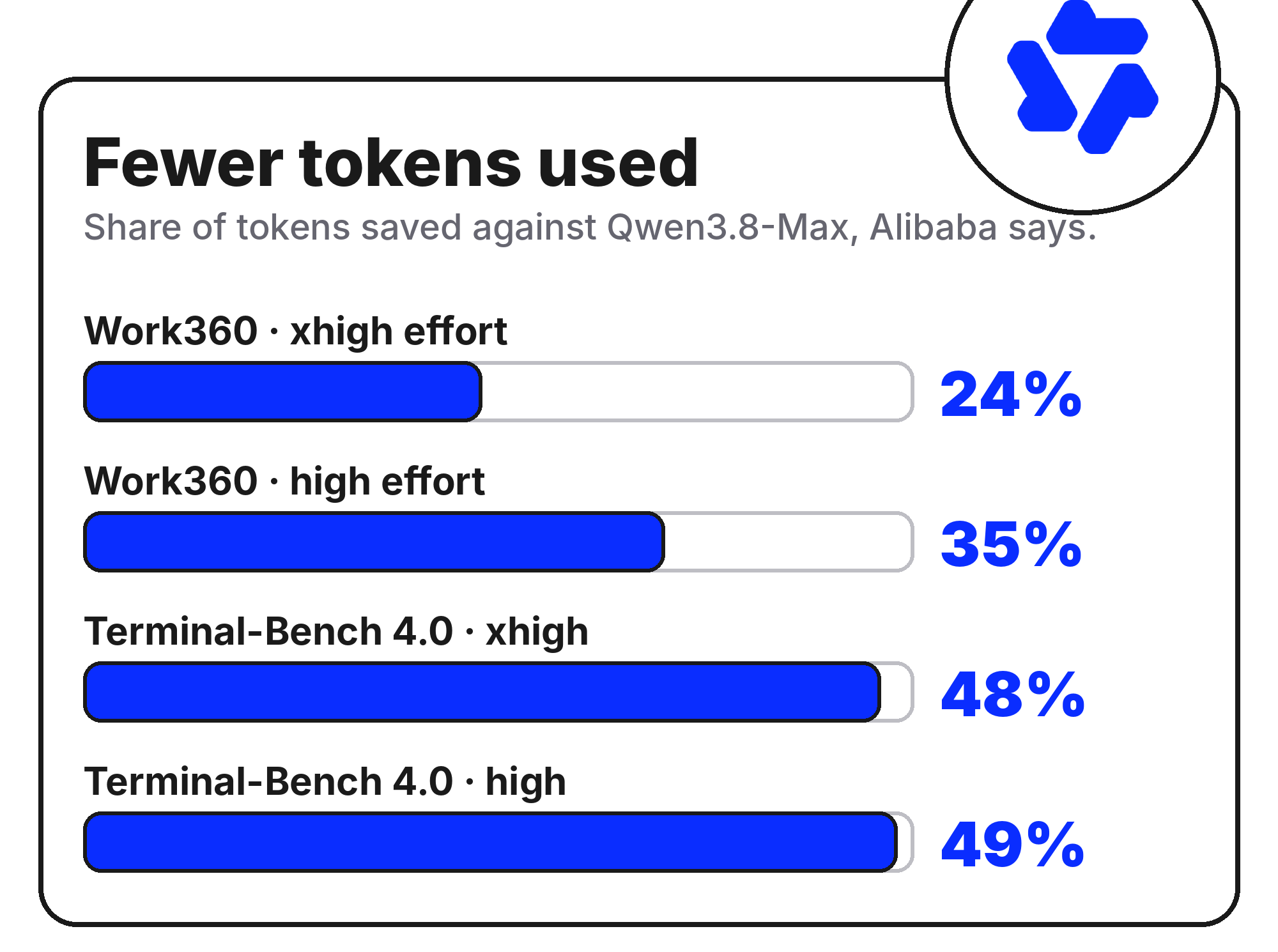
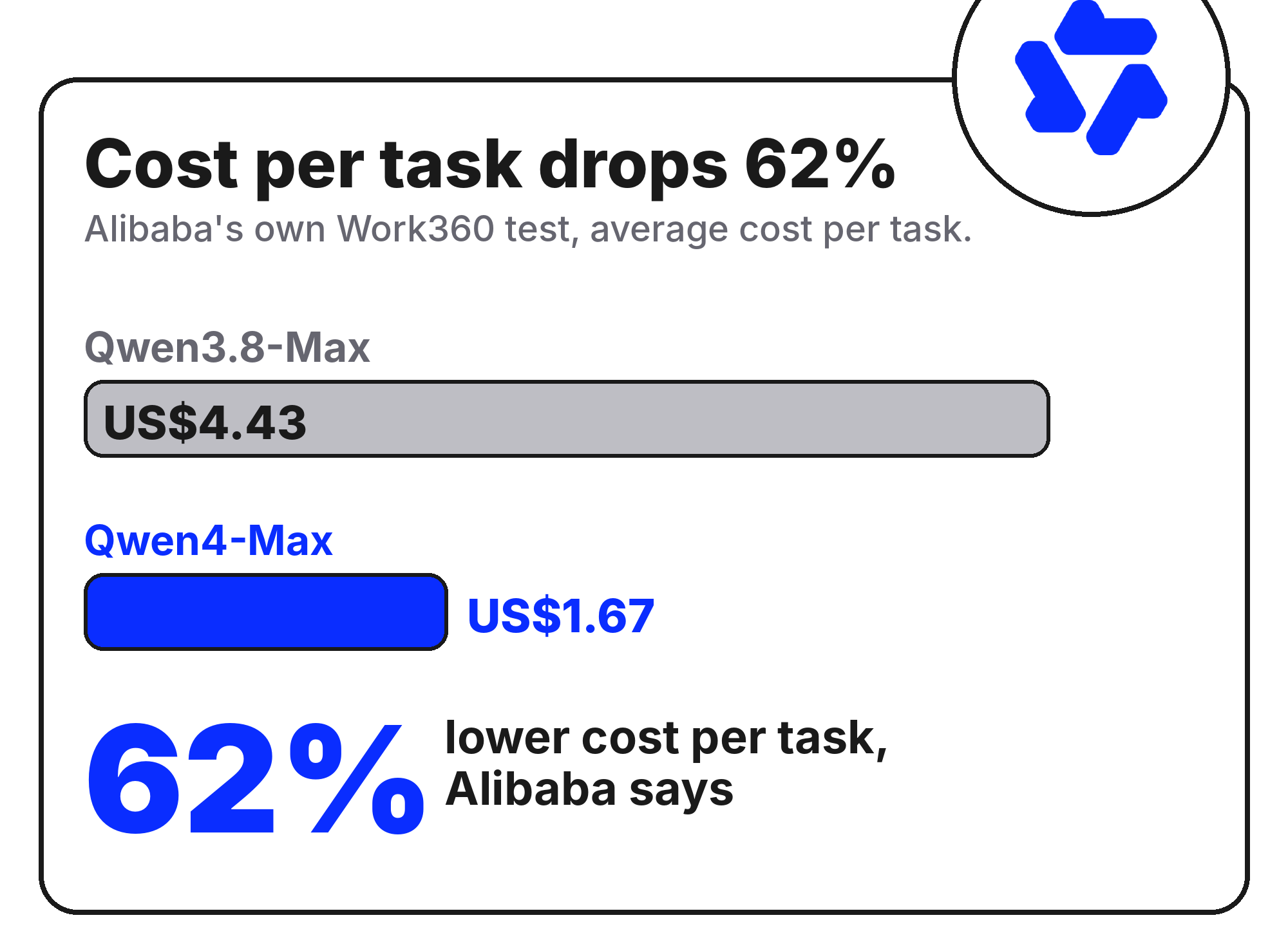
Work360 is Qwen’s own benchmark, covering 26 top-level domains, 182 subdomains and 721 specialised fields. Qwen4-Max scored 52.69 on it. Qwen3.8-Max scored 47.74. In that evaluation the average cost per task falls from US$4.43 to US$1.67, a 62% cut. Qwen’s X post calls it an internal evaluation. The blog’s comparison chart also cites results from Mercor, Artificial Analysis, LM Arena and Vals.
Price and access
Qwen says every price is lower than Qwen3.8-Max’s, and the implicit-cache price is down 70%. Input can be text, images or video, and output is text. QwenCloud lists a 991,000-token input cap, 393,000 tokens of output and 262,000 for reasoning. It also lists function calling, structured outputs, web search and caching. Qwen4-Max also runs in the Token Plan, QwenWork, Qoder and QwenStudio.
| Item | US$ per million tokens |
|---|---|
| Input | 1.50 |
| Output | 4.50 |
| Input, implicit cache | 0.075 |
| Explicit cache creation, 5 minutes | 1.875 |
| Explicit cache creation, 1 hour | 3.00 |
| Explicit cache read | 0.075 |
What Qwen showed it doing
In game development, Qwen says Qwen4-Max built playable games in Unreal Engine, Unity and Godot from a written brief. It also drove Blender to model and render 3D scenes. At SANF and Pacific Union, programming a single workpiece fell from about 475 minutes of manual effort to 24. For a finance task it called 90 MCP tools. In a legal due-diligence case it sorted 198 working papers into 14 folders and wrote an 86-page report.
The science demos are longer. On Deep Principle’s Mira platform, Qwen says the model ran for 48 hours, screened 2.7 million candidate molecules and directed an automated lab to make a physical sample of a new coolant. On DP Technology’s PharmMaster platform it made 454 tool calls and designed 24 candidate molecules for a protein linked to Alzheimer’s. Qwen puts the top pick’s nominal binding affinity at about 3.6 times the reference molecule’s. DP Technology’s experts think it’s worth wet-lab testing, Qwen says. Those runs happened on partner platforms, and the results are Qwen’s reports.
What’s still to come
Qwen is open-sourcing a Live Delivery plugin. Its job is to have a long-running agent ship a usable first version early, then keep improving it while the user steers. On Last Secure Code Bench, Qwen says the share of Qwen4-Max code that passes both functionality and security checks at function level rose from 22.0% to 31.8%.
Qwen says smaller Qwen4 models are coming as open weights. It hasn’t given sizes or dates.
Discover more from Sulat AI & Tech News
Subscribe to get the latest posts sent to your email.