
CrowdReply, a company that sells brand mentions on pages AI tools already cite, posted on X on 21 November that Ramp “got AI to recommend it 370 times”. The figure comes from Ramp’s engineering blog, where Ramp reported on 30 April 2026 that it had served an offer only to AI bots on about 50 ramp.com pages and counted the answers that repeated it. CrowdReply’s version drops what Ramp tested and turns the result into advice to get mentioned on other sites’ pages.
- What Ramp did
- What the CrowdReply post changes
- The catch: pages only bots see
- How other companies cracked it
- What the examples share
What Ramp did
Ramp’s write-up, credited to Grace Cummins on the company’s builders blog, covers three concurrent tests. A Cloudflare Worker, a small script that runs at the edge of a website, checked whether each visitor was a person or an AI bot. People saw the normal page. Bots got an alternate page with a tracked offer in one of three formats: markdown, stripped-down HTML or schema-heavy markup. Each variant carried its own tracking, and Ramp balanced the test groups by how often AI tools already cited each page.
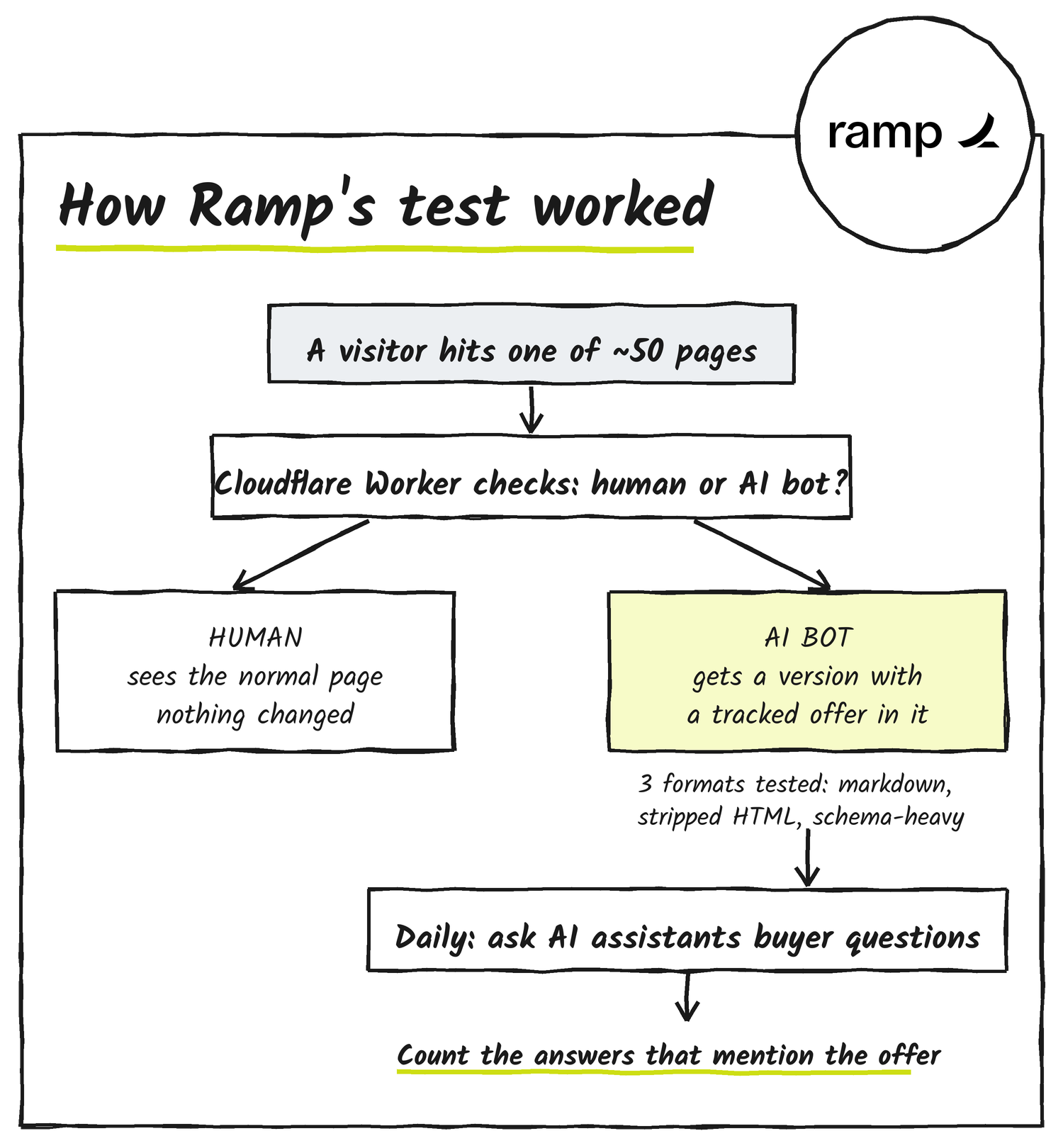
Ramp checked the results by asking AI assistants the questions a prospect would ask when picking a spend management tool, every day, and scanning each answer for the offer.1 Its logs also recorded thousands of bot visits from seven AI platforms in the first two weeks, and Ramp says DeepSeek’s crawler presents itself as Chrome 58, a browser from 2017.
1,300+
AI bot visits in the first 2.5 weeks
~40
answers repeating the offer at 2.5 weeks
370
matches by day 32
33
matches on the best single day
Ramp says the count didn’t climb steadily. About three weeks in, one assistant’s daily match rate jumped roughly fourfold overnight, with no content change on Ramp’s side and no model release Ramp could tie it to. By day 32 the total was nearly ten times the 2.5-week count.
Markdown was the only format that reliably showed up in answers, Ramp says, and schema markup, which Ramp expected to win, did worse. Ramp flags a caveat: “part of this may reflect a targeting issue”. One variant missed the major bots for several days because Cloudflare files them under “AI Assistants” rather than “AI Search”.
The post doesn’t show anyone taking the offer up. Ramp writes that the second half of its hypothesis, a person or agent acting on the incentive, “hasn’t happened yet but has some promising signs”.
What the CrowdReply post changes
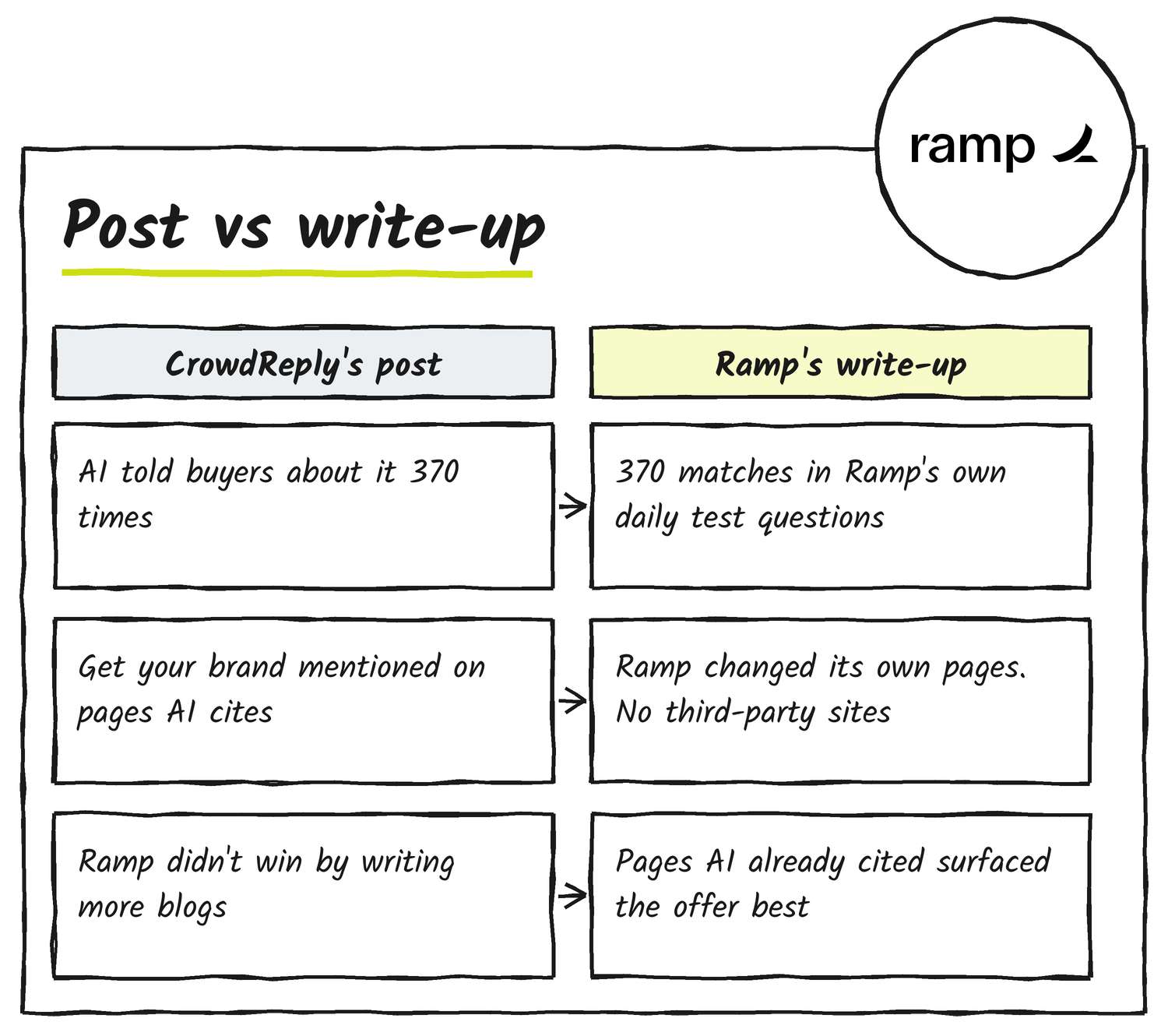
CrowdReply’s thread is two images of bullet points. Its closing lines say Ramp “figured out which pages AI already trusts, then put the right message there”, and tell readers to “Get your brand mentioned on those pages”. Ramp changed its own pages. The write-up doesn’t test mentions on anyone else’s.
| CrowdReply’s post says | Ramp’s write-up says |
|---|---|
| “In 32 days, AI told buyers about it 370 times” (9 November post) | Ramp counted 370 matches of its offer in answers over 32 days, and found the early ones by running its own daily test questions. It says no person or agent had yet acted on the offer. |
| “Get your brand mentioned on those pages” | Ramp changed its own pages and served the offer only to bots. The post tests no third-party sites. |
| “Ramp didn’t win this by writing more blogs” | Pages with higher existing AI citation volume surfaced the offer far more often, and pages with low volume got none, whatever the format. One top page wasn’t one Ramp had prioritised for search. |
CrowdReply’s homepage sells “offsite mentions” under the line “Get your brand into the pages AI already cites”, alongside onsite content and visibility tracking. Its illustration of the process reads “You set the budget”, “We get the mention live”, “You show up in the answer”, and the site says 10,000+ brands use it. Ramp’s post says nothing about buying mentions.
Ramp’s team has described other routes since April. In a Siege Media podcast episode published in early October, Eric Wu, who leads SEO, GEO and CRO at Ramp, said prospects asked Ramp’s sales team about a $162 AI-exclusive demo offer they hadn’t seen on the site: “where’s that $162 offer that I saw?” The show notes also list Ramp’s Reddit experiments and link to a subreddit named Ramp Platform.
The catch: pages only bots see
Ramp’s test served bots something people didn’t see, and the search engines have a position on that. Search Engine Land reported on 6 February that Google’s John Mueller and Bing’s Fabrice Canel recommend against building separate markdown pages for AI crawlers. Writer Barry Schwartz tied the practice to cloaking, which Google’s spam policies prohibit.
Why would they want to see a page that no user sees?
John Mueller, Google, on Bluesky, February 2026
We’ll crawl anyway to check similarity.
Fabrice Canel, Microsoft Bing, on Bluesky, February 2026
Format and content are separate questions. Cloudflare’s Markdown for Agents returns a markdown copy of the same page when a client asks for one, and Cloudflare says its own blog post takes 16,180 tokens as HTML and 3,150 as markdown, an 80% cut. Ramp’s offer existed only in the bot version. Ramp calls it an “above-board referral offer” and says it wasn’t “a jailbreak or a prompt injection”.
How other companies cracked it
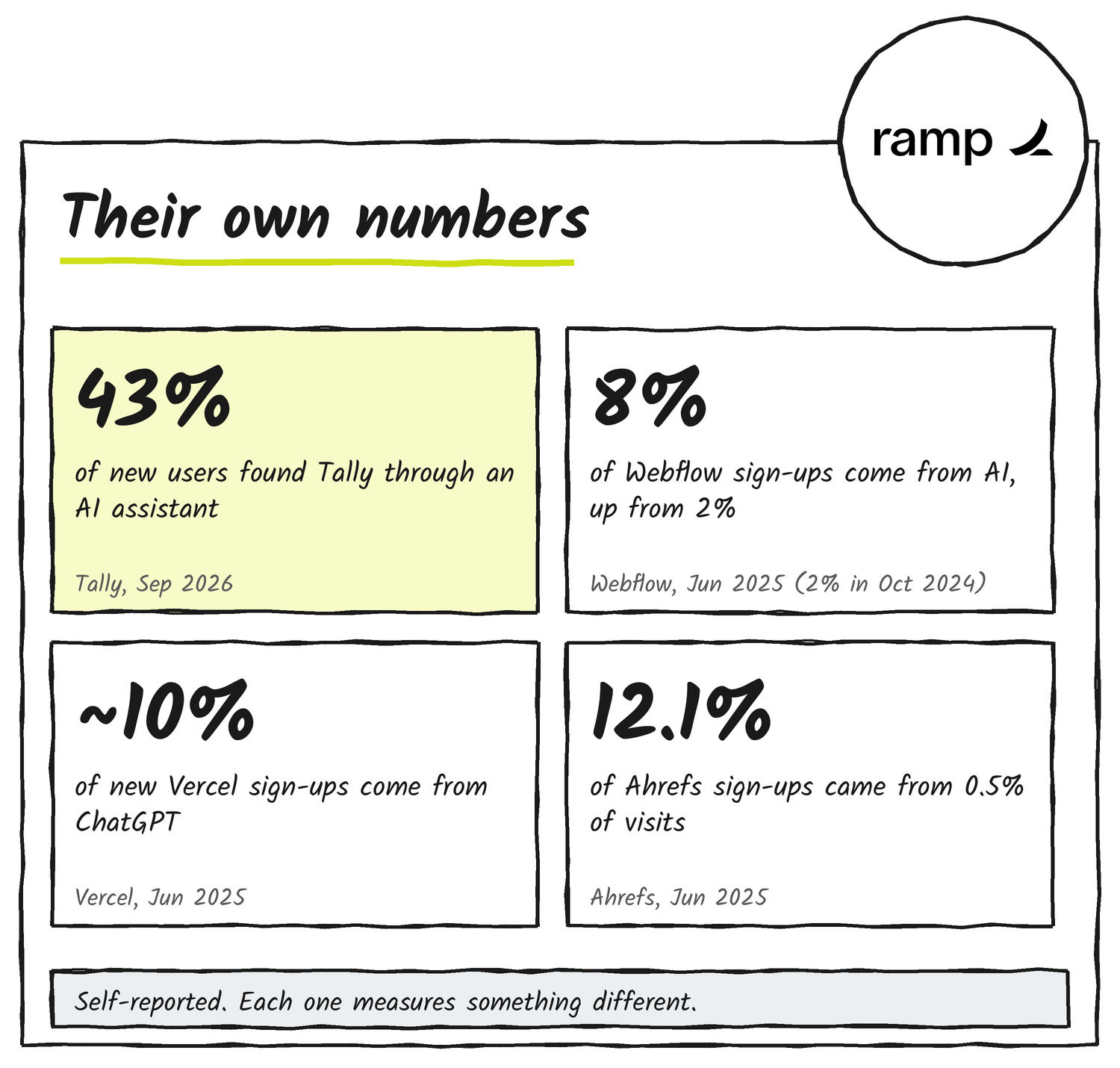
Every figure below is the company’s own, taken from its blog or newsletter, and each measures something different: a share of new users, a share of sign-ups, a count of citations.
| Company | What it reports | Where |
|---|---|---|
| Tally | 43% of new users find it through AI assistants; it says it never bought the channel | Tally blog, 22 September 2026 |
| Webflow | 8% of new sign-ups from AI in June 2025, up from 2% in October 2024 | Webflow blog, 12 June 2025 |
| Vercel | ChatGPT refers about 10% of new sign-ups, up from 1% six months earlier | Vercel blog, 10 June 2025 |
| Ahrefs | 12.1% of sign-ups came from AI search, on 0.5% of visits, over 30 days | Ahrefs blog, 16 June 2025 |
| HubSpot | AI-sourced qualified leads up 1,850%, converting at 3x other sources | HubSpot blog, updated 10 November 2026 |
| Cloudflare | A markdown copy of its own blog post uses 3,150 tokens against 16,180 for the HTML | Cloudflare blog |
Tally: years of answering questions, no purchase
Tally’s co-founder Marie Martens wrote in a 22 September post that 43% of new users now discover the form builder through ChatGPT, Claude, Gemini, Perplexity and other assistants, and that “AI recommendations have taken the number one spot”. Her April post says Tally asks new users in an onboarding survey where they found it, and that word of mouth and AI search “are powered by the same thing: our community”, meaning users recommending Tally on Reddit and elsewhere. Of the AI channel she wrote: “We never bought this channel.”
Vercel: own a concept, serve it as HTML, skip paid links
Vercel’s 10 June 2025 post, by Kevin Corbett and Malte Ubl, says ChatGPT refers around 10% of new sign-ups, up from 4.8% a month earlier and 1% six months before. Its recipe has five parts: find a concept competitors cover thinly, publish the evidence-based source with original data, structure pages for machines, seed citations in places such as Reddit, GitHub and Stack Overflow, and refresh content on a 30, 90 and 180 day cadence. Because most AI crawlers fetch pages but don’t execute JavaScript, Vercel says to serve static HTML through server-side rendering or static generation.
Avoid paid links. Organic citations carry more weight in training data.
Vercel, “How we’re adapting SEO for LLMs and AI search”, 10 June 2025
Webflow: structure, automation and schema
Webflow’s June 2025 post, by Vivian Hoang, says 8% of its new sign-ups came from AI, against 2% in October 2024. Its owned-content rules are to answer search intent quickly, structure headlines and sections for semantic parsing, break content into concise questions and add original data. Josh Grant, Webflow’s VP of growth, wrote in a November 2025 newsletter that Webflow owns about 60% of AI answers in the CMS category on under 2% market share, that AI-referred traffic converts at about 24% against 4% for non-brand Google, and that structured content and schema were a main lever.
HubSpot: measure, build pages, then recruit partners and Reddit advocates
HubSpot’s case study comes closest to CrowdReply’s pitch, and HubSpot sells the tooling it describes. The post by Rory Hope says the marketing team began measuring AI visibility with the tool XFunnel in June 2025 and found its own pages weren’t being cited. On site, industry pages built from case studies with FAQ schema were cited 92% of the time and lifted AI visibility 49%, comparison posts gained 642% in citations, and product pages gained 56%.
Off site, HubSpot says its partnerships team found publishers already winning citations without mentioning HubSpot and gave them templates, which by the end of 2025 meant hundreds of partner sites and nearly a thousand new pages. It also asked community advocates to post answers to buyer questions on Reddit. Reddit-driven citations grew from 178 in May 2025 to 146,000 in December 2025, and in one month its mention rate went from 0% to 33.5% in France and 17.1% in Germany. The post doesn’t give the terms of the partner arrangements.
Ahrefs: count the sign-ups
Ahrefs’ Patrick Stox reported in June 2025 that AI search sent 0.5% of Ahrefs’ visits but 12.1% of its sign-ups over 30 days, and that those visitors converted at 23 times the rate of traditional organic search visitors. The numbers come from Ahrefs Web Analytics.
What the examples share
Four of the six companies started by measuring. Ramp ran its own question set every day, HubSpot tracked prompts for each stage of the buyer’s journey, Tally asks new users where they came from, and Ahrefs counts sign-ups by source. On paying for reach, the sources split. Tally says it never bought the AI channel and Vercel tells readers to avoid paid links, while HubSpot describes working with partner publishers and Reddit advocates without giving terms. Ramp’s test involved no outside sites at all.
Ramp’s minimum setup for running the test, as it lists it
- A Cloudflare Worker in front of one high-intent page, sorting visitors into human, known AI bot or ambiguous by user agent, IP, ASN and an optional bot score.
- Three content variants (markdown, stripped HTML, schema-heavy) with identical offer text.
- A tracked conversion URL for each variant, so results trace back to the format.
- Raw access logs with user agent, IP, ASN and bot score as separate fields, kept for 30 days or more.
- A weekly run of top prospect questions across the major assistants, with a comparison of the answers.
- AEO
- Answer engine optimisation: shaping a site and its mentions elsewhere so AI assistants name a brand in their answers. HubSpot and Webflow use the term.
- Cloaking
- Showing search engines different content from what users see. Google’s spam policies prohibit it when the aim is to manipulate rankings or mislead users.
- Citation
- A page an AI answer names as a source. HubSpot and Ramp both count them.
Ramp says it will keep going: more high-intent pages, per-model content, landing pages for agent-referred prospects, and attribution that requires an agent to take a trackable action instead of relying on link clicks.
- Ramp’s post calls the daily questions “one way we tracked it” and says the roughly 40 matches in the first 2.5 weeks came from them. It doesn’t describe the other ways. ↩︎
Discover more from Sulat AI & Tech News
Subscribe to get the latest posts sent to your email.