Linus Torvalds released Linux 6.1 on 11 December, after an extra week of testing. His announcement described a quiet final week, with networking drivers prominent among the remaining fixes. The release opens the next development cycle just before the holidays.
Illustration: Sulat. Tux: Larry Ewing, Garrett LeSage, IFo Hancroft.
A starting point for Rust
Rust support enters the kernel as a foundation for further development. The initial work supplies build integration, core support and examples. It does not replace the existing kernel or deliver a complete collection of Rust drivers.
The versioned documentation explains how Rust abstractions wrap functionality implemented in C through bindings. Those wrappers do not yet cover every internal interface. The project expects that coverage to expand, with subsystems supplying safer interfaces for modules such as drivers.
Changes below applications
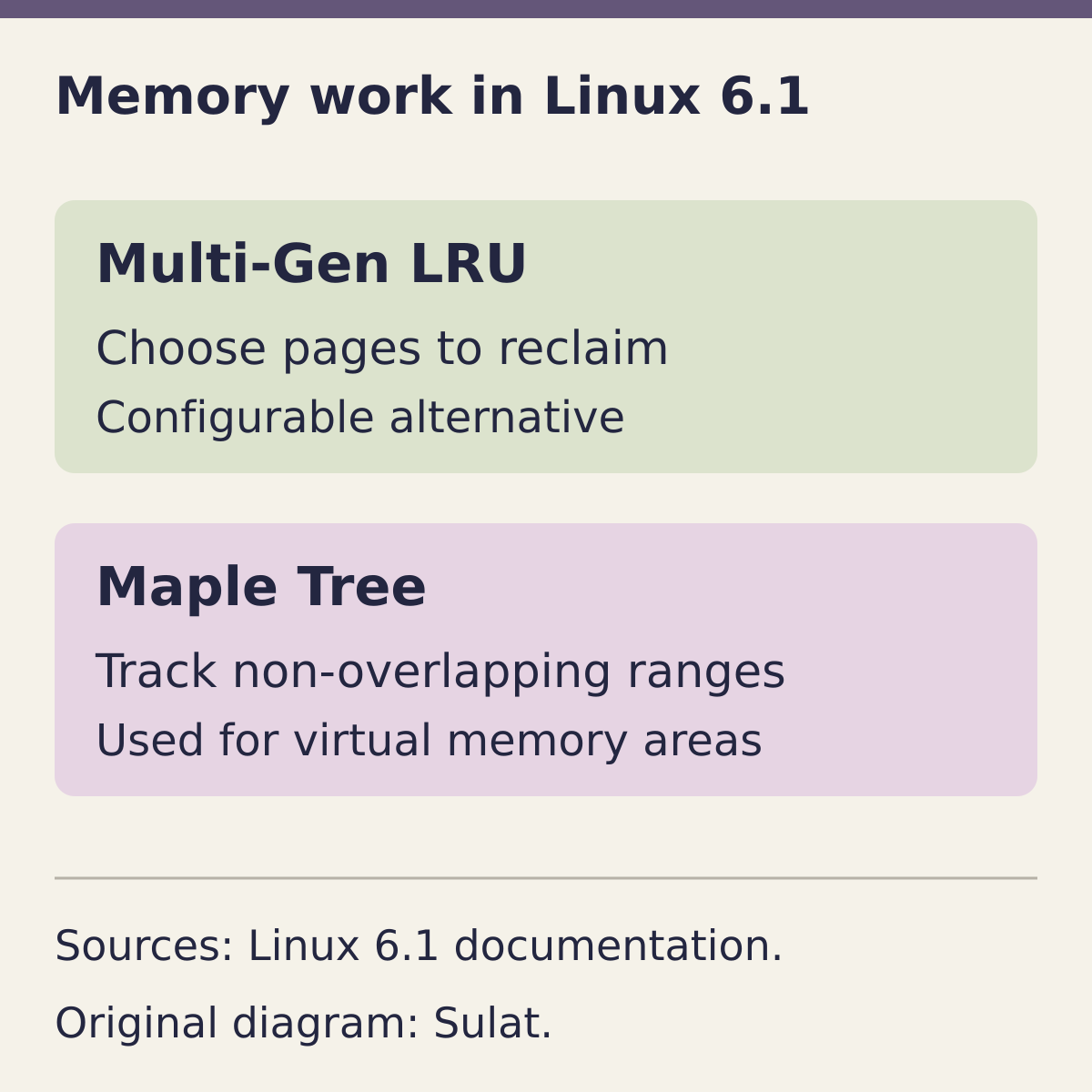
Linux 6.1 also includes Multi-Gen LRU, an alternative way to decide which memory pages to reclaim. Its documentation describes the aim as improving behaviour under memory pressure. Kernel configuration and runtime controls determine whether it is enabled; inclusion in this release alone does not mean every system will use it.
The Maple Tree supplies a data structure for non-overlapping ranges, with tracking virtual memory areas identified as its main use. Its design targets a small memory footprint and efficient use of processor caches. It can also support concurrent readers and writers, with writers still requiring synchronisation.
A tool for finding bugs
The new Kernel Memory Sanitizer, or KMSAN, detects uses of uninitialised values through compiler instrumentation. This is development infrastructure rather than a production setting: the documentation warns that it substantially increases memory consumption and slows the system. Its runtime initially supports x86-64, with Clang required to build an instrumented kernel.
Discover more from Sulat AI & Tech News
Subscribe to get the latest posts sent to your email.