Editorial composite: Anthropic’s official mark with Alan Stark’s “Ocotillo Power Plant at Night,” photographed in Tempe, Arizona, in 2011. The photograph illustrates gas-fired power infrastructure; Ocotillo is unrelated to Anthropic and OnePWR. Photo cropped and logo added by Sulat. Photograph and photo adaptation: CC BY-SA 2.0. Anthropic’s logo remains a separate trademark.
Anthropic bought commitments for 1.7 gigawatts of gas-fired generators from OnePWR Solutions in a $3.4 billion deal, the Financial Times reported on 8 November. The purchase included installation capabilities rather than an acquisition of the company, according to the report. Both companies declined to comment to the FT.
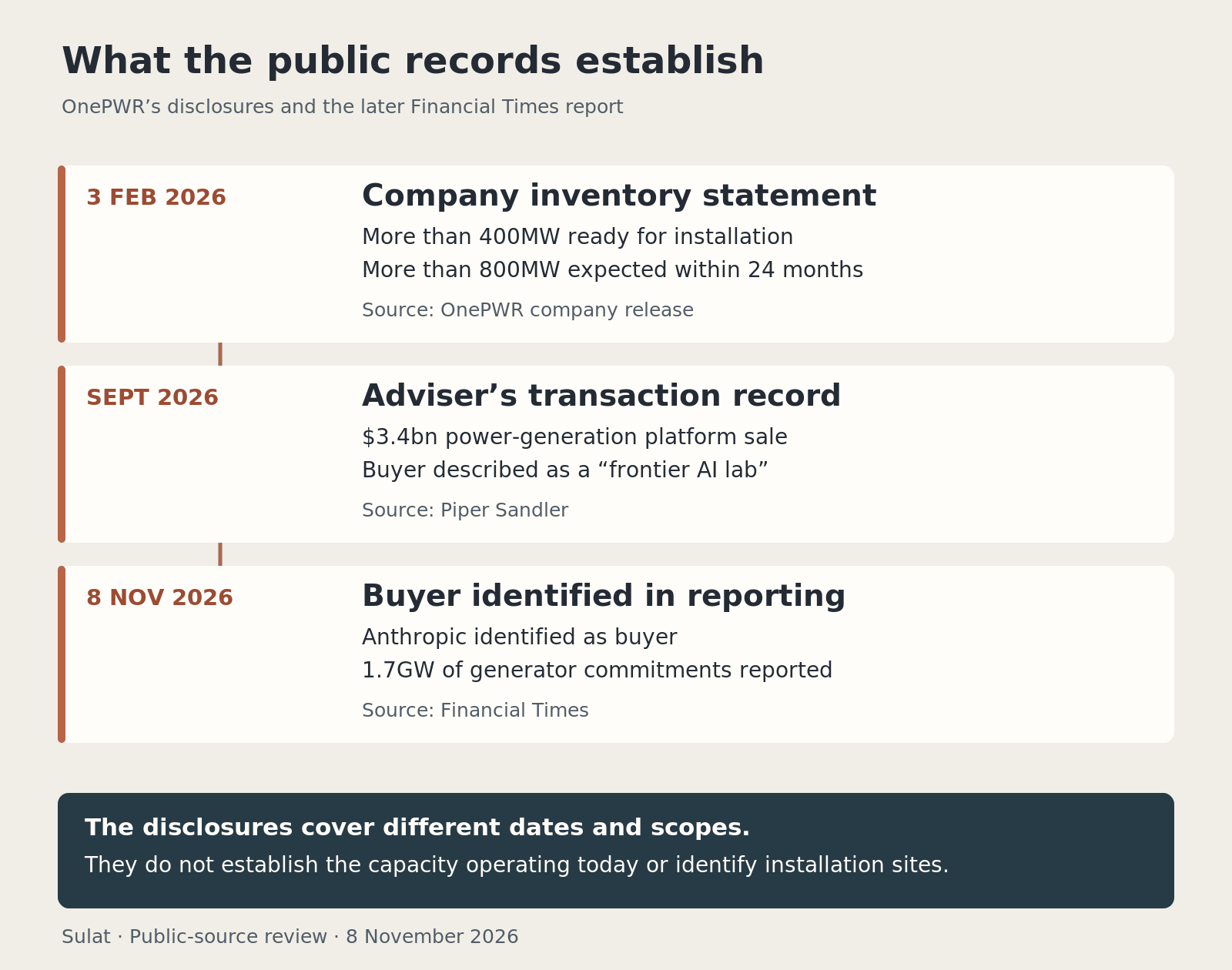
A public transaction record supplies partial corroboration. Piper Sandler’s listing records a $3.4 billion sale of OnePWR’s power-generation platform to a “frontier AI lab” in September 2026. The investment bank says it was OnePWR’s exclusive financial adviser. It identifies the seller as OnePWR Solutions, or CK Holdings Group, LLC, but leaves the buyer unnamed.
That makes the adviser’s record useful evidence of the transaction’s value, timing and broad structure. The buyer’s identity and generating capacity remain attributed to the FT. The listing provides no installation addresses or operating dates.
The equipment pipeline predates the sale
OnePWR had already described a substantial equipment inventory months before the transaction. In a 3 February company announcement, it said more than 400 megawatts of generation equipment and supporting plant were in stock and ready for installation. It expected more than 800MW of additional capacity within the following 24 months.
Those figures explain part of OnePWR’s pitch: customers could combine equipment access with engineering, procurement and construction services. The release described projects supported by long-term power-purchase agreements, allowing customers to secure dedicated electricity supplies.
The February inventory statement and the later transaction cover different dates and scopes. The earlier figures were lower bounds, and the documents reviewed do not provide an equipment-by-equipment reconciliation. They cannot establish how much machinery has since been delivered, allocated to individual customers or brought into service.
A separate carbon-capture plan needs separate evidence
Caterpillar’s own records confirm an earlier relationship with OnePWR. In March, Caterpillar, OnePWR and Vero3 announced a collaboration combining natural-gas generation, batteries, carbon capture and underground carbon storage for data centres and other facilities.
Under that proposed arrangement, OnePWR would build, own and operate the generation infrastructure. Caterpillar would supply power-system expertise and lead front-end engineering for carbon capture. Vero3 would develop and operate the capture and storage infrastructure. The first project was expected to begin with a 500MW generation site.
The announcement describes intentions and assigned roles. It does not name Anthropic or establish that the September sale includes this project. Claims that Anthropic’s newly reported equipment comes with working carbon capture would therefore run ahead of the available evidence. The same caution applies to treating the planned project as already operational.
From equipment capacity to usable computing
A generator rating tells only part of the deployment story. Installation and commissioning still have to connect the equipment to the facility it serves. Caterpillar’s documentation for one continuous-power product, for example, discusses on-site commissioning, building-management integration and performance that depends on site conditions. That is an engineering illustration; the model of equipment covered by this transaction has not been established in the records reviewed here.
Electricity also serves cooling and other building systems alongside the computers. Microsoft’s definition of power usage effectiveness divides total facility energy by IT-equipment energy. A generation-capacity figure alone therefore cannot specify how much electricity reaches chips, how many GPUs a site can support or how much AI work it can perform.
Sulat’s review of data-centre expansion in Southeast Asia documented the practical separation between equipment or power commitments, permits and operating facilities. The jurisdictions differ, but the reporting problem carries over: announcements describe different stages of construction and operation.
For this deal, the next useful disclosures would identify the receiving sites, equipment delivery dates, fuel arrangements and commissioning milestones. They would also show whether any carbon-capture infrastructure accompanies the generation assets. Until then, the public record supports a large platform transaction, while its contribution to operating AI capacity remains unmeasured.
Discover more from Sulat AI & Tech News
Subscribe to get the latest posts sent to your email.