BDx announced a 640-megawatt AI data-centre campus in West Java on 22 September, describing six planned buildings, a substantial grid-power commitment and a first phase expected in early 2027. Eight days later, the provincial governor told the project to stop. Its environmental assessment and building approval had not been issued.
The sequence is documented in BDx’s announcement and an official West Java account. It exposes a difficulty that investment totals tend to conceal: securing a customer, financing or a power allocation does not finish the approval process for a building.
A Japanese-language post on X on 8 November grouped that stoppage with restrictions in Thailand, Malaysia and Singapore, presenting a chain of construction halts caused by power and water shortages. The Guardian had reported on the regional constraints a day earlier.
The underlying cases are substantial, but their dates, scope and legal force differ. Thailand has been rewriting its approval system. Johor is screening projects for water and electricity demands. West Java intervened in one campus’s permits. Singapore has resumed allocating capacity after an earlier moratorium. Calling all four a current construction freeze obscures what each government is doing, and which projects can still proceed.
About this investigation
This is a review of public government records, company disclosures and local reporting, current to 8 November 2026. Sulat has not inspected the sites or interviewed the parties. Project announcements, forecasts and reported responses are identified as such.
Thailand’s 166 projects were not all ordered to shut down
The widely repeated figure comes from the first meeting of Thailand’s national data-centre policy board on 4 September. The Nation reported 49 projects under construction and 117 awaiting approvals, a combined 166. Approval decisions were paused while agencies worked on common standards.
The position of the 49 construction sites was more complicated. AFP reported that authorities sought a voluntary pause because they lacked the power to impose one at that stage. Danucha Pichayanan, secretary-general of the National Economic and Social Development Council, said:
“We don’t have the power to suspend the construction of the 49 data centers”
Danucha Pichayanan, quoted by AFP, 4 September 2026.
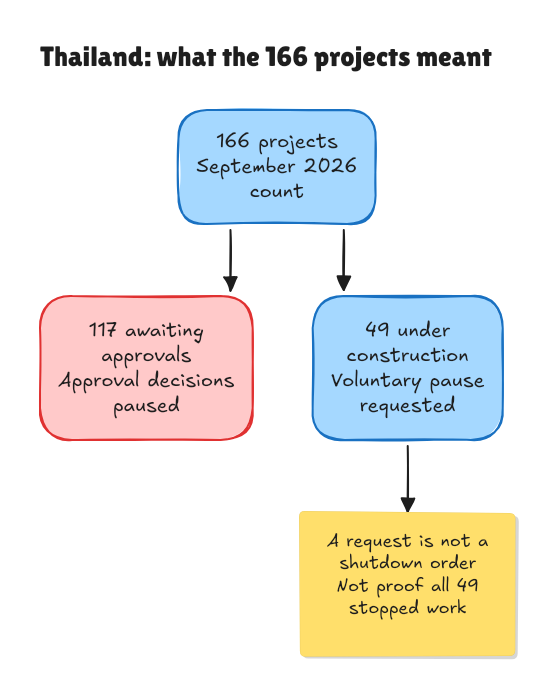
That is a material limitation on the headline number. A request to cooperate does not establish that every developer stopped work, and a pending application is not a construction site.
The government’s own September account described an administrative problem. Investors dealt separately with utilities, water authorities and building regulators. The new board wanted a shared view of projects, minimum requirements and an assessment of benefits to Thailand. It said the policy was not intended to block investment.
By 27 October, the board had approved a draft governance framework for Cabinet consideration. It covered siting, electricity and water connections, environmental practice, and economic and social benefits. Seven size categories, a national dashboard and centralised screening were intended to replace the fragmented process.
NationTV reported on 6 November that the draft was due before Cabinet on 10 November, with possible new approvals from December. Those are prospective dates, not completed decisions. Its newer tally of 63 operating projects and 20 under construction also differs from the September count; the available reports do not reconcile the two populations.
A separate building-regulation proposal reported in October would require reuse of at least 80% of cooling-tower blowdown each month. Blowdown is water drained to control accumulated minerals, not all water used or evaporated by a facility. The report scheduled review for 27 November. The proposal should not be described as an enacted 80% water-recycling requirement.
How the decisions unfolded
- 2019–2022: Singapore’s moratorium precedes the present wave of restrictions.
- 21 August 2026: Singapore provisionally allocates 200MW to four operators.
- 4 September: Thailand pauses approvals and seeks a construction pause while drafting rules.
- 30 September: West Java directs the BDx project to stop pending permits.
- 27 October: Thailand advances its draft national framework.
- 4 November: Google announces a US$15 billion Malaysian expansion for 2027–2028.
A chronology of different policy and investment events, not a series of equivalent bans.
In West Java, the missing approvals were specific
The provincial account names the two missing requirements at BDx’s Jatiluhur site: AMDAL, the environmental impact assessment, and PBG, the building approval. Governor Dedi Mulyadi instructed consultants to complete the documentation for issuance by Purwakarta regency. He also called for water-use and noise studies to be made public, with farmers’ access to reservoir water protected.
Detik’s local reporting on 1 October adds a check beyond the announcement. Purwakarta officials said an inspection found construction inactive. The local public-works chief confirmed that a building application existed, but documents still needed correction. His account placed notification of those deficiencies on 31 August, before BDx’s September announcement.
BDx’s release described a three-year development, with a 120MW first building delivered in phases. Its 640MW figure refers to the planned campus, not an already operating load removed from Indonesia’s electricity system. The company also said it had secured 845MVA of PLN grid capacity. MVA measures apparent electrical power; it cannot simply be substituted for the megawatts of IT capacity in the campus announcement.
The governor’s follow-up statement on 2 October is important. He said construction could be accepted if an objective environmental assessment passed and residents’ water access was protected. He also argued that an available reservoir allocation could accommodate the project. The intervention was therefore not an official finding that the campus would inevitably exhaust local water supplies.
The Straits Times reported that BDx confirmed the stoppage but retained its early-2027 first-phase target, subject to approvals. No authoritative restart notice was found for this review.
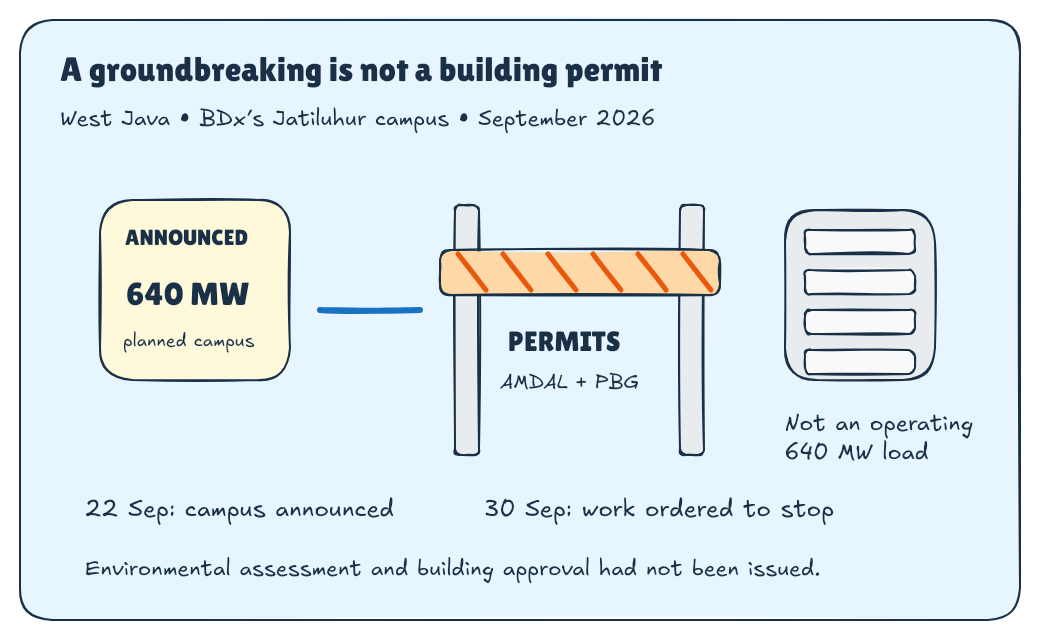
The unresolved questions are narrow enough to check: whether the permits have been issued, what conditions they contain, and whether work has resumed. Neither a groundbreaking announcement nor a governor’s willingness to consider the project answers them.
Johor’s 24% figure needs its source attached
Johor, across the border from Singapore, has become a major data-centre market. The claim that these facilities consume about a quarter of the state’s electricity originates in a Wood Mackenzie release from 18 June. The research firm estimated their share of end-user electricity consumption at approximately 24%, rising to around 40% by 2035.
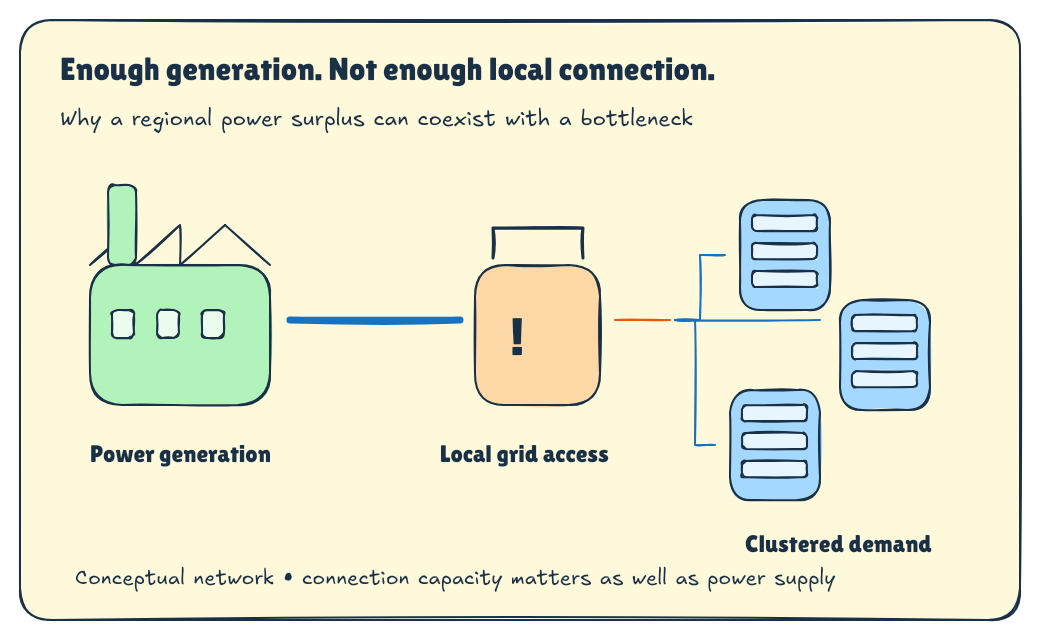
The public release does not clearly identify the period or underlying energy totals for the 24% estimate. It should be attributed to Wood Mackenzie rather than presented as a government-metered statistic. Its diagnosis is also more specific than a general power shortage: generation was sufficient in the near term, while access to local substations and transmission and distribution infrastructure constrained clustered developments.
A Johor government-media account of a state-assembly speech in May illustrates how different the numbers can look depending on what is counted. It reported about 920MW of actual power use among 20 operating projects in March, against 5,628MW of approved capacity for 28 projects. These are power figures, not annual energy totals, and they do not independently validate Wood Mackenzie’s percentage.
Three numbers that cannot be swapped
Capacity, in MW: the power a facility or connection is designed or authorised to accommodate.
Load, in MW: the rate at which equipment draws power at a particular time or under a stated measure.
Energy, in MWh or TWh: electricity used over time. An annual consumption share requires matching energy totals and a defined period.
Restrictions on approvals are real. In a November 2025 interview with the New Straits Times, state official Mohd Jafni Md Shukor said Johor would focus on Tier 3 and Tier 4 facilities in designated industrial zones, with water sources, cooling and efficiency examined during approval. Bernama reported the chief minister reiterating that position in October 2026.
The tier terminology requires care. Uptime Institute’s tier system describes infrastructure redundancy, maintainability and fault tolerance. A higher tier is not, by itself, proof of lower water consumption. The cooling design and water source need separate assessment.
National policy also stops short of a blanket ban. The Edge reported on 28 October that Investment Minister Johari Ghani ruled out a general moratorium while insisting states demonstrate adequate water supplies. Bernama reported that decisions on 24 new applications remained pending while electricity and water availability were checked.
Some adaptations have progressed beyond plans. In an August report based on site visits, Bernama described water-reclamation plants serving Bridge Data Centres and Computility facilities. It also distinguished DayOne’s treated river water from reclaimed sewage and noted a BDC site that still used freshwater. Those distinctions matter to any claim that the industry has solved, or ignored, its water problem.
Singapore is allocating growth, not continuing its old moratorium
Singapore’s moratorium ran from 2019 to 2022, according to an official parliamentary reply in October. Growth since then has been calibrated against energy security, water and decarbonisation. The government uses competitive calls for applications to allocate new capacity.
“Singapore does not have a pre-determined upper limit to DC capacity”
Ministry of Digital Development and Information, 3 March 2026.
In August, the Economic Development Board announced a provisional 200MW allocation to four operators. The selected operators must source at least 50% of their energy from eligible green pathways, according to the government’s October explanation. The conditions restrict which developments qualify, but additional capacity is still being awarded.
The government has also put actual electricity consumption on record: Singapore’s data centres used 6.5TWh in 2024, slightly more than 10% of national consumption. Its separate 1.6GW IT-capacity figure includes the new allocation. Conflating the two would make an expansion plan look like electricity already being consumed.
Singapore’s earlier moratorium helped accelerate investment in Johor, as ISEAS research describes. That history supports a spillover effect. It does not show that every subsequent project elsewhere was displaced from Singapore or that the country is now trying to export all new demand.
Efficiency claims need an absolute number alongside them
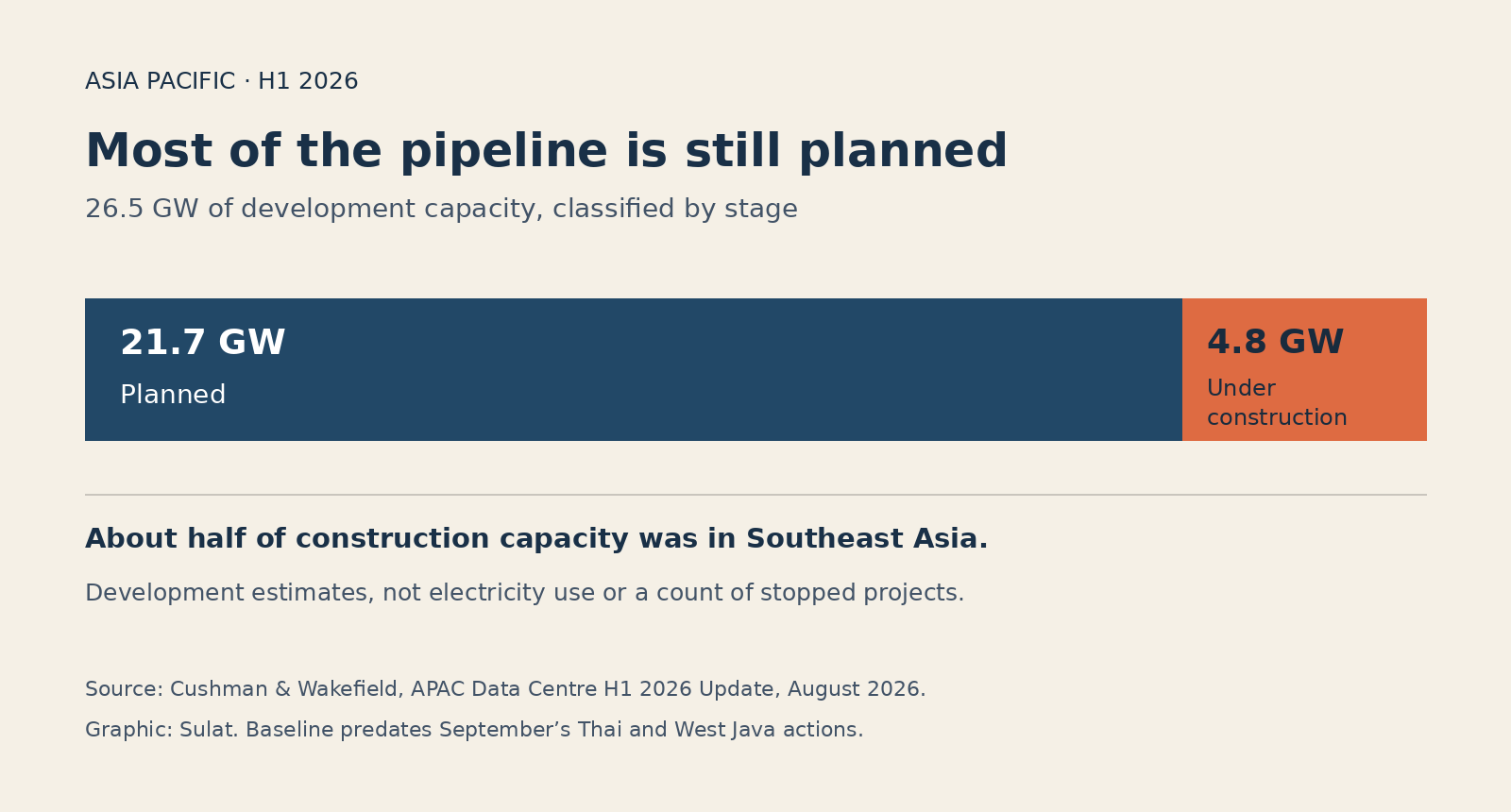
The scale behind these policy changes is large. Cushman & Wakefield’s first-half 2026 assessment counted 26.5GW in Asia Pacific’s development pipeline. Only 4.8GW was under construction; the remaining 21.7GW was planned. Southeast Asia accounted for roughly half the construction capacity.
A project can be efficient and still be large. Power usage effectiveness, or PUE, divides total facility energy by IT-equipment energy. Water usage effectiveness, or WUE, expresses cooling and humidification water relative to IT energy. Microsoft’s definitions make clear that both are ratios. Neither is an annual limit on a site’s total electricity or water use.
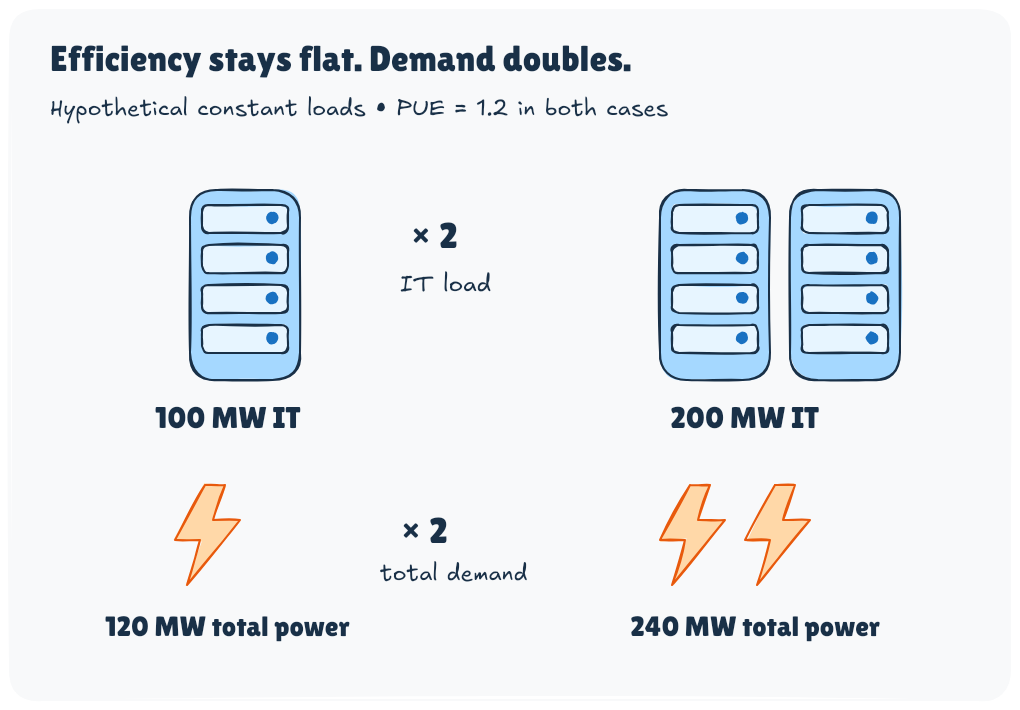
For illustration, a constant 100MW IT load at a PUE of 1.2 would require 120MW across the facility. Doubling the IT load while holding the ratio unchanged doubles total facility power to 240MW. This is arithmetic, not a measurement of any campus in this story. It explains why a low PUE cannot settle whether a local grid has room for a project.
Water and energy also need to be evaluated together. Google says water cooling can cut energy use by approximately 10% compared with air cooling in many places. That is a company claim with a geographic qualification. Uptime Institute’s April analysis found that well-designed dry and adiabatic systems could match evaporative systems in the climate zones it studied. Design, configuration and operation matter; a cooling label alone does not determine performance.
The International Energy Agency expects regional electricity demand to grow by about 5.4% a year from 2026 to 2030, driven by industry, cooling, data centres and wider electrification. Data centres enter power systems that already have other growing customers. A national generation surplus can coexist with a saturated local connection, just as a water-efficient building can still create a substantial seasonal demand.
Beyond Southeast Asia, a Sydney project loses its data centre
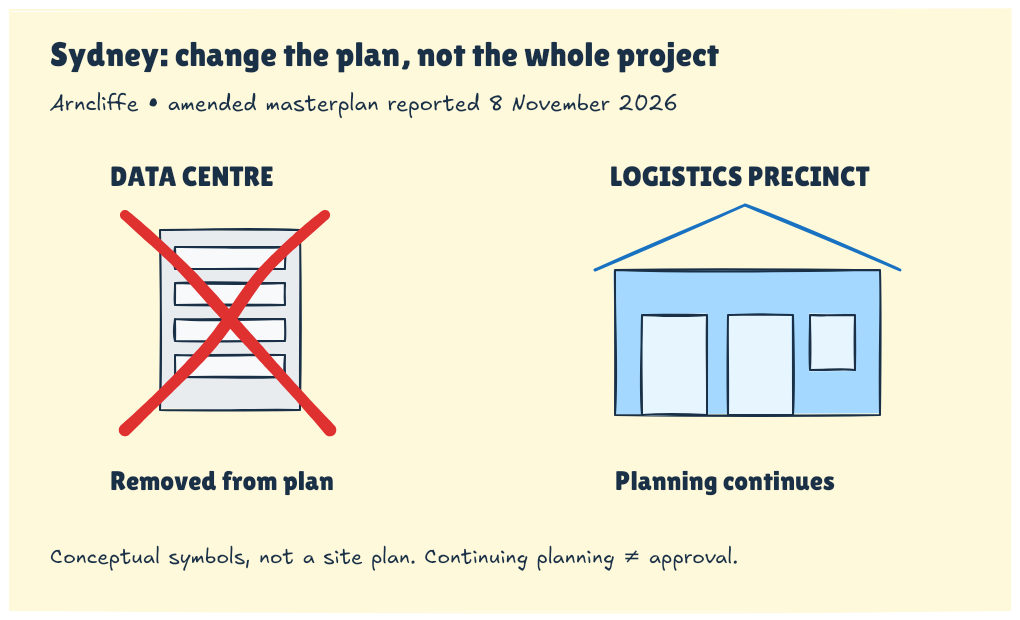
Australia offers a comparison outside the Southeast Asian cases. On 8 November, Bloomberg reported that Stockland had dropped a proposed Sydney data centre following community opposition. The facility was to form part of a logistics precinct on the former Kogarah Golf Club site at Arncliffe, beside the Cooks River.
“does not include a data centre as part of the amended Concept Masterplan”
Stockland spokesperson, describing the revised logistics precinct to ABC News on 8 November 2026.
ABC’s reporting distinguishes the withdrawal from the fate of the wider development: Stockland and joint-venture partner John Boyd Properties continue to pursue the logistics hub. Residents raised concerns about energy use and the river environment. Those are reported objections, not findings that the unbuilt facility caused environmental harm. The campaign group also told ABC it would continue opposing the logistics scheme.
The company’s wider strategy supplies an important check on the interpretation. In its 19 October operational update to the ASX, Stockland described data centres as a growth platform and reported about 450MW of power secured across three sites, subject to final design, documentation and customer negotiations. That disclosure predates the Sydney withdrawal and is not a measure of operating electricity demand.
The Sydney decision documents one proposed use being removed from one site. Alongside Southeast Asia’s permit holds and conditional allocations, it shows why an investment pipeline cannot be read as a construction forecast: local opposition can change what a developer proposes to build even while its broader expansion plans remain in place.
Updated 8 November 2026 to include the Stockland decision in Sydney.
Expansion continues, with conditions attached
On 4 November, Google announced US$15 billion of investment in Malaysia for 2027–2028. Its Elmina campus in Selangor was already operational, it said, with further campuses planned in Selangor and Negeri Sembilan. The announcement included plans to add more than 1GW of clean-energy capacity to the national grid and invest in water resilience.
Those commitments are evidence of continued investment, not proof that future campuses or their supporting infrastructure are already complete. Their geography also matters: Selangor and Negeri Sembilan are not Johor. A restriction in one state cannot safely be generalised into a national shutdown.
The X post ends by asking what this means for Japanese construction. Japan faces its own resource and siting decisions. Its Strategic Energy Plan anticipates rising demand from new data centres and semiconductor plants. The energy agency’s 2026 explanation of efficiency rules sets out additional data-centre reporting and a PUE benchmark target of 1.4 or below by fiscal 2030 for covered operators. Nothing in the records reviewed establishes that the paused Southeast Asian projects are moving to Japan.
The next developments are more concrete than a verdict on whether the regional boom has ended. Thailand’s draft still has to become an operative approval system. The BDx site needs issued permits and a verified restart. Malaysia’s pending applications need power and water clearance. Singapore’s provisional allocations must become operating facilities under the promised conditions.
That leaves a region continuing to attract investment while becoming more selective about where it can connect. The constraint is visible in the paperwork: a proposed campus, a power allocation, a building approval and an operating data centre are four different stages. The remaining gap between them is what the next round of announcements will have to close.
Discover more from Sulat AI & Tech News
Subscribe to get the latest posts sent to your email.