Intel launched its fourth-generation Xeon Scalable processors on 10 January, bringing the Sapphire Rapids platform to its server lineup. The company says processors are already with customers, alongside a broader launch of its Xeon CPU Max and Data Center GPU Max families.
Illustration: Sulat. Logo: Intel Xeon.
The platform combines up to four chip tiles made on Intel 7, connected by Intel’s EMIB packaging. Its processor range varies in core count, accelerator mix and memory throughput, giving operators different configurations for cloud services, databases and network equipment.
More specialized work inside the CPU
Intel’s launch product brief lists up to 60 cores per socket, DDR5 memory, 80 PCIe 5.0 lanes and CXL 1.1 support. Built-in accelerators target tasks such as AI matrix operations, data movement, database analytics and compression.
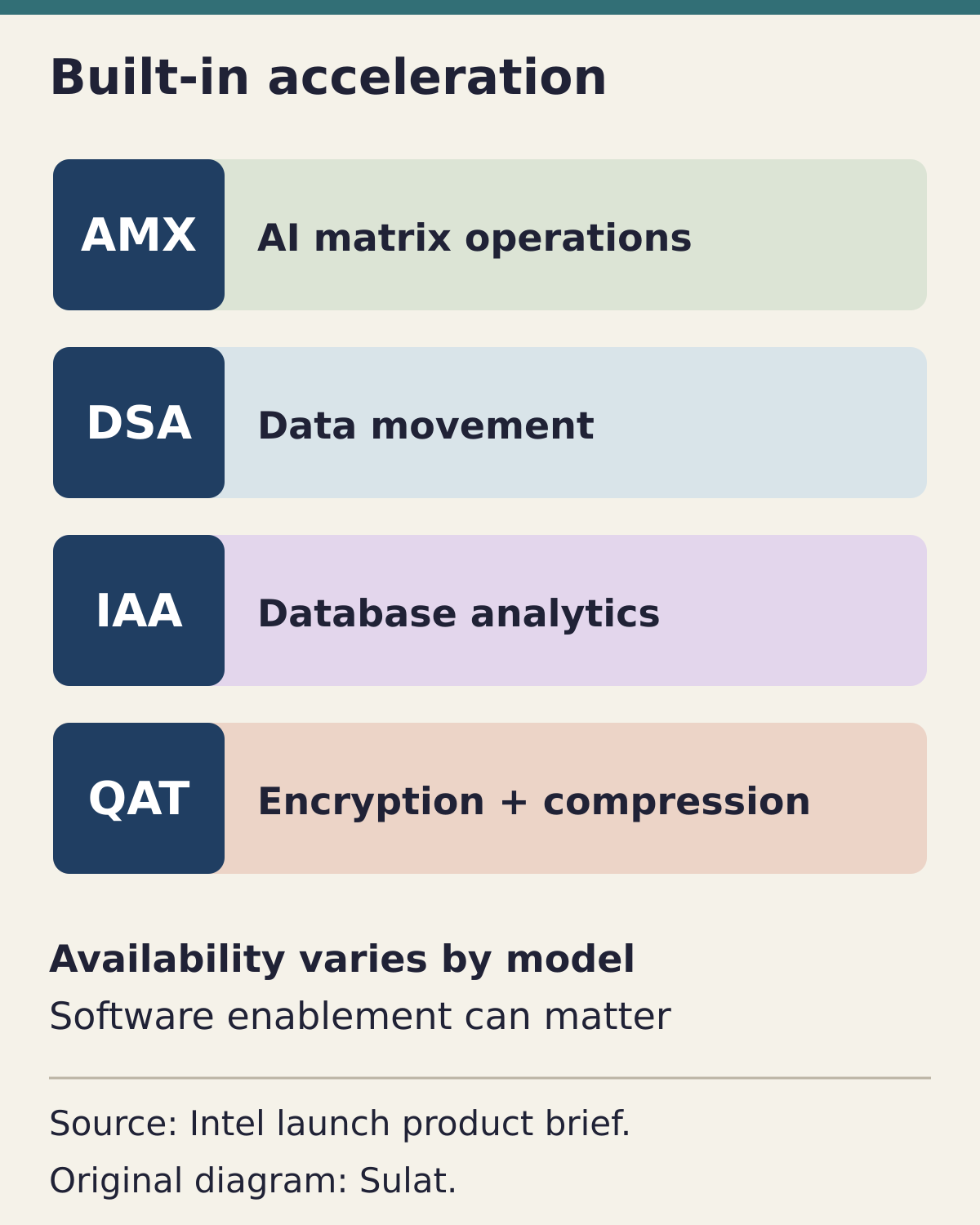
For software teams, the choice involves more than core count. Accelerators differ by processor model, and Intel says features can require enabled software or activation. Buyers need to match the intended application and software stack to the selected chip.
Max adds high-bandwidth memory
The Max families were announced in November, with a January launch planned. Xeon CPU Max places 64GB of high-bandwidth memory on the package for memory-intensive work. Data Center GPU Max is a separate accelerator family. These products extend the platform’s reach into high-performance computing; the November announcement already described GPU blades shipping to Argonne for Aurora.
Separate provider schedules
The launch-day customer fact sheet includes AWS support for the Amazon EC2 portfolio and Cisco’s newest UCS servers. IBM Cloud says it will offer the processors, while Google Cloud describes capabilities customers will be able to use. Those statements do not establish simultaneous general availability at every provider.
Operators choosing a hosted service need to check their provider’s actual instance options and release schedule.
Discover more from Sulat AI & Tech News
Subscribe to get the latest posts sent to your email.