Vercel has added GLM 5.3 Flash, a coding model from the Chinese AI lab Z.ai, to Token Pass, its US$30-a-month token subscription for teams on its Pro plan. The model joins Kimi K3, GLM 5.3 and DeepSeek V4.1 Flash, and all four draw on the same US$80 of monthly credit, according to Vercel’s changelog.
GLM 5.3 Flash is now in Vercel Token Pass.
— Vercel Developers on X
• Z.ai’s native multimodal coding model
• 1M-token context window
Get $80 of tokens for $30/mo ↓
GLM 5.3 Flash isn’t new to Vercel. Developers have been able to call it through Vercel’s AI Gateway since Z.ai released it on 26 August, paying per token. What’s changed is that Token Pass credit now covers it.
What Token Pass is
AI Gateway is Vercel’s service for sending requests to AI models from many providers through one account and one bill. Coding agents and apps connect to it with an API key or a Vercel login. Token Pass is a subscription layered on top: for US$30 per team each month, added to the Pro bill, the team gets US$80 of credit to spend on a short list of “featured” open-weight models.
The credit belongs to the team, so every member and every API key shares it. It resets to US$80 at the start of each billing period, and anything unused expires. Vercel says Token Pass requests have zero data retention, meaning neither AI Gateway nor the company serving the model keeps prompts or outputs, and prompts aren’t used for training. The featured models are served under a provider Vercel calls Vercel Token Pass, which currently runs on Wafer, an outside inference company.
Only Pro teams can subscribe. Hobby users have to upgrade first, Pro trial teams have to move to a paid plan and Enterprise teams can’t buy it. Token Pass is still in early access, which Vercel opened on 15 October to the first 500 Pro teams. When places run out, the dashboard shows a waitlist.
The rules for running out changed this month. At launch, requests stopped when the credit ran out. Since 6 November, any AI Gateway credential spends Token Pass credit first on the featured models and then falls back to the team’s regular, pay-as-you-go AI Gateway credits at the serving provider’s rates. Teams that want a hard cap can still create a Token Pass-only key, which stops with an error until the next billing period instead of spending more.
What GLM 5.3 Flash is
Z.ai, the international brand of Beijing-based Zhipu AI, describes GLM 5.3 Flash as the first natively multimodal model in its GLM-5 series, meaning it was trained to handle images and video alongside text from the start. Its developer documentation lists video, image, text and file input, text output, a context window of 1 million tokens and up to 128,000 tokens of output. A context window is how much text, code and conversation the model can take into account at once.
The model has 320 billion parameters in total but activates only 18 billion for each token it processes, a design that cuts the computing cost of running it. Z.ai published the weights on Hugging Face under the MIT licence, so anyone can download and run it. Before release, Z.ai tested it anonymously on OpenCode and OpenRouter under the name Ox Alpha, and says it serves the model on Chinese-made AI chips.
Introducing GLM-5.3-Flash
— Z.ai on X
– Leading capabilities at a highly competitive price
– Natively multimodal with a 1M-token context window
– A 320B-A18B model released under the MIT License
– Previously previewed as Ox Alpha, running entirely on Chinese AI chips
Vercel’s description of it as a “native multimodal coding model” echoes how Z.ai pitches it. The company says it trained the model to check its own work visually: render a web page, game or slide it has built, look at the result as a user would, spot what’s wrong and change the code. Z.ai’s documentation gives examples that include rebuilding an app from screenshots, laying out presentations and building scenes in the 3D software Blender.
“Vision therefore needs to be natively integrated into the model, enabling it to decide when to observe and use visual feedback to guide subsequent actions.”
— Z.ai, GLM-5.3-Flash announcement
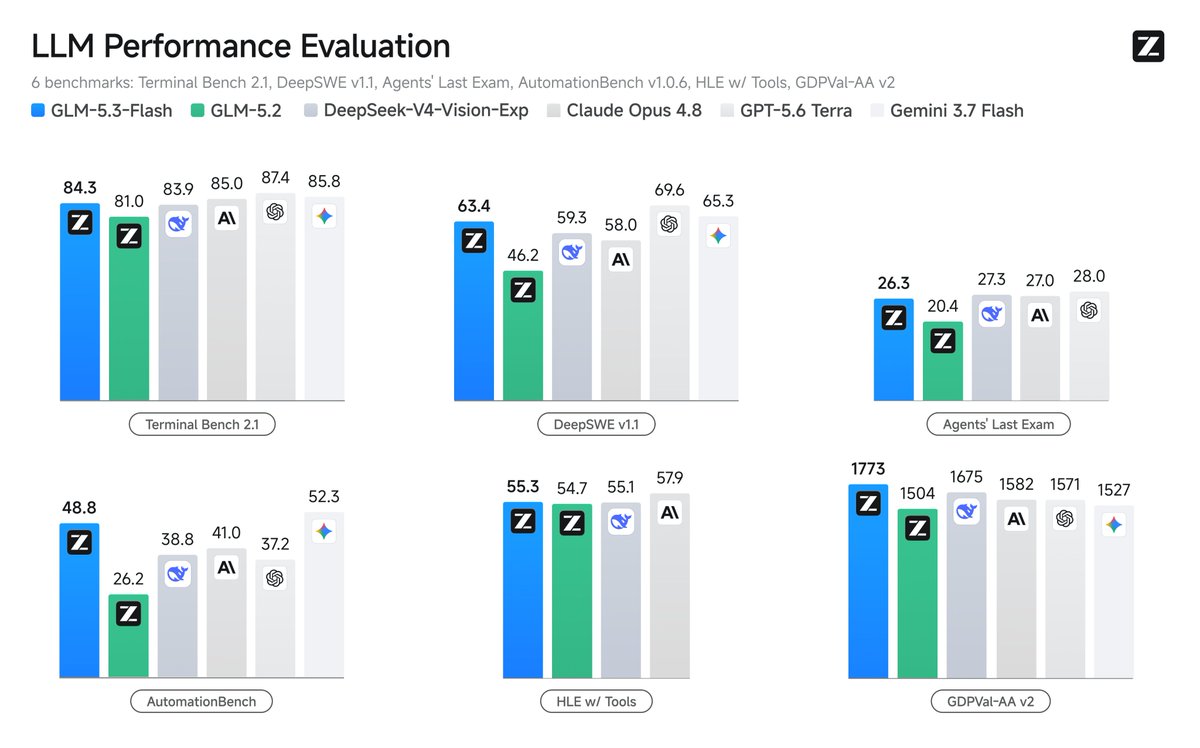
Z.ai says GLM 5.3 Flash beats its earlier GLM-5.2 on its benchmarks while approaching Anthropic’s Claude Opus 4.8 on coding and agent tasks. On DeepSWE v1.1, a software engineering benchmark, Z.ai reports 63.4 for GLM 5.3 Flash against 46.2 for GLM-5.2 and 58.0 for Claude Opus 4.8. On Terminal Bench 2.1, which tests work in a command-line terminal, it reports 84.3, against 85.0 for Claude Opus 4.8. Jie Tang, a Tsinghua University professor who lists himself as a founder of Z.ai, put its price at “1/100 frontier price”.
How far US$80 goes
Token Pass doesn’t give a token allowance. AI Gateway deducts each request from the credit at the model’s list price, which Vercel defines as the model maker’s own API rate. For GLM 5.3 Flash, those rates match Z.ai’s published pricing, and they put it level with DeepSeek V4.1 Flash as the cheapest of the four for uncached input. DeepSeek charges less for cached input, and GLM 5.3 Flash charges less for output.
| Model | Input | Cached input | Output | US$80 if spent only on input | US$80 if spent only on output |
|---|---|---|---|---|---|
| GLM 5.3 Flash | US$0.15 | US$0.03 | US$0.50 | About 533 million tokens | 160 million tokens |
| DeepSeek V4.1 Flash | US$0.15 | US$0.003 | US$0.60 | About 533 million tokens | About 133 million tokens |
| GLM 5.3 | US$1.40 | US$0.26 | US$4.40 | About 57 million tokens | About 18 million tokens |
| Kimi K3 | US$3.00 | US$0.30 | US$15.00 | About 27 million tokens | About 5 million tokens |
Used in full, US$30 for US$80 of credit works out to 37.5% of list price. For GLM 5.3 Flash, that’s roughly US$0.056 per million input tokens, US$0.011 per million cached input tokens and US$0.19 per million output tokens.
Outside Token Pass, prices vary. Vercel’s model page lists 25 providers for GLM 5.3 Flash on AI Gateway. Vercel’s public model data listed Relace, which offers zero data retention, at US$0.0335 per million input tokens and US$0.083 per million output tokens, and Wafer at US$0.054 and US$0.20 for regular AI Gateway users. Relace’s rates for uncached input and output were below a fully used Token Pass for this model, but its cached-input rate of US$0.03 was higher than Token Pass’s effective US$0.011. Provider prices change often, and the two options handle billing caps and routing differently.
What isn’t covered
Token Pass credit only applies when a featured model is served by the Token Pass provider. Vercel’s routing documentation says requests a coding agent sends to another provider, to the “fast” variants of featured models or to other models, including image, video and embedding models, are billed to regular AI Gateway credits instead. GLM 5.3 FlashX, a faster version Z.ai sells at a higher price, isn’t on the featured list. Some agents also send background work, such as titles, summaries and subagent tasks, to a different model unless they’re configured otherwise.
What Sulat could and couldn’t confirm
Vercel’s Token Pass overview, billing and routing pages list GLM 5.3 Flash. Its getting-started guide still told new subscribers to pick from the three earlier models.
The benchmark scores and the description of how the model checks its work come from Z.ai. Sulat hasn’t subscribed to Token Pass or run GLM 5.3 Flash, and the provider prices above come from Vercel’s published listings.
Vercel says it plans to add more featured models and providers, and its terms let it change either at any time while Token Pass is in early access.
Discover more from Sulat AI & Tech News
Subscribe to get the latest posts sent to your email.