Gemini 4 Hydrogen is out, and it’s already in Devin Desktop and the Devin CLI. Google says the new model is built for speed, and for everyday coding and agentic workflows. You can start with it in Google AI Studio and through the Gemini API, including on the free tier. It’s also rolling out in the Gemini app and in Google Search, and paid Google AI Pro and Ultra subscribers can use it in Google Antigravity.
Koray Kavukcuoglu, Google DeepMind’s chief AI architect, introduced the model in a 12 November blog post. Google places Hydrogen alongside its two frontier Gemini 4 models, Argon and Carbon, which it reserves for the hardest, long-horizon work. Hydrogen, he writes, is “built for rapid execution across diverse agentic workflows.”
Now in Devin Desktop and the Devin CLI
Cognition, the company behind the Devin coding agent, says Gemini 4 Hydrogen is now live in Devin Desktop and the Devin CLI. Devin Desktop is Cognition’s coding editor, and the CLI runs in a terminal on the developer’s own machine. Users can pick Hydrogen in both. In the CLI, typing /model opens the selector, and a --model flag can set the model at the start of a session. The public pricing tables on Cognition’s Desktop and CLI model pages are still dated 9 November, before Hydrogen’s launch, and they tell people to check the selector in Desktop or the CLI for what’s on their plan, and what it costs.
Gemini 4 Hydrogen is now live in Devin Desktop and Devin CLI. On FrontierCode 2.0, our benchmark that evaluates models on real-world engineering tasks based on quality and mergeability, Gemini 4 Hydrogen scores 38.2%, just behind GPT-6.1 Sol.
November 12, 2026
FrontierCode 2.0, the benchmark Cognition cites, is its own test of whether AI-written code meets the standards of production codebases. Hydrogen scores 38.2% on it. That sits just behind GPT-6.1 Sol, at 39.0%, and close to Gemini 4 Carbon, at 40.0%, according to Cognition.
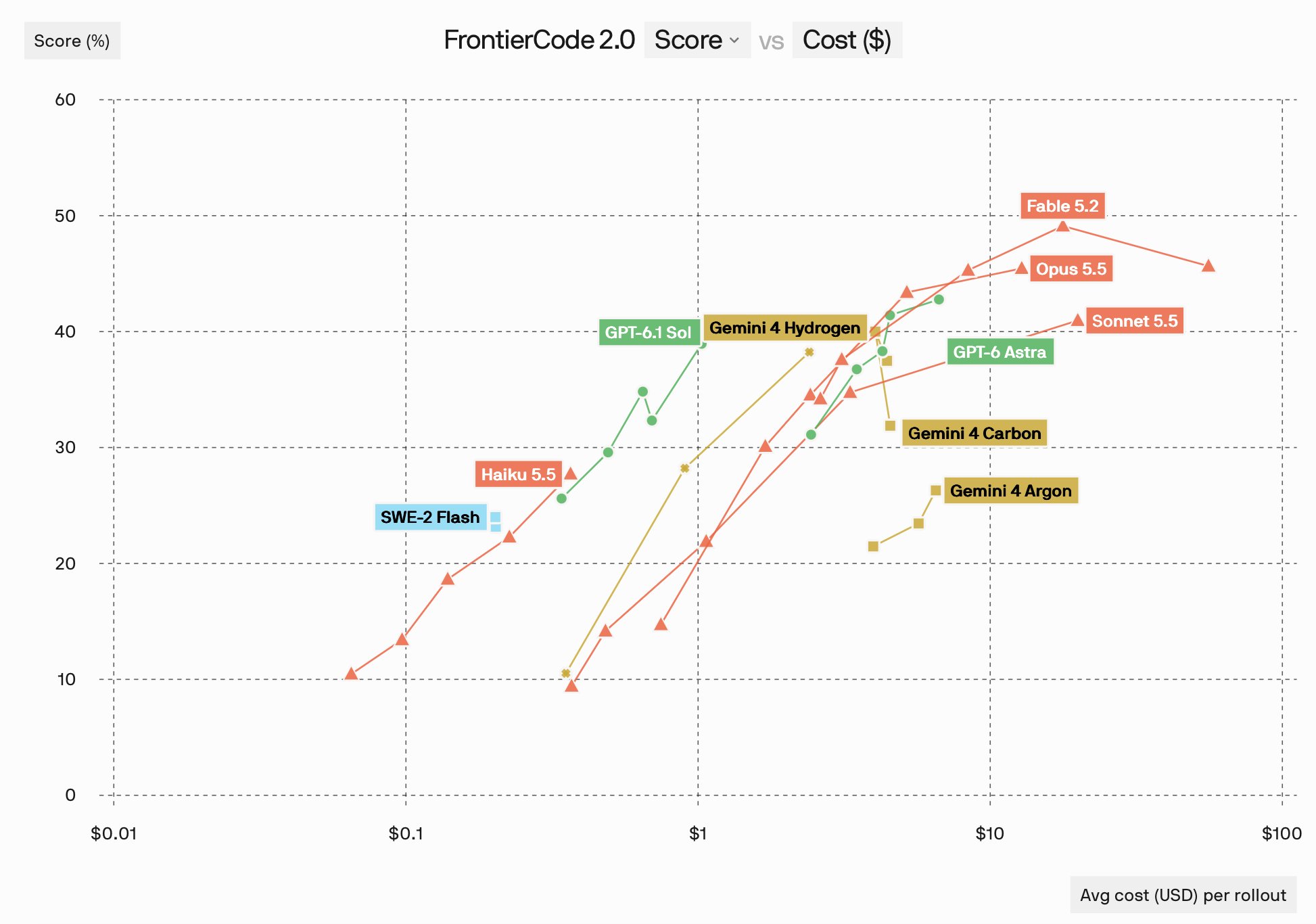
The cost gap is wider in Cognition’s write-up than the score gap. Hydrogen reaches 38.2% at US$2.40 per task, against US$4.04 for Carbon’s 40.0%. Cognition measures that as mean spend per rollout at list API prices, including public discounts. It also says that at medium reasoning effort, Hydrogen already beats Argon’s best result, at less than a seventh of the cost per task. Those figures have not been independently re-run here. Cognition has not said which Devin plans include Hydrogen, or what it charges for the model inside Devin.
introducing Gemini 4 Hydrogen this new model brings cutting-edge intelligence to everyone — with speed and efficiency for everyday coding and agentic workflows
November 12, 2026
Price, context and thinking levels
The model ID is gemini-4-hydrogen. Google’s Gemini API docs list a unified 1 million-token context window, with a default synchronous output limit of 65,536 tokens and long decode up to 1,048,576 tokens. Inputs can be text, images, video, audio and PDFs; output is text. Implicit context caching is supported; explicit caching is not. Batch, Flex and Priority inference are listed as available. The changelog marks the model generally available, and it is now the default for the Antigravity agent in Gemini Managed Agents.
Paid API use is priced flat across that context window at US$1.50 per million input tokens and US$7.50 per million output tokens, including thinking tokens. Implicit cached input is US$0.075 per million tokens. Batch and Flex are US$0.75 input and US$3.75 output. Priority is US$2.70 input and US$13.50 output. The changelog also lists Hydrogen on the Gemini API free tier, where standard input, output and caching are free of charge. Argon and Carbon were not offered on that free tier. Google says every token the model processes is counted and billed on the paid tier, including thinking tokens and tool instructions.
Hydrogen’s standard rate is twice Gemini 3.8 Flash’s current promotional price of US$0.75 and US$3.75, and it matches the Flash rate that begins on 1 January 2027.
Hydrogen has four thinking levels: low, medium, high, which is the default, and a new xhigh tier. Sundar Pichai, Google’s chief executive, said the levels mean “you only wait and pay for the reasoning depth a task requires.”
Following Carbon + Argon, Gemini 4 Hydrogen brings cutting-edge intelligence to everyone. Built for speed and efficiency for everyday tasks, coding and agentic workflows.
November 12, 2026
What Google claims, and what Artificial Analysis measured
Google says Hydrogen scores 51 on the Artificial Analysis Intelligence Index at its default high setting, just above Gemini 4 Argon’s 50, and 54 at xhigh. Against Gemini 3.8 Flash, the previous everyday model, Google says Hydrogen finishes tasks 2.5 times faster at high, more than triples the Terminal-Bench 4.1 score, at 57% against 18.2%, and cuts fabricated claims by more than five times. The blog also lists first place on the Vals Tax Agent Bench, at 52.3%, and a tie for first on the Vals Legal Research Bench, at 55.8%. Google says Hydrogen leads its class on HLE-Diamond, at 58.8%, on AutomationBench-AA, on a new Multimodal Knowledge Agent test, at 53.4%, and on Agents’ Last Exam v1.1, at 71.6%. On Agent Arena, Google places it fifth. Partner tests cited in the blog put Hydrogen two to 2.8 times faster than 3.8 Flash on complex graph, SQL and data-heavy workflows, with 12% to 23% fewer tokens.
Artificial Analysis posted its own results the same day. Its Intelligence Index numbers match Google’s: 51 at high, 54 at xhigh. That puts Hydrogen one point behind Claude Sonnet 5.5 at its max setting, and GPT-6.1 Sol at its max setting. It estimates xhigh costs about 32% as much per task as Sonnet 5.5 at max, and about 2.5 times as much as GPT-6.1 Sol at max. At high, it says Hydrogen matches Argon’s intelligence for about 19% of the cost per task. Its cost-per-task figures are US$3.16 at xhigh, US$1.87 at high, US$0.80 at medium and US$0.29 at low, with Intelligence Index scores of 54, 51, 41 and 27. It also records an output speed of about 200 tokens per second, and places the high, medium and low settings on its Time per Task versus Intelligence frontier.
On Terminal-Bench 4.0, Artificial Analysis scores Hydrogen at 54%, behind Claude Sonnet 5.5 at max, at 64%, and GPT-6.1 Sol at max, at 56%. On Terminal-Bench-Science 0.1 it scores 50%. The firm says xhigh lifts that science score from 41% at high, and makes no difference on Terminal-Bench 4.0. Those terminal results use a different suite from Google’s Terminal-Bench 4.1 comparison with 3.8 Flash. On AA-Omniscience, Artificial Analysis gives Hydrogen a hallucination rate of 8%, against 43% for Sonnet 5.5 at max and 52% for GPT-6.1 Sol at max. On GDP.pdf, a visual reasoning test over long documents, it says medium reasoning ties for the top all-pass score.
Google’s new Gemini 4 Hydrogen has Intelligence just below Claude Sonnet 5.5 and GPT-6.1 Sol, at a third of Sonnet’s cost but ~2.5x that of GPT-6.1 Sol
November 12, 2026
Arena’s numbers are in too. Its Agent Arena leaderboard, built from about 6,500 real agentic sessions, has Hydrogen on high in fifth place. Nothing else in its top 10 is quicker: Arena clocks a median of 5.3 minutes a task, at a median cost of US$1.60. One trade-off is output. Hydrogen writes 41% more output tokens per task than Carbon does, and 2.8 times what Argon writes. Narrow it to knowledge work and Hydrogen climbs to fourth, passing Claude Opus 5.5, GPT-6 Astra and Claude Sonnet 5.5 at max, which all beat it overall.
Gemini 4 Hydrogen (High) by @GoogleDeepMind debuts #5 on Agent Arena with +14.8% net improvement across 6.5k real-world agentic sessions. Hydrogen stands out for its speed and cost efficiency
November 12, 2026
Over on Arena’s WebDev board, the same high setting starts 10th with 1,703 points. That’s a whisker above Claude Opus 5 at max and Gemini 4 Argon on high. HTML and content-creation tools are its best categories, at fifth in each.
CursorBench, Cursor’s in-house coding test, gives Hydrogen 54.3% on high, at an average of US$5.59 a task. Drop to medium and it’s 46.7% at US$1.76. Low lands at 27.9% for 28 US cents. For comparison, Claude Fable 5.2 on low gets 53.2% at US$3.94 a task on that chart, and Gemini 4 Carbon on high gets 60.4% at US$9.22.
Parallel Web Systems builds web search tools for AI agents, and its leaderboard tests how well models answer research questions when they’re allowed to search. Hydrogen comes in eighth, on 72.7, two places above Gemini 4 Argon, and costs US$175 per 1,000 tasks. Parallel says no other closed model beats it on speed, price and intelligence all at once. Claude Fable 5.1 scores 73.4 on the same board, but costs about ten times as much. Parallel’s run used an early version of the model, tested on 10 November.
Artificial Analysis has a new robotics test too, AA-Robotics, with jobs like pouring a drink and tidying blocks. Hydrogen is the best Google model on it and fourth overall, behind Claude Fable 5.2, GPT-6 Astra and GPT-6.1 Sol. The firm noticed Hydrogen was honest about how it did: it flagged a small spill during the pour and a lid it left open after tidying.
Gemini 4 Hydrogen is the leading Google model on AA-Robotics v0.1, sitting fourth overall behind Claude Fable 5.2 (75), GPT-6 Astra (69) and GPT-6.1 Sol (65) Hydrogen was very honest about its performance, pointing out a minor spill when pouring the drink and an unclosed lid when tidying blocks
November 12, 2026
Box has its own numbers. Aaron Levie, Box’s chief executive, says the company tested Hydrogen in early access on its Box AI Complex Work Eval, which gives Box’s agent complex tasks with enterprise documents from finance, consulting, life sciences and other fields. By his account, Hydrogen was five percentage points more accurate than Gemini 3.8 Flash, finished in less than half the time and used about 12% fewer tokens on a typical task. He says Hydrogen is coming to Box AI Studio shortly, so customers can build custom agents with it.
Ok this is a big deal. We’ve been testing Gemini 4 Hydrogen in early access with the Box AI Complex Work Eval, and it’s a serious jump for fast models. Hydrogen is 5 percentage points better in accuracy than Gemini 3.8 Flash.
November 12, 2026
Rapidata, which runs benchmarks judged by crowds of people, says Hydrogen entered its LLM-to-3D leaderboard in fourth place, from more than 1.48 million human judgements across 25 models. That puts three Gemini models in its top four.
Commure, a healthcare technology company, also had early access. Ash Bhat, its vice-president of R&D, says Hydrogen scored 92.91 on the company’s RCM-Bench, a set of 97 medical billing, claims and insurance eligibility tasks. That’s just above Claude Opus 5 on 92.68, and ahead of Gemini 4 Carbon (90.38), Gemini 3.8 Flash (90.23) and GPT-6.1 Sol (87.37). He puts Hydrogen’s estimated agent cost about 71% below Opus 5’s. Against 3.8 Flash, he says, the gain is 2.68 points at twice the token price. The public RCM-Bench-1 leaderboard that Fireworks hosts hasn’t added Hydrogen yet.
Commure R&D had early access to Gemini 4 Hydrogen & Carbon—and joined the @GeminiApp team for the GA release! On Commure’s 97-case RCM-Bench: • Gemini 4 Hydrogen: 92.91 • Claude Opus 5: 92.68 • Gemini 4 Carbon: 90.38 • Gemini 3.8 Flash: 90.23 • GPT-6.1 Sol: 87.37
November 12, 2026
In Google Antigravity, Google is also shipping Orchestrator, which it says switches between models such as Carbon and Hydrogen in a single session. On Terminal-Bench 4.0, Google says Orchestrator reached near-Carbon success rates while, on average, using 24% less quota and finishing 19% faster. In that setup, Carbon can plan while Hydrogen runs worker and verifier agents. Google’s official posts say Orchestrator is available to Google AI Ultra subscribers.
Logan Kilpatrick, who leads Google AI Studio, said he has been using Hydrogen daily, “alongside thousands of people across Google.”
Introducing Gemini 4 Hydrogen, an extremely capable and fast model built to bring Gemini 4 to everyone!
November 12, 2026
What people have been building with Hydrogen
Google has also posted its own Hydrogen demos. A Managed Agent app called 3D Medic, built in Google AI Studio, inspects 3D files, catches errors and patches them before export.
Watch how the 3D Medic Managed Agent app built in @GoogleAIStudio uses Gemini 4 Hydrogen to inspect your 3D files, catch errors, and patch them before export.
November 12, 2026
The launch blog shows Hydrogen adding structures to a shared voxel world called Geminisland from a single prompt, building an e-commerce storefront in one shot in Antigravity with Google’s new Gemini front end design skill, turning Google Sheets into an animated pixel canvas, and generating a Google Slides deck from a YouTube keynote, then running an audit-and-fix loop on the layout. Chandu Thota, who leads engineering for Google Workspace, said Hydrogen can generate interactive Sheets canvas outputs over 30% faster than previous models. The front end design skill lives in Google’s Gemini DemoLab repository. Google says its own evaluations found people preferred designs made with the skill 67% of the time over designs with no skill, and 75% of the time over popular third-party frontend design skills.
Independent testers have been putting Hydrogen on 3D and SVG jobs, including some runs on Arena and in Antigravity as the model was rolling out.
Lumina, who tests new models, posted a 3D seaplane built with Hydrogen at xhigh, and called this their favourite Gemini 4 release so far, “arguably on par with Argon while being much cheaper, more efficient and significantly faster.”
Gemini 4 Hydrogen xhigh 3D seaplane This is probably my favourite drop of the Gemini 4 series so far, arguably on par with Argon while being much cheaper, more efficient and significantly faster
November 12, 2026
A tester writing as Iam_ compared Hydrogen at high with GPT-6 Astra at max on a 3D scene. Hydrogen finished in under three minutes, the tester said, while Astra took more than 30 minutes and cost ten times as much. They preferred Hydrogen’s result, including a shadow that Astra left out. In a later 3D test, the same account said Hydrogen at high built the scene in under five minutes and, in their view, matched the quality of Claude Sonnet 5.5 and Opus 5.5 on that task.
Gemini 4 Hydrogen vs GPT-6 Astra Max Hydrogen finished in under 3 minutes while Astra took over 30 and cost 10 times as much on this test, but I liked Hydrogen’s result way more. Look at the shadow it added that Astra left out
November 12, 2026
Before the public launch, Marcel ran the same prompt on Arena: an SVG of a pelican riding a bicycle across five animated seasons. Fable 5.2 at high, in Claude Code, took about 25 minutes and about US$25. The Hydrogen Arena run took about five minutes, with the cost unknown. Marcel said Hydrogen held up surprisingly well, and that Fable won on detailing. After the launch, Super Niu ran a similar pelican-on-a-bike comparison against GPT-6.1 Sol and said Hydrogen finished in 50 seconds, against 25 minutes for Sol, and used about 15% of Sol’s tokens.
Fable 5.2 vs Gemini 4 Hydrogen (Pelican SVG Test) same prompt: create an svg of a pelican riding a bicycle across five animated seasons. Fable 5.2 (high, Claude Code): ~25 mins, ~$25. Gemini 4 Hydrogen (Arena): ~5 mins, cost unknown. Hydrogen held up surprisingly well
November 10, 2026
Marcel came back after the launch with a new prompt: a Studio Ghibli-style SVG of a girl and her cat on a tandem bike at golden hour. He gave it to Claude Opus 5.5 in Claude Code, which took about an hour and roughly US$18 in API costs. Hydrogen, running in Cursor, needed about 15 minutes and under a dollar. Opus used the extra time on a night mode and music. Hydrogen just got the whole scene finished.
Gemini 4 Hydrogen vs Opus 5.5 (Tandem Ride SVG) same prompt: create an SVG of a girl and her cat on joined bikes, golden hour, ghibli style • opus 5.5 in claude code: ~1 hr, ~$18 api cost • gemini 4 hydrogen in cursor: ~15 mins, ~$0.9 api cost
November 12, 2026
Sai Nemani tried a simpler test. He asked Hydrogen and Gemini 3.8 Flash, both on high, to make a beautiful and creative single-page website, then put the two videos next to each other. His verdict was that Hydrogen is a big step up in both intelligence and speed.
Shengzhe Yao, who works on Antigravity at Google DeepMind and created the Antigravity CLI, pointed Hydrogen at the CLI’s swarm mode from an empty directory. One prompt, he said, spun up a queen coordinator plus 22 workers: Carbon ran the coordinator, four QA verifiers and a shell integrator, and Hydrogen ran 16 parallel builders, plus a stall monitor, that shipped 16 canvas mini-apps at 60 frames per second, with no extra dependencies.
Gemini 4 Hydrogen just landed in Antigravity CLI (`agy`), and it flies in `/swarm`. 1 prompt from an empty directory -> 1 Queen + 22 worker bees: Queen coordinator, 4 QA verifiers & shell integrator on Gemini 4 Carbon. 16 parallel builders (+ stall monitor) on Gemini 4 Hydrogen
November 12, 2026
Other hands-on tests are worth recording, even where the accounts have posted less about them. Stats Wire built an interactive 3D pelican riding a vintage bike in Three.js, and later started a four-way test of a playable 3D Mario in Three.js, with no external models or textures, across Gemini 3.8 Flash, Argon and Carbon at high and Hydrogen at xhigh. The post did not name a winner. Adam Holter ran a frontend test at Hydrogen’s extra-high setting with Google’s design skill on one side and without it on the other, and posted the two results side by side. On an NYC skyline scene, one tester put Hydrogen above Claude Haiku 5.5 and said Hydrogen took test screenshots, reported that it had “visually verified all 5 rendered frames” with zero errors, and never fixed a giant black blob in the middle of the screen. The parts you could see, the tester said, were good, including the Statue of Liberty, One World Trade Center, both bridges, taxis, subway globes and hot dog carts. Camper asked Hydrogen at high to build a voxel Chinese mountain temple at sunrise, and said it took 42 minutes, one prompt and three sign-offs, with no Blender edits from the author. Leo compared SVG gamepads and said Hydrogen’s buttons and overall detail beat GPT-6.1 Sol, at about ten times the tokens per second. KC and Bhavani posted the same clip of a Hydrogen run finishing in about a minute, against three minutes on Gemini 3.8 Flash; they did not describe the underlying task in the post text.
Camper’s second go was an ice crystal drifting down onto a forest floor, written in plain Three.js with no 3D models or textures pulled in from outside. On xhigh it ran for 13 minutes, GPU renders and all, and cost about US$4.64 for an 18-second clip. By Camper’s account, Hydrogen modelled an 8,448-triangle snowflake, wrote its own ice shader that splits light into colours, then went back and fixed three bugs of its own. One was a NaN error in the audio.
Tony runs the same prompt through rival models and posts what each one costs and how long it takes. His Hydrogen run finished in 1 hour 23 minutes and cost US$4.27. Gemini 4 Carbon needed 2 hours 39 minutes and US$8.83. He said he was surprised how fast and cheap Hydrogen was.
Gemini 4 Hydrogen vs Gemini 4 Carbon 🧊 Gemini 4 Hydrogen is out 😱 I’m very surprised by how fast and cheap it is. I’m very impressed by it. Almost twice as fast and half the price of Gemini 4 Carbon. Gemini 4 Hydrogen: $4.27 · 1h 23m 40s Gemini 4 Carbon: $8.83 · 2h 39m 10s
November 12, 2026
Some people kept it to one file. Artem wanted a 3D reaction-diffusion organism in a single Three.js file, and he says Hydrogen came back with a full GPU simulation pipeline and a procedural audio synth on the first try. Alok gave it one prompt for a realistic Earth seen from space, with the camera gliding all the way down to the Statue of Liberty, and posted the animation. Uzzy, a game developer, showed a 3D preview of The Last Moon, his game in progress, made with Hydrogen.
Haleemah gave Hydrogen and Claude Sonnet 5.5 the same 3D koi pond prompt and left the verdict to her followers. She hasn’t picked a winner yet. Her next plan is to rerun the prompt in Devin.
gemini 4 hydrogen beat sonnet 5.5 on benchmarks so I put it to the test 3d koi pond gemini 4 hydrogen vs sonnet 5.5 who did it better ?
November 12, 2026
Camper’s third test was a glazed pot shattering on a wooden floor, again in plain Three.js. On xhigh it took 31 minutes and about US$6.21 across 121 API calls, with three sign-offs and no manual edits to the scene. Camper says Hydrogen cut the pot into 71 Voronoi shards, worked out how they bounced and slid, built a sunlit living room around them, and caught several of its own rendering bugs in test stills before producing a 16-second clip.
Google’s Android Developers team gave Hydrogen a prompt in Antigravity and, after some back and forth, ended up with Lingo City, an app built around bilingual conversations. It streams 2D SVG sketches, lets you wander 2D and 3D streets from Paris to Rome, and has local characters you can talk to out loud, voiced in real time by Google’s Gemini Audio models.
Speed keeps coming up in the hands-on tests. AJ, an independent AI developer who posts as ItsmeAjayKV, says Hydrogen built an isometric Sahara desert scene in Three.js inside the Gemini web app in 25 seconds. He then got an animated 3D teahouse out of it in a single turn on high effort, in about a minute by his reckoning, and says he’ll start using it for quick, cheap prototypes.
Not every test went smoothly. Roboflow’s open-source lead, who posts as SkalskiP, asked Hydrogen on xhigh to read the jersey number in a photo. It thought for nearly ten minutes, burned through 131,069 thinking tokens and about US$1.08, then stopped without an answer. He says he saw the same thing on 1.8% of his team’s text benchmark, even with a thinking budget of 131,072 tokens. When another user tried the same photo and got 11 back using about 300 tokens, SkalskiP said you need xhigh to see it.
I asked gemini hydrogen (xhigh) to read the jersey number in this image 131,069 thinking tokens 9 minutes 55 seconds $1.08 estimated cost no answer. I saw the same budget-exhaustion behavior on 1.8% of our text benchmark, even with a 131,072-token limit.
November 12, 2026
Cost can cut the other way, though. Luckey Faraday, who tests and compares models on X, ran the same prompt through Hydrogen, Gemini 4 Carbon and Claude Fable 5.2. Hydrogen used 3.69 million tokens and cost US$1.62. Carbon got there on 398,000 tokens for US$0.77, less than half the price, and Fable 5.2 used 19.1 million tokens at US$29.41. He didn’t share the prompt, but the result lines up with SkalskiP’s finding that Hydrogen can spend heavily on thinking.
Where you can use it
Availability is broader than the earlier Gemini 4 releases. Besides the API and AI Studio, Google is rolling Hydrogen out to all users of the Gemini app on desktop, mobile and web, and to Google Search worldwide. Free Gemini app users get it through automatic model selection when Google judges it the right model for the prompt; paid users can pick it from the model dropdown. Paid Google AI Pro and Ultra subscribers can use it in Antigravity and in Gemini in Google Sheets. An official post from Google’s main account also lists Gemini in Chrome for those paid plans. Enterprises can call it in Gemini for business. Android Studio access is on the paid tier.
Google’s safety write-up for Hydrogen is in the model card. Among the figures it publishes, it says Hydrogen reduces overreach in agentic tasks by up to 81% and under-service by up to 79% against 3.8 Flash, and that false refusals on HealthBench Pro stay under 0.4%.
The API docs include a migration guide from Gemini 3.8 Flash, which Google now recommends teams replace with Hydrogen for everyday coding, tool-using agents and multimodal document work.
Hydrogen is now in the OpenRouter catalogue as google/gemini-4-hydrogen, with a batch variant, at Google’s list prices of US$1.50 and US$7.50 per million tokens on the standard route, and US$0.75 and US$3.75 on batch and on OpenRouter’s Google AI Studio flex endpoint. A Google Vertex global endpoint is also listed, at the standard rate. OpenRouter’s catalogue sets the default reasoning effort to medium, which differs from Google’s API default of high. Google has also published a Gemini Enterprise Agent Platform model page for gemini-4-hydrogen, with the same 1 million-token context window. Google’s Gemini cookbook has switched its general-purpose quickstarts to Hydrogen as the default. A pull request is open on Vercel’s AI SDK to add the model ID and the xhigh thinking level. Google for Developers also pointed builders at Firebase AI Logic for client-side use.
You can now pick Hydrogen inside Cursor too, as gemini-4-hydrogen. Cursor’s model page gives it 200,000 tokens of context by default, up to a million at most, and sets effort to high, which it says to leave alone for agentic coding. It’s billed as a third-party model, so it doesn’t come out of the usage bundled with a Cursor plan. Google Cloud’s Gleb Otochkin, who looks after databases as a developer advocate, posted a demo of an AlloyDB query calling Hydrogen directly through ai.generate.
Robby Stein, vice president of product for Google Search, wrote that Hydrogen is “the biggest model upgrade to Search yet,” and that it is rolling out globally for all users, with tighter intent following, a broader query fan-out to links, and more visual, structured answers.
Search Engine Journal and 9to5Google report that Hydrogen is now the default model in AI Mode for everyone, and that Google is using it for the hardest questions in AI Overviews. Nick Fox, Google’s senior vice president for Knowledge and Information, called it “the biggest model improvement to Search yet.”
Today, Search is getting a massive upgrade with Gemini 4 Hydrogen! It’s the biggest model improvement to Search yet. And it’s available now for all users, globally.
November 12, 2026
Google’s rate-limits page now includes Hydrogen in its batch enqueue tables: 3 million tokens on tier 1, 400 million on tier 2 and 1 billion on tier 3, the same figures as Gemini 3.8 Flash, and below Argon and Carbon on tiers 1 and 2. The page does not list a separate free-tier requests-per-minute row for Hydrogen.
Google has not named Hydrogen as a Flash model, and it has not announced Gemini 4 Helix, a name testers had used for a possible Flash-Lite follow-on. Testers still often describe Hydrogen as Flash-class. Gemini in Chrome is still listed only in the official post from Google’s main account; a separate product page has not been posted alongside the other official product write-ups.
Discover more from Sulat AI & Tech News
Subscribe to get the latest posts sent to your email.