Innovation Council Action, a pro-AI advocacy group, posted a clip on 12 November of a man who lives under half a mile from Google’s data centre in Clarksville, Tennessee, saying noise and light pollution haven’t bothered him. The quote is accurate. It comes from a 14 News (WFIE) report that also has Clarksville’s mayor and the county mayor saying they don’t want a second data centre.
The man is Greg Farmer, a neighbour of the site. The post’s text doesn’t name him or the station, and X showed 1.6 million views on it on 13 November.
🚨 A man who lives LESS THAN HALF A MILE from Google’s data center in Clarksville, Tennessee, says noise and light pollution have NOT been an issue. “Everybody’s saying how bad they’re gonna be… I haven’t seen anything negative. I’ve only seen the positive side.”
— Innovation Council (@innovationcncl) November 12, 2026
What Farmer said
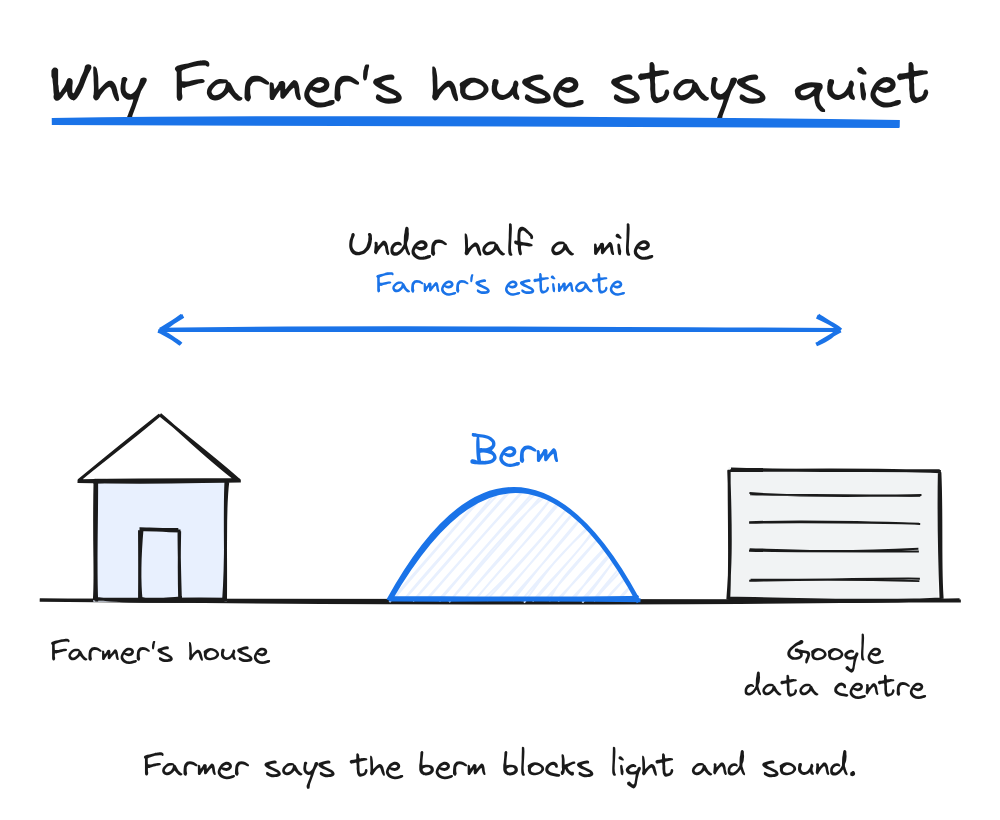
Reporter Emma Beck quotes Farmer saying the berms around the site keep light and sound from reaching his home. He puts the data centre at less than a half-mile away, “just over the berm”. The berms were installed by Hemlock Semiconductor, the manufacturer that once planned to build on the site, and the data centre sits in a large industrial park they border. Farmer says that without the berm “we would probably see more lights”, and that the industrial park was already lighting the area before the berm went up.
He says the facility hasn’t changed his water or electric bills and has given local people jobs. He also says “I don’t know much about the data center itself.” The line the post uses is a direct quote, and the full sentence opens with “The data centers around the United States”.
The post, claim by claim
| Claim in the post | Check | What the sources say |
|---|---|---|
| He lives under half a mile from Google’s Clarksville data centre | Confirmed | Farmer’s own estimate to 14 News. Nobody has measured it. Jeff Tyndall, director of the Clarksville-Montgomery County Regional Planning Commission, says the nearest neighbourhood is more than 1,000 feet from the site. |
| Noise hasn’t been an issue | Confirmed as his account | Farmer credits the berms. Tyndall told the Arkansas Democrat-Gazette he knows of no resident complaints about noise, pollution, water use or power draw at the site. |
| Light pollution hasn’t been an issue | Confirmed as his account, with a qualifier | Farmer says the berm blocks it and the industrial park was lit before the berm. County Commissioner Joshua Beal raised light on 19 October, and ClarksvilleNow quotes Tyndall saying it was the first he’d heard of it. |
| “I’ve only seen the positive side” | Accurate quote | Farmer also says he doesn’t know much about the data centre itself. |
| Implied: worries about data centre noise and light are overblown | Not shown by this clip | One neighbour at one site. Residents at other sites describe constant noise, covered below. |
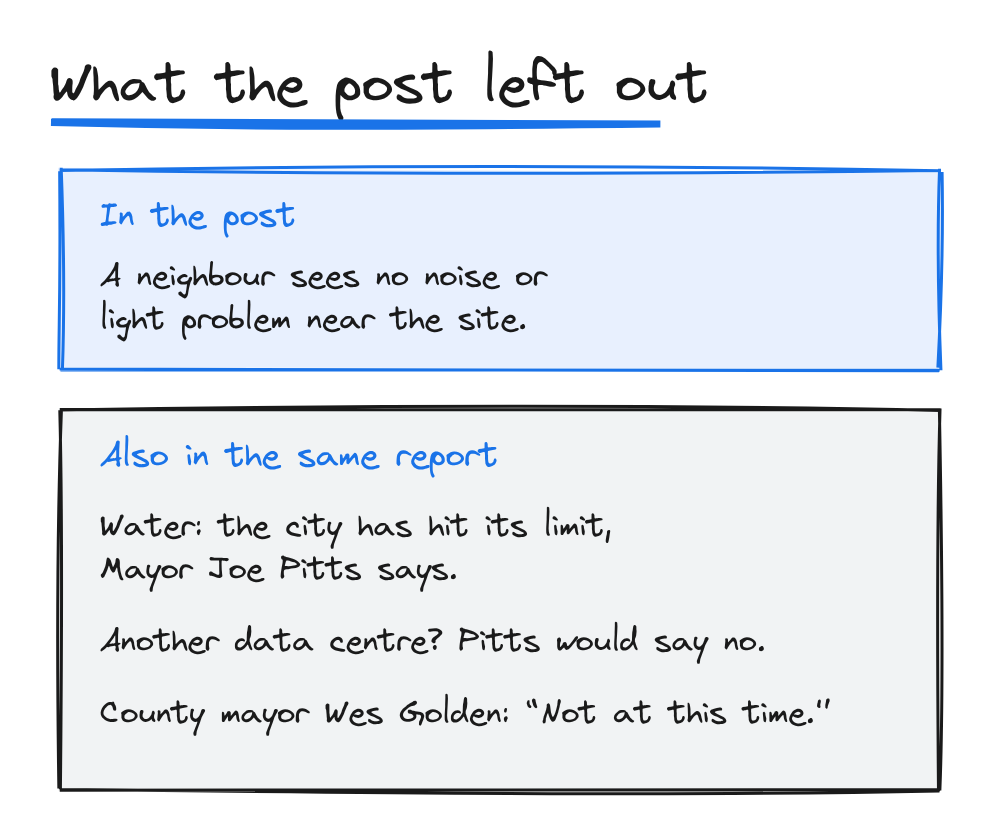
| Not in the post’s text | In the same report | Mayor Joe Pitts says the city has hit its water limit for the site and would say no to another data centre. County Mayor Wes Golden says “Not at this time”. |
One quiet site doesn’t speak for the rest
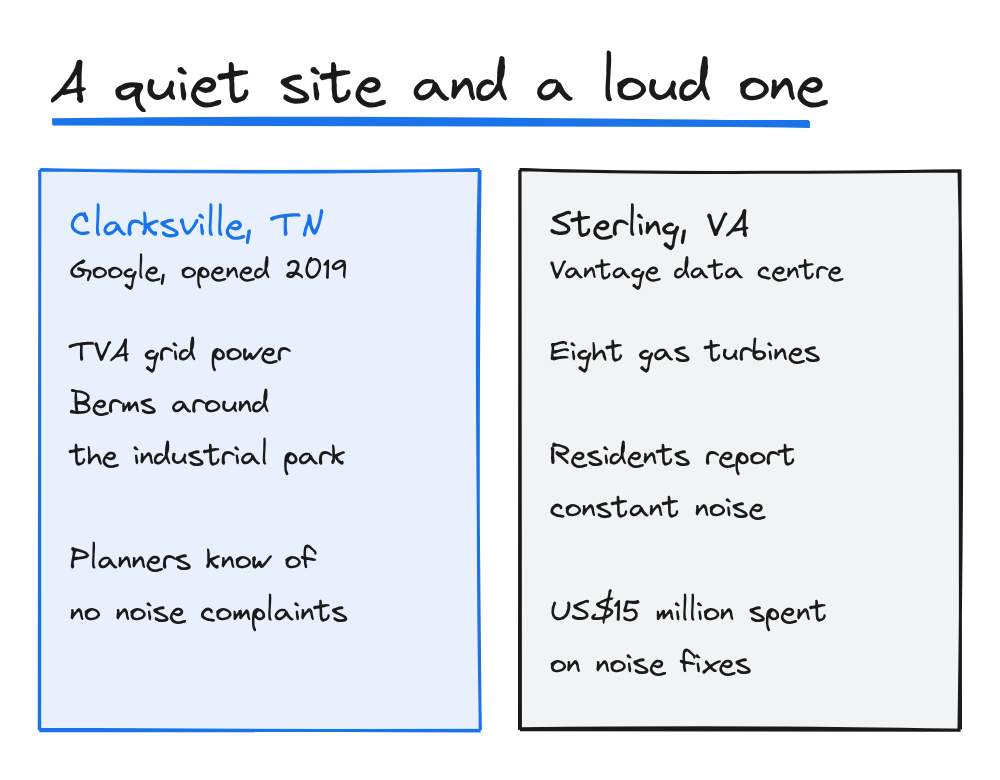
Google has run the 1.4-million-square-foot Clarksville facility since late 2019, 14 News reports. The Compute Atlas listing for the site names the Tennessee Valley Authority as its utility and records no on-site generation.
Newer sites that run their own power draw complaints. Loudoun Now reports that residents beside Vantage’s campus in Sterling, Virginia, which it calls Virginia’s only data centre powered by on-site gas turbines, say they have heard a high-pitched whine almost constantly since the turbines came online. Vantage says it has put US$15 million into noise mitigation. The Salt Lake Tribune reports that neighbours of Aligned Data Centers’ West Jordan, Utah, campus describe a constant low hum that gets louder when generators run. The Salt Lake County Health Department has received four formal noise complaints since August, and Aligned says it has hired a third-party firm for a sound study. Those are residents’ accounts.
Loudoun County’s own guidance says data centre noise often sits in a narrow band of frequencies, and that single tones can be more aggravating than background noise at similar volumes.
What the same report says about another data centre
Pitts told 14 News he would say no to another data centre in Clarksville because the city doesn’t know the impacts, doesn’t have the water capacity and, he says, the TVA is struggling to keep up with demand. Google and the local government signed a non-disclosure agreement when the company arrived, so the site’s water use is confidential. “I just know that we’ve hit our limit,” Pitts said. Golden said the county has no resources left for another one.
Pitts also credits Google’s arrival with letting the city expand Wi-Fi in three parks and in lower-income neighbourhoods, and says the rise in local bills comes from TVA rate increases and inflation, “not due to Google necessarily”. Google says it has invested more than US$6 billion in Tennessee since it built the site in 2018, according to its Montgomery County page.
Montgomery County commissioners voted 17 to 4 on 9 November for the county’s first data centre zoning rules, Fox 17 reports. Future sites must be 10 to 100 acres and at least 500 feet from most zones. A noise plan must keep sound within three decibels of the ambient level, with a 55-decibel maximum next to property outside industrial zones, and applicants need letters confirming water, power and gas service. The commission didn’t vote on the moratorium that residents asked for, and no data centre proposal was before it. Tyndall told NewsChannel 5 the rules can’t apply retroactively to Google’s current operations, but any expansion would have to meet them. Farmer told 14 News he knows Google is expanding.
Who posted it
Innovation Council Action says on X that it’s advancing policies that “unleash American genius and ensure the United States dominates the future of artificial intelligence”. It launched in March with a pledge to spend at least US$100 million, the New York Times reported, led by Taylor Budowich, a former White House deputy chief of staff, and welcomed by David Sacks, who chairs the President’s Council of Advisors on Science and Technology. Transformer reported on 6 November that a Utah filing lists three directors: Chris Applegate, Brian Murray and Mark Woolway. Murray and Woolway are executives at Craft Ventures, the firm Sacks founded. Craft says it “is not a donor or involved in the group”. As a 501(c)(4) nonprofit, the group doesn’t have to disclose its donors. Transformer also reported that its political action committee was dissolved without raising or spending money.
The Midas Project’s Model Republic reported in July that three of the group’s videos drew roughly 100,000 to 375,000 views each on X, driven by quote-posts from more than 25 right-wing influencers, while the same videos had between six and 17 views on YouTube. It said it couldn’t confirm the promotion was paid, and the group didn’t respond. That report covered July videos. None of the sources checked shows how the Farmer post was promoted.
Nobody has measured sound or light at Farmer’s home, and Google’s water use stays confidential under its agreement with the city.
Discover more from Sulat AI & Tech News
Subscribe to get the latest posts sent to your email.