Artificial Analysis has released version 2.1 of its Coding Agent Index, and Anthropic’s Claude Fable 5.2 and Claude Opus 5.5 share the lead at 58. The independent testing firm says the update swaps in a harder coding benchmark, and that scores fell by 5 points on average as a result.
Artificial Analysis announced the release in a post on X on 14 November 2026. The index scores a model together with the agent harness it runs in, meaning the program that lets the model read files, run commands and work through a task in steps, so each entry is a model and harness pair.
What changed in the index
The index is an equal-weight average of three benchmarks, according to Artificial Analysis’s methodology page. Two of them changed in version 2.1 and one stayed.
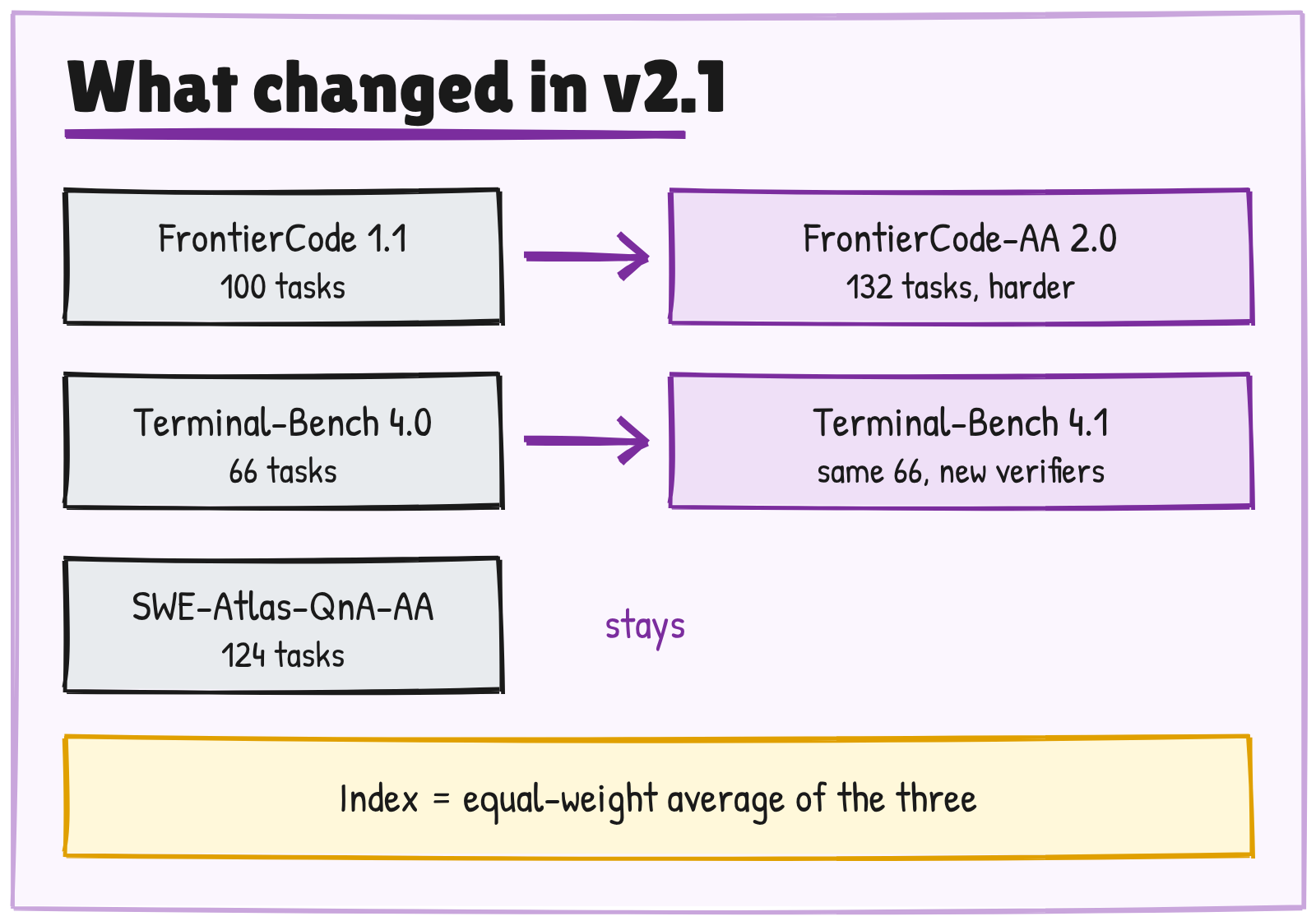
FrontierCode-AA 2.0 replaces FrontierCode 1.1. It is Artificial Analysis’s implementation of Cognition’s FrontierCode 2.0: 132 tasks in real open-source repositories, each graded on whether a maintainer of the repository would merge the agent’s change. Version 1.1 had 100 tasks. Cognition says the 2.0 reference solutions change 67% more files and 89% more lines of code than version 1.1, in codebases that are 25% larger.
An attempt that fails any blocking check scores zero. One that passes them all scores between 70% and 100%, depending on how many non-blocking checks it meets. Artificial Analysis runs three attempts per task, uses GPT-6 Luna at medium effort as the judge, and scores an attempt zero if the integrity checks find it looked up the upstream solution, such as the original pull request. The tasks aren’t public.
Terminal-Bench 4.1 keeps the 66 tasks of version 4.0 and changes how they’re graded. Tasks that run code the agent wrote now run it as an untrusted user in a separate process, so the code can’t read the tests or edit the reward file, and verifiers that rejected valid solutions are corrected. The Terminal-Bench team says its regrade changed the score of 162 trials on the 4.0 leaderboard. SWE-Atlas-QnA-AA, 124 questions that ask an agent to trace code in a repository and explain it, is unchanged.
Who leads, and by how much
Claude Fable 5.2 scores 58 at both xhigh and high reasoning settings in Claude Code, Anthropic’s coding agent. Claude Opus 5.5 at max scores 58 in Claude Code and also 58 when paired with GPT-6 Luna High in Devin Fusion CLI, the multi-model harness from Cognition, the company that wrote FrontierCode. That makes four entries at 58.
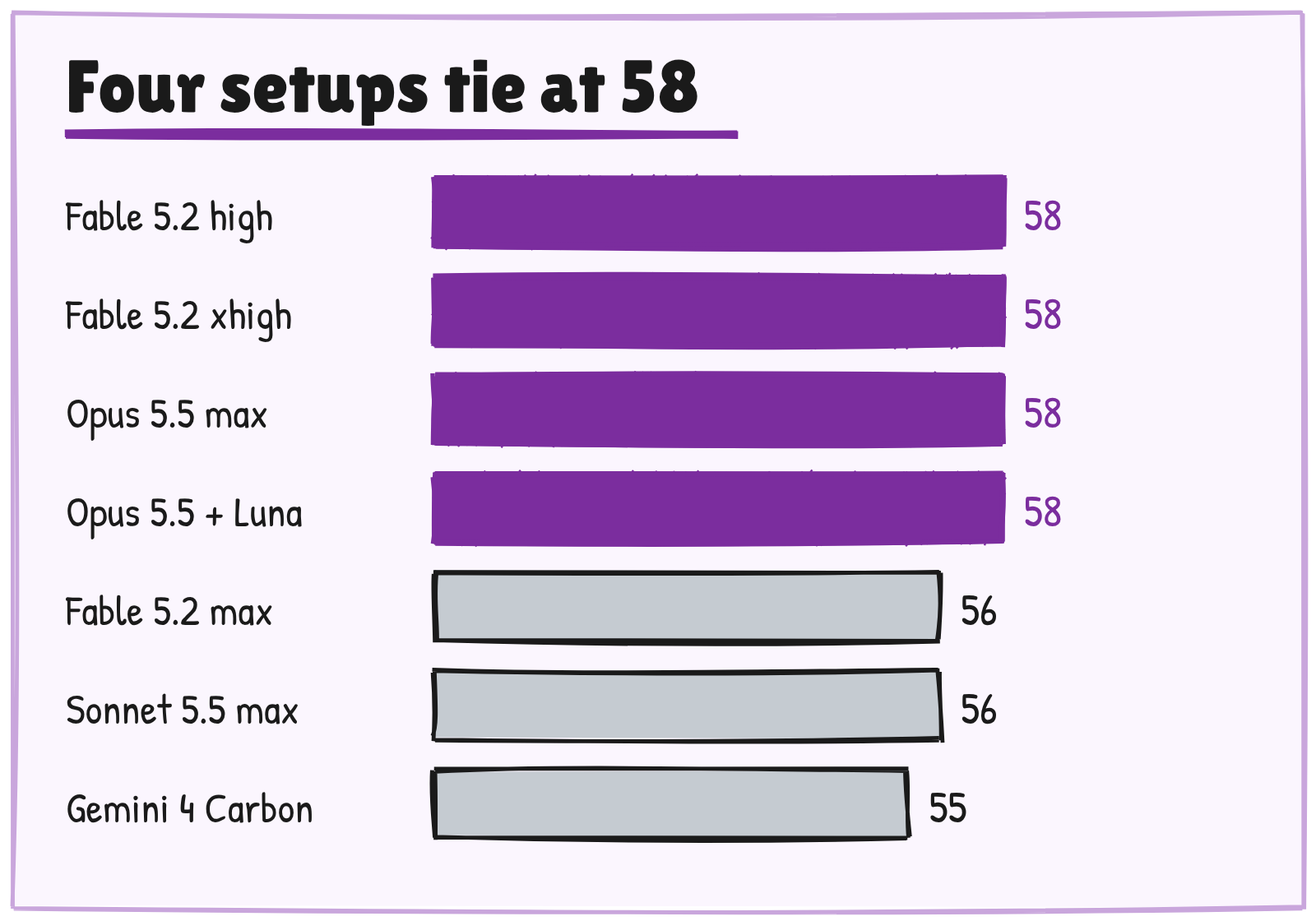
Fable 5.2 at max scores 56, because more of its attempts hit the task time limits, Artificial Analysis says. Claude Sonnet 5.5 at max also scores 56 in Claude Code, and Gemini 4 Carbon at high scores 55 in Antigravity CLI. Codex with GPT-6.1 Sol at max scores 52.
The drop comes from FrontierCode. Artificial Analysis says models score 5 points lower on average in version 2.1, and Codex with GPT-6.1 Terra at max is the only configuration that didn’t fall, finishing within 1 point of its old score. On FrontierCode-AA 2.0 alone, the firm’s evaluation page puts Fable 5.2 at high first with 49.1%, ahead of Fable 5.2 at max with 48.8% and at xhigh with 47.6%. Cognition’s own launch results on 27 October had Opus 5.5 at 47.3% on FrontierCode 2.0 against 54.6% on version 1.1.
What a task costs
Cost per task varies about 30 times among setups that score 48 or more, Artificial Analysis says. Codex with GPT-6.1 Sol at max, which scores 52, costs US$1.51 a task. Claude Code with Fable 5.2 at max, which scores 56, costs US$44.22 a task and sits below the same model at high.
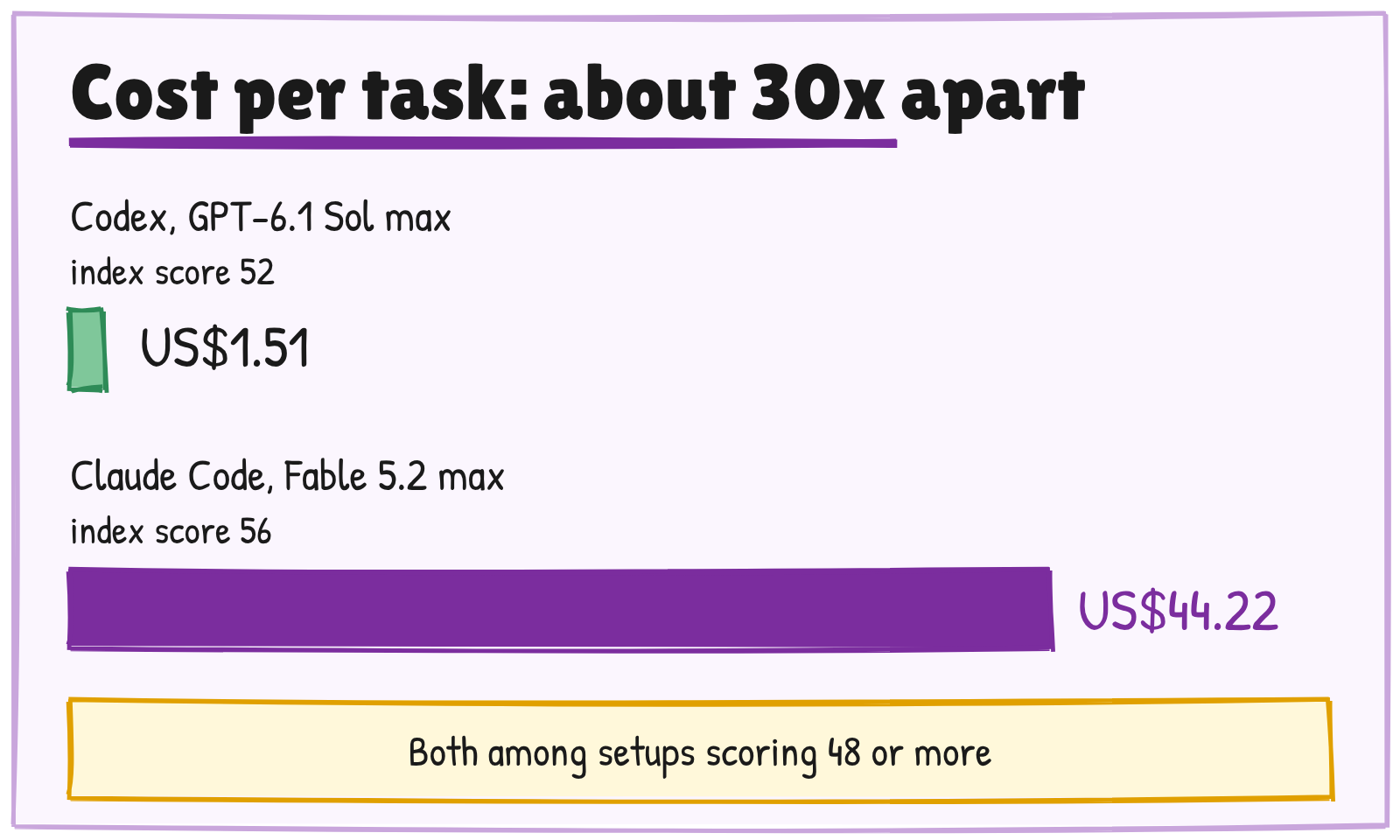
Those are pay-per-token API prices, including cache charges and discounts. Artificial Analysis says the figures aren’t consumer plan prices, and that many people use these harnesses through subscriptions.
What the index doesn’t show
The scores are Artificial Analysis’s own runs, and the FrontierCode tasks are private, so readers can’t rerun them. GPT-6 Luna, an AI model, judges the FrontierCode attempts. Artificial Analysis’s own site says two agents with similar index values can differ on repository questions, terminal work and merge-quality coding, and it publishes the per-benchmark scores beside the index. The post’s text gives index scores and two costs; the per-benchmark scores are on the leaderboard.
The index has changed quickly: the methodology page dates version 2.0 to October and November 2026, and version 2.1 to November. The full leaderboard is on Artificial Analysis.
Discover more from Sulat AI & Tech News
Subscribe to get the latest posts sent to your email.