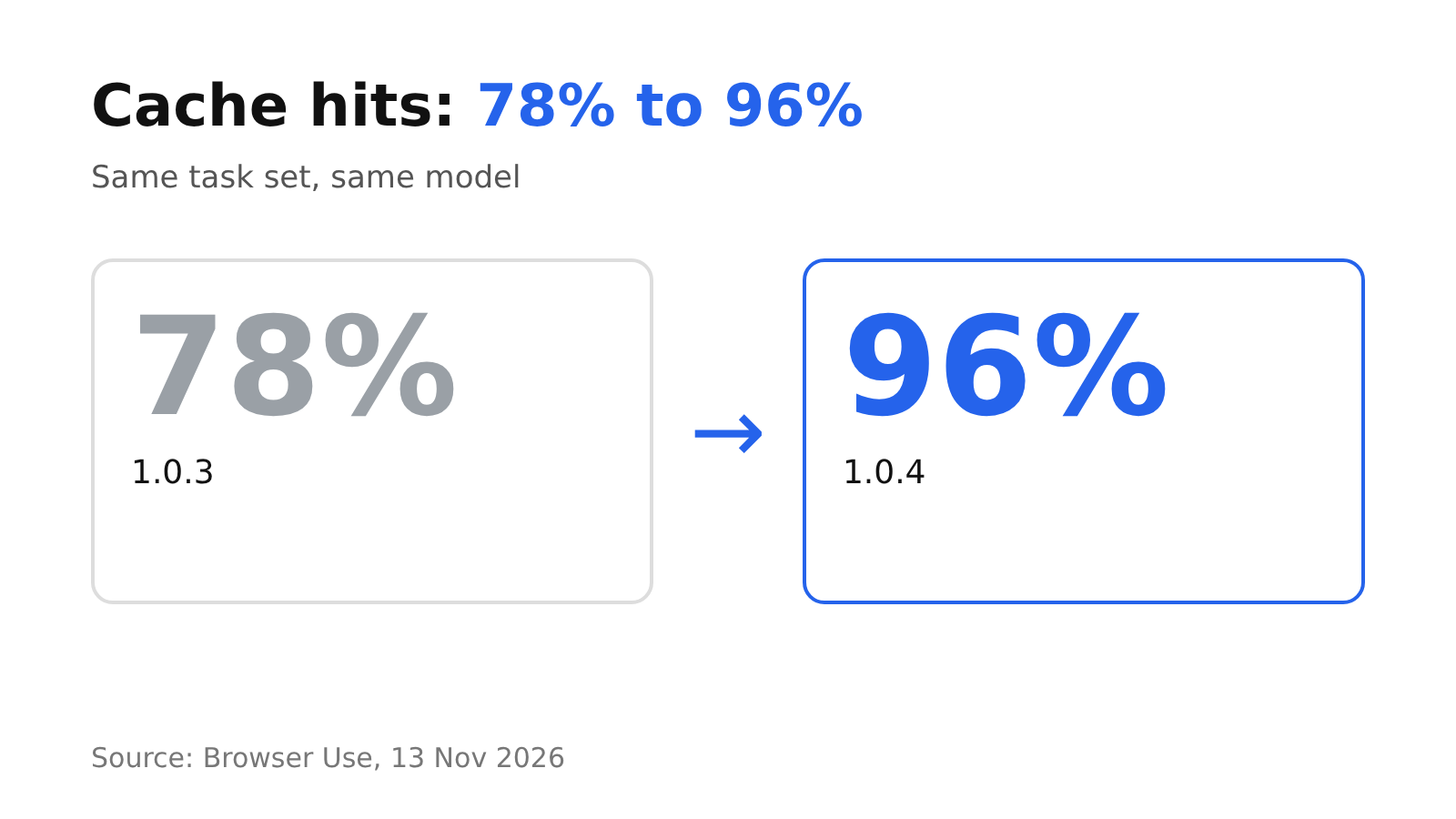
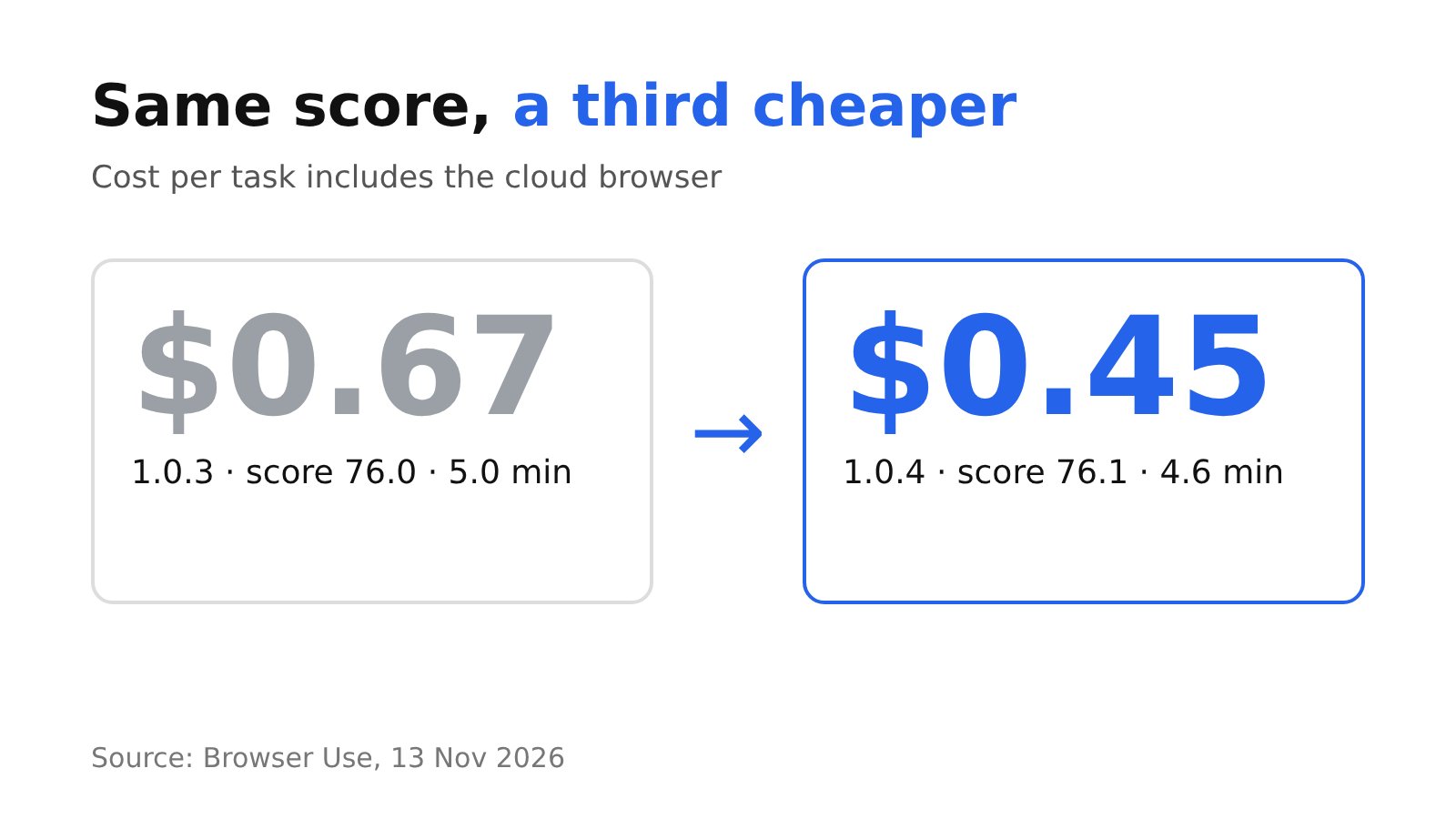
Browser Use has released version 1.0.4 of its open-source browser agent, and the company says the update cut the cost of a task by a third without changing the score. Its cache hit rate rose from 78% to 96%, cost per task fell from US$0.67 to US$0.45, and a task now takes 4.6 minutes instead of 5.0.
The figures come from Browser Use’s own benchmark, BU Bench v2.1, which has 200 long tasks on live websites. The company ran every harness on the same model (GPT 6.1 Terra at medium reasoning), the same tasks and the same judge. Its cost figure includes the cloud browser, according to the chart’s axis label.
What was breaking the cache
A prompt cache lets an AI provider reuse the start of a conversation it has already read, and charges less for the reused part. It only works while that start stays identical from one request to the next. The agent sends every earlier step with each new request, so any edit to old history makes the provider read the whole conversation again at full price.
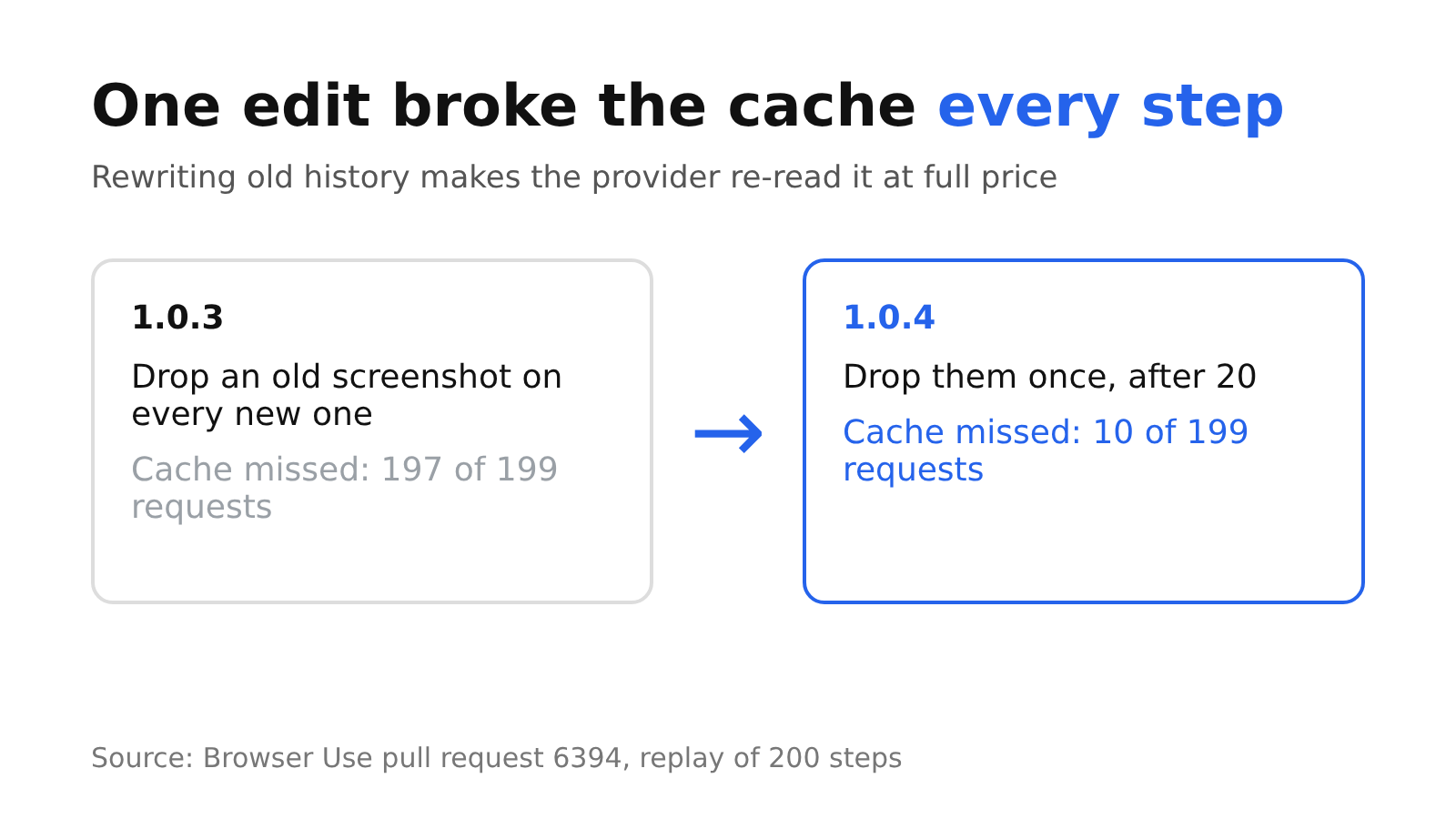
Browser Use’s pull request 6394 says that is what 1.0.3 did. To keep requests small, the agent dropped an old screenshot every time a new one arrived. Each drop rewrote an earlier message, so every request that pruned a screenshot missed the cache. In the company’s 1.0.3 benchmark traces, one 705-step task read 27.8 million input tokens and only 1.6 million came from the cache. On 14 screenshot-heavy tasks, the pull request says, the misses cost US$47 of a US$87 run.
The fix and the result
Version 1.0.4 prunes in one batch. Once 20 tool results carry a screenshot, the agent drops all but the newest two in a single step, and the history stays untouched until then. In a replay of 200 steps with a screenshot every step, cache-missing requests fell from 197 of 199 to 10 of 199. With a screenshot every third step they fell from 65 to 3.
The 1.0.4 release notes report the same run in model cost alone: US$0.208 per task against US$0.434 for 1.0.3, with scores of 76.1 and 76.0. The tweet’s US$0.45 and US$0.67 include the cloud browser, which is why the two pairs of numbers differ.
| Measure | 1.0.3 | 1.0.4 |
|---|---|---|
| Score (0 to 100) | 76.0 | 76.1 |
| Cache hit rate | 78% | 96% |
| Cost per task, with cloud browser | US$0.67 | US$0.45 |
| Model cost per task | US$0.434 | US$0.208 |
| Minutes per task | 5.0 | 4.6 |
How it compares with other browser tools
Earlier on 13 November, Browser Use published a comparison of seven browser harnesses on the same 200 tasks. Six of them ran as browser tools inside OpenAI’s Codex command-line agent: Playwright MCP, Browser Use’s own MCP server, Chrome DevTools MCP, agent-browser, OpenCode browse and Stagehand. They scored between 62.4 and 73.5. The Browser Use 1.0 agent scored 77.5.
That chart labels the agent “Browser Use 1.0” without a patch number, and a later chart puts 1.0.3 at 76.0, so the 77.5 predates the 1.0.4 run. Browser Use wrote the benchmark, chose the tasks and ran every harness itself. The benchmark’s runner and setup are on GitHub, with the tasks and rubrics encrypted.
What changes for users
Developers update with uv add "browser-use==1.0.4". Browser Use tells users to pin with == rather than >=, because releases can break things. The agent now sees up to 20 old screenshots in a request instead of two, which the pull request says changes how it behaves. Setting PRUNE_IMAGES_AT = KEEP_IMAGE_RESULTS restores the 1.0.3 pruning. The release also gives BU_NAME callers their own Chromium when Chrome can’t be used, and makes the command-line tool and MCP server tell the agent to upgrade when a newer release fixes a browser setup error.
The post gives cache hit rates only for 1.0.3 and 1.0.4; neither it nor the release notes give one for the other harnesses. The release notes compare 1.0.4 with 1.0.3 alone.
Discover more from Sulat AI & Tech News
Subscribe to get the latest posts sent to your email.