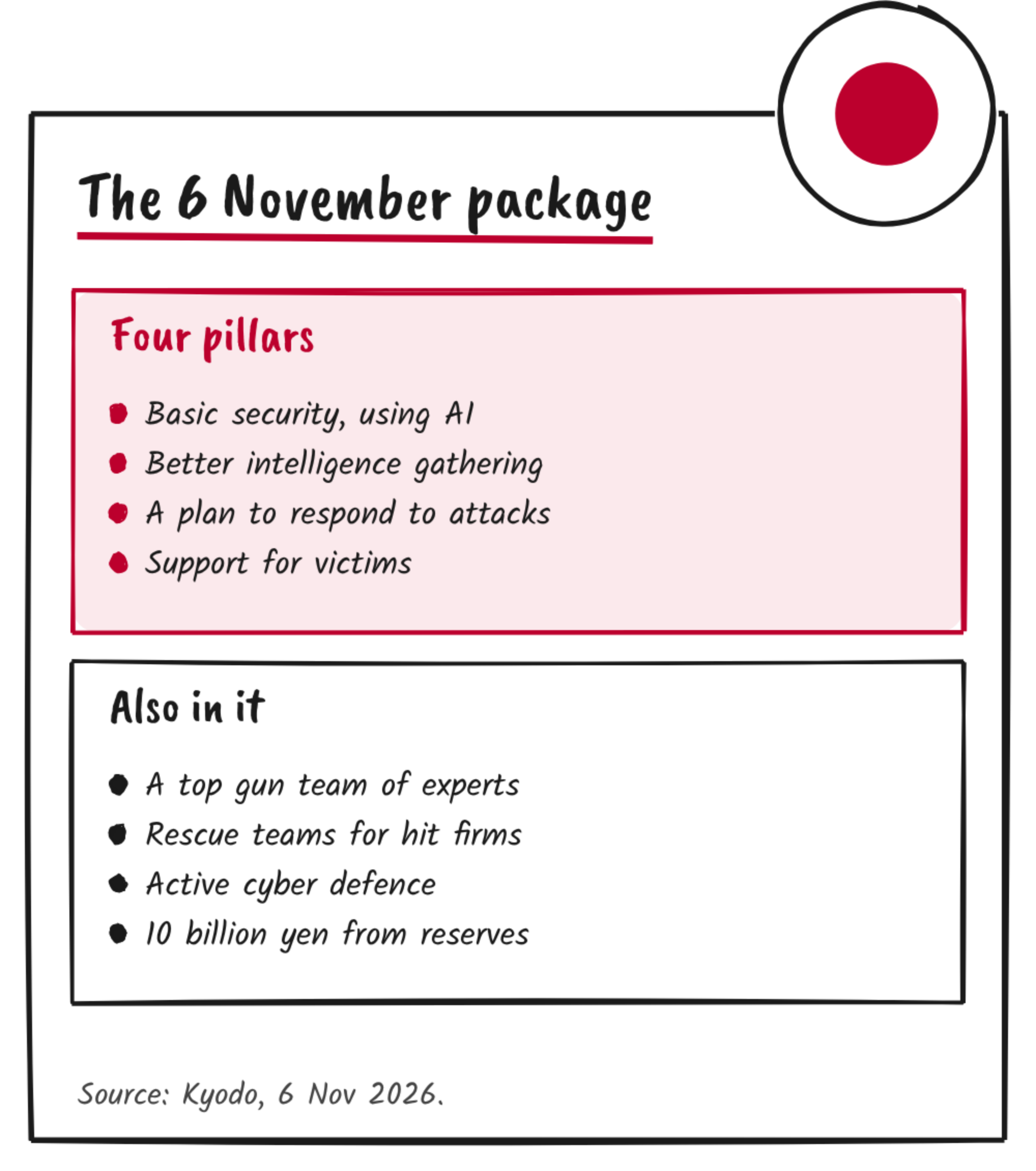
Japan’s government announced a package of emergency cybersecurity measures on 6 November, Kyodo reported, after a run of data breaches that Bloomberg describes as an intense wave of AI-powered cyberattacks. Japan’s computer emergency response team, JPCERT/CC, has logged attack attempts that used three AI penetration-testing tools, and Trend Micro says it hasn’t confirmed AI in the breaches themselves.
Prime Minister Sanae Takaichi presented the package at a ministers’ meeting, Kyodo said. It has four pillars: strengthening basic security through AI, improving information gathering and analysis, taking a strategic approach to responding to attacks, and supporting victims to prevent further damage. The government plans a “top gun” team of specialists, a rescue team of public and private experts to send to hit businesses, and AI to find weaknesses in computer systems. It also plans active cyber defence, which means proactively accessing servers that attackers use, under a law that took effect in October. Ahead of the announcement, the government decided to draw 10 billion yen (US$63 million) from its fiscal 2026 budget reserve funds.
How big the wave is
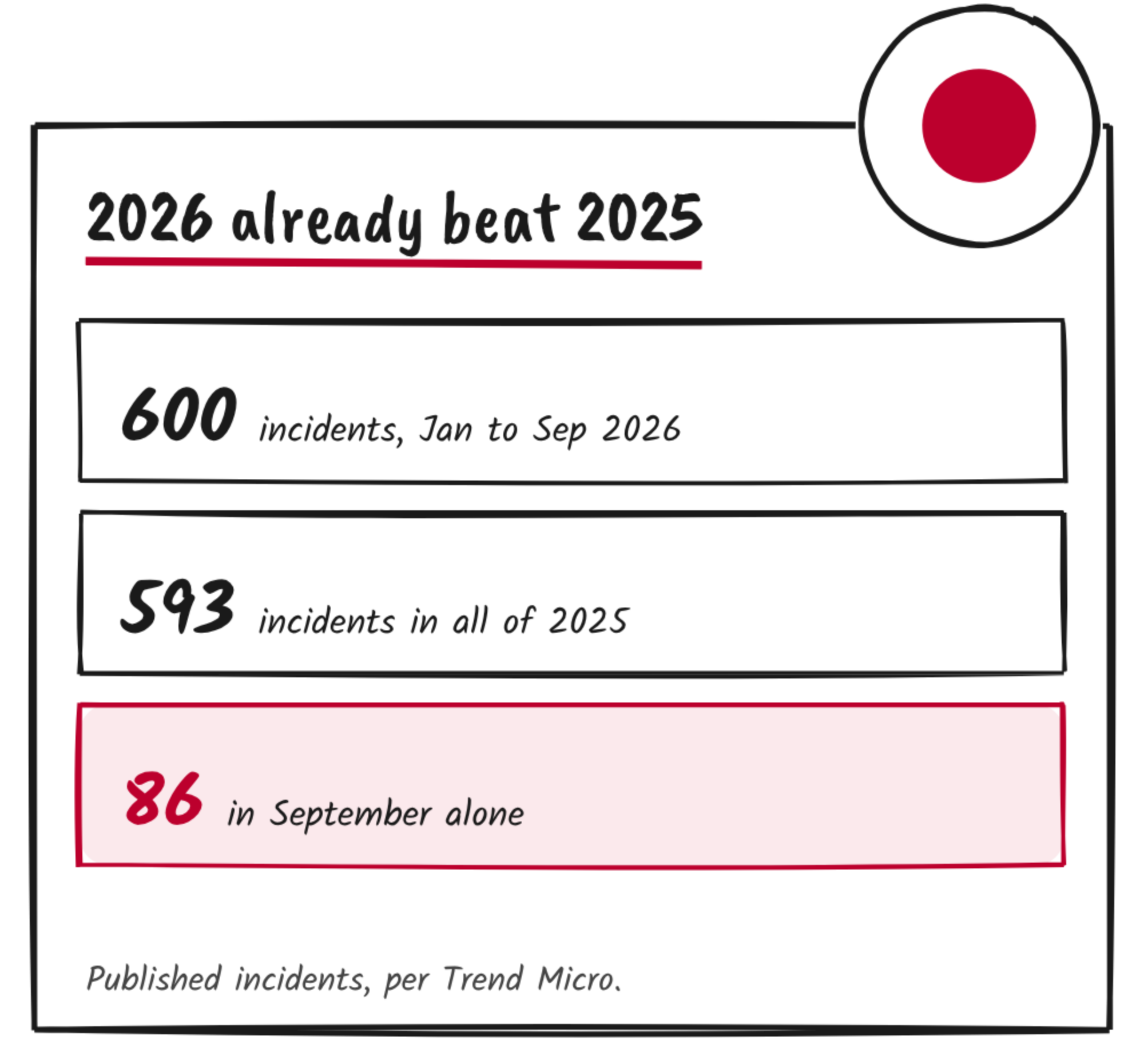
Trend Micro says Japan published 600 cybersecurity incidents from January to the end of September 2026, against 593 in all of 2025, and 86 in September alone. Bloomberg reported, citing Trend Micro data, that 13 were disclosed on a single day in September, the most this year.
Recorded Future counted reports of attacks on Japanese organisations rising 48% from the second to the third quarter, from 621 to 918. Single incidents now run to millions of records: about 33 million from the EPARK PeakManager reservation platform in July, 6.6 million accounts from Times Car in September, and 22,519,960 customer records from the software company Sourcenext on 13 October. Recorded Future says a third party took the Sourcenext records by misusing the company’s member information retrieval API. It adds that a ransomware attack on the cloud provider IDCFrontier on 7 October disrupted 495 companies and local governments, citing Cybernews.
Macnica Security counted 119 personal-information leak cases disclosed in Japan in 2026, and says about 68% of them were announced since July. Bloomberg’s 29 October report said the government disclosed a breach of an official website for electricity and gas trading information, days after hackers claimed to have published customer data from GMO Internet Group’s currency trading platform. Kyodo reported that the attack on GMO Internet came with a ransom demand.
Where AI shows up, and where it doesn’t
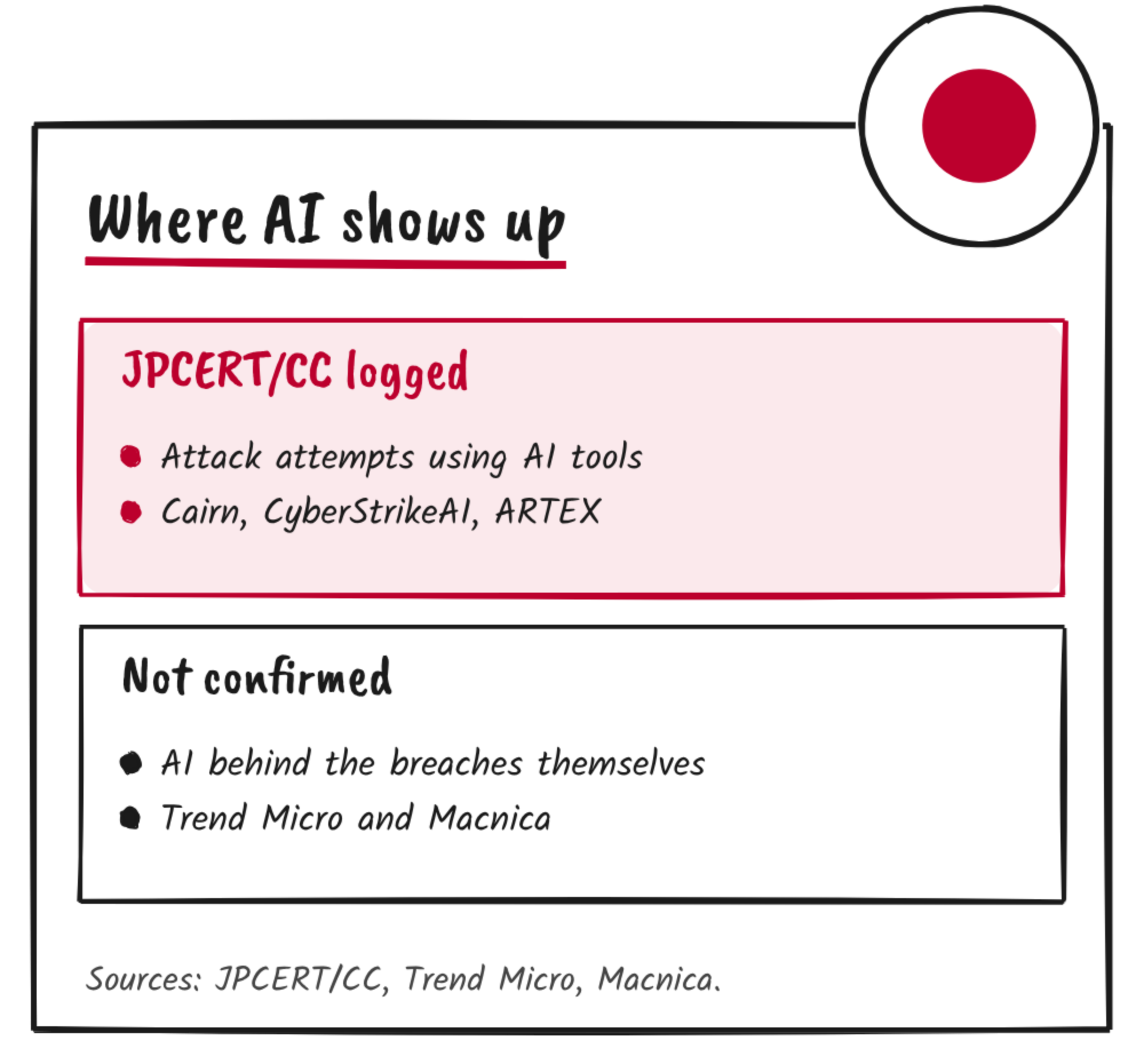
JPCERT/CC’s alert AT-2026-0030, published on 8 October and updated on 23 October, lists attack attempts that used the AI penetration-testing platforms Cairn, CyberStrikeAI and ARTEX. The tools mainly scan internet-facing web applications for vulnerabilities and for poor device management, such as exposed configuration and backup files. JPCERT/CC says some attempts targeted internet-facing WSUS servers, which distribute Windows updates.
The same alert says the attacks don’t share one vulnerability. It also records attackers pulling API endpoints and keys out of public smartphone apps, exploiting a maximum-severity SQL injection flaw in the Metabase data tool (CVE-2026-72898), and planting web shells on application servers. A web shell is a small script that lets an attacker run commands on a server.
Recorded Future, citing the Wall Street Journal, says GMO Cybersecurity by Ierae concluded on 19 October that ARTEX, a Chinese open-source AI penetration-testing tool, was used in attacks on roughly 80 Japanese companies.
Trend Micro hasn’t confirmed a link between the recent incidents and attackers’ use of AI. Ryan Flores, a director of forward-looking threat research at Trend Micro’s TrendAI business, said in the company’s 13 October release that it can’t say AI is directly involved in the attacks, and that the concern is attackers using AI to find targets and automate work. Macnica says it couldn’t confirm AI use in the attacks it tracked. Trend Micro adds that AI helps attackers write convincing phishing emails, which weakens the Japanese language as a barrier. Robert McArdle, another Trend Micro research director, said the surge should be treated as a new baseline, not a peak.
What Japan wants from AI companies
Nikkei reported on 5 November that Japan will look for ways to get information on undisclosed software vulnerabilities early from US AI developers and other overseas tech companies, Reuters said. Nikkei added that Japan had recently sought expanded access to advanced AI models from US developers including Anthropic and OpenAI in response to the wave. Kyodo’s account of the package says the government will work with overseas IT firms and advanced AI developers to keep vulnerability information up to date.
Takaichi told the finance minister and other ministers to consider the funds the measures need, and told cybersecurity minister Toshiharu Furukawa to consider revising a law to strengthen the government’s ability to respond to attacks, Kyodo said.
Discover more from Sulat AI & Tech News
Subscribe to get the latest posts sent to your email.