Developers have found a full set of usage-quota code in the front end of DeepSeek’s chat site, chat.deepseek.com, IT Home reported on 14 November. DeepSeek hasn’t announced a plan, a price, a tier or a launch date.
The finding reached Chinese tech media on 13 November. MyDrivers reads it as DeepSeek preparing a “Coding Plan” subscription and says guessing the price is too early. IT Home says the code points to a package with that name and describes the subscription idea as community speculation.
What the code does
According to IT Home, the latest front-end commit adds quota-status polling: while the page is visible, it syncs each model’s quota every five minutes. When a quota runs out, a banner appears above the input box, and the home screen’s welcome area shows quota text sent down from the server. The code also carries the message “usage quota has reached its limit, please try again after the quota recovers”, an error branch for exhausted quotas, and a check of an is_exhausted flag in a quotas array when someone continues a shared conversation.
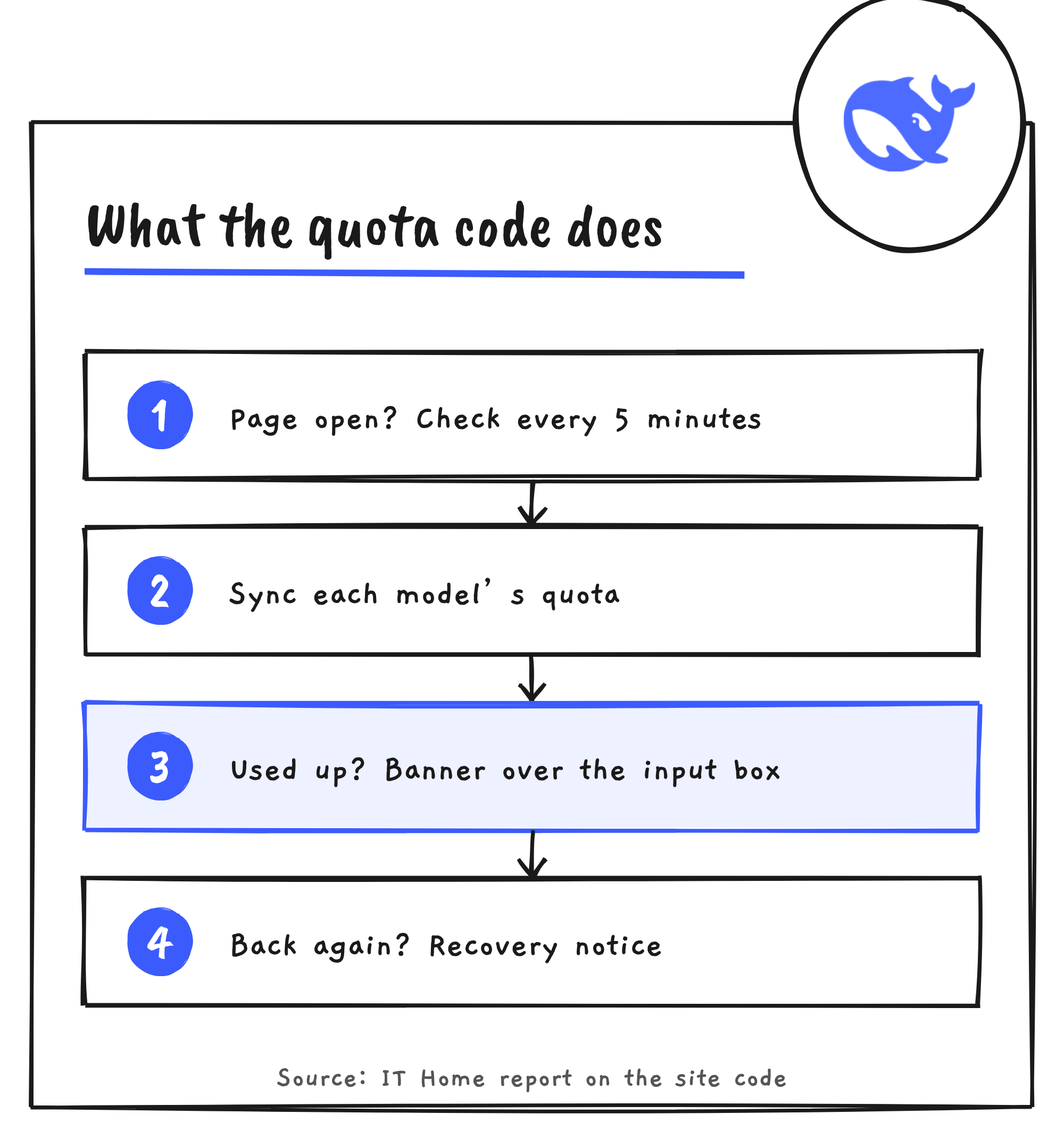
IT Home lists the rest of the system as live remaining-quota sync, exhaustion alerts, recovery notices and server-side warnings about usage limits. Quotas are tracked per model, so a limit on one model is a separate counter from a limit on another.
What the code doesn’t show
IT Home’s account of the code mentions no price, no payment screen and no tier. It doesn’t say whether the quotas apply to free users, paying users or both. DeepSeek’s chat app is free: its Google Play listing calls the assistant free to use, and DeepSeek publishes no message cap for it.
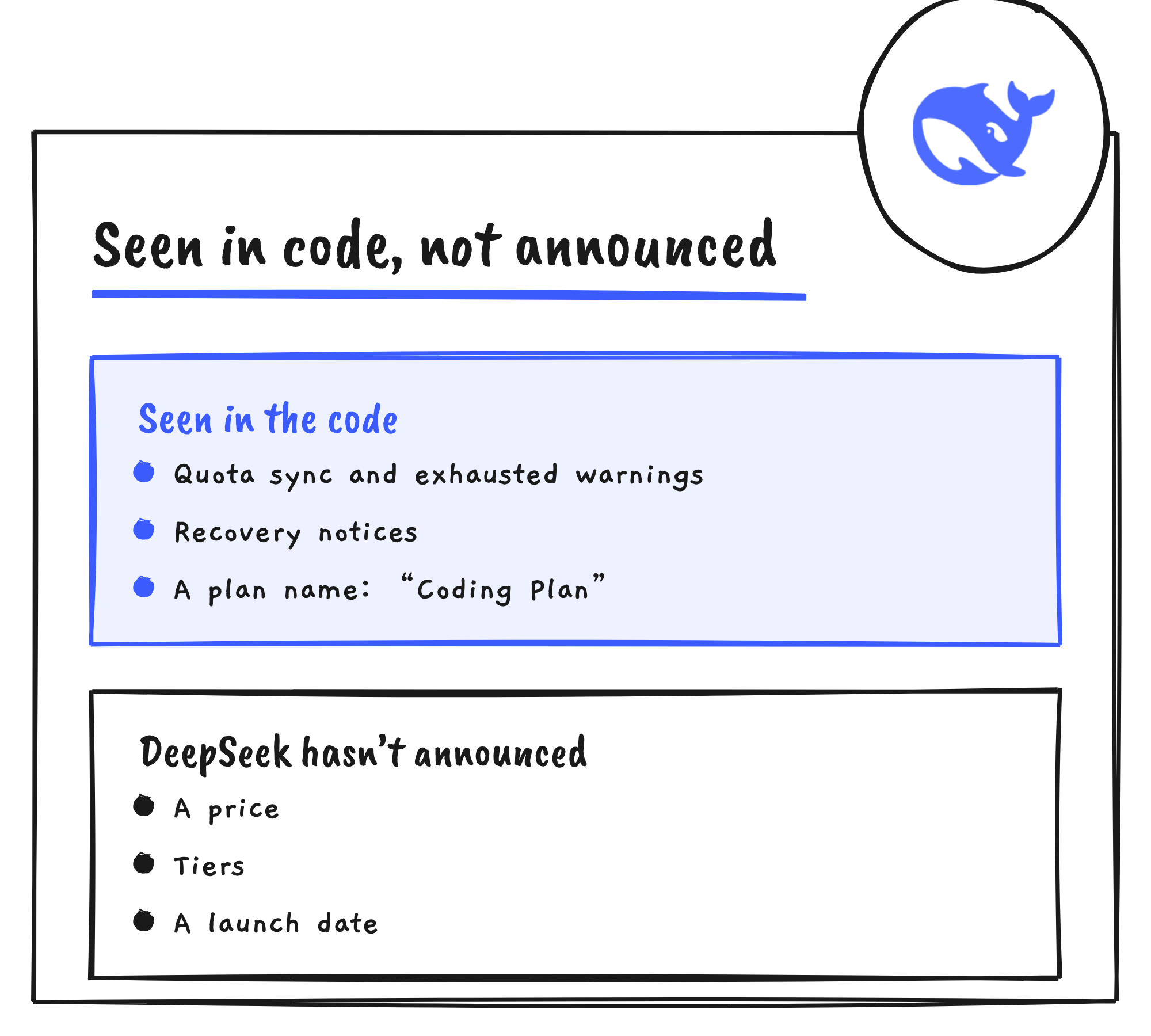
The “Coding Plan” name comes from the same reports. A column on Renren Product Manager, republished on Toutiao, calls it a clue to a package and says DeepSeek hasn’t confirmed anything. Some commenters expect a plan to arrive with DeepSeek V4.1 Pro. That model hasn’t launched: DeepSeek’s 10 September release note calls it a future release, and the newest entry in the API changelog is still dated 17 October.
DeepSeek models are already sold by subscription
DeepSeek’s paying customers are developers. IT Home says the company’s only direct charge to individuals is the API, billed per token, and that its revenue comes almost entirely from there. The Information, via Reuters on 24 September, put DeepSeek’s annualised revenue at US$1 billion.
Meanwhile, partners already sell DeepSeek models in subscriptions. DeepSeek’s 10 September note names WorkBuddy and OpenCode as “official partners” that fully support V4.1-Flash. OpenCode Go costs US$10 a month and gives DeepSeek V4.1 Flash a monthly allowance of US$100, counted at DeepSeek’s token prices. The allowance is capped at 20% every five hours (US$20) and 50% every week (US$50). OpenCode says bulk discounts and reserved GPU capacity make the higher allowances possible, and that its limits can change.
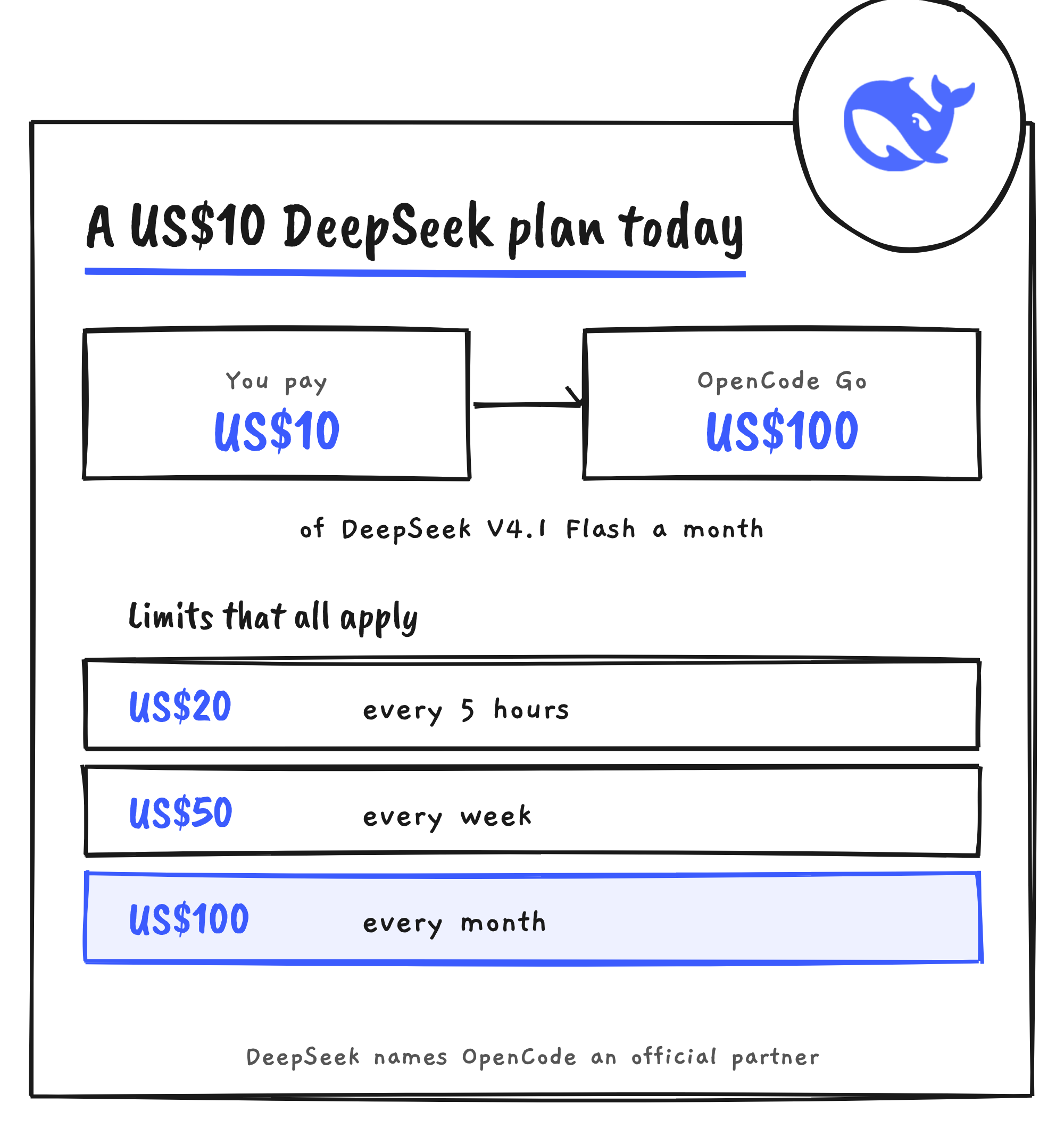
OpenCode’s documentation gives an example request: 410 new input tokens, 71,300 cached input tokens and 310 output tokens, with about 216,670 such requests a month. I priced that at DeepSeek’s off-peak list rates (US$0.15 per million uncached input tokens, US$0.003 cached, US$0.60 output). It comes to about 15.6 billion tokens and US$99.97, so the US$100 allowance is measured at off-peak prices. At peak rates, which are double, the same allowance buys half as much. DeepSeek’s peak hours are 01:00 to 04:00 and 06:00 to 10:00 UTC on weekdays.
That 10-to-1 ratio between what a customer pays and what the usage costs at DeepSeek’s list prices is the number a DeepSeek-run plan will be set against. The peak and off-peak split itself is DeepSeek’s: its 13 August changelog says it introduced the pricing “to allocate resources more reasonably”, effective 16 August.
How other coding plans meter usage
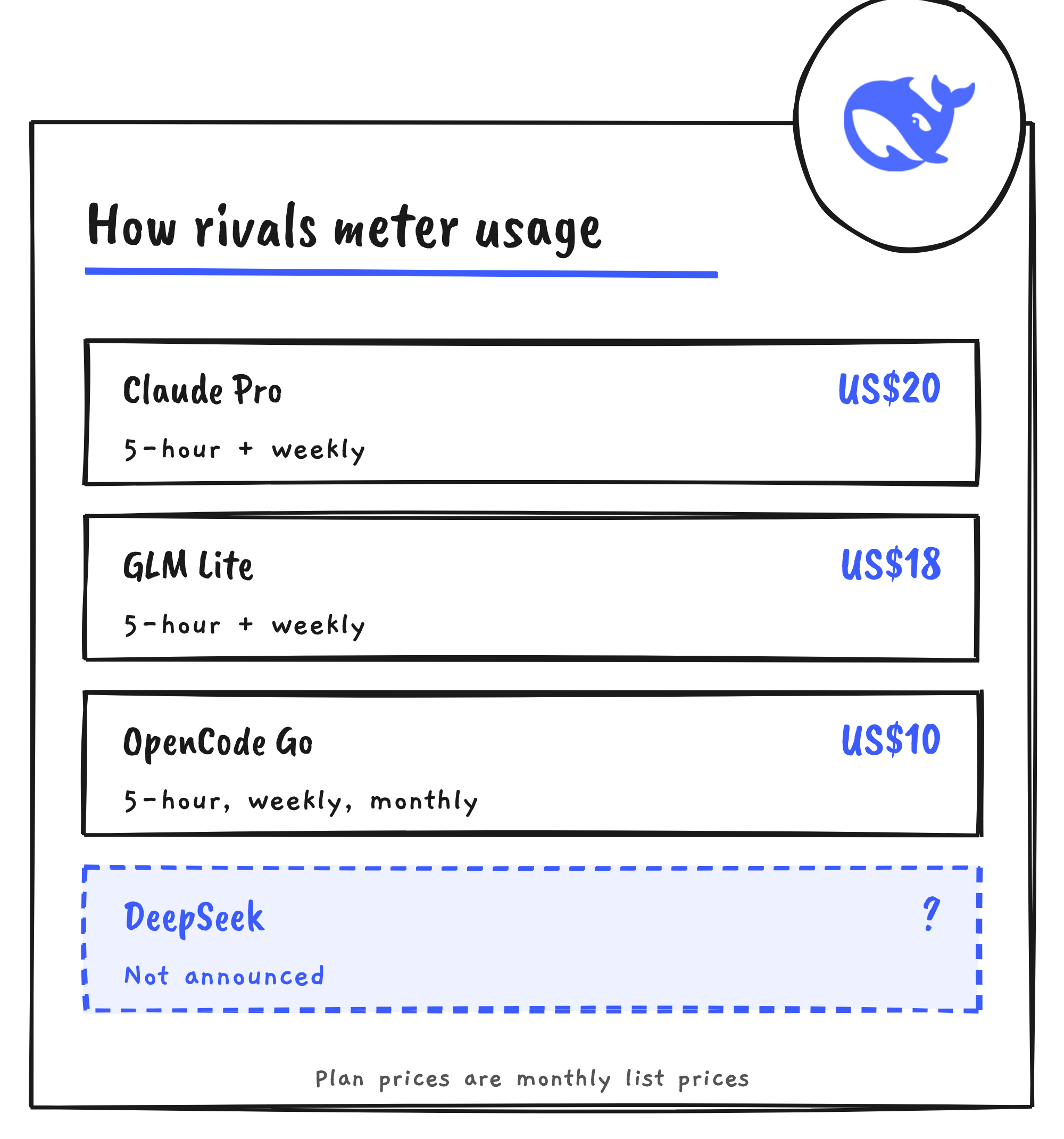
The code’s design, a per-model counter that resets, matches how the paid plans already on the market work. Anthropic’s Claude Pro, Z.ai’s GLM Coding Plan and OpenCode Go all use rolling windows rather than a single monthly cap.
| Plan | Monthly price | How usage is metered |
|---|---|---|
| Claude Pro | US$20 (US$17 billed annually) | Limits every five hours and every week, shared with Claude Code |
| GLM Coding Plan Lite | US$18 | 2,000 credits per five hours and 10,000 per week; credits cost half as much off-peak, with peak at 14:00 to 18:00 Singapore time on weekdays |
| OpenCode Go | US$10 | Per-model dollar allowance with five-hour (20%), weekly (50%) and monthly limits |
| DeepSeek | Not announced | Not announced |
Where Harness fits
DeepSeek Harness, its open-source agent app, is the product people cite. DeepSeek said Harness reached 1.54 million daily users on 4 November, Bloomberg reports, a count limited to people connecting to its servers. The Renren Product Manager column says Harness still needs an API key and bills by token, which it calls a barrier for ordinary users.
In October, IT Home says, DeepSeek merged its Harness team with the Web, App and Platform teams into one product department under Cui Tianyi, who ran Harness. The chat site and Harness now sit in the same department. DeepSeek also opened its app’s search, file and voice features to its API on 13 November.
DeepSeek hasn’t confirmed a plan, a price, a tier or what the quota code is for. Its announcements come through @deepseek_ai and the API changelog.
Discover more from Sulat AI & Tech News
Subscribe to get the latest posts sent to your email.