President Ferdinand Marcos Jr. signed Executive Order 131 on 12 November. It adopts the AI Governance Framework for the Philippines as national policy and creates a National Artificial Intelligence Council, chaired by the Executive Secretary, to coordinate and monitor it.
Palace Press Officer Claire Castro said in a Saturday briefing, in Filipino, that EO 131 “places value on AI so that Filipinos may benefit from it”, The Manila Times reports. The Official Gazette uploaded the order’s text on 14 November. The order takes effect on publication in the Gazette or in a newspaper of general circulation.
What the framework contains
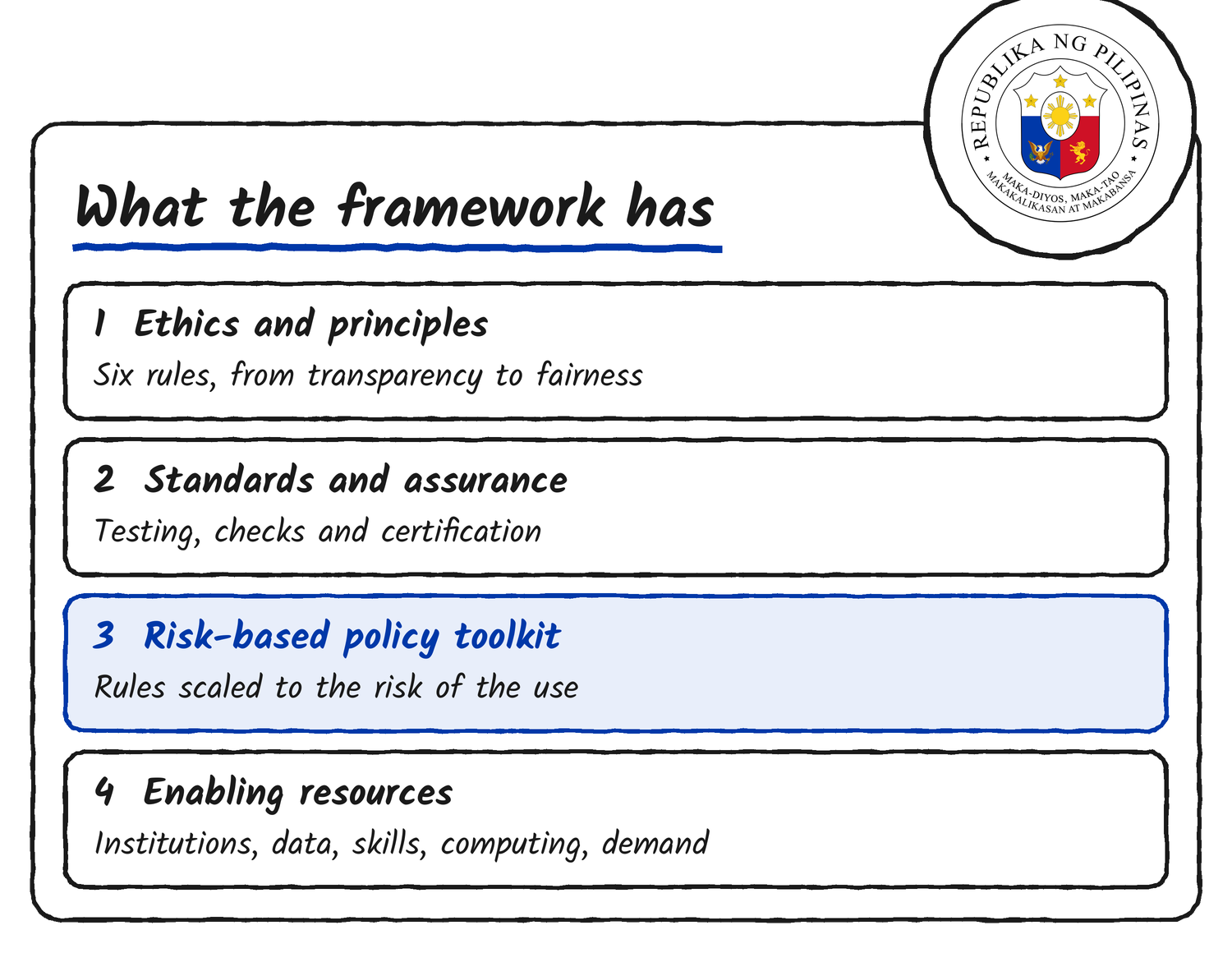
Section 1 makes the framework “the national strategic guide” for policy formulation, regulatory coordination, institutional development and capacity-building. It lists four elements: ethics and principles, standards and assurance, a risk-based policy toolkit, and enabling resources.
The principles are transparency and explainability, security and safety, accountability and integrity, human centricity, fairness and equity, and sustainable development. The toolkit is where the order gets specific about measures: guidelines for all sectors or one, AI impact assessments, regulatory sandboxes, a review of existing laws and coordinated complaint mechanisms. It adds that “existing sector regulators shall continue to exercise their respective mandates”, so the order creates no new regulator and sets no penalties.
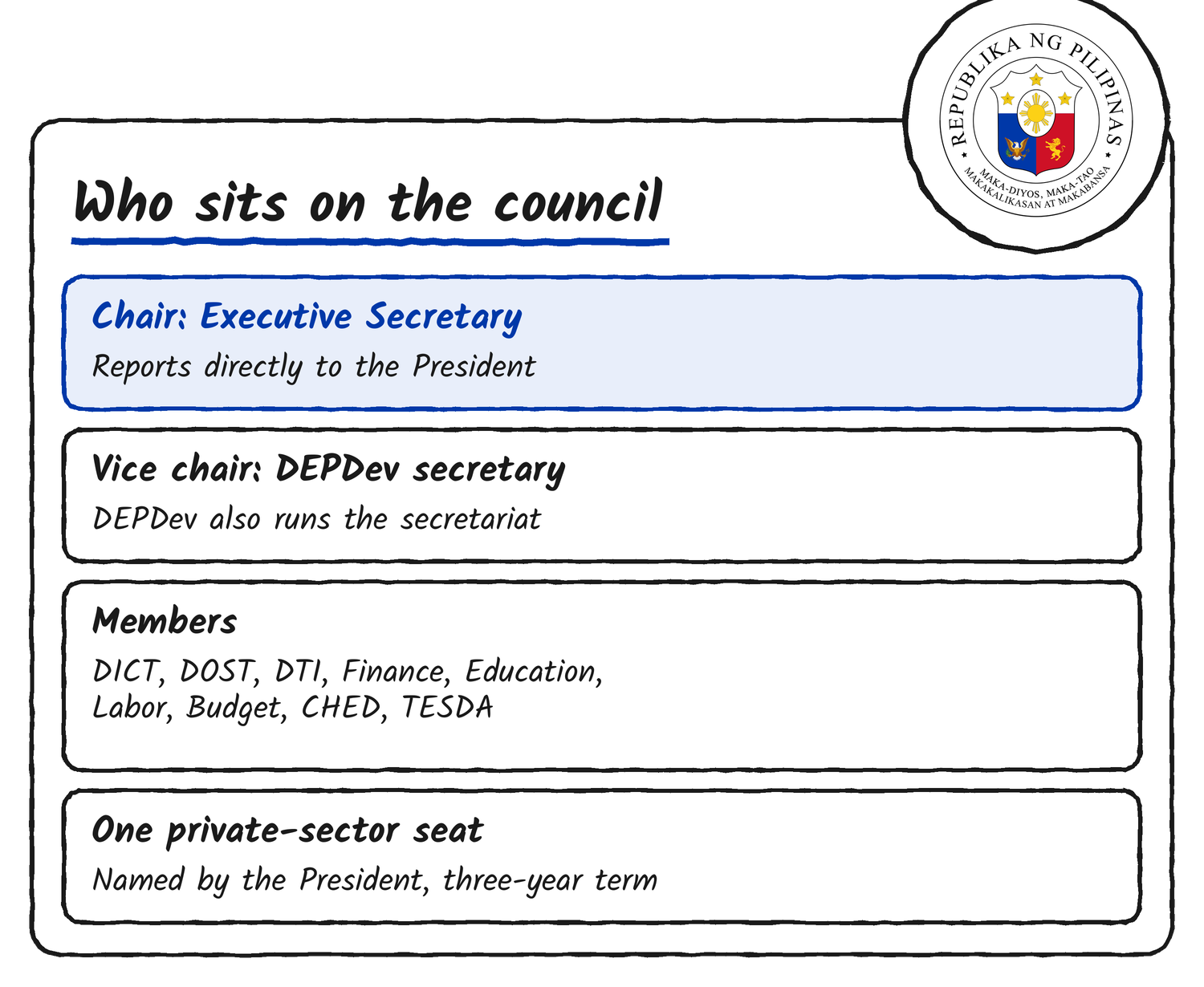
Who sits on the council
The council reports directly to the President. The Executive Secretary chairs it and the secretary of the Department of Economy, Planning, and Development (DEPDev) is vice chair. Members include the secretaries of the Department of Information and Communications Technology (DICT), Science and Technology, Trade and Industry, Finance, Education, Labor and Employment, and Budget and Management, plus the chairperson of the Commission on Higher Education and the director general of TESDA, the technical education and skills authority.
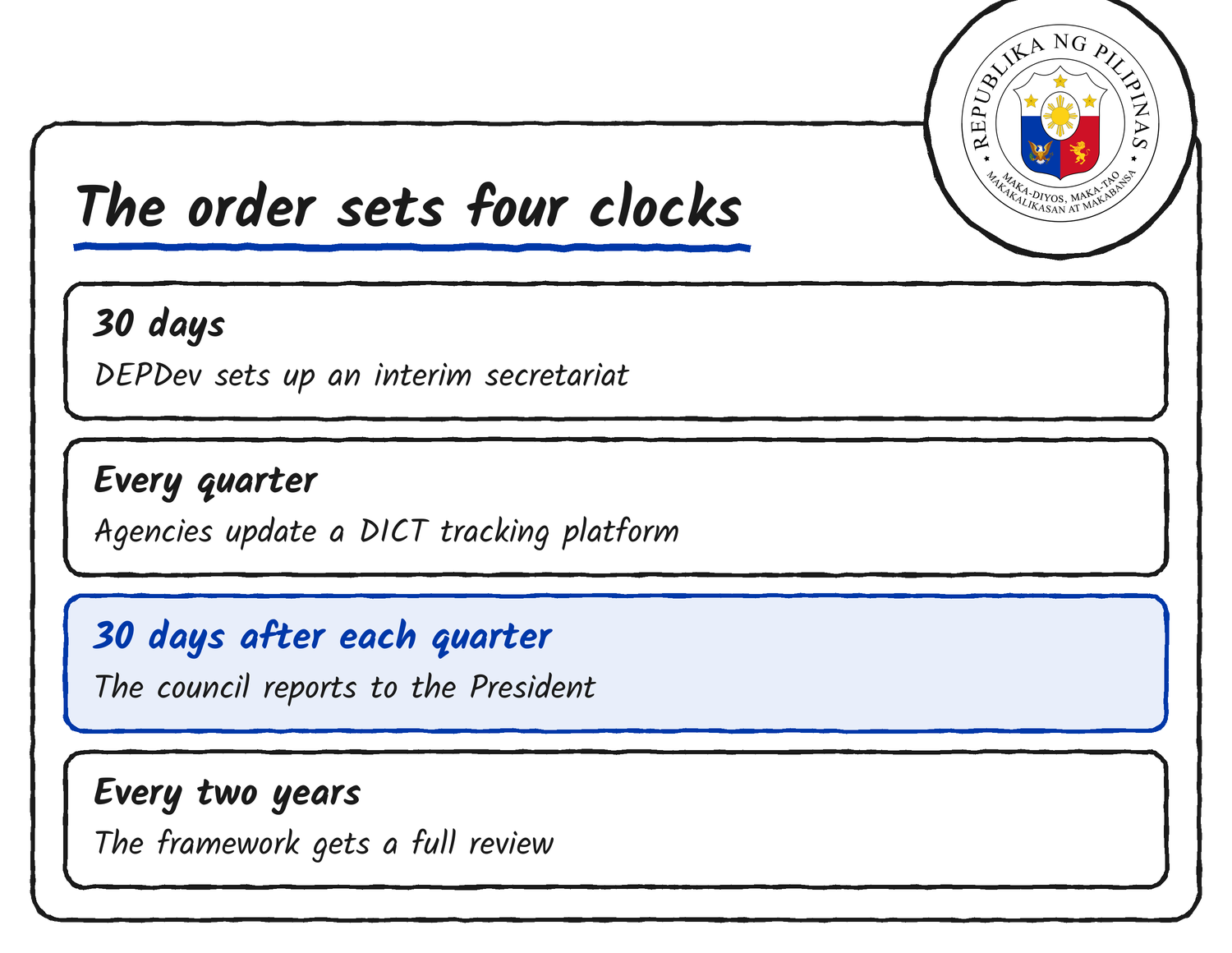
One seat goes to a private-sector representative. The President appoints that person from nominees put forward by business groups, for three years with one reappointment. DEPDev is the secretariat. Until the Department of Budget and Management approves a permanent structure, DEPDev must stand up an interim secretariat, drawn mainly from its own staff, within 30 days of the order taking effect.
What the council does
Section 3 gives the council eight duties. It checks that government AI programmes match the framework and trims duplication, aligns the action plans of its working groups, and clears policy and regulatory bottlenecks. It also recommends policy, fiscal and legislative measures to the President, including measures to “safeguard the rights and welfare of workers and learners affected by AI-driven transitions”. It can issue its own implementing guidelines.
Section 4 sets up five technical working groups under the Enabling Resources element. Each writes an action plan with responsible agencies, deliverables, timelines, resource needs and performance indicators.
| Working group | What its plan covers |
|---|---|
| Institutions | Institutional capacity for AI governance in government policies and programmes |
| Data and R&D | AI research, secure data systems under data privacy law, better datasets, data interoperability |
| Capabilities | A national AI competency and digital workforce programme, AI education and scholarships |
| Infrastructure | Digital infrastructure and computing investment, tied to the Philippines AI+ Infrastructure Masterplan 2026-2033, including the energy and water AI needs |
| Demand generation | AI investment in public planning and budgets, public-private partnerships, financing for small businesses and startups |
Deadlines and funding
Section 5 makes DICT build and run a digital platform that tracks the framework’s action plans. Agencies update it every quarter. The council then sends the President a progress report within 30 days of each quarter’s end, and reviews the framework at least every two years.
Section 9 pays for the first stage from the current appropriations of council members, plus any sources the Department of Budget and Management identifies. After that, members put the costs in their regular budget proposals. The order names no budget figure.
How it got here
The order’s preamble traces the framework to the National AI Strategy for the Philippines, which Marcos approved in May 2025. The National Innovation Council then approved the framework as the national policy for responsible AI development and use.
On 10 November, DEPDev Undersecretary Rosemarie Edillon told reporters the framework was final and that DEPDev expected the order within the month, BusinessWorld reported. The Philippine Daily Inquirer quoted her saying the council’s job is to make sure the framework is carried out coherently, with standards and assurance mechanisms in place. She also proposed a private-sector member on each working group. The order leaves working-group membership to the council, which must ensure “appropriate representation” from government, the private sector, academia and civil society.
The order’s full text is on the Official Gazette. The council’s first dates are set by the order: DEPDev’s interim secretariat is due 30 days after the order takes effect, and the first quarterly reports follow.
Discover more from Sulat AI & Tech News
Subscribe to get the latest posts sent to your email.