Retell, the San Carlos, California voice agent platform for contact centres, has launched Tell-1, its own language model that speaks the first sentence of a reply and keeps reasoning while that sentence plays. Retell says Tell-1 averages 94.4% on its own vCX benchmark, the top score on the board, at US$0.035 per minute, and that it reaches Retell customers on 19 November.
Retell announced the model in a press release on 12 November US Eastern time and in an X post on 13 November, alongside a technical post from Retell Labs. Bing Wu, Retell’s co-founder and CEO, said in the release that for voice agents “the bottleneck isn’t intelligence but timing”.
Introducing Tell-1, Retell’s LLM purpose-built for contact centers.
— Retell AI (@retellai) November 13, 2026
Intelligence. Latency. Cost.
We built Tell-1 to deliver all three.
Tell-1 uses interleaved reasoning: it answers first and reasons while it speaks, following complex business rules, choosing the right next action, and handling unexpected turns while keeping the conversation moving.
Benchmarks & technical breakdown below.
How it thinks while it talks
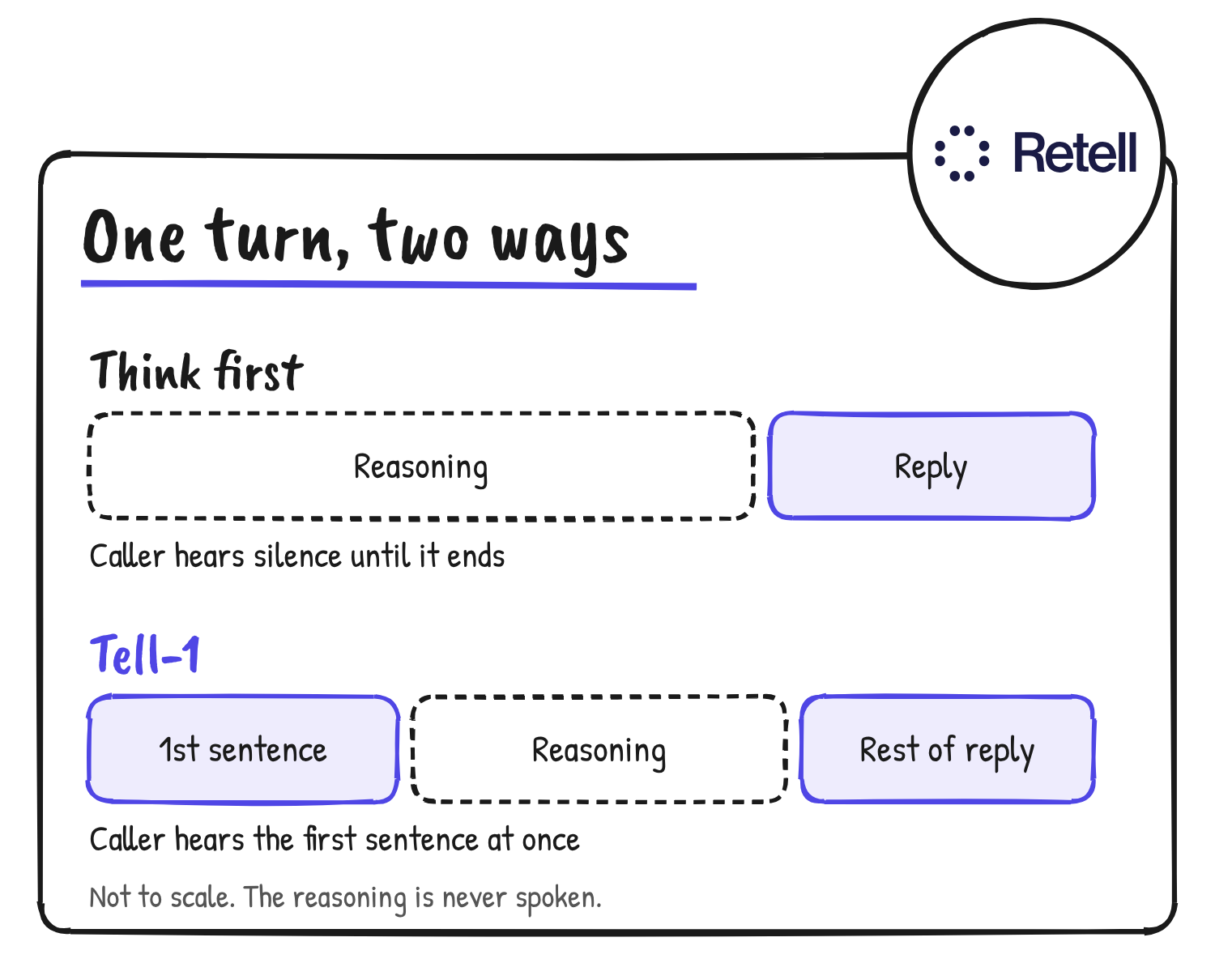
Most models get smarter by thinking longer, Retell’s post says, and on a phone call every second of thinking is a second of silence. Tell-1 writes the first sentence of its reply straight away. While that sentence plays, it reasons silently about which rule in the agent’s script applies, what information is still missing and whether it’s time to call a tool. Then it continues the reply, grounded in that reasoning. The caller hears one unbroken answer, and the reasoning is never spoken.
Retell puts the reasoning at 200 tokens on average mid-reply. A token is a chunk of text a model reads or writes, usually a word or part of one. The post names the cost of the design: speaking sooner means committing to the opening sentence before any reasoning has happened. It also says the model drifted back to think-first midway through reinforcement learning, producing an empty lead and then reasoning, a failure Retell calls lead collapse. Retell fixed it with a bonus on the first token only.
How Retell trained and served it
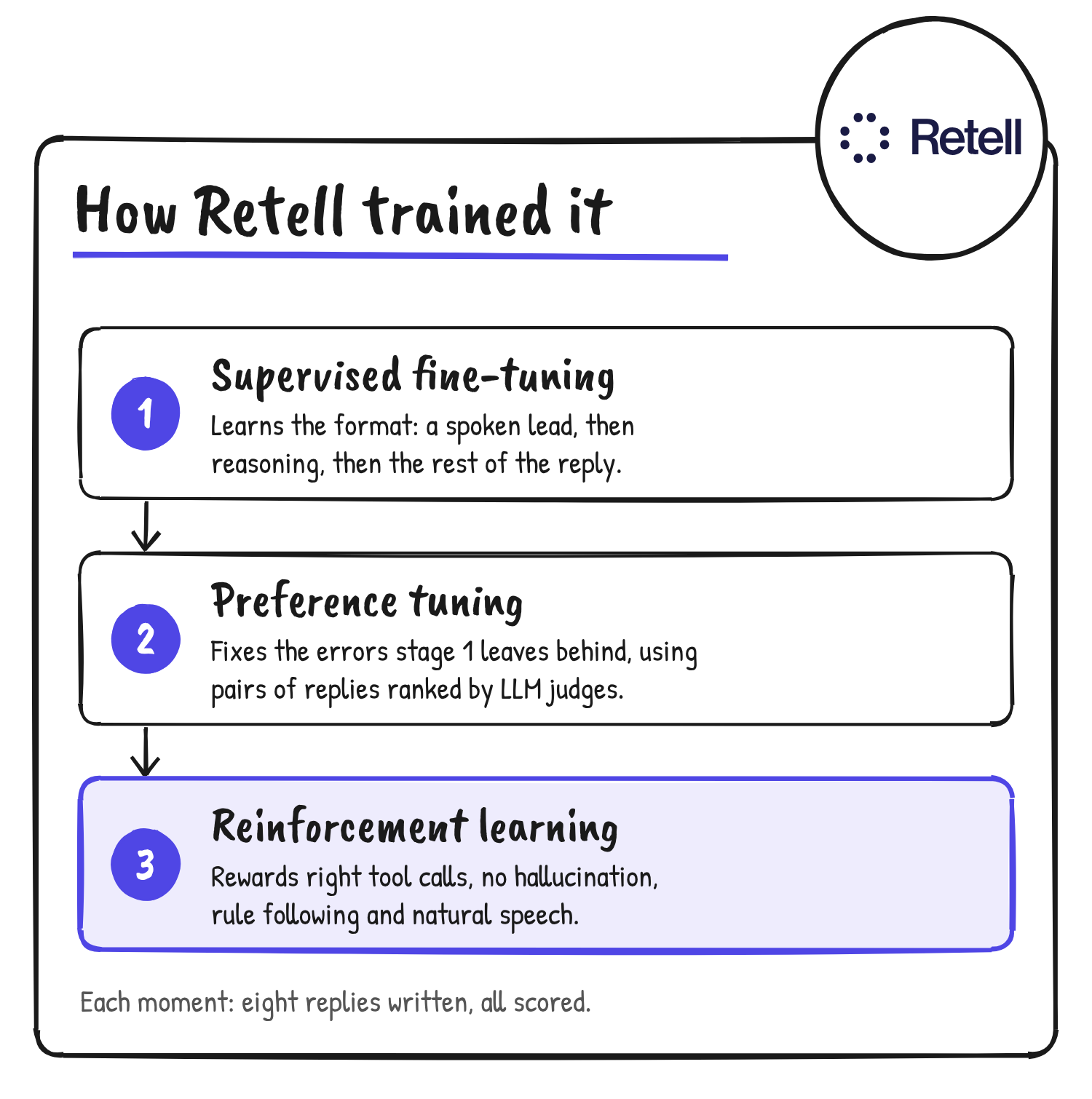
Retell says it trained the model in three stages on curated production conversations: supervised fine-tuning, which teaches the interleaved format; preference tuning, which targets the errors that stage leaves behind; and reinforcement learning, which rewards correct tool calls, no hallucination, instruction following and natural speech. For each moment in a call the model writes eight responses, and every one is scored. The press release says Tell-1 was trained on hundreds of millions of calls.
Because the rest of a reply has to be ready before the first sentence ends, Retell also rebuilt its serving stack. The post says running every step on CUDA graphs, a way of replaying a pre-recorded set of GPU operations, and reading long prompts in small slices cut stalled replies from 34% to 0.3%. Keeping each call on the GPUs that already hold it in cache raised the share of prompt tokens served from cache from 36% to 69%. Speculative decoding gets about four tokens out of each pass of the full model.
Under heavy load, Retell says, Tell-1 takes a median of 3.2 milliseconds per token, and 99.98% of turns pause for less than 400 milliseconds after the first sentence. Retell describes about 400 milliseconds as a natural gap between sentences in speech.
What the benchmarks show
The vCX benchmark is Retell’s own. It scores tool calling, hallucination, instruction following and natural phone speech on contexts drawn from real calls. On its Tell-1 page, Retell reports Tell-1 first overall with a 94.4% average, first on colloquial speech, second on grounding and instruction following, and fifth on tool calling.
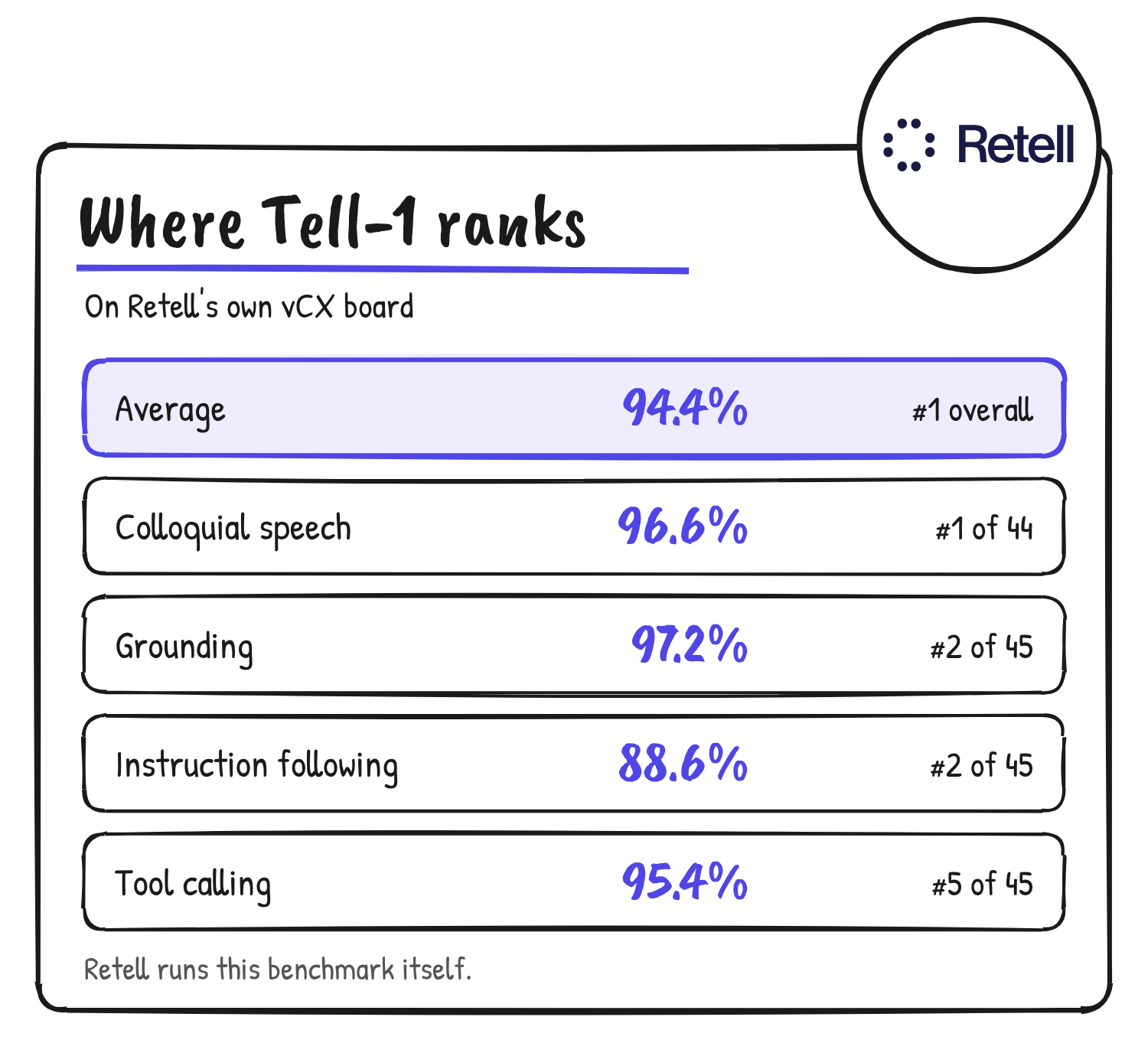
Retell’s own benchmark explainer says vCX is a vendor benchmark and that Retell has an entry in it. Retell’s changelog says other models still lead on grounding, instruction following and tool calling. The press release goes further, saying Tell-1 posted the highest overall score of any model tested, ahead of the latest models from OpenAI, Google and Anthropic. Retell also says Tell-1 costs 45% less than models with similar vCX scores.
Retell lists results on three public benchmarks, Sierra’s τ²-bench, Multi-IF and GPQA Diamond, and links testing by Cekura, Bluejay and Hamming. Cekura ranked Retell, running Tell-1, first of 10 voice platforms for reliability, which is a ranking of platforms rather than of the model.
Latency, price and availability
Retell’s pages give three latency figures for Tell-1. The technical post says 126 milliseconds to the first token and a median of 72 milliseconds to the first meaningful chunk, meaning the first full sentence, over live traffic. The Tell-1 page says about 150 milliseconds to the first token. The press release says under 100 milliseconds on Retell’s live benchmark and under 300 milliseconds at peak call volumes. The post says its times are model time only and exclude network, speech recognition and speech synthesis.
Retell lists Tell-1 at US$0.035 per minute. It says the model is available in Retell from 19 November, when customers can select it as an agent’s model and compare it with other models on their own calls. Retell also launched Retell Dialer on 12 November, a tool for running outbound campaigns across its voice and SMS agents.
Retell says it was founded in 2023, serves more than 4,000 businesses including Lenovo, CVS Health and BILL, and handles more than 100 million connected calls a month. A day earlier it said it had passed US$100 million in annualised run rate on US$4.6 million in total funding. Retell’s post doesn’t name the base model Tell-1 starts from or give its size.
Discover more from Sulat AI & Tech News
Subscribe to get the latest posts sent to your email.