Migel Tissera has released Tess-4.5-594B-A17B, an open-weights fine-tune of Thinking Machines’ Inkling 2 Small that he says resolves 88.2% of SWE-Bench Pro v2 Hard tasks, against 86.3% for the base model, Tissera said on X on 13 November. The weights are on Hugging Face under the Apache 2.0 licence.
Tissera, who makes the Tess family of models, describes the release as the Tess recipe applied to Inkling 2 Small, post-trained on real engineering sessions for “intellectually dense reasoning, warm and empathic tone, and hardcore engineering”. His post says the model uses about 10% fewer tokens than the base. The model card puts that figure at 9% fewer output tokens.
Introducing Tess-4.5-594B-A17B, the best Tess model ever. 🎉
— Migel Tissera (@migtissera) November 13, 2026
Inkling 2 Small, post trained with the Tess-4.5 recipe, on real engineering sessions to do what Tess does best: intellectually dense reasoning, warm and empathic tone, and hardcore engineering.
On SWE-Bench Pro v2 Hard, Tess-4.5 resolves more of the hardest public software-engineering tasks than the base model (88.2% vs 86.3%), and it does it with ~10% fewer tokens.
What Tissera changed
Inkling 2 Small is a mixture-of-experts model, one that routes each token to a few specialist sub-networks instead of running the whole network. Thinking Machines’ model card lists 594 billion parameters in total, 17 billion active per token and a context window of up to 1 million tokens. Thinking Machines released it on 5 November under Apache 2.0.
Tissera’s model card says Tess keeps all of that and works as a drop-in replacement, with the same checkpoint format, serving recipes and hardware. He trained a LoRA, a small set of add-on weights, at rank 32 on the attention projections and the output head, with the experts frozen, then merged it into the base model’s BF16 tensors. The experts, routers, embeddings and vision tower are identical to the base.
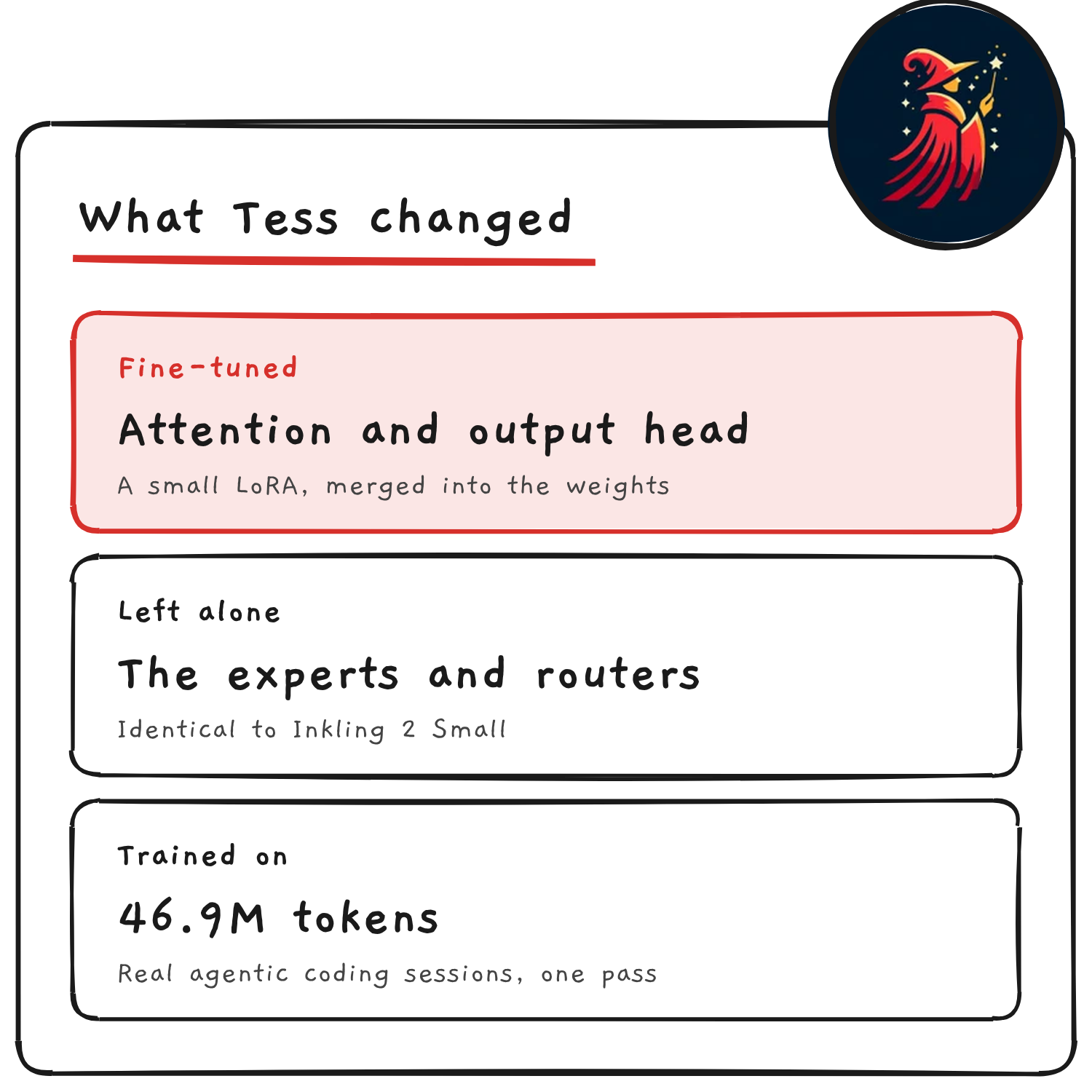
The training set was 1,073 rows of up to 64,000 tokens each, 46.9 million tokens in all: anonymised real agentic coding sessions, Tess-4 samples and a self-distilled multi-turn conversation slice. Training ran for one epoch of 135 steps on Thinking Machines’ Tinker platform, where he says Inkling 2 Small was available for fine-tuning before its weights were public.
The benchmark numbers
Tissera ran three benchmarks from the Inkling 2 Small card at reasoning_effort: "xhigh" and compares the results with the base model’s scores on that card. Tess is ahead on SWE-Bench Pro v2 Hard (88.2% against 86.3%) and AA-LCR v1.1 (85.0% against 83.3%), and 0.4 points behind on LongBench v2 (70.2% against 70.6%).
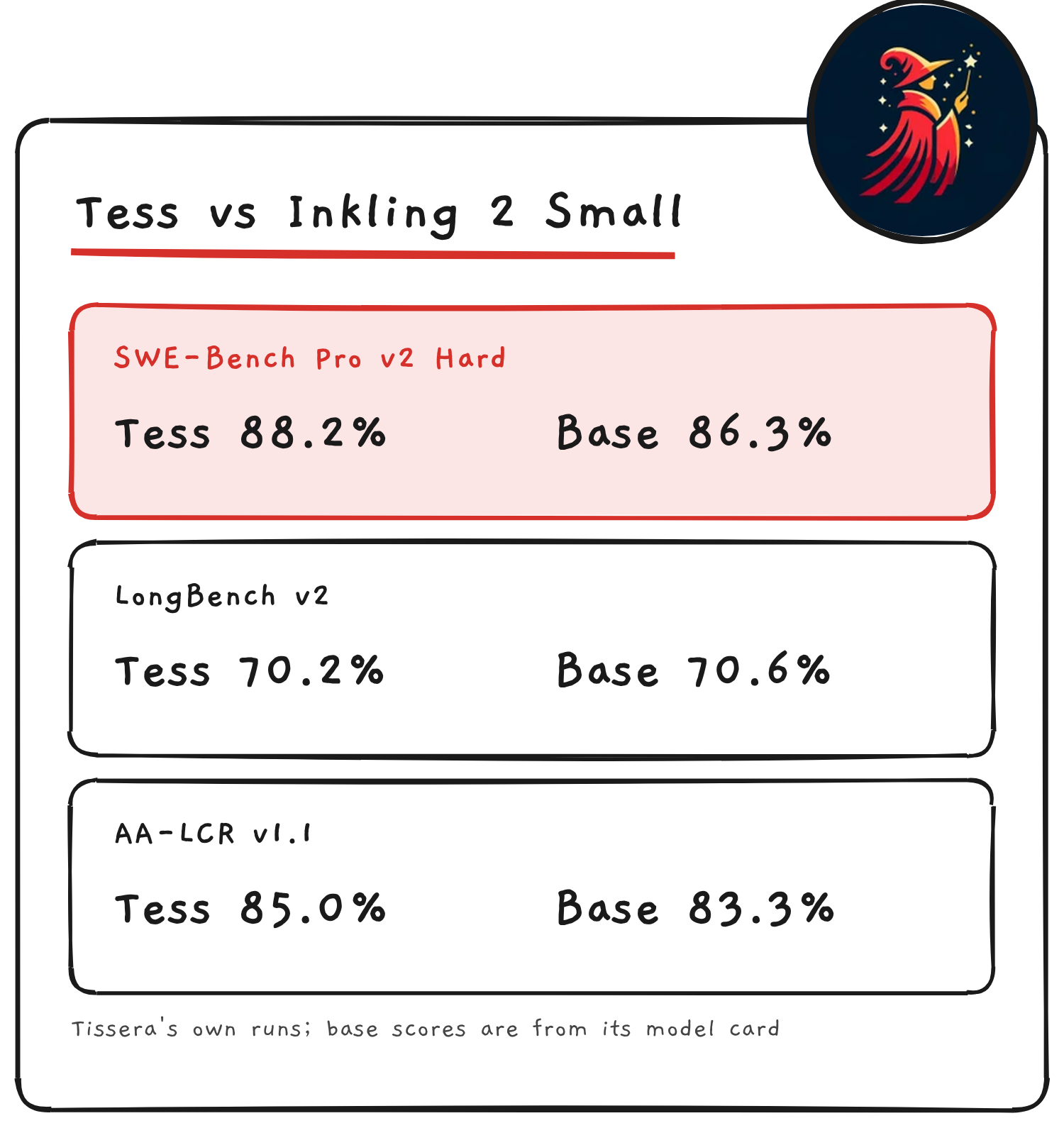
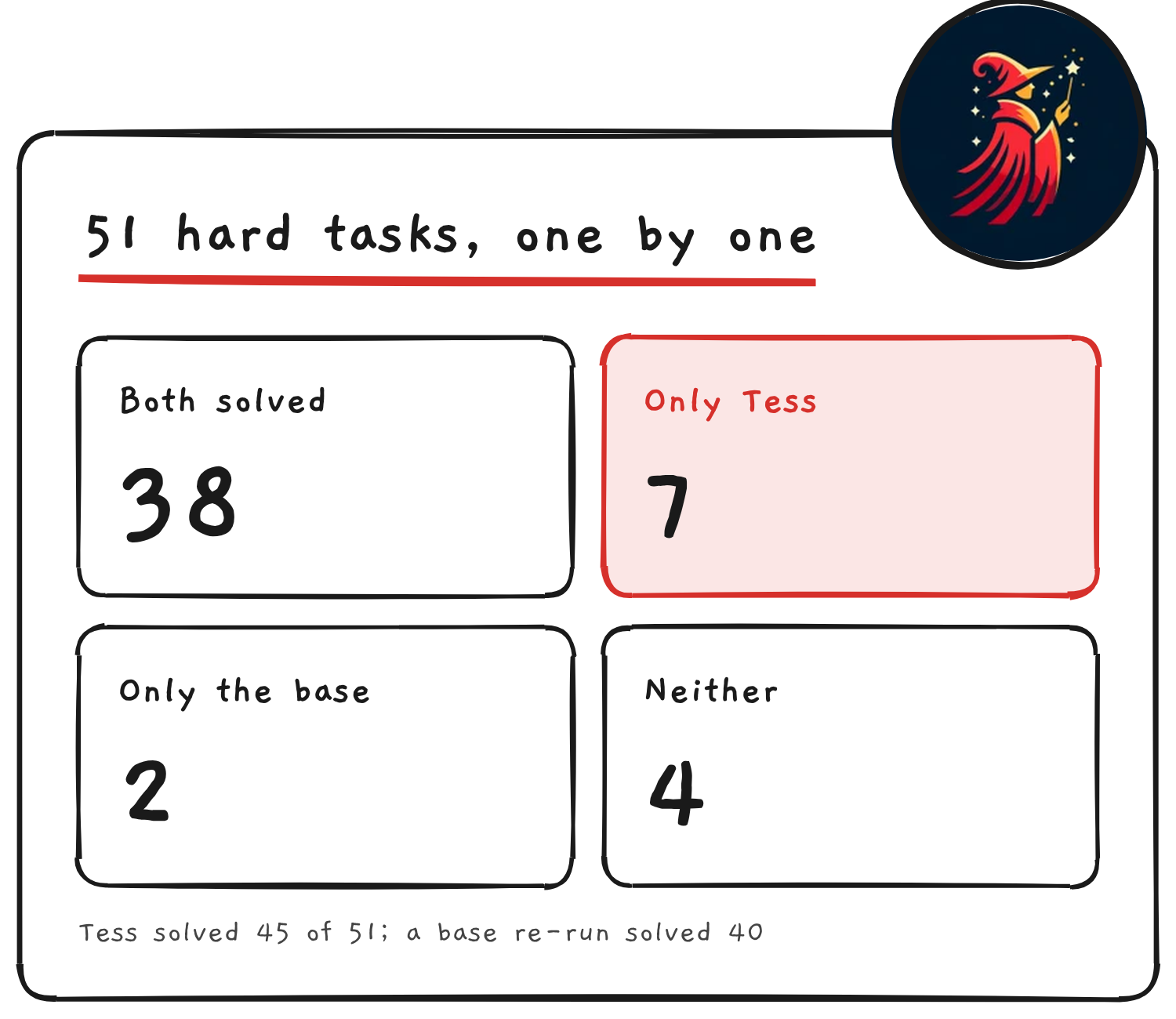
The SWE-Bench Pro result comes from the public hard split of 51 tasks, which at least two of five frontier model families failed under Scale’s locked protocol. Tess resolved 45. Across those tasks it generated 4.07 million output tokens, against 4.45 million for the base run through the same harness, mini-swe-agent 2.4.6 with one attempt per task. Tissera served Tess with SGLang on four NVIDIA B200 GPUs.
The 86.3% for the base is the figure on its own model card. The model card says Tissera’s run of the base through the same harness on Tinker scored 78.4%, or 40 of 51 tasks, at both high and xhigh effort. Against that run, both models resolved 38 tasks, Tess alone resolved seven, the base alone resolved two and neither resolved four. The card says a 51-task set moves by a task or two on luck alone, and that Tess scored 70.6% on the same tasks at high effort, so it recommends running it at xhigh.
The model card’s notes add two figures for the long-context tests. On AA-LCR, graded with Claude Sonnet 5 as the judge instead of the GPT-5.6 Luna that Artificial Analysis uses, the base also scored 85.0% on Tissera’s setup. On the 395 LongBench v2 questions that fit a 256,000-token window, Tess scored 69.9% and the base 68.6% under identical treatment.
What it takes to run
The merged checkpoint is about 394 GB. A separate LoRA adapter of 327 MB is for people who already serve Inkling 2 Small and want to switch adapters per request. Hardware is the base model’s: at least 500 GB of aggregated GPU memory, for example two B300, four H200 or four B200 GPUs. The card gives vLLM and SGLang launch commands, and asks users to state the working directory in the system prompt and attach their real tool definitions.
There’s no GGUF build yet, because llama.cpp doesn’t support the Inkling 2 architecture; the card says one will follow when it does. Hugging Face lists no inference provider for the model. The card calls Tess built for software engineering and agentic work in English, and says general chat, creative writing and image understanding come from the base model. The fine-tuning rows were 64,000 tokens or shorter, so the card says behaviour past that length rests on the base. It also warns that an agent which can run commands can run the wrong one, and advises running Tess with permission prompts, in a sandbox or in a container.
Discover more from Sulat AI & Tech News
Subscribe to get the latest posts sent to your email.