Headcount for US software developers aged 22 to 25 is 18.6% below its November 2022 level in Stanford Digital Economy Lab’s Canaries dashboard, while headcount for developers aged 41 to 49 is 20.2% above it. The latest data runs to September 2026 and comes from payroll records at firms that use ADP, the payroll processor.
The Kobeissi Letter, a markets commentary account on X, posted a version of these figures on 14 November and wrote that “the AI boom is destroying job opportunities for entry-level tech workers”. That’s a stronger claim than the lab makes.
The AI revolution is leaving younger tech workers behind:
— The Kobeissi Letter (@KobeissiLetter) November 14, 2026
US software developer employment among workers aged 22-25 has fallen -20% since November 2022, when ChatGPT was launched.
Over the same period, the 26-30 age group has recorded a -4% decline.
By comparison, employment among developers aged 41-49 has surged +20%.
What the dashboard shows
The lab indexes each age group’s software developer headcount to 100 in November 2022, the month ChatGPT launched. It puts software developers in the group of occupations most exposed to AI, with “large declines for early-career workers (22-25), modest declines for the next-youngest groups, and expansion for the remaining age groups”.
| Age group | Index, Sep 2026 | Change since Nov 2022 |
|---|---|---|
| 22 to 25 | 81.4 | -18.6% |
| 26 to 30 | 95.8 | -4.2% |
| 31 to 34 | 106.7 | +6.7% |
| 35 to 40 | 112.8 | +12.8% |
| 41 to 49 | 120.2 | +20.2% |
| 50 and over | 107.7 | +7.7% |
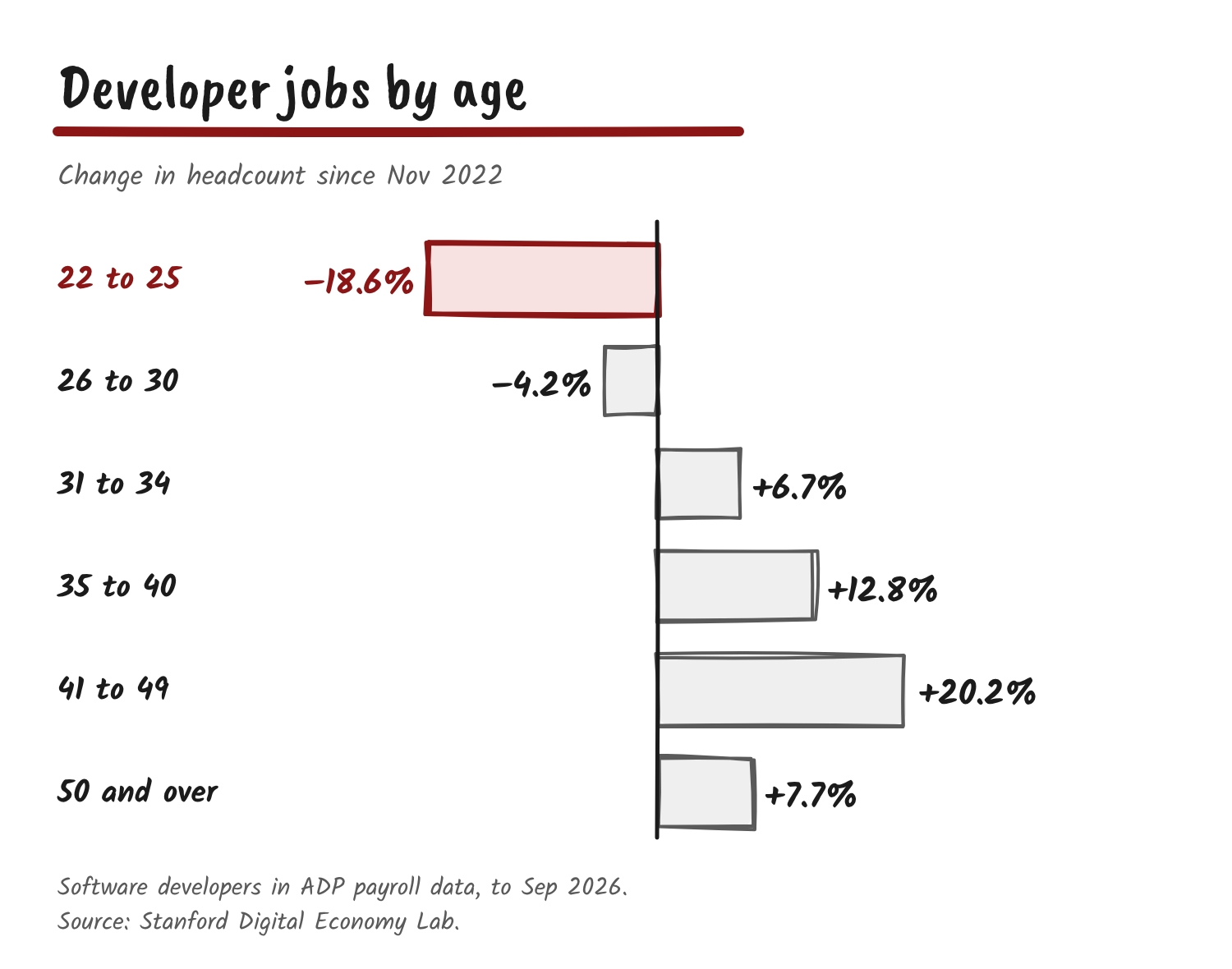
The youngest group has sat between 17.6% and 21.5% below its November 2022 level in every month of 2026. August’s 20.0% is the figure in the Kobeissi post, along with its 4% for ages 26 to 30 and 20% for ages 41 to 49. The post’s +6% for ages 31 to 34 and +11% for ages 35 to 40 are lower than the dashboard’s in every month of 2026; the September figures are +6.7% and +12.8%. The gap between the oldest and youngest of those groups is 38.8 percentage points in September and 40.4 in August.
What Stanford says the data can’t show
The dashboard’s authors, Erik Brynjolfsson, Bharat Chandar and Ruyu Chen, describe their results as descriptive patterns, not causal estimates. In the lab’s words, the data alone can’t establish how much of the divergence generative AI caused rather than other forces. The dashboard adds that in a February 2026 update, which used the broadest set of controls, declines in AI-exposed occupations became statistically significant in 2024, and “the earlier declines are likely driven by non-AI factors”.
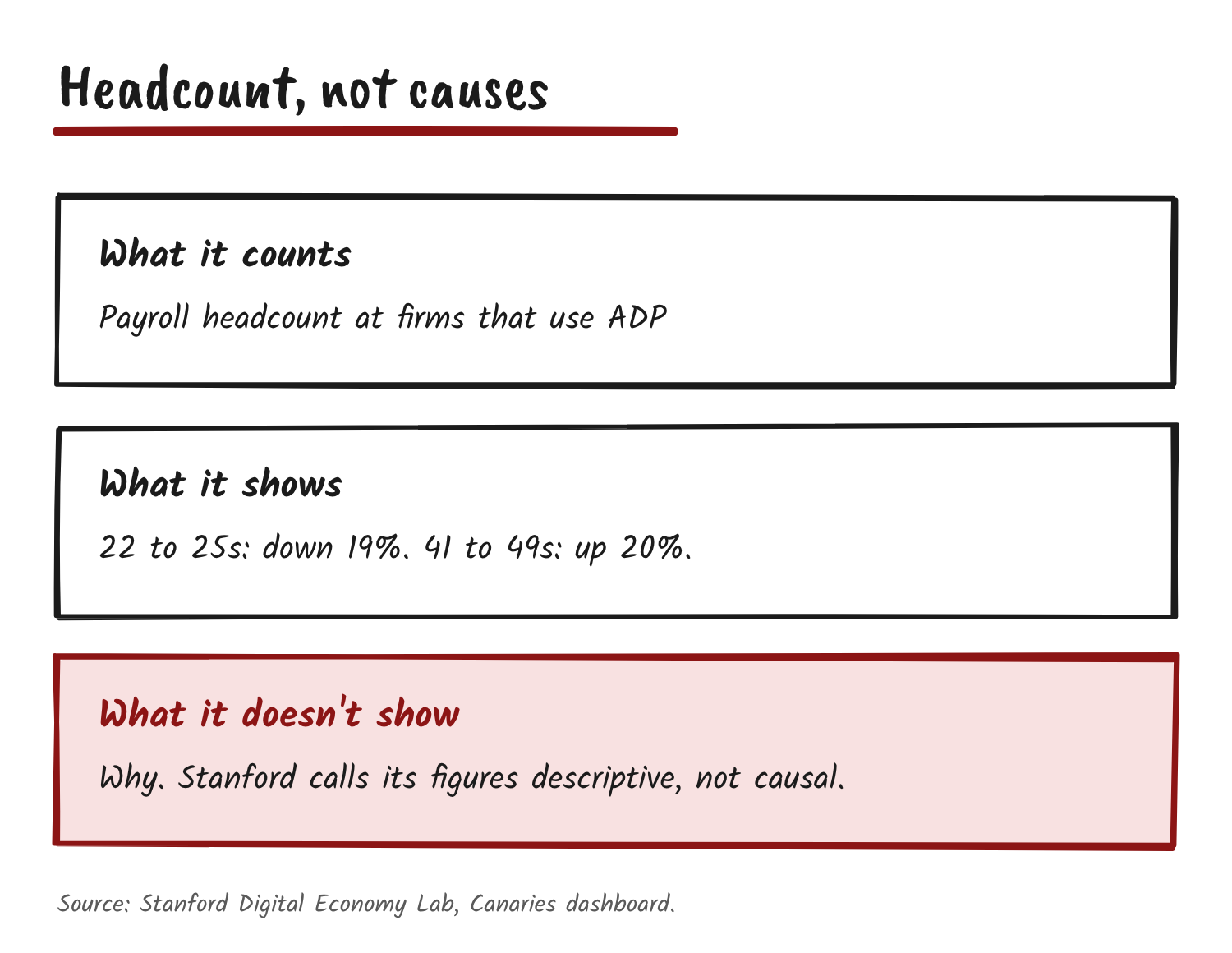
The sample is a five-year balanced panel of firms that use ADP, which processes payroll for firms employing more than 26 million US workers. The lab says it represents neither the whole US labour market nor every ADP client. The authors’ August 2026 paper says the patterns are more pronounced in the ADP sample than in national survey benchmarks. It also says estimates for these age and occupation groups in the monthly Current Population Survey commonly swing by 20% or more from one month to the next.
The paper’s headline number is a different measure from the developer headcount above. It finds that employment of 22 to 25-year-olds in AI-exposed occupations is 19% below where it would be had it kept pace with less-exposed peers, up from 15% in the July 2025 data. The authors say the adjustment comes mainly through reduced hiring of young workers, not more separations, and that the divergence persists when technology firms and computer occupations are excluded.
The lab publishes the dashboard’s data as downloadable files, including the software developer series used here.
Discover more from Sulat AI & Tech News
Subscribe to get the latest posts sent to your email.