Apple has added AI declarations for mainland China to App Store Connect, according to its help page on China mainland compliance. Apple says all existing apps available in China mainland must have completed and verified declarations by 31 January 2027 to stay on the App Store there.
TechNode reported the change on 17 November, citing the Chinese outlet IT Home. TechNode’s summary says existing apps have until 31 January to submit the information. Apple’s page goes further: the declarations have to be verified by then, not only filed.
Who has to declare
Apple says every app available on the China mainland App Store has to complete the declarations. A developer picks Yes if the app offers the regulated features there, and No if it doesn’t offer them or has them disabled or geoblocked in China mainland. Only the Account Holder or an Admin can fill them in, under General, then App Compliance, for each app in App Store Connect.
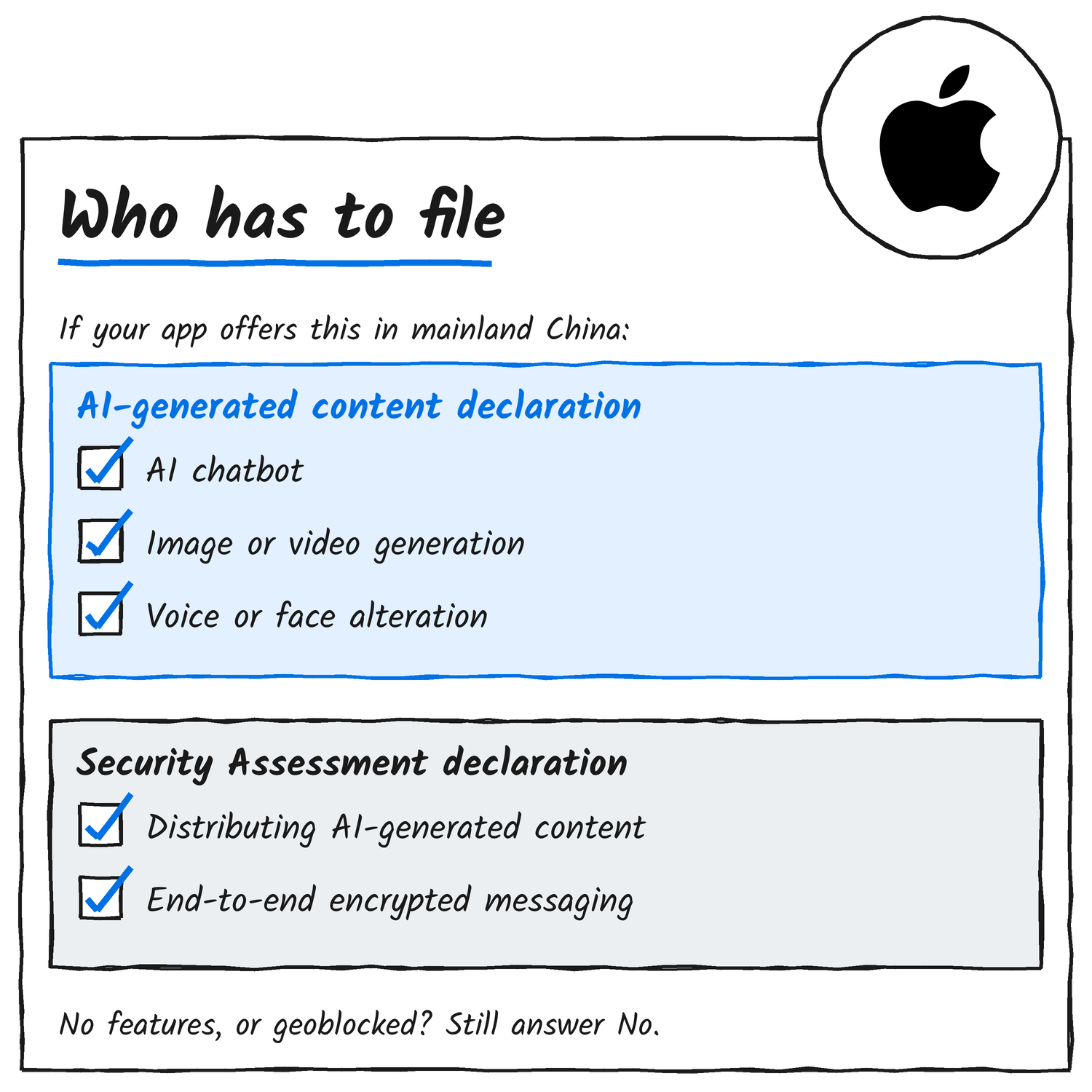
There are two declarations. The AI-Generated or Synthetic Content declaration covers apps with services such as AI chatbots, image or video generation, and voice or face alteration. The Security Assessment declaration covers apps that distribute AI-generated or synthetic content, and apps that enable end-to-end encrypted instant messaging. That second trigger reaches messaging apps with no AI features at all.
What each declaration needs
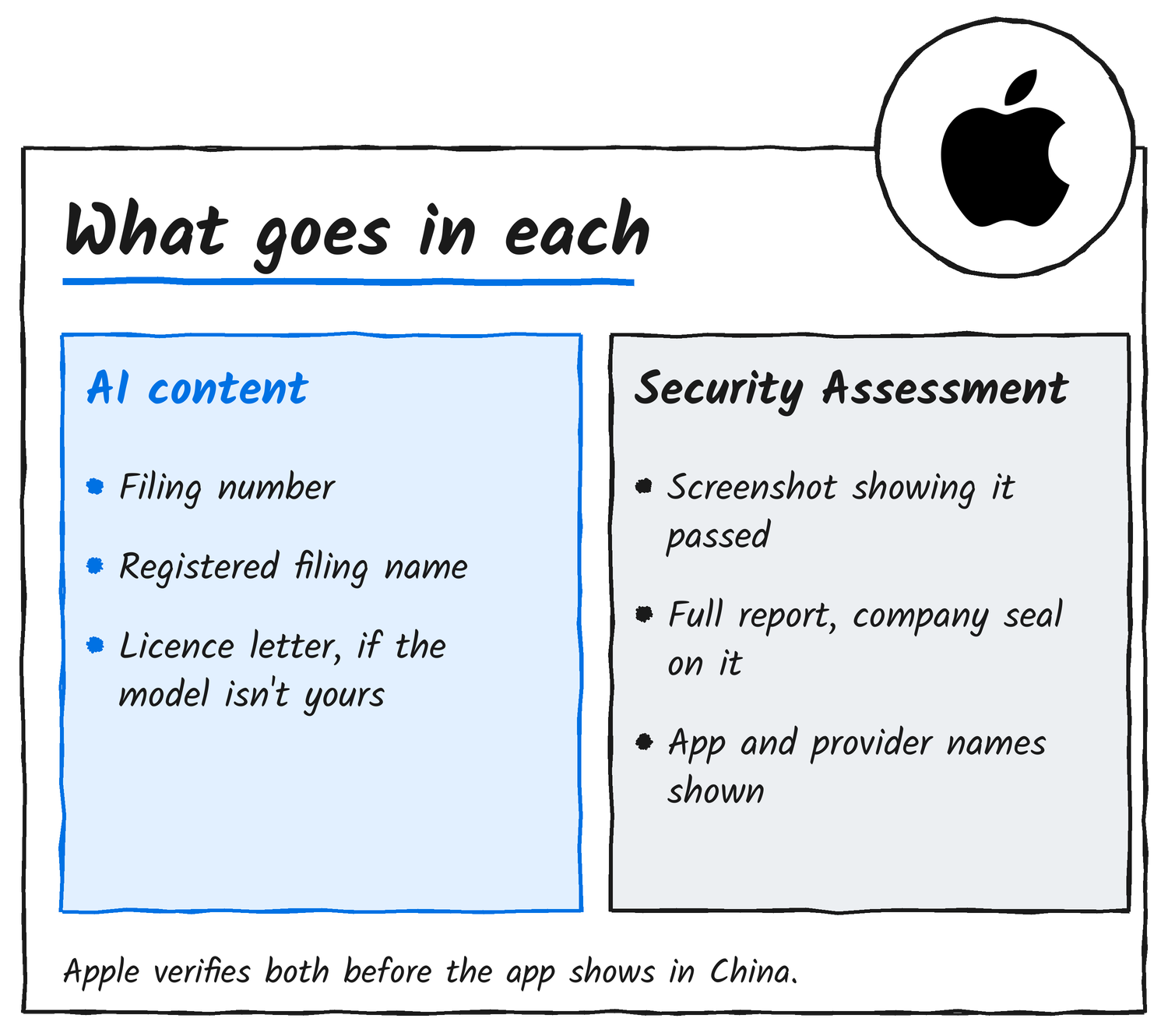
For the AI declaration, Apple asks for the approved filing number and registered filing name of the app’s large language model (LLM) or algorithm. If the app’s AI features run on someone else’s technology, the developer also uploads an authorisation or usage agreement from the technology’s owner. Apple says that document has to show the registered name and filing number of the model or algorithm, name the developer as the authorised party, and match the owner listed in the Cyberspace Administration of China (CAC) approval registry.
For the Security Assessment declaration, Apple asks for two documents. One is a screenshot from China’s National Internet Security Management Service Platform showing the app name, the provider name and a status of “pass” or “passed review”. The other is the full assessment report, which has to carry the app name, the provider name and the company seal, known in China as a chop. Apple tells developers to redact confidential or proprietary information before uploading.
The Chinese rules behind the page
Apple’s page names its legal basis. The first is the Measures for Labeling AI-Generated or Synthetic Content, issued on 7 March 2025 by the CAC, the Ministry of Industry and Information Technology, the Ministry of Public Security and the National Radio and Television Administration. They took effect on 1 September 2025. Article 7 says app distribution platforms must, when an app is listed or goes online, require its provider to state whether it offers AI generation or synthesis services, and must check the provider’s labelling materials if it does. Article 12 says providers hand those labelling materials over when they complete algorithm filings and security assessments.
The security declaration points to the Interim Measures for the Management of Generative AI Services, which took effect on 15 August 2023. Under Article 17, generative AI services with public opinion attributes or social mobilisation capacity need a security assessment and an algorithm filing, as a summary of the measures puts it. Apple also links the CAC’s 2018 provisions on security assessments for internet services with those attributes.
Apple has cleared AI apps out of its China store before. In August 2023, TechCrunch reported that several generative AI apps had been removed two weeks before the interim measures took effect. Apple told the developer of OpenCat that its app was tied to ChatGPT, “which does not have requisite permits to operate in China”.
What happens when verification fails
After a developer saves a declaration, its status becomes Pending Verification. The other statuses are Missing Info, when required documents are absent, Verification Failed, and Active, which means the app is eligible for distribution in China. Apple says an app won’t be available on the China mainland App Store until its compliance information is verified, while it still releases in every other selected country and region.
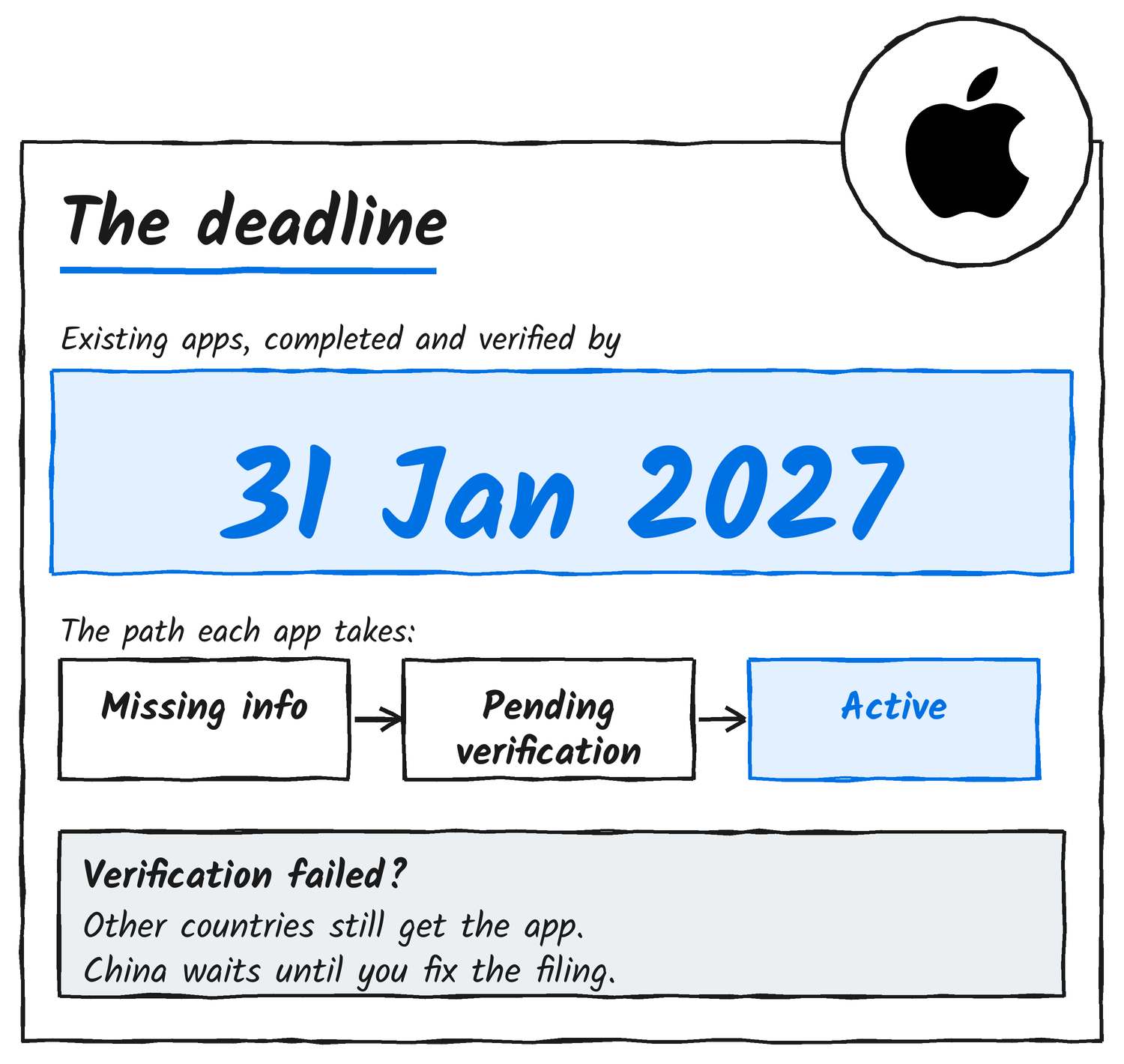
A developer whose declaration fails fixes it on the App Compliance page. Apple reviews the updated declarations when the developer submits the next app version to App Review. Apple’s page doesn’t give a review time, and it doesn’t say when the compliance page went live. For questions on how to comply, Apple points developers to the CAC and the National Internet Security Management Service Platform.
Sources
- View China mainland compliance information, App Store Connect Help, Apple
- Apple adds generative AI compliance filings to App Store Connect in China, TechNode
- Measures for Labeling AI-Generated or Synthetic Content, Cyberspace Administration of China
- Interim Measures for the Management of Generative AI Services, Cyberspace Administration of China
- Generative AI services pulled from Apple’s App Store in China, TechCrunch
Discover more from Sulat AI & Tech News
Subscribe to get the latest posts sent to your email.