Liquid AI has released d1.2 and d1.2-ultra, new versions of its decision models that accept audio as well as text and images and add five new kinds of answer, according to its launch post. d1.2-ultra scores 75 on Artificial Analysis’s Decision Index v2.1, first among 24 decision models, and both models are live on the Liquid API at US$0.02 and US$0.042 per million input tokens.
Today, we release d1.2 and d1.2-ultra, the state-of-the-art omnimodal decision models. d1.2 and d1.2-ultra both can process text, images, and audio with new output capabilities.
November 16, 2026
> #1 on the @ArtificialAnlys Decision Index (75)
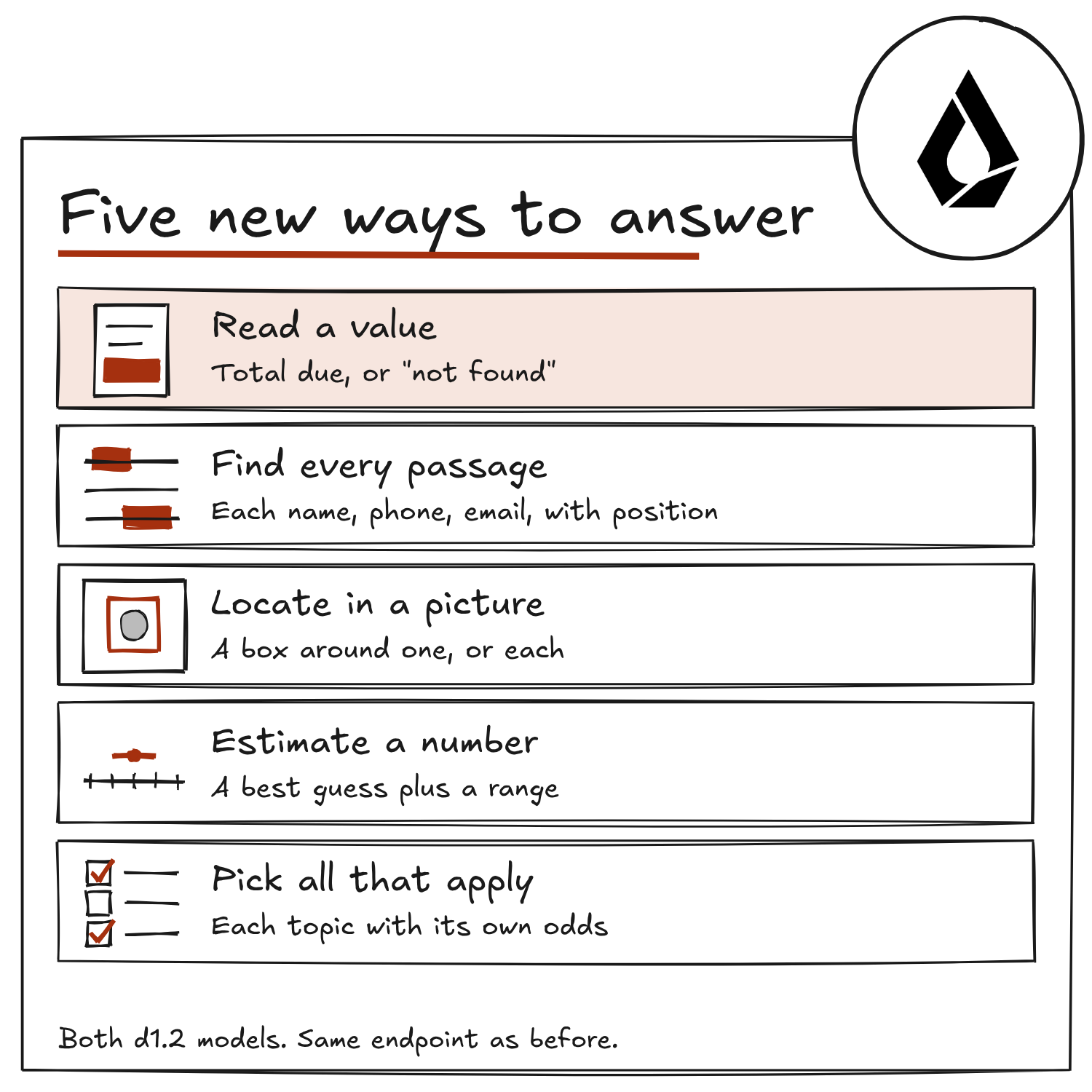
> Read a value from the input (text, number or date)
> Find every passage of a kind in a text (spans)
> Locate things in a picture (box for one, boxes for every instance)
> Estimate a number (number with a range)
> Pick every option that applies (choice)
1/ 🧵
Liquid AI posted the announcement on X on 16 November. A decision model reads some input, such as a support ticket, an invoice or a photo, along with a list of questions, and returns an answer to each with a probability, instead of writing text. Liquid launched d1-ultra on 15 October at the same US$0.042 price for text and images, and Perplexity’s Decider v1.3, which added span extraction on 12 November, is a competing model of the same kind.
Five new answer types
The hosted d1-ultra answered yes or no, picked one option, or placed something on a scale. Liquid’s post lists five additions to the API. Reading a value returns a text, number or date together with the characters it came from, or “not found” when the input doesn’t show it. Span finding returns every passage of a requested kind, such as each name, phone number and email address in a note, with its position in the text. Locating returns a box around one object, such as a signature on a scanned form, or around every instance, such as each tree in a photo, with a count. Estimating returns a best guess and a range; Liquid’s example is 12 people in a photo, with a range of 10 to 14. Multi-select returns every option that applies, such as billing and delivery for a support message, each with its own probability.
Liquid’s LFM3 release on 27 October gave its open-weight d1-2B and d1-omni-2B models typed answers, including boxes, values and estimates. The d1.2 post adds the five tasks to the hosted API, on the same endpoint and request format.
Liquid’s example reads three values from an invoice and asks for a fourth that the invoice doesn’t state. The model returns ACME SA, 1234.5 and 2026-04-03, and None for the VAT, rather than a guess. It also reads 03/04/2026, which the invoice labels day, month, year, as 3 April.
import os, requests

invoice = "ACME SA\nInvoice 2026-117\nTotal due: 1 234,50 EUR\nPay before 03/04/2026 (day/month/year)"

response = requests.post(
    "https://api.liquid.ai/decisions/v1/systemone",
    headers={"Authorization": f"Bearer {os.environ['LIQUID_API_KEY']}"},
    json={
        "model": "d1.2-ultra",
        "state": invoice,
        "questions": {
            "payee": {"type": "text", "instructions": "Who issued the invoice?"},
            "total": {"type": "number", "instructions": "How much is due?"},
            "due": {"type": "date", "instructions": "By when must it be paid?"},
            "vat": {"type": "number", "instructions": "How much VAT is charged?"},
        },
    },
)

a = response.json()["answers"]
print(a["payee"]["text"], a["total"]["number"], a["due"]["date"], a["vat"]["number"])
# ACME SA 1234.5 2026-04-03 None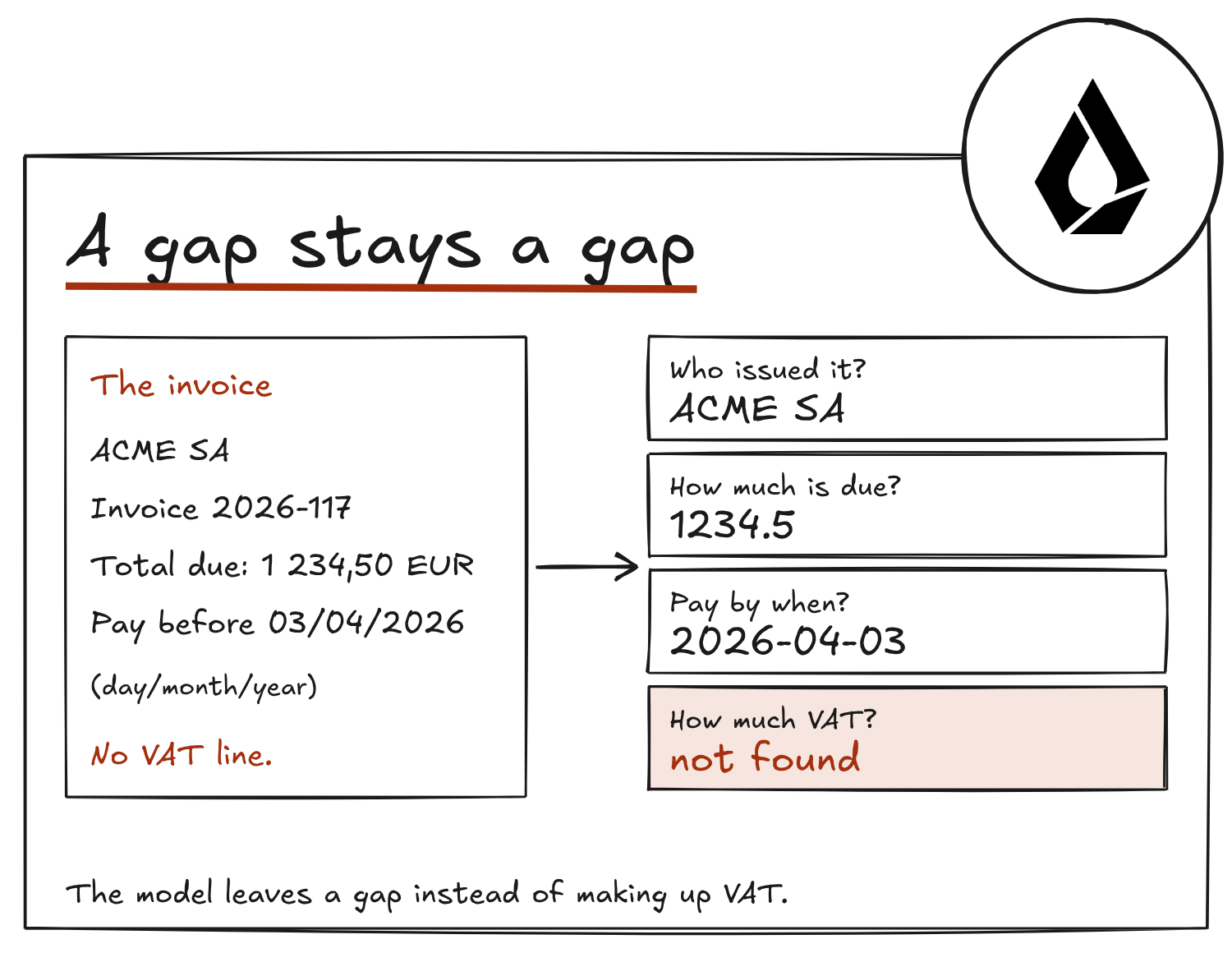
Audio works in two ways. A recording can be what you ask about, such as which language someone speaks or whether a siren is audible, or the question itself can be a recording, spoken instead of typed. Liquid says both models score 95% to 97% on held-out recordings when asked which sound is heard (ESC-50) or which language is spoken (FLEURS, 43 languages), with three to six options per question. Artificial Analysis lists text and image input for both models.
Where it ranks
The Decision Index v2.1 combines six benchmarks, covering decisions and extraction on documents such as resumes, receipts and research papers, tool calling, knowledge and hallucination, reasoning, and whether answers stay the same when a question is reworded. It scores the probability a model gives each answer, so a confident wrong answer costs more than a hesitant one, according to Artificial Analysis.
Artificial Analysis lists d1.2-ultra at 75, first of 24, and d1.2 at 69, ninth of 24. Liquid says d1.2-ultra is two points ahead of the previous best decision model, that no model scores higher than d1.2 for less money, and that none scores higher than d1.2-ultra at any price. On cost and speed, Artificial Analysis puts d1.2-ultra at US$133 per million tasks and 218 ms a task, against medians of US$135 and 209 ms, and d1.2 at US$63 and 150 ms.
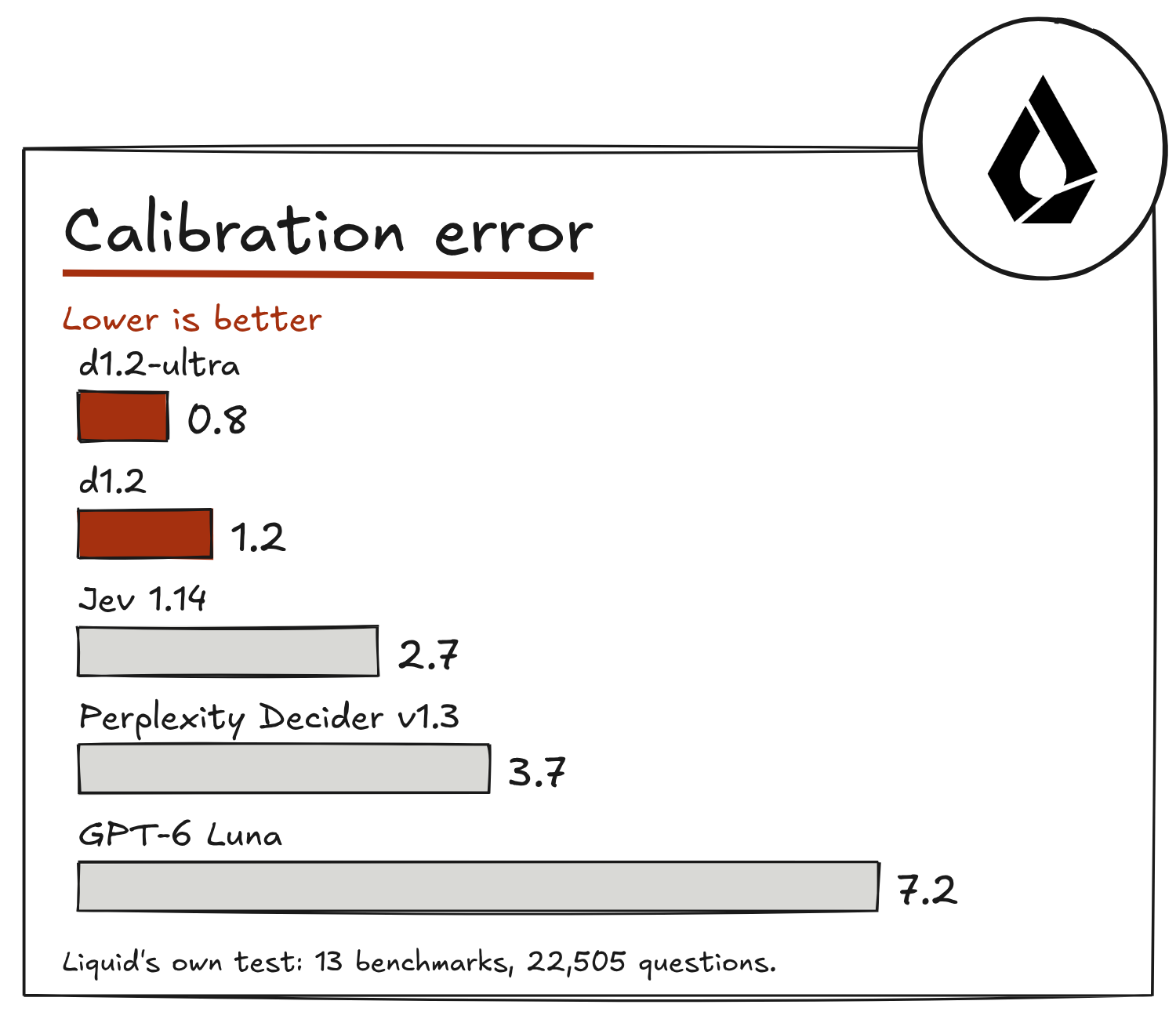
Liquid also reports calibration error, the gap between the probability a model states and how often it’s right. A model that says 80% should be right about 80% of the time, which lets you set a threshold and send low-confidence cases to a person. Across 13 benchmarks and 22,505 questions answered by all five models, Liquid measured 0.8 points for d1.2-ultra and 1.2 for d1.2, against 2.7 for Jev 1.14, 3.7 for Perplexity’s Decider v1.3 and 7.2 for GPT-6 Luna on its Decisions API. Those figures are Liquid’s own.
Accuracy on the new tasks
No public benchmark measures the five new tasks yet, Liquid says, so it tested them on internal sets built from held-out splits of public datasets. Liquid counts an answer as right when the model finds the target, or correctly reports “not found” because the target isn’t in the input.
| Task (dataset) | d1.2-ultra | d1.2 |
|---|---|---|
| Read a value from a receipt (CORD, SROIE) | 98% | 96% |
| Find every piece of personal data, precision / recall (Nemotron PII) | 94% / 93% | 92% / 88% |
| Locate an object described in a photo (RefCOCO, RefCOCO+, RefCOCOg) | 94% | 94% |
| Estimate the number of objects in a photo, within one (COCO) | 93% | 92% |
| Pick every object present in a photo (COCO) | 87% | 90% |
d1.2 beats d1.2-ultra on picking every object present in a photo, 90% to 87%, and the two tie at 94% on locating an object.
Price and access
Both models bill input tokens only, and output is free. d1.2 costs US$0.02 per million input tokens and d1.2-ultra US$0.042. An image costs 1.5 tokens per 32 by 32 pixel patch, so a 1024 by 1024 image is 1,536 tokens. A request’s text and pictures are billed once, and each extra question adds only its own text. You call the models as d1.2 and d1.2-ultra with a key from the Liquid console, and the API reference is in Liquid’s decision models documentation. Liquid says OpenRouter and Vercel support is coming soon and hasn’t given a date.
Discover more from Sulat AI & Tech News
Subscribe to get the latest posts sent to your email.