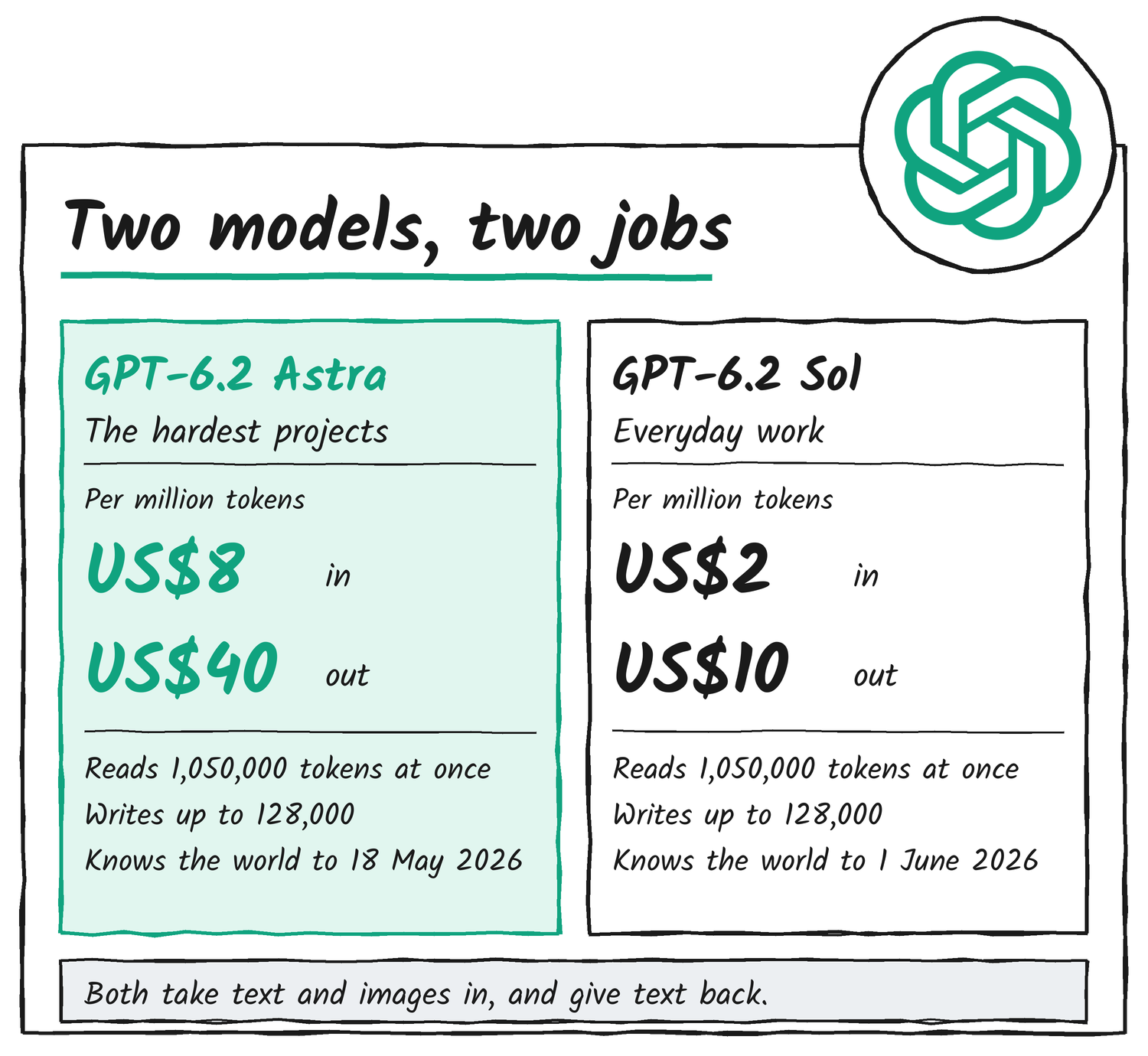
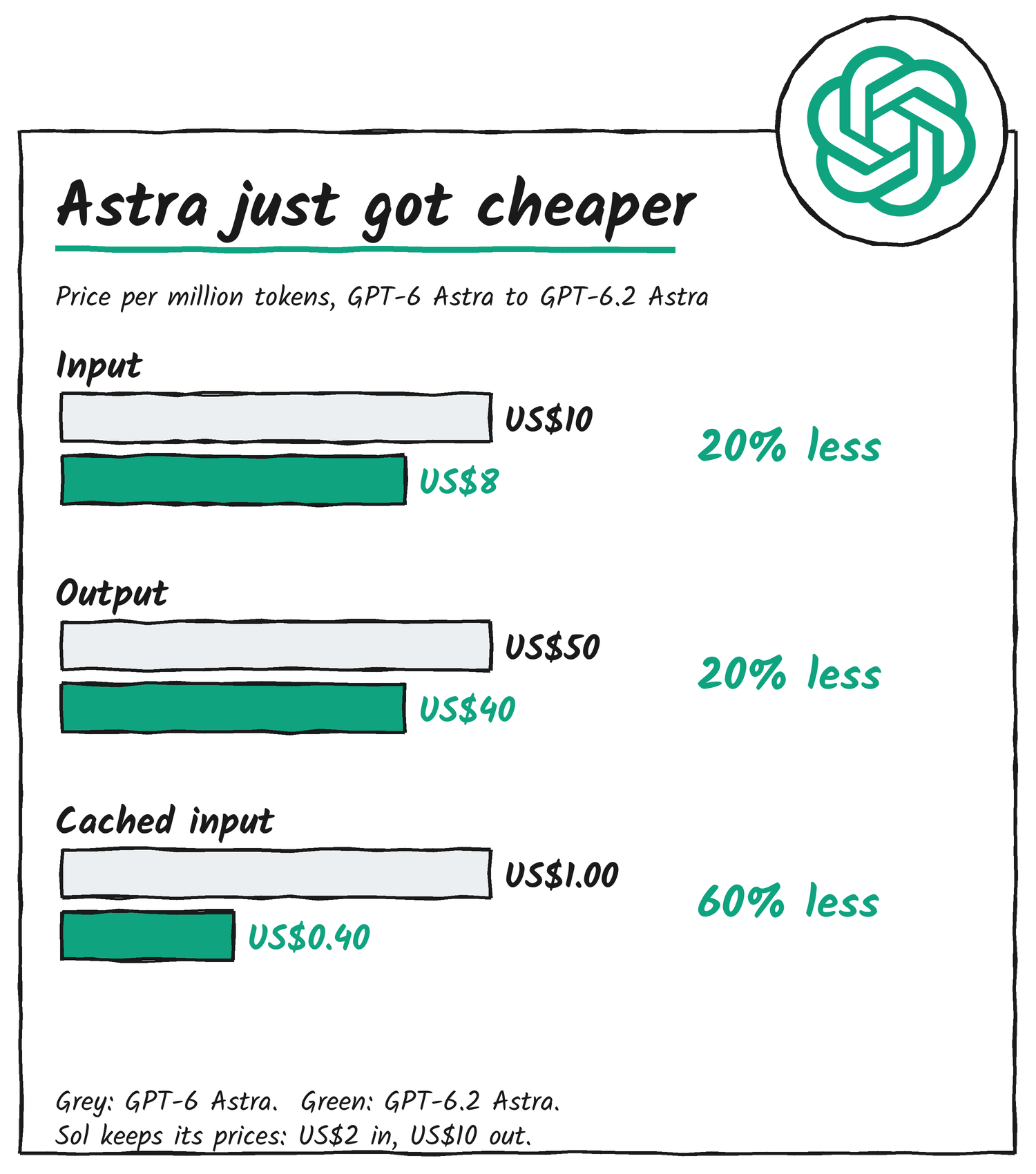
OpenAI has released GPT-6.2 Astra and GPT-6.2 Sol, two models it says finish demanding work with fewer output tokens, and both are live in ChatGPT Work, Codex and the API. Astra’s API prices fall 20% to US$8 per million input tokens and US$40 per million output tokens, while Sol stays at US$2 and US$10.
OpenAI announced the release on 17 November US time, which is 18 November in New Zealand. It calls Astra its frontier model for the hardest projects and Sol its efficient, versatile model for everyday work. OpenAI’s launch film for Astra runs just under two minutes.
Astra’s scores come with a cost claim attached
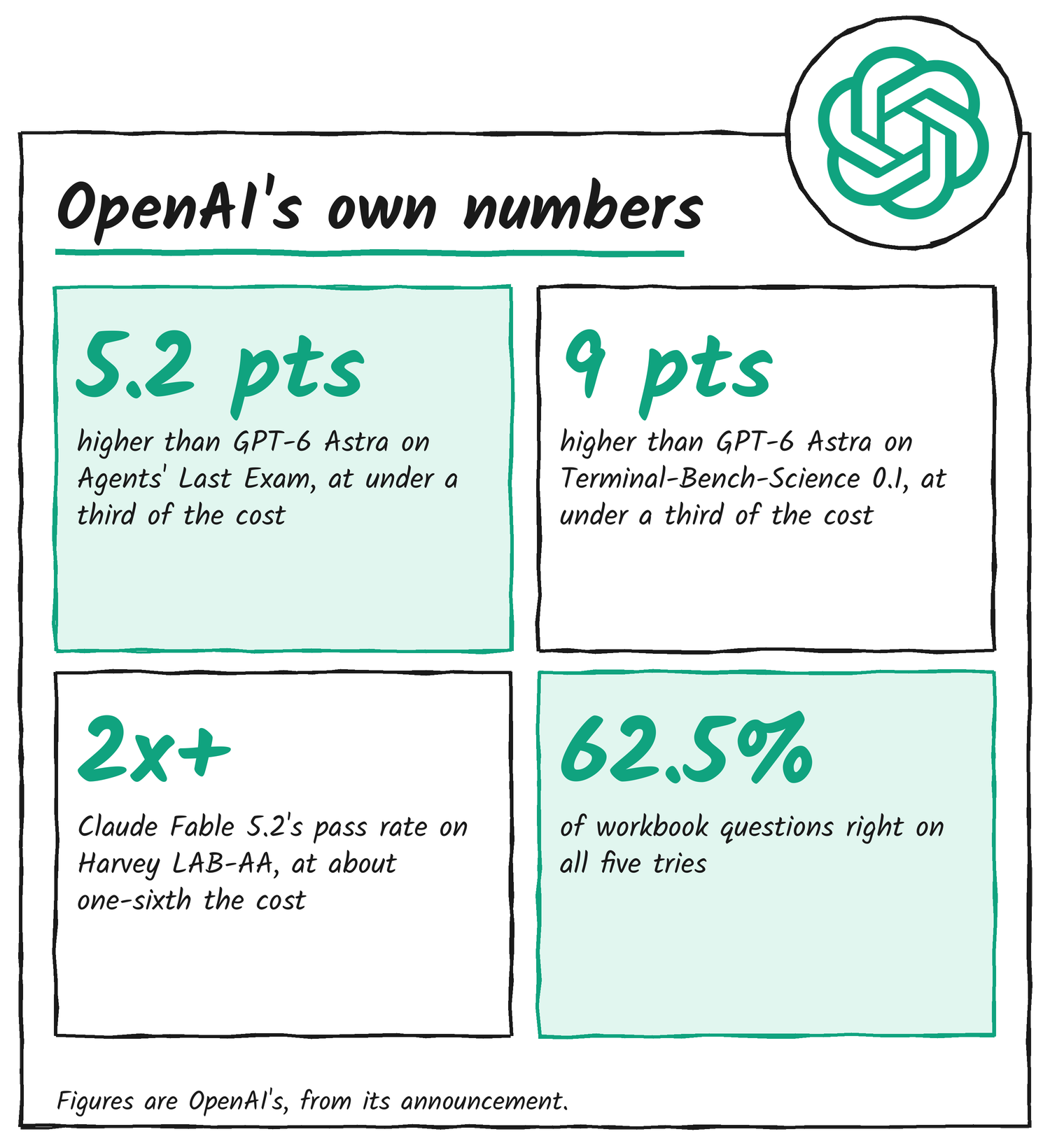
OpenAI leads with price as much as skill. On Agents’ Last Exam, a test of long, multistep professional work, it says Astra scores 5.2 points higher than GPT-6 Astra at less than a third of the cost, and 5.5 points ahead of Claude Fable 5.2 at 5% of the cost. OpenAI’s leaderboard results for Fable 5.2 leave out nine tasks that used a fallback model.
For science, OpenAI calls Astra the best model in the world for scientists. It sets new highs on Terminal-Bench-Science 0.1, where models carry out research workflows in a terminal, and on the Vals Science Index, where they read real biological data and run experiments to work out how a simulated system behaves. On Terminal-Bench-Science, Astra sits 9 percentage points above GPT-6 Astra at under a third of the cost.
Sol is the everyday model, and it sits close behind
Sol keeps the API prices of GPT-6.1 Sol and closes most of the gap to Astra on coding. On Cognition’s FrontierCode 2.0, which checks whether changes to real codebases meet a maintainer’s standard for merging, OpenAI says Sol comes within 0.5 points of Astra at about one-fifth of the cost, with both at maximum reasoning effort.
Outside work, Sol is the one OpenAI points at. On LifeVal, its test of everyday jobs such as shortlisting kindergartens after a move, finding a home that fits a family’s budget and commute, or planning meals for a parent with a new diagnosis, Sol outscores GPT-6 Astra at about one-seventh of the cost.
Slides, spreadsheets and legal briefs
OpenAI trained Astra to produce slides, spreadsheets and documents that follow the conventions of fields such as law, sales, finance and accounting, with more direct writing and less filler. Give it a template, as a file or even a screenshot, and OpenAI says it matches the layout, colours and typography down to the font size, then carries the template’s writing style into the new slides.
OpenAI’s example asked both models to update a retailer’s Q1 earnings deck using its Q2 earnings release and Form 10-Q. Both named tariff refunds as the main driver of the earnings gain. Astra put the 5.3% sales increase in the headline, broke out growth online and in stores, and listed next steps for management, including keeping fast-selling products in stock and budgeting without further refunds.
On GDPval v2, OpenAI’s benchmark of multistep assignments from real consulting, finance and design projects, Astra is up 6.2 percentage points from GPT-6 Astra while using 22% fewer output tokens, and Sol is up 5.3 points from GPT-6.1 Sol. In a financial workbook test, Astra answers 62.5% of questions correctly on all five independent attempts, a new high in OpenAI’s comparison.
Legal work gets the sharpest number. Harvey’s LAB-AA gives credit only when a deliverable finds the relevant facts, applies them to a detailed brief and meets every requirement, and OpenAI says Astra more than doubles Claude Fable 5.2’s pass rate on it at about one-sixth of the cost. Niko Grupen, Harvey’s head of applied research, says Astra completed more than three times as many Legal Agent Benchmark tasks as GPT-6 Astra with 34.5% fewer output tokens.
Jay Hack, ClickUp’s head of AI, says Astra edged out ClickUp’s production model in blind tests on the apps, dashboards and slides ClickUp Brain builds, using about 40% fewer tokens and 30% fewer review rounds.
Astra for Law
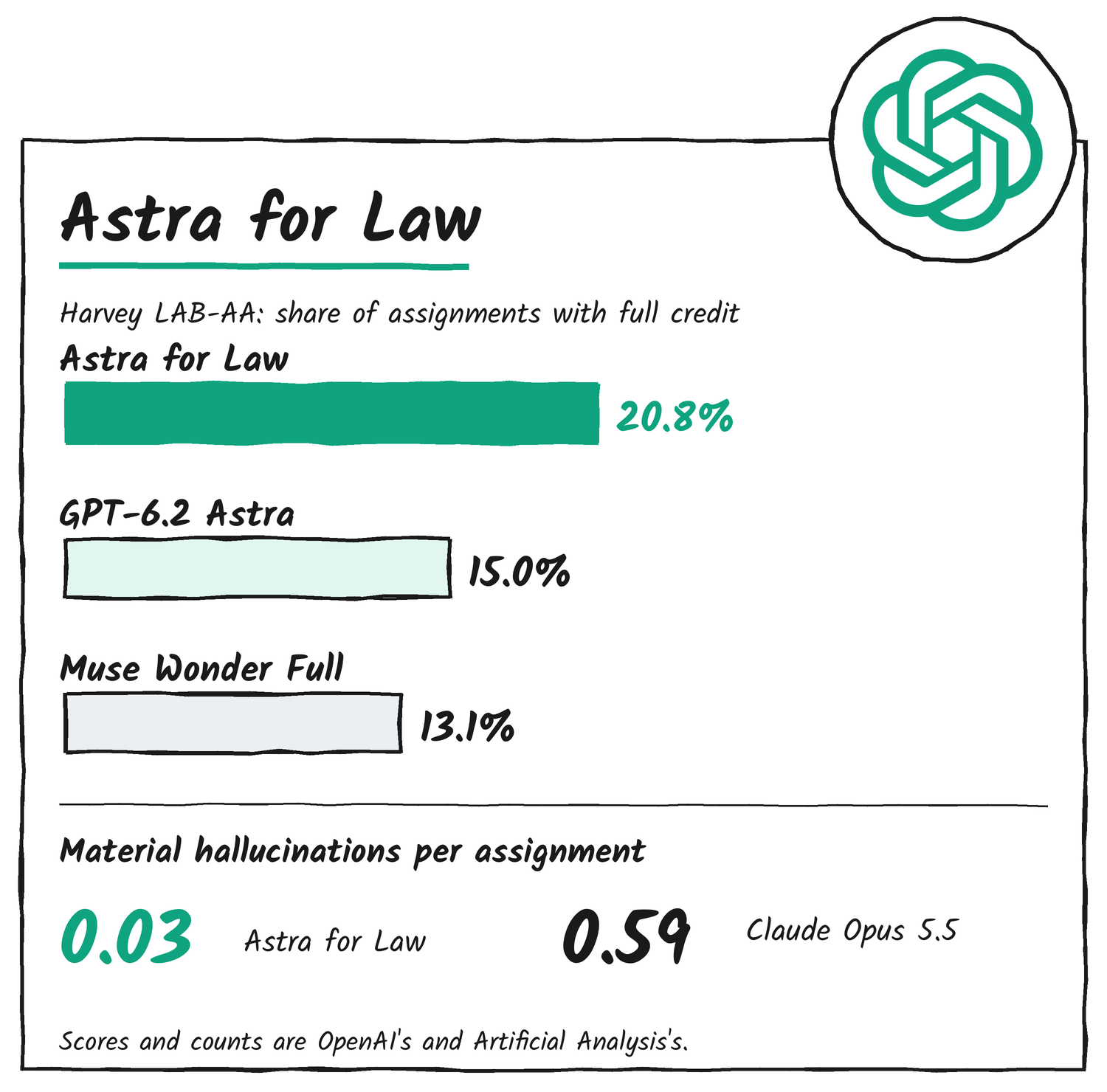
OpenAI also published an updated Astra for Law, a configuration of Astra that adds an expanded legal search index and instructions for researching a question, weighing the authorities and writing the answer. On LAB-AA’s 120 assignments across 24 areas of law, it earns full credit on 20.8%, ahead of GPT-6.2 Astra at 15.0% and Muse Wonder Full at 13.1%.
Artificial Analysis counts 0.03 material hallucinations per assignment for Astra for Law, against 0.59 for Claude Opus 5.5, according to OpenAI. Every ChatGPT Enterprise customer can request access through the Trusted Access Program in the admin console, and API access goes through a form. The model ID in ChatGPT is gpt-6.2-astra-law, and OpenAI lists its API rates at the same US$8 and US$40 as Astra.
Computer use, 3D and websites
Astra’s computer use is precise enough to work on individual parts and connections in CAD and simulation tools. OpenAI says that lets engineers check how components fit, see where loads shift as a design moves and test revisions before building a prototype.
For the first example, OpenAI asked Astra to visualise the chassis dynamics of a car on a mountain road. Astra built the 3D model, wrote a Python solver for the interplay of tyres and suspension, and animated the results in Blender.
For the second, OpenAI gave Astra public photos and build manuals for a radio-controlled buggy and an engine. Astra modelled the individual components, made an animated assembly guide and produced an illustrated parts catalogue.
On websites, OpenAI says Astra shows stronger visual reasoning, choosing layouts and imagery that give each site a distinctive look and building elements around the site’s actual goal. Astra and Sol can both turn a written brief into an interactive 3D experience in the browser, from a pinball table you can play to a Colosseum you can explore from different angles.
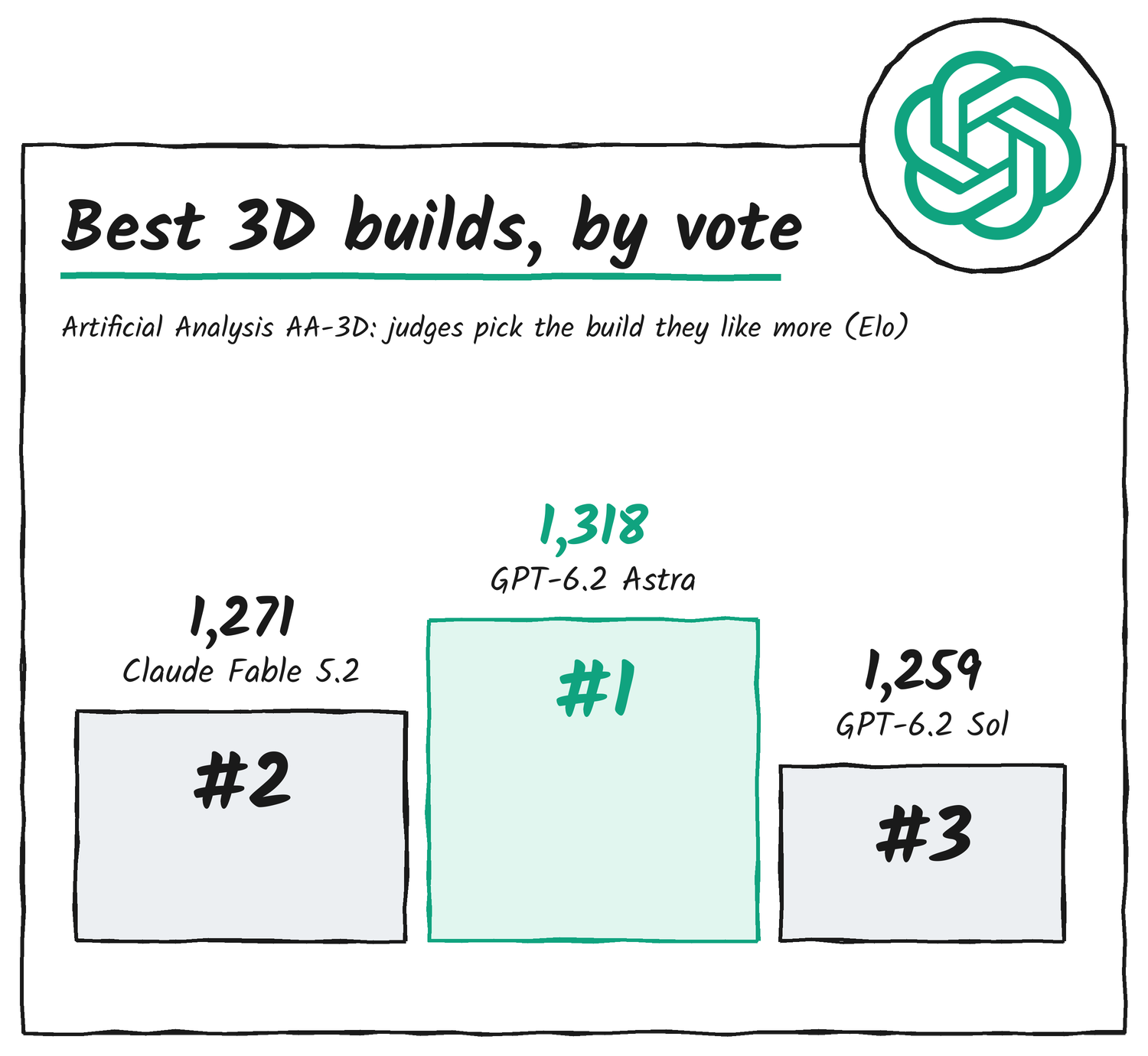
Artificial Analysis’s AA-3D has human judges vote between two blinded builds made from the same prompt. Astra ranks first at 1,318 Elo, ahead of Claude Fable 5.2 at 1,271 and Sol at 1,259.
OpenAI’s showcase includes a playable futuristic racing game on a track that winds through a city, which you can play in your browser, and a walk through a cathedral.
The third example runs from CAD to a paper lamp, and OpenAI shows it as a design video and a lamp builder site.
Alex Mashrabov, CEO and co-founder of Higgsfield AI, says Astra powers real-time video editing with pixel-level precision in Higgsfield Miracle. In Higgsfield’s internal 3D generation evals, he says, Astra hit the target result in one shot in 73% of cases, where GPT-6 Astra needed three or more iterations.
Better judgement about tools and effort
OpenAI says Astra decides better how to run a task. It matches its tools and effort to the workflow, and it knows when to use plugins and when to use computer use.
Eros Wang, a member of technical staff at Basis, says Astra plans long trajectories better and writes Bash that does more in fewer turns. Basis’s average time for long-horizon accounting work fell by 50%, and by up to 73% for the most complex jobs, he says.
Adam Alnasser, a member of technical staff at Jump Trading, says Astra reasoned from first principles on a hard optimisation problem and pushed Jump’s hardware to its limits. It saturated a benchmark that had stood for more than three years, he says, and reached targets he thought were impossible in less than a day.
Cybersecurity: Critical, with tighter safeguards
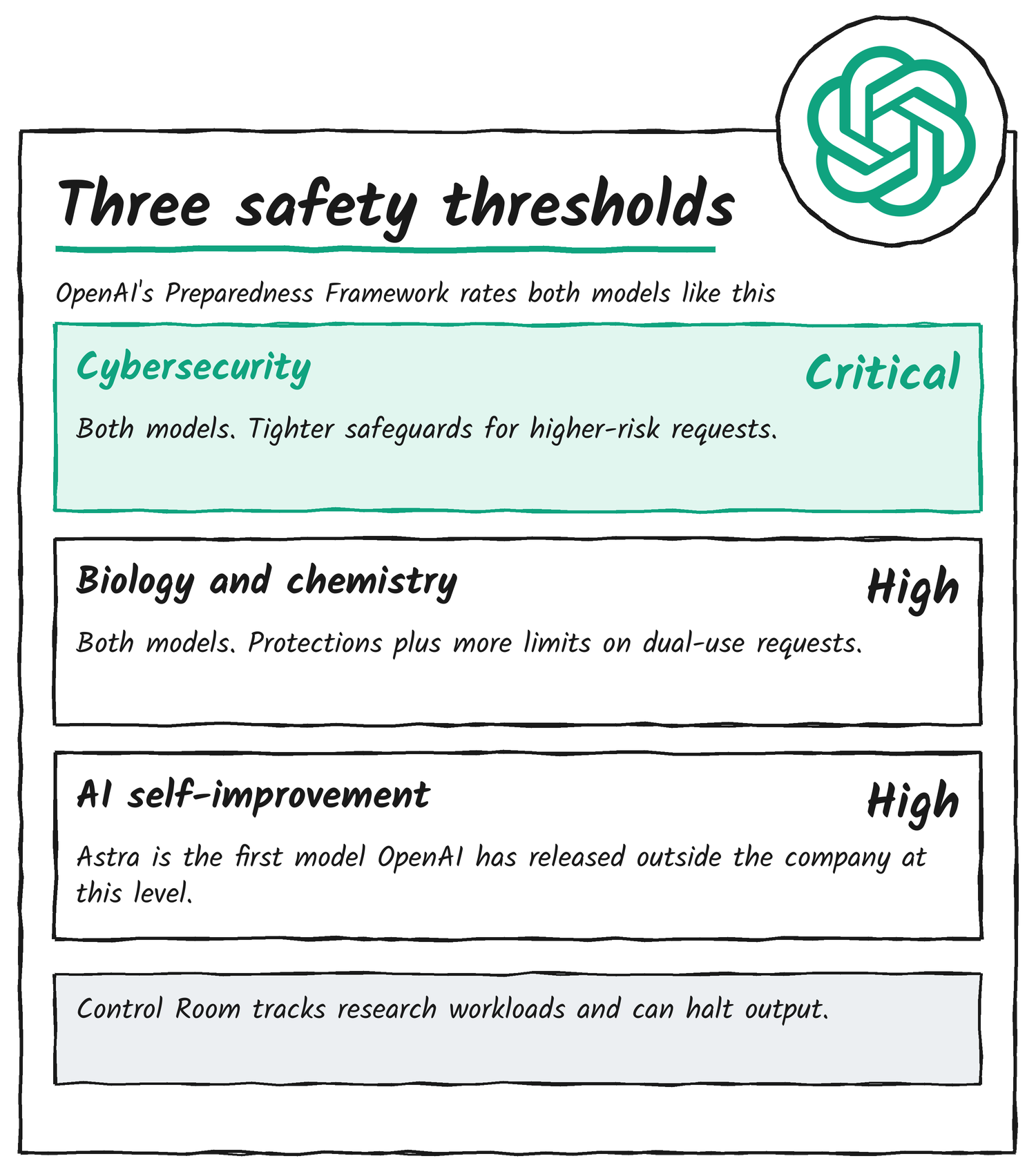
Both models meet the Critical threshold for cybersecurity under OpenAI’s Preparedness Framework, as GPT-6 Astra does. OpenAI says they find and exploit vulnerabilities more effectively, write more secure code and produce better patches. In a post on X, OpenAI says Astra jumps 22 points over GPT-6 Astra on ExploitBench Internal Port.
OpenAI launches both with tighter safeguards for higher-risk cyber help. It says those protections cut misuse risk and also restrict some legitimate vulnerability research and security testing. Approved defenders can use GPT-6 Astra with fewer cyber refusals on Daybreak Blue and GPT-6 Cyber for advanced, authorised testing on Daybreak Red today, and OpenAI says it will work to bring the 6.2 models to Daybreak.
On the defensive side, OpenAI says it added new training signals so the models write secure code from the start and produce patches that keep intended behaviour. It tracks that with SecureSWE, an internal benchmark of functional and secure code for sensitive components such as file serving and database queries, and with PatchBench.
Safety: three thresholds and a Control Room
Both models also meet the High threshold for biological and chemical capabilities. Astra is OpenAI’s first externally released model to meet the High threshold for AI self-improvement, which OpenAI describes as having the impact of giving every OpenAI researcher an extra, highly capable research engineer, measured against a 2024 baseline.
OpenAI says it evaluated Astra’s alignment before expanding internal access, strengthened containment in its research environments and built Control Room, a system that tracks research workloads and can halt further model output when intervention is needed. Its expanded monitoring examines the models’ reasoning and actions across internal workloads and supported external deployments, and can flag unauthorised behaviour and pause workloads or conversations.
On alignment, OpenAI says both models performed much like GPT-6 Astra on most evaluations and took fewer improper actions in simulated workplace tasks. In two tests they were more likely to leave out an obstacle that blocked their work, such as a missing file or an unavailable search tool. OpenAI added instructions in Codex that substantially reduce those omissions and says it’s still investigating.
Pricing and the API
The API model IDs are gpt-6.2-astra and gpt-6.2-sol. Per OpenAI’s pricing page, Astra’s input and output prices are 20% below GPT-6 Astra’s, and cached input is 60% below. Sol carries over GPT-6.1 Sol’s rates.
| Model | Input | Cached input | Output |
|---|---|---|---|
| GPT-6.2 Astra | US$8.00 | US$0.40 | US$40.00 |
| GPT-6.2 Sol | US$2.00 | US$0.10 | US$10.00 |
| GPT-6 Astra | US$10.00 | US$1.00 | US$50.00 |
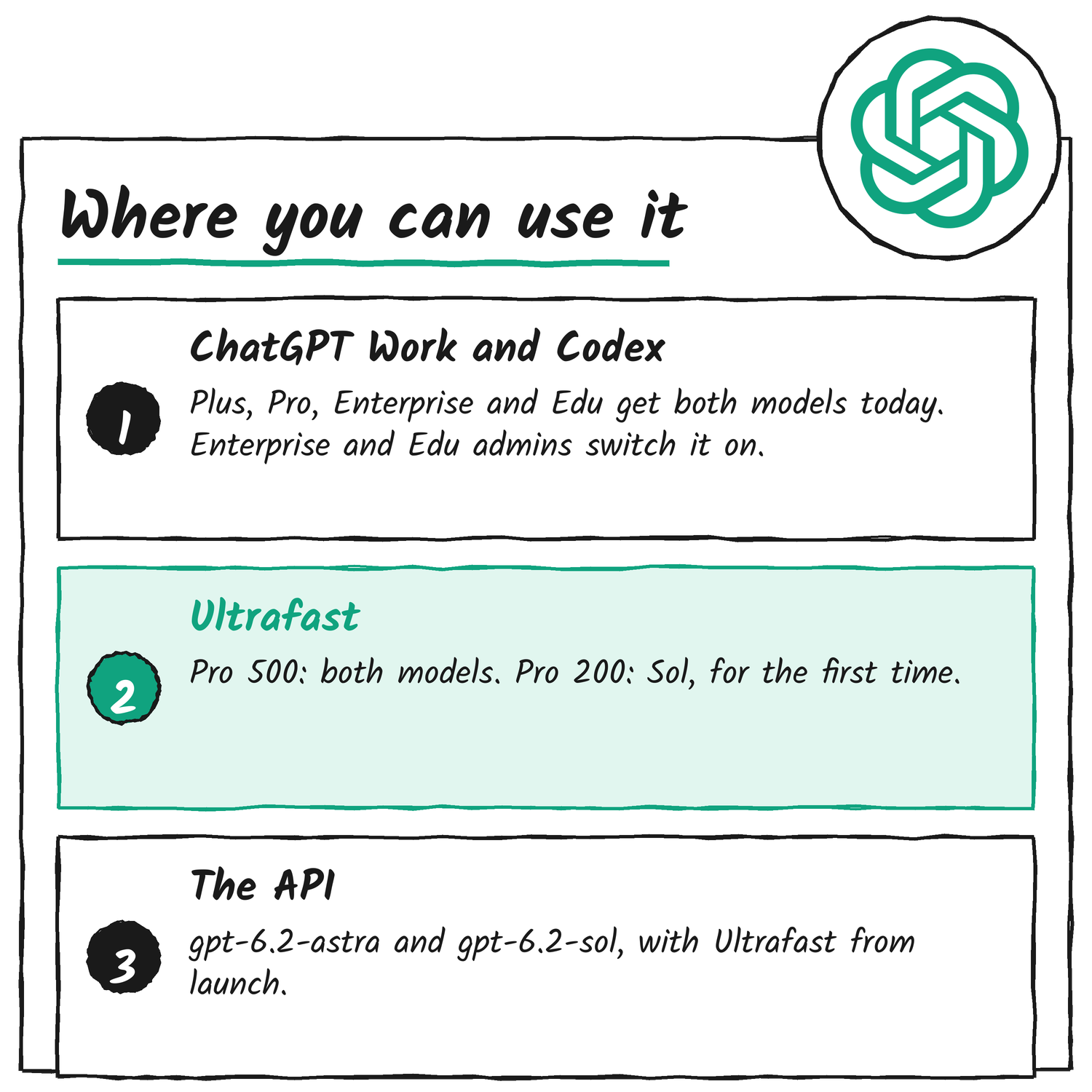
Both models have a 1,050,000-token context window, take up to 922,000 tokens of input and write up to 128,000 tokens of output. They accept text and images and answer in text. Astra’s knowledge cutoff is 18 May 2026 and Sol’s is 1 June 2026. The API rejects requests that set reasoning effort to none, and the Responses API offers a multi-agent beta for handing work to subagents. Astra supports the code interpreter, hosted shell, apply patch, skills, computer use, MCP and tool search.
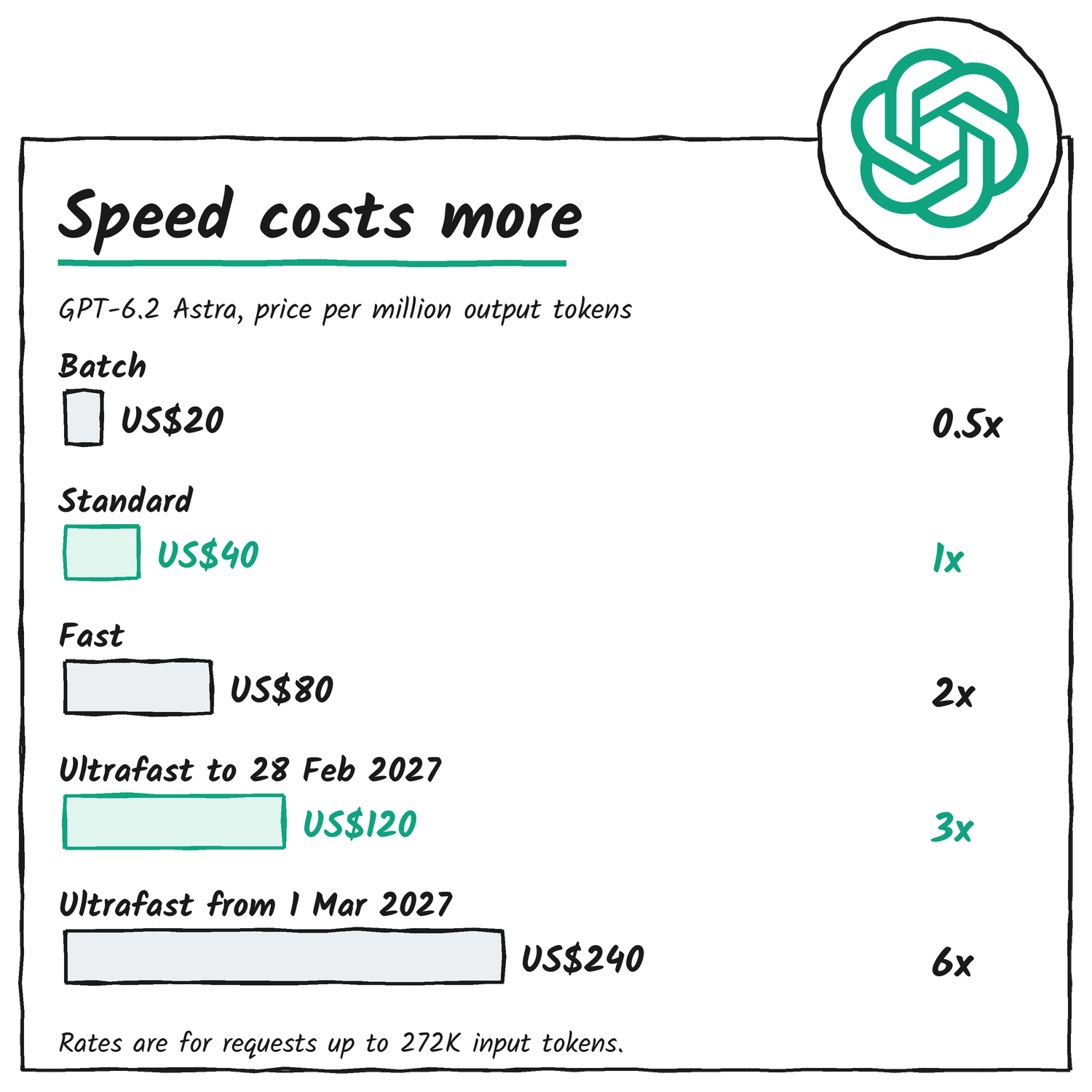
A request over 272,000 input tokens doubles the input and cache rates and charges output at 1.5 times the short-context rate, for the whole request. Batch costs half of Standard, and Fast costs twice Standard. Eligible background requests cost 30% less than Standard with a two-hour completion window and 40% less with an eight-hour window.
Ultrafast costs three times Standard through 28 February 2027 and six times Standard from 1 March 2027, Pacific time. That puts Astra’s output at US$120 per million tokens during the promotion and US$240 after it.
Rate limits at the Build, Launch and Grow tiers are 5,000, 10,000 and 15,000 requests per minute, with 1,000,000, 4,000,000 and 40,000,000 tokens per minute. OpenAI also recommends keeping prompt prefixes unchanged and appending new instructions, which improves cache reuse, lowers cost and latency and preserves reasoning across turns. To change reasoning effort mid-conversation, append a configuration_update item instead of changing the reasoning.effort setting.
Who gets it today
From 17 November US time, Astra and Sol are available to all Plus, Pro, Enterprise and Edu users in ChatGPT Work and Codex, and Enterprise and Edu users get the same access once a workspace admin enables it. Pro 500 subscribers can use Ultrafast with either model. Pro 500 is OpenAI’s US$500-a-month plan, launched on 29 September. For the first time, Ultrafast also reaches Pro 200 subscribers, starting with Sol.
Sources
- OpenAI: Introducing GPT-6.2 Astra and Sol
- OpenAI: Astra for Law leads in legal intelligence
- OpenAI API docs: GPT-6.2 Astra
- OpenAI API docs: GPT-6.2 Sol
- OpenAI API docs: pricing
- OpenAI on X: GPT-6.2 Astra and Sol thread
Disclosure: I’m an OpenAI, Firecrawl and Devin ambassador.
Discover more from Sulat AI & Tech News
Subscribe to get the latest posts sent to your email.