Replit has launched Missions, a feature that hands a goal to a swarm of agents and lets them plan, build, test and redo the work within a budget and boundaries you set. You start one from the New button in the sidebar.
The headline demo is DataCat, a monitoring tool Replit says a swarm built in two days on a US$3,000 cap. A self-hostable copy is on GitHub under the Apache 2.0 licence. Everything offered as proof so far is Replit’s own: that build, a NumPy speed test and a simulated shop benchmark.
What a mission is
You don’t hand over a task list. You hand over a goal, then answer questions about it. Replit’s example is “win our first 10 paying enterprise customers”, and setup asks things like whether a paid pilot counts toward the 10 or only a signed annual contract above some value. Those answers, plus a spending limit, the trade-offs you’ll accept (paid pilots, discounts) and a list of actions that need your sign-off, make up the mission agreement.
Replit’s sample limits are a US$1,000 cap, and approval before the agent contacts a prospect, shares a proposal, changes customer-facing sales material or makes product commitments. The limits stay in place as the approach changes.
The swarm part is parallel work. One agent researches buyers while another builds a demo. Once approved outreach goes out, the mission looks at which accounts and messages drew qualified conversations and shifts its effort. You pick which updates reach you (blockers, progress, general status) and how often: immediately, daily or weekly. The agents run in the cloud, so closing your laptop doesn’t stop them.
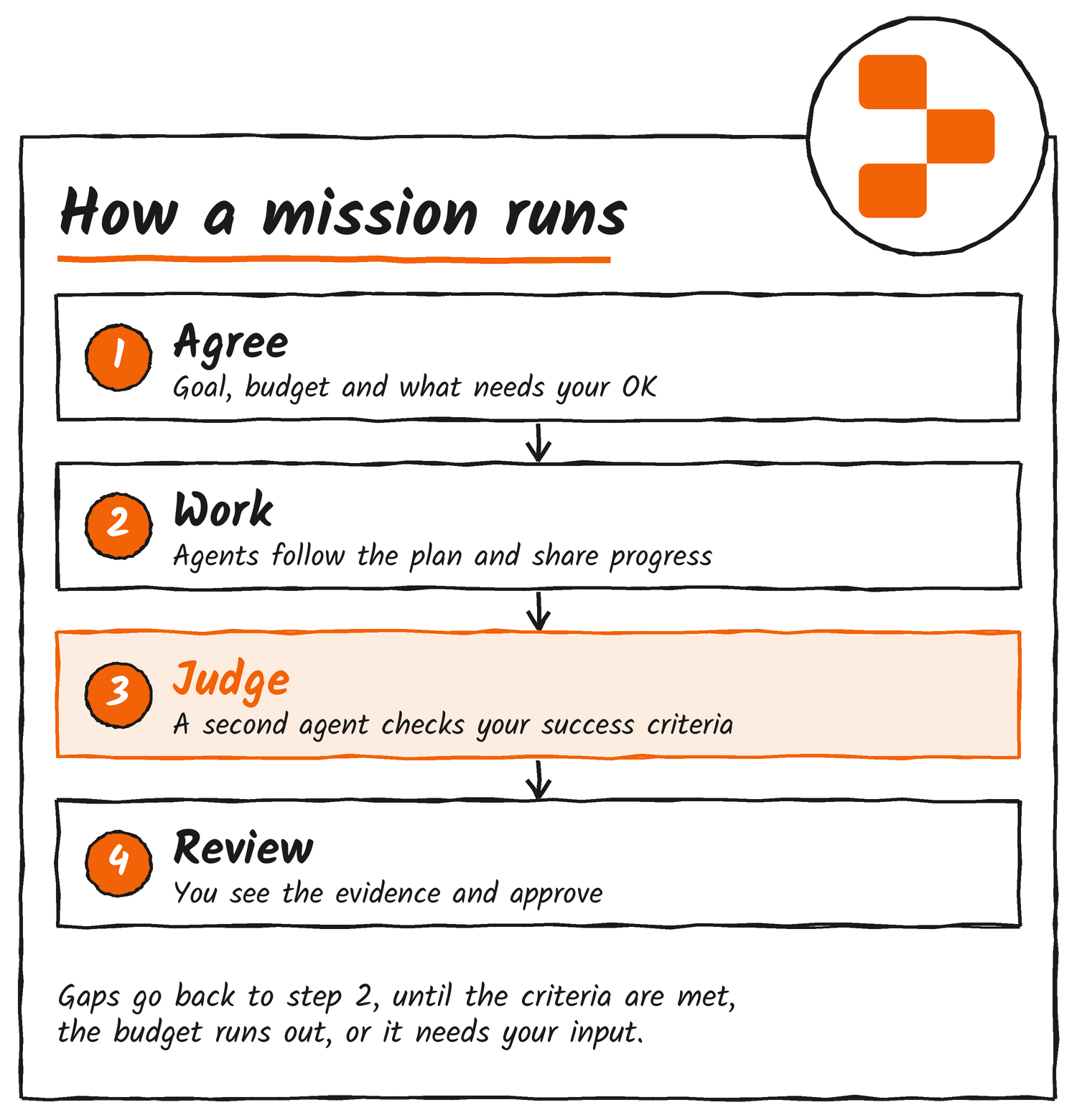
Quality control is a separate agent. An independent AI judge scores the output against the criteria you agreed at the start, and the working agents take its feedback and try again. The mission finishes when the criteria are met. If the money runs out first, it stops with the job unfinished. The Missions page adds three details: you can run several missions at once, you can leave mission mode whenever you like, and any message you send mid-mission counts toward the budget.
The NumPy swarm test
The scaling claim rests on 13 benchmark tasks using NumPy, the Python maths library. Replit says the agents tried alternative implementations, reworked how memory is read and checked correctness on their own. In Auto (Max) mode, one agent got speedups of up to 4×. Sixteen agents got 17×, and 32 got 19×. Auto (Power) mode followed the same shape at 2×, 7× and 9×.
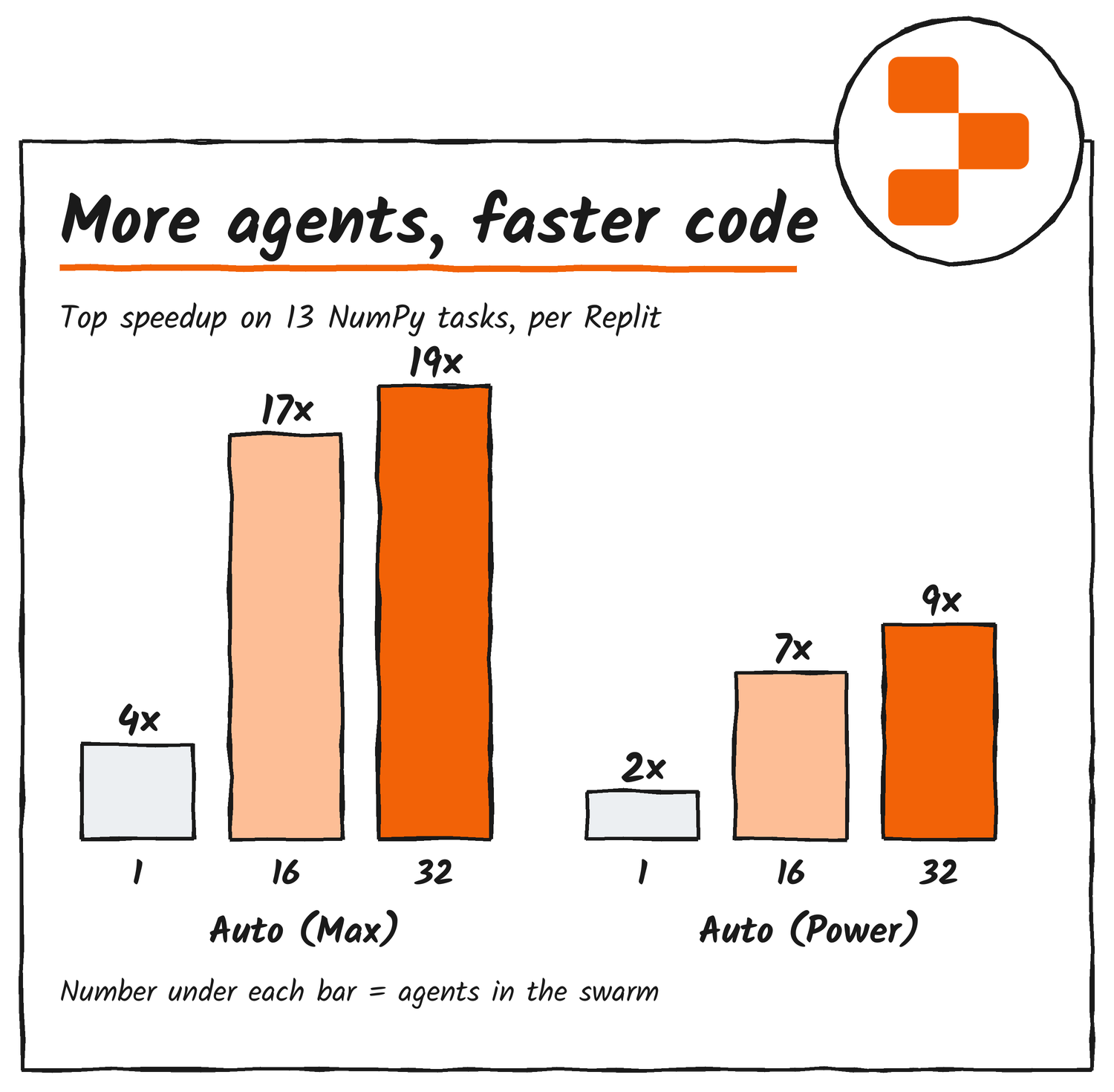
Most of the gain came early. Doubling from 16 agents to 32 added 2× in both modes. The post doesn’t give run times or say what the swarms cost.
DataCat, built in two days
DataCat is where Replit gives the most detail. It says Missions built the dashboards, alerts and application tracing, along with DataCat’s own server agent and tracing libraries. To test it, Replit planted a database bug. DataCat raised an alert in 38 seconds, inside a 60-second target, and pointed to the exact query and its logs. A three-hour load test pushed in 26 million activity records and 4.4 million log entries, with nothing lost and searches and alerts still working. All 36 data-correctness checks and 15 alert-reliability checks passed.
Against the original platform’s own agent and tracing library, Replit reports that matched Node.js tests handled 39% more requests with 51% less monitoring-related processor overhead. DataCat’s agent used 82 to 108 MB of memory under load where the original used 319 MB, and made logs searchable in 0.5 seconds against 4.2. The post never names that platform. DataCat’s README says it accepts Datadog-compatible agent traffic and isn’t affiliated with Datadog. Replit’s own caveat is that the controlled tests don’t establish performance against the original platform’s hosted service or on Replit’s production systems.
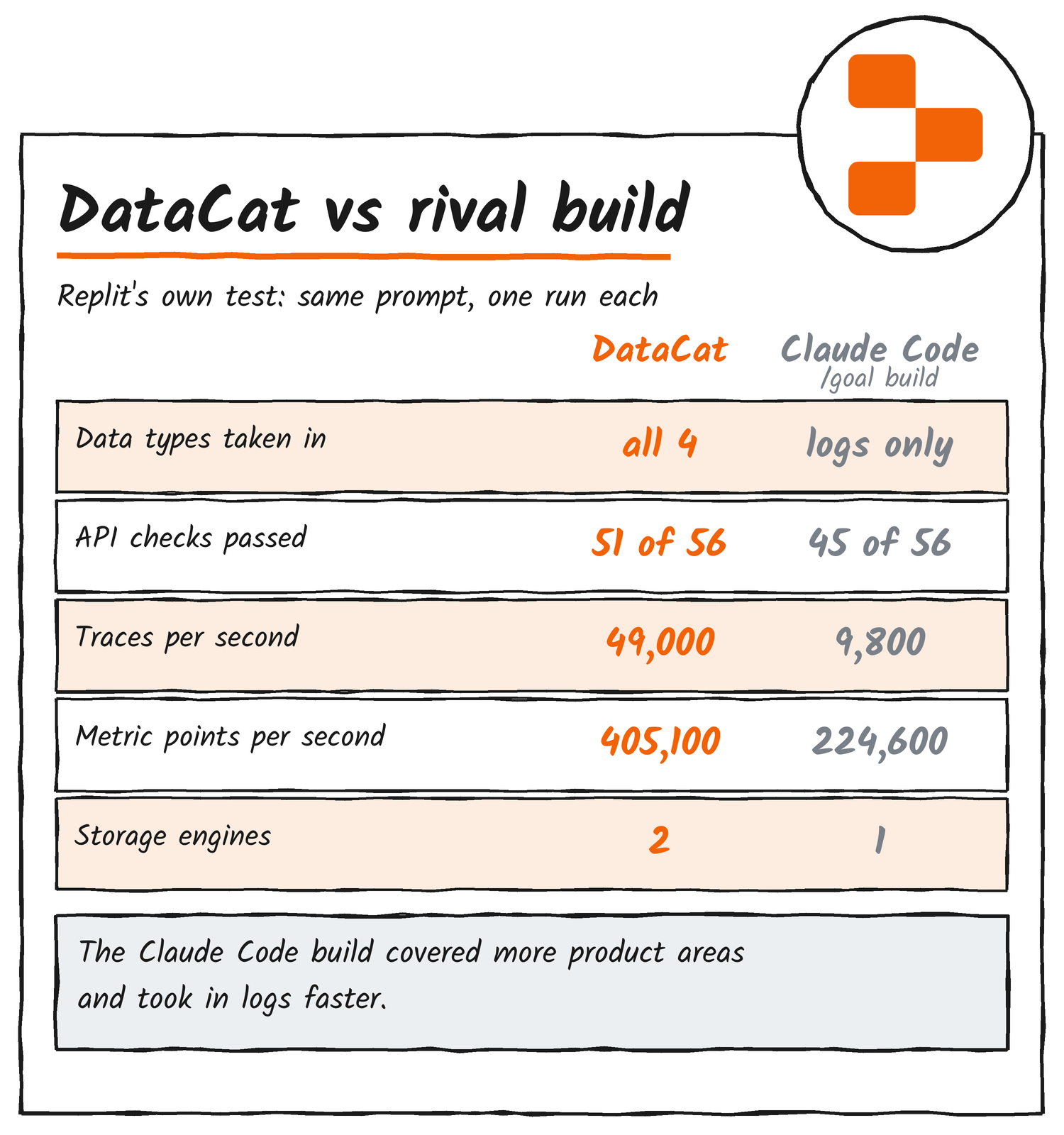
Replit also set DataCat beside a monitoring platform built from the same starting prompt with /goal in Claude Code. DataCat took in all four data types from the original agent. The Claude Code build took logs only. DataCat was faster on traces and metrics; the Claude Code build covered more product areas and was faster on logs. It was one run per setup on identical cloud machines, scored only on the areas both builds shared.
The store benchmark, and what’s missing
One more benchmark gets a mention. In E-Commerce Bench, an agent starts with ¥100,000 and runs online stores for a simulated year. Replit says one Missions run turned that into ¥4.82 million, more than three times the best score on the public leaderboard. The benchmark’s own site lists ¥1,431,425 as its top earner, and that’s a mean over five episodes. Replit’s number is a single run.
Replit hasn’t published a price. Neither the announcement nor the Missions page gives one or says which plans include Missions. The FAQ says you set a maximum budget up front and that work done during the mission counts toward it. Organisations are pointed to Replit’s sales team.
Discover more from Sulat AI & Tech News
Subscribe to get the latest posts sent to your email.