Cognition has launched Devin Bots, agents that take an outcome such as “own checkout”, start a Devin session for each piece of work and keep going until the pull requests are ready to merge. Cognition announced them on X on 17 November 2026, saying beta testers merge 4.5 times more pull requests per message and that individual engineers went from 50 PRs a week to nearly 2,000.
Cognition’s post says: “Meet Devin Bots. From writing firmware to merging thousands of PRs a week, a Devin Bot leads a team of agents to get the job done.” A pull request, or PR, is a proposed code change that a person reviews before it joins the codebase. The 4.5x figure is an average across beta testers, according to Cognition.
Meet Devin Bots.
— Cognition (@cognition) November 17, 2026
From writing firmware to merging thousands of PRs a week, a Devin Bot leads a team of agents to get the job done.
What a Devin Bot does
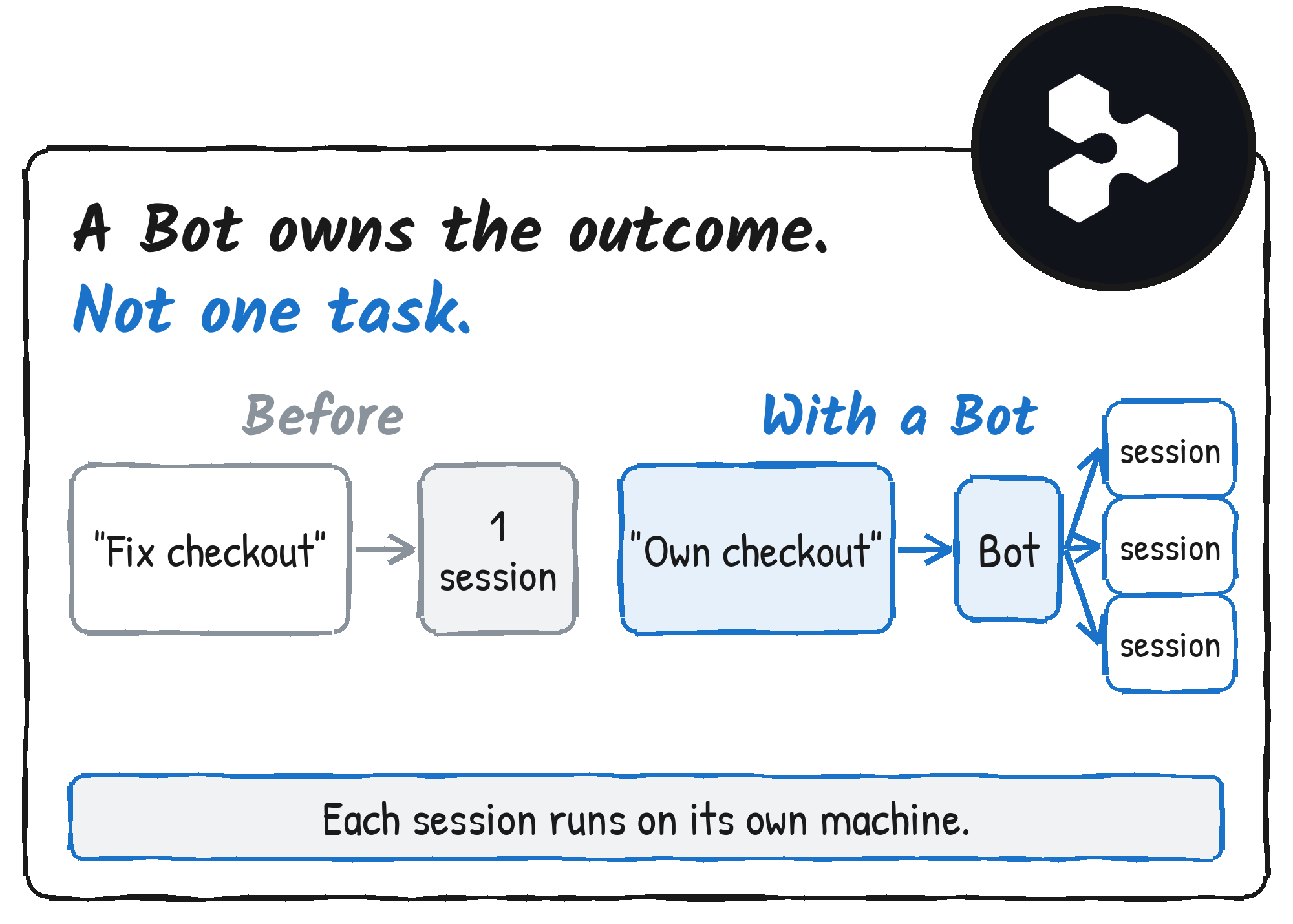
According to Cognition’s docs, a Bot has one chat for everything it owns. You tell it the outcome you want there, and its reports come back there. The docs’ example is “You own the Android app now. Keep it at feature parity with iOS.” The Bot plans the work, starts a Devin session for each piece, follows up on those sessions and comes back to you when something needs you.
Each session runs on its own cloud machine, the same as a session you start yourself, the docs say. Before, one request started one session that opened one pull request. Now one request goes to a Bot, which connects tools such as Slack, GitHub and Linear and keeps as many sessions running as the work takes. Cognition’s product page shows a Bot given “Move checkout to the new payments API” splitting it into updating the API client, migrating webhooks and rewriting checkout tests, each on its own machine.
| Part | What it does |
|---|---|
| Chat | One chat for everything the Bot owns; its reports come back there. |
| Sessions | Each piece of work runs in its own child session with its own machine. |
| Automations | The Bot runs on a schedule or when something happens in a connected tool. |
| Needs you | Approvals, decisions and pull requests to review collect in one list. |
| Memory | What the Bot learns is saved and used in later sessions. |
| Access | The Bot has its own connections and secrets, separate from the people who message it. |
Where you talk to one
You can reach a Bot from the Devin web app, Slack or iMessage, the docs say. In Slack, each Bot can have its own Slack app and handle, so your team mentions it in a channel or messages it directly and it replies in the thread. If your workspace requires admin approval for apps, a Slack admin has to install the Bot’s app.
iMessage works through a one-time code. You open the iMessage page of the Bot’s settings, send the text it prepares, and that links your number to the Bot. Texts go to the same chat as your messages in Devin. iMessage isn’t available on Enterprise plans. Cognition’s product page adds that you can call a Bot for an update or bring one into a group chat.
Fortune reports that a Devin Bot joins a team’s Slack as its own member, remembers context across weeks and contacts people when it’s blocked or needs a decision. Fortune’s headline frames Bots as a challenge to Anthropic’s Duet and OpenAI’s Dots, and the paper reports that the product incorporates technology from The Interaction Company, the startup behind the Poke assistant, which Cognition acquired in July.
Cognition announced that deal on 23 July. Co-founder Scott Wu wrote then that the Interaction team had built an agent that’s “proactive, it knows you, and it’s fun to talk to”, and that “that’s exactly how working with Devin should feel”. Interaction co-founder Marvin von Hagen told TechCrunch: “I think there’s a lot of value in having Poke orchestrate different Devin sessions.”
Bots that hand work to each other
Cognition’s page describes a team that coordinates itself. A QA Bot finds that discount codes aren’t applied at checkout and asks the Developer Bot to take a look. The Developer Bot fixes it and opens a pull request, the QA Bot retests on staging, and a PM Bot tells the channel the launch stays on track for Thursday. Cognition’s own summary: “Your QA Bot finds a bug and brings in your Developer Bot to fix it, then tests the result.”
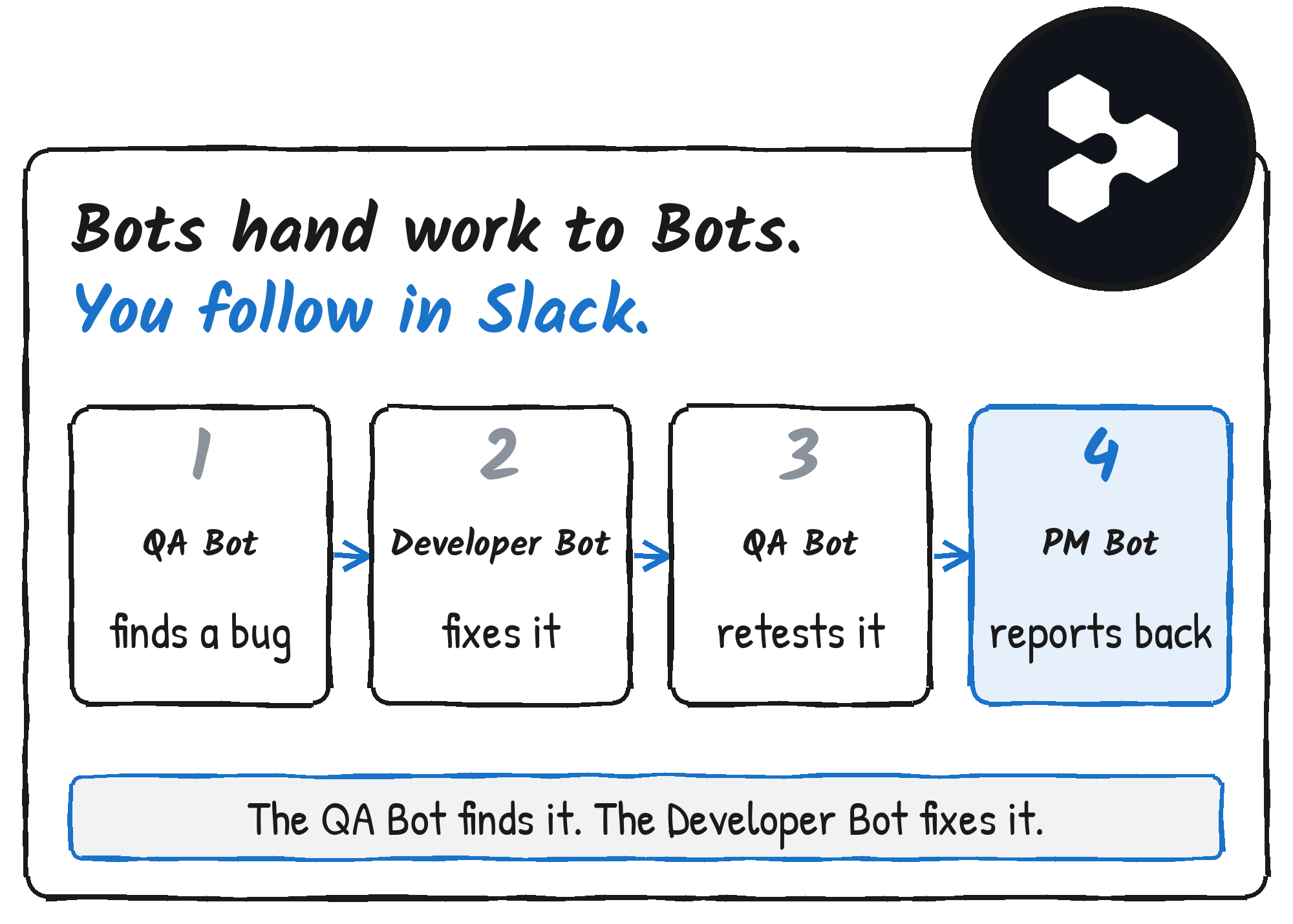
Handoffs run on grants. Giving Bot A access to Bot B lets A read B, including its conversation and sessions, and message it, the docs say. A can’t change B’s settings. The Chief of Staff template, for example, “watches your channels, posts the updates and hands work to the rest of the team”, then follows that work until it’s done.
Bots also set their own triggers. Cognition’s page lists watching a Slack channel for customer issues, verifying CI health every night at 2am and monitoring Linear for blockers. CI, short for continuous integration, is the set of automated checks that run on code before it merges.
Sixteen templates to start from
Cognition’s Bot marketplace lists 16 templates, and you can browse them without signing in. A new Bot built from a template gets the template’s prompt and nothing else. It’s private to you and has no connections, secrets or memory until you add them, per the templates page.
| Template | What it does |
|---|---|
| Software Factory | Finds bugs, polish, performance and refactoring work in a product area and opens one small pull request for each, with proof it works. |
| Product Engineer | Takes a ticket or request all the way to a tested pull request and sees it through review. |
| QA Engineer | Tests each pull request in a real browser and posts the video. |
| Chief of Staff | Watches your channels, posts updates and hands work to the rest of the team. |
| Latency Optimizer | Finds your slowest endpoints, jobs and queries, and once a week tries a fix for the worst one. |
| Code Reaper | Finds code nothing uses and removes it, one safe pull request at a time. |
| Migration Engineer | Owns one big migration, shipped as small, tracked pull requests. |
| iOS Engineer | Builds SwiftUI features and ships them to TestFlight. |
You can also share your own Bot’s instructions as a template. On Teams and Enterprise it appears in your organisation’s library, and on Pro, Max and Teams you can copy a public link. The docs warn that a public link can’t be edited or revoked, and that Cognition reviews only its own templates.
What early users report
Jenny Xu, founder of the mobile game studio Talofa Games, posted on 17 November: “I used to have 50 PRs a week, now I have 1,900.” She says she built a bot called SuperJenny three weeks ago that works with about 20 AI teammates to ship her game Monster Walk every week, covering builds, QA, store reviews, release notes and analytics. She says the setup helped her grow the studio’s revenue sixfold.
Xu named five of the roles. SuperJenny delegates, SuperPM publishes a ranked daily fix list, SuperRelease builds weekly with a version ready to submit on Fridays, SuperQA runs real-device tests with video proof, and SuperSupport drafts every store review reply for her approval. She checks in four times a day from her phone. She released the setup free as SuperJennyStack, which is in Cognition’s template library.
I used to have 50 PRs a week, now I have 1,900.
— Jenny Xu (@xujennyc) November 17, 2026
Three weeks ago, I built an AI bot called SuperJenny that works with ~20 AI teammates.
They ship Monster Walk every week: builds, QA, store reviews, release notes, analytics. I 6x’d my mobile game studio’s revenue by automating myself.
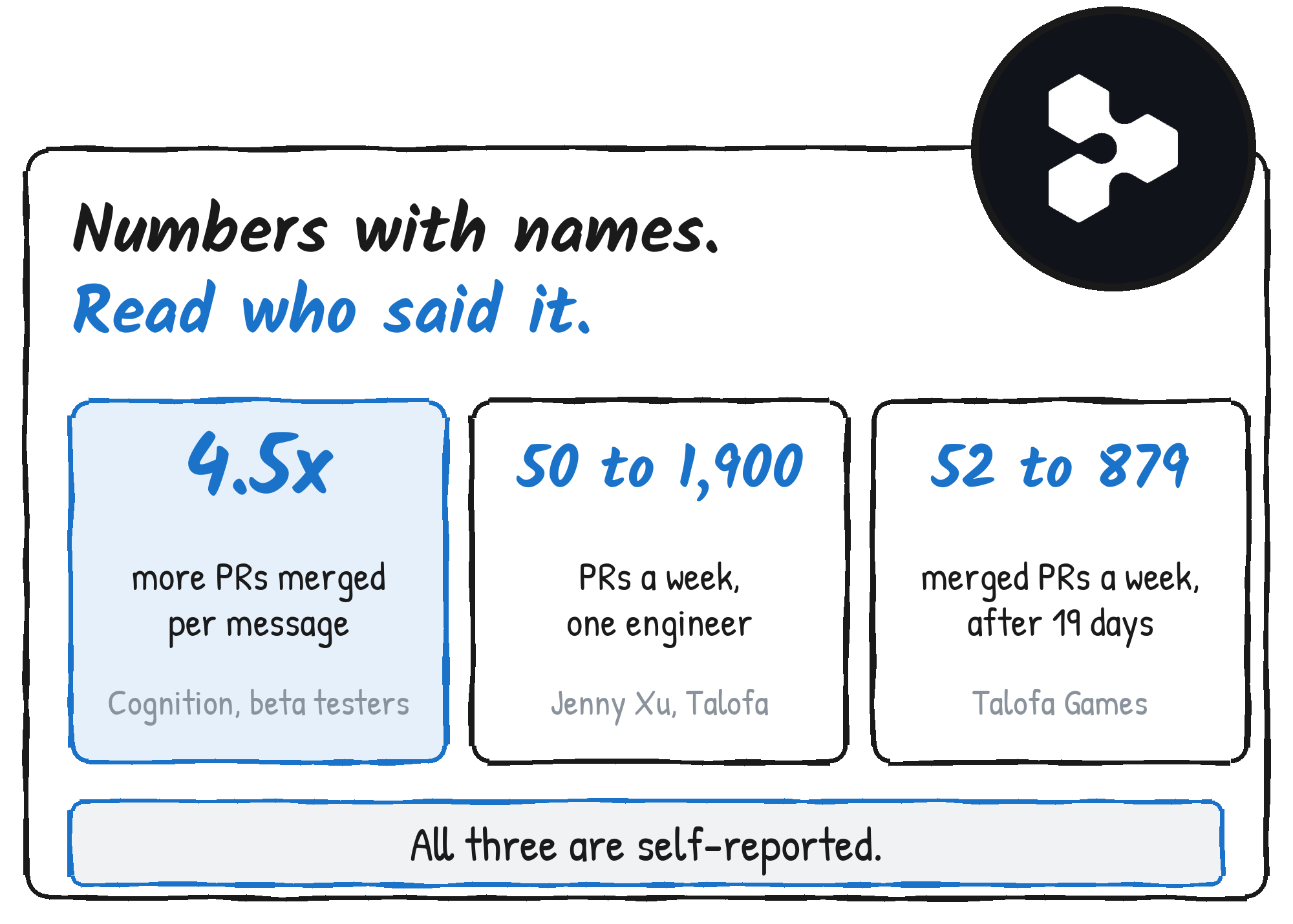
The jump isn’t new for Talofa. On 26 October the studio wrote that 19 days after it put Devin on Monster Walk, merged PRs per week went from 52 to 879 and 48 automations ran parts of the studio. Talofa is also running Devin for Gaming with Cognition, a three-week programme for game studios with a demo day on 19 November.
More early users on X
Early users are posting their setups. Avinash, Cognition’s regional community lead for MENA, borrowed an idea from Xu: a Chief of Staff bot that rewards the other bots every day. He says the system lets the bots self-improve, and suggests anyone new to Bots try it. Mark Fenner, an AI engineer and Devin ambassador, runs four Bots, led by a Chief Agent called Frankie that coordinates the rest and reports back to him. He says his Software Factory Bot, told to do a “Polish push”, scouted the codebase, split the issues into separate Devin sessions and returned fixes and pull requests. One of them fixed keyboard focus escaping behind a checkout window, and Devin Review flagged that the tests hadn’t covered the real Stripe fields.
One of the incredible things I have been trying out (yes, I did steal this from @xujennyc) is creating a reward system for your @DevinAI bots, just a way to incentivise excellent work!
— Avinash (@Avi31m) November 17, 2026
Devin Bots are here!!
— Hybrid (@markfenner) November 17, 2026
Here’s how I’m actually using them.
I have four set up with different jobs, starting with Frankie, my Chief Agent.
Chris Wozniczek, who lists himself as a Cognition ambassador, says he mostly uses Bots in Slack to run his web studio, handle cold outreach and build previews for customers. Nick White, who founded Helionova and is also a Cognition ambassador, says he’s tested Bots for a few days and that the focus is on building with your own swarm of professional developers. Ariel Cárdenas posted in Spanish that he connected Devin to his home lab. From his phone he tells it which film he wants, one bot finds it, downloads it to Jellyfin and syncs the subtitles, and it’s ready when he sits down at the TV.
This is the launch of the decade ladies and gentlemen
— Chris W (@Chris_Wozniczek) November 17, 2026
No more [REDACTED]
@DevinAI bots from @cognition are here
I have been testing @DevinAI bots for the past few days and it truly takes on a new form. The focus is more on building things with your own swarm of pro devs. LFG!
— Nick White (@nick_white) November 17, 2026
Devin Bots ya está aquí!
— Ariel Cárdenas (@Ariel_Cardenas0) November 17, 2026
Una locura utilizar multiples agentes para realizar tus tareas cotidianas.
Access, security and who pays
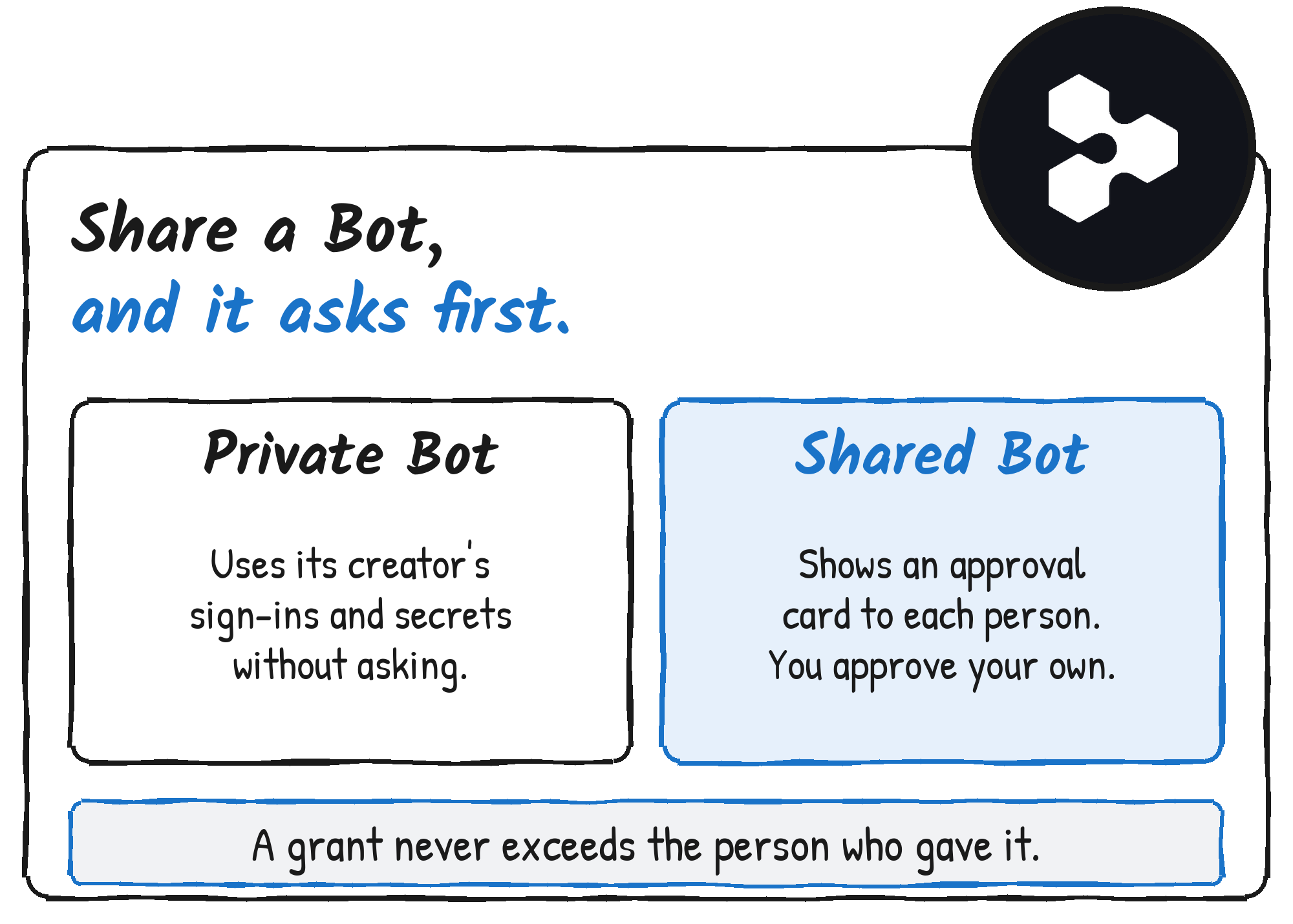
A Bot works with its own access, not the access of whoever messages it, according to the access and security page. A new Bot is private to its creator. Share it, and everyone you add can use every sign-in, secret and session the Bot holds, by asking it. Access comes in three separate levels, Can use, Can configure and Can share, and none includes another.
A private Bot takes its creator’s sign-ins, plugins and secrets without a prompt. A shared Bot shows an approval card to the person it’s answering, who approves giving their own. Two rules tie each grant to the person who gave it: a grant never exceeds the giver, and a sign-in lasts only while the giver still has it.
Cognition’s product page shows SOC 2, ISO 27001 and FedRAMP badges. It lists comprehensive audit logs, zero data retention enforced with model providers, a separate VM for every session, role-based access control, SSO, SCIM, OIDC and private networking.
A Bot’s usage is its chat plus every session it starts, and its creator pays, per the usage limits page.
| Plan | Who pays | Cap |
|---|---|---|
| Max | The creator’s included quota, then on-demand credits | No separate limit for a Bot |
| Teams | The creator’s included quota, then the team’s on-demand credits | On-demand cap in dollars, set by the creator or admins; an admin can give the Bot its own limit |
| Enterprise | Counts toward the creator’s own usage limit | ACU or dollar limit; the Bot stops at it when budgets and user limits are enabled |
How to start one
- In the Devin sidebar’s Bots section, click Create new Bot.
- Pick a template or Start from scratch, then name the Bot.
- Tell it in the chat what it owns, such as a repository, project or channel.
- Set up its connections, and give it its own Slack app if your team will message it.
- Check Needs you for approvals, decisions and pull requests.
A Bot’s work counts toward your plan’s usage like any session. Cognition’s last launch before Bots was Devin Apps, private web apps hosted on Devin’s cloud computer, on 13 November.
Disclosure: I’m an OpenAI, Firecrawl and Devin ambassador.
Discover more from Sulat AI & Tech News
Subscribe to get the latest posts sent to your email.