
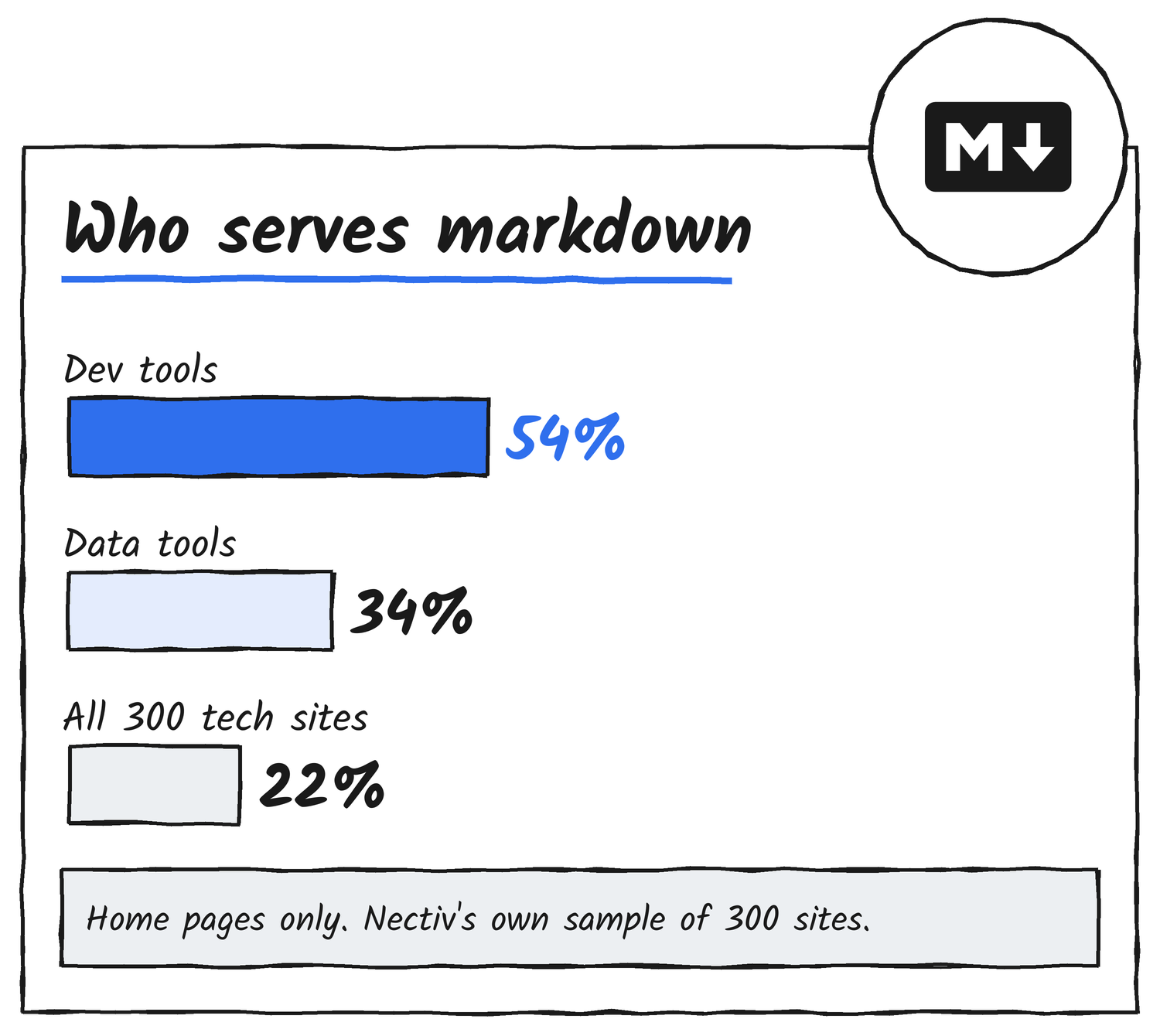
Chris Long, co-founder of Nectiv, says 22% of the 300 technology sites his team tested serve a markdown version of their home page when a request asks for one. In the post, dated 19 November US time (20 November in New Zealand), he says dev tools lead at 54% and data tools follow at 34%. Nectiv does answer engine optimisation, known as AEO, for B2B and technology companies, and Long checked home pages only.
Long explains the mechanism in the post. A site reads the headers on each request, so a request for text/html returns the full page and a request for text/markdown returns a markdown version. To check a competitor, he says, you tell Claude Code which sites to look at, and it sends requests without a browser and groups the results. On whether serving markdown counts as cloaking, he says that as long as the content is the same, he doesn’t see a problem.
AEO Tip: More companies are serving their content via markdown to LLMs. 22% of technology sites we tested served markdown. Here’s how to analyze your competitors:
— Chris Long (@chris_nectiv) November 19, 2026
What the chart shows
Long attached a chart that lists, by category, the sites that answered with markdown. Dev tools account for 14 sites, ahead of AI companies at nine and data and analytics at eight. The screenshot cuts off after the Consumer row, which shows one site. The list still holds up in at least one case: a request with the header to redis.io on 20 November returned content-type: text/markdown, with Vary: Accept.
| Category | Sites | Examples in the chart |
|---|---|---|
| Dev tools | 14 | Sentry, PagerDuty, Redis, Auth0, Prisma |
| AI | 9 | Jasper, Together AI, Fireworks AI, Replicate, Pinecone |
| Data and analytics | 8 | Snowplow, Airbyte, ClickHouse, MotherDuck, Domo |
| Sales and marketing | 7 | Pipedrive, ZoomInfo, Hootsuite |
| Productivity | 4 | Wrike, Zapier, Craft |
| HR and ops | 4 | Eightfold, Workable, Zip |
| Security | 4 | Illumio, Tanium, Orca Security |
| Fintech | 3 | Checkout.com, Novo, Increase |
| Health tech | 3 | Function Health, Ambience, Garner Health |
| Consumer | 1 | Not shown |
How a site serves markdown
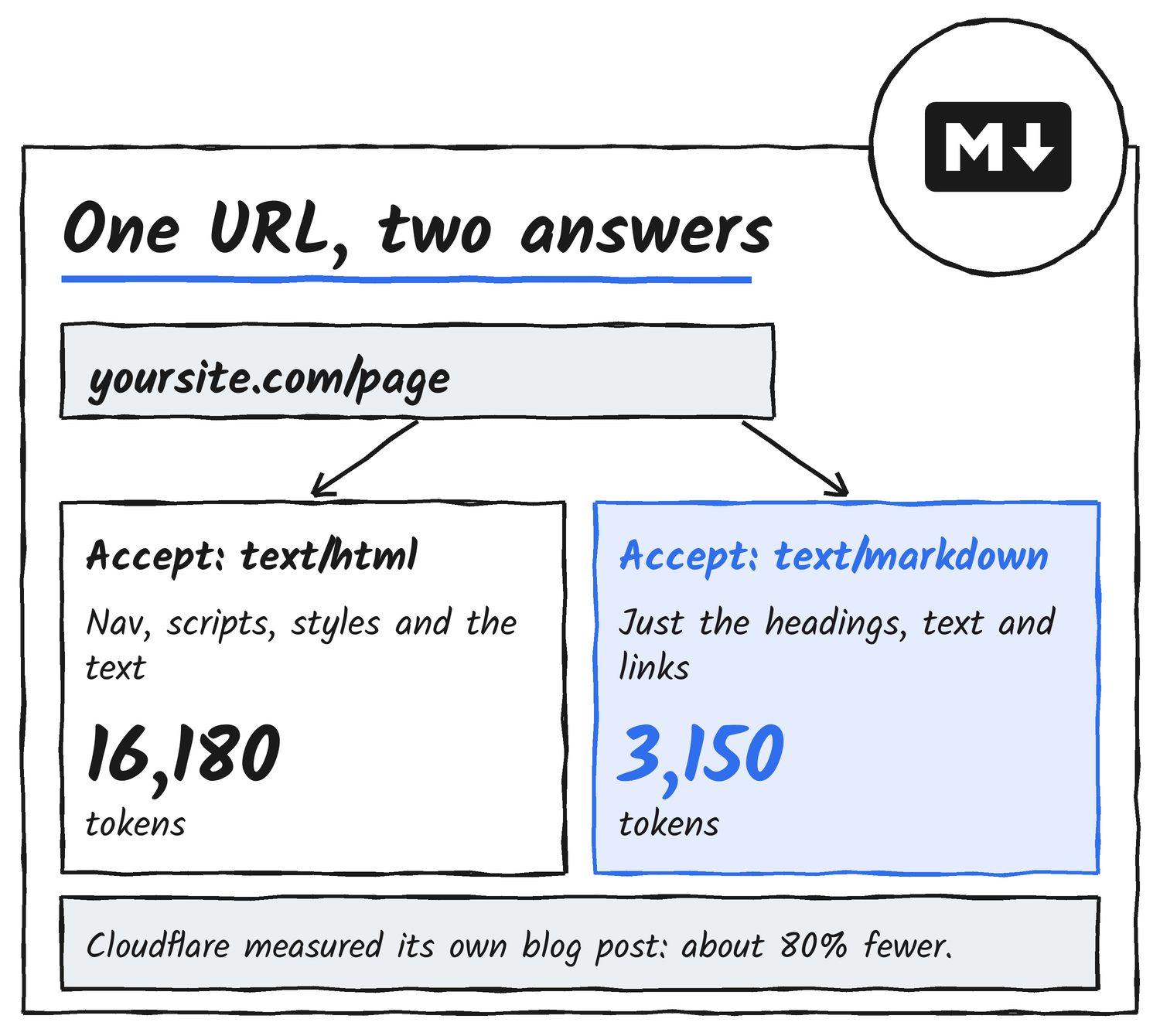
The technique is HTTP content negotiation, the mechanism a browser uses to say which formats it can take. An agent sends Accept: text/markdown, and a server that supports it returns markdown from the same address, adding Accept to its Vary header so caches keep the two versions apart. Cloudflare turned that into a switch on 12 February with a feature it calls Markdown for Agents. Cloudflare says its network fetches the original HTML from the site’s server, converts it on the fly and returns markdown to any client that asks.
Cloudflare’s documentation, last updated 9 November, lists the feature on Pro, Business and Enterprise plans and for SSL for SaaS customers at no cost. It caps conversion at 6 MiB of decompressed HTML. If a site’s own server sends a content-signal header, Cloudflare keeps that value. If not, it adds ai-train=yes, search=yes, ai-input=yes, which signals that the content can be used for AI training, search and AI input.
Bloomberry, which tracks which companies use which web services, counted 16,342 companies using the feature in an update on 15 November, plus 488 that have stopped. That count covers Cloudflare’s feature only, so sites that serve markdown from their own servers aren’t in it.
The payoff Cloudflare points to is size. It says its own announcement post takes 16,180 tokens as HTML and 3,150 as markdown, an 80% cut. Checkly, a monitoring company, measured one docs page at 615.4 KB and 180,573 tokens as HTML against 2.3 KB and 478 tokens as markdown. Tokens are the chunks of text a model reads and bills by.
Who asks for it
Serving markdown only helps if something requests it. Checkly’s February test of seven coding agents found three that send text/markdown in the Accept header: Claude Code, Cursor and OpenCode. Cloudflare’s announcement names Claude Code and OpenCode as agents it already sees sending it.
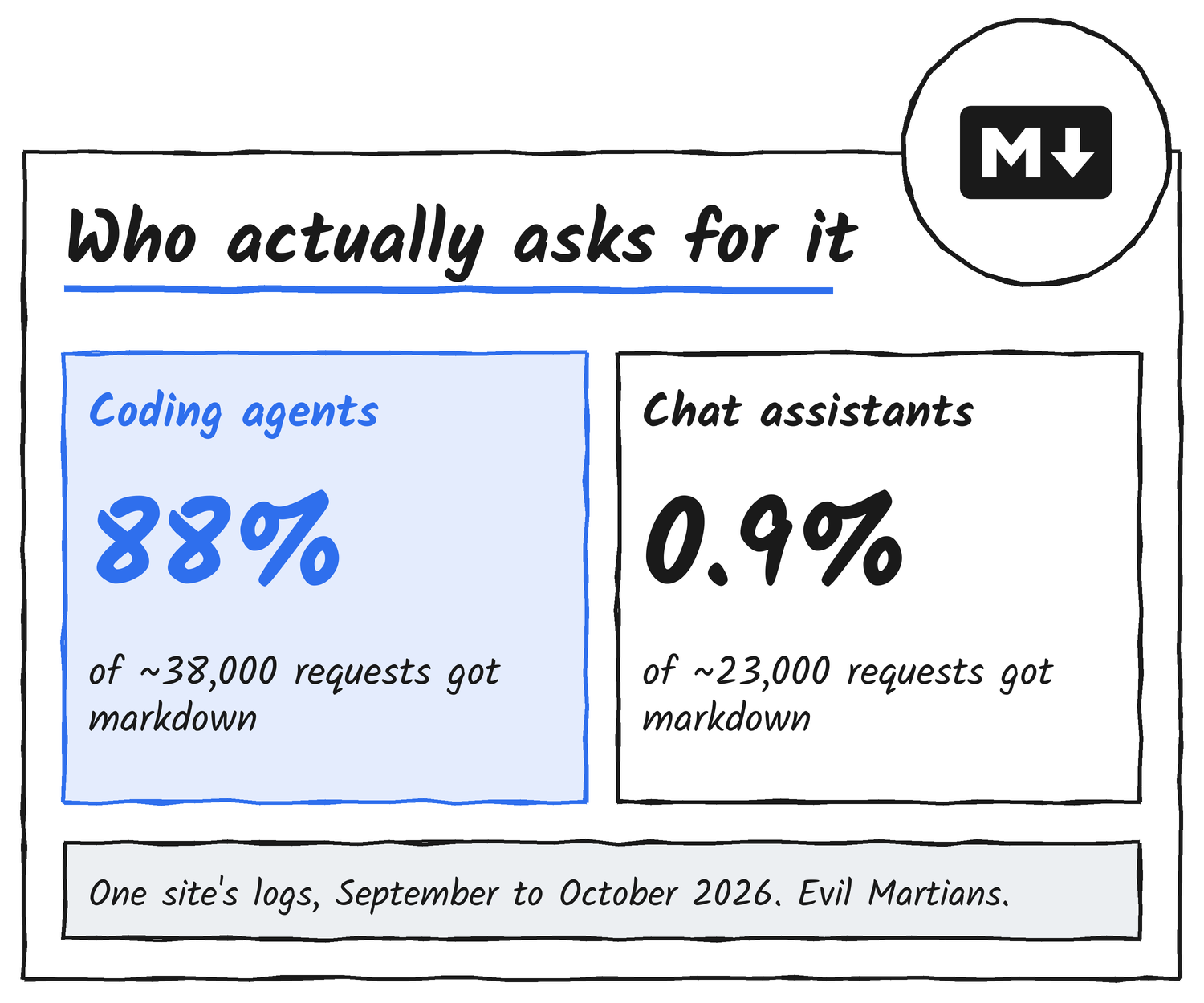
Server logs show the same split. Evil Martians, a software consultancy, logged requests to its own site in September and October 2026. Coding agents made about 38,000 requests and got markdown on 88% of them. Chat assistants made about 23,000 and got markdown on 0.9%. Claude Code alone accounted for 94% of all markdown reads on the site.
Ethan at Gauge replied to Long with similar numbers from Gauge’s data: about 25% of coding agents’ fetches to docs pages are attempts to get the markdown version. He says Gauge recommends that its devtool customers add markdown versions of their pages.
What the check doesn’t show, and the pushback
Long’s post says nothing about how the 300 sites were chosen, and it doesn’t say whether each markdown version matched its HTML page. It doesn’t claim that serving markdown wins citations in AI answers. The one controlled test of bot traffic found no significant change: Brandon Punturo’s randomised experiment covered 381 pages on six sites for 20 days from 19 January 2026, using Profound’s Agent Analytics. Median visits per page were 6.0 for HTML and 7.0 for markdown, and the difference wasn’t statistically significant. It measured bot visits, not citations.
Google and Bing have pushed back on separate pages for bots. Google’s John Mueller said in November 2025 that large language models have always read normal web pages, and asked “Why would they want to see a page that no user sees? And, if they check for equivalence, why not use HTML?” Microsoft’s Fabrice Canel asked whether publishers want to double the crawl load, since Bing would crawl anyway to check similarity. SEO consultant David McSweeney raised cloaking when Cloudflare launched the feature: because the Accept header reaches a site’s server, a site could send an agent different content from what a person sees, Search Engine Land reported.
Mueller has also drawn a line around developer docs. In May he said Google publishes markdown versions of its developer documentation for AI coding tools and that it isn’t done for search. In August he said that on his test sites the only crawlers claiming to accept markdown were SEO tools.
Check a site yourself
The check Long describes takes one command. It sends the header and prints the response headers.
curl -s -o /dev/null -D - -H "Accept: text/markdown" https://example.com/A site that serves markdown answers with content-type: text/markdown and a Vary header that includes Accept. One that doesn’t returns text/html. Mueller’s advice is to log the Accept header on your own server before building anything, since many server setups don’t record it.
The full list of 300 sites isn’t in the post, and neither is the date range of the check.
Discover more from Sulat AI & Tech News
Subscribe to get the latest posts sent to your email.