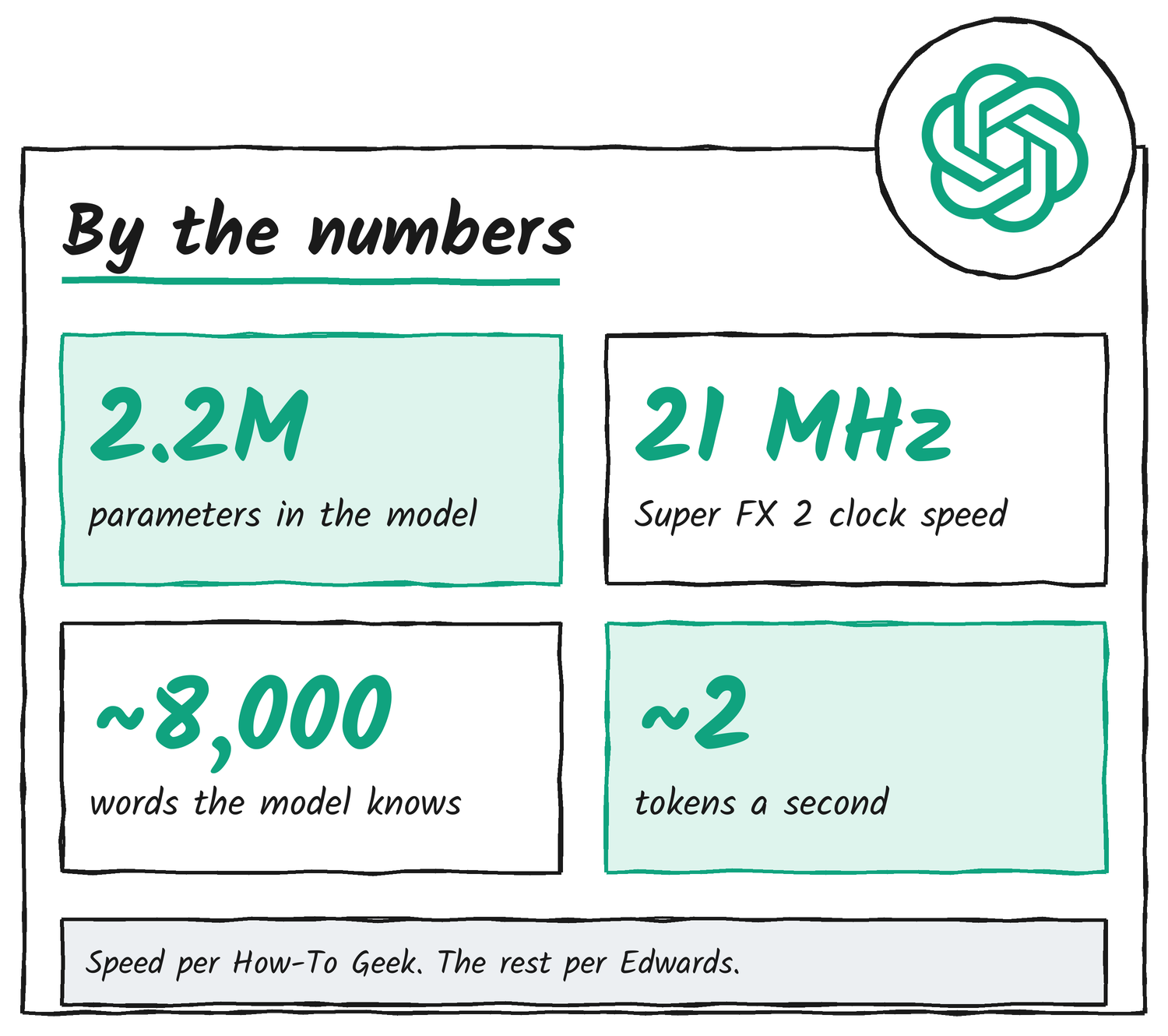
Benj Edwards has built an unofficial ChatGPT for SNES, a chat program whose language model of about 2.2 million parameters runs on the Super FX 2 chip inside a Super Nintendo cartridge.
It isn’t the ChatGPT service running on a console. The model is a small one that learned from conversations written by gpt-oss-120b, OpenAI’s open-weight model, and Edwards’s page says the project is “Not made or endorsed by OpenAI.” He told The Register it is a distilled version of gpt-oss-120b.
Edwards announced it on X on 19 November, crediting GPT-6 Astra and gpt-oss for help with the build.
How the Super FX 2 runs a language model
The Super FX 2 is a 21 MHz coprocessor that debuted in 1995 with Yoshi’s Island, where it scaled and rotated sprites. An earlier version of the chip drove the 3D graphics in Star Fox in 1993, Edwards notes.
Here the chip runs the model, which writes its answers one word at a time. How-To Geek reports that, per Edwards, the chip reads the model’s 8-bit weights straight from the cartridge ROM and generates about two tokens a second, or roughly one word every half second.
The chip isn’t strictly required. The pure build could run from a real custom cartridge without the chip, Edwards said, and he has a version with no Super FX chip at all, though the answers aren’t as good without the extra processing power.
Two builds, in a browser or on a real console
Version 0.7, dated 2 November, comes in two builds. In the pure build, every word comes from the model; the ROM is a 1.5 MB zip and the browser version loads about 4 MB.
The fact book build adds the opening sentences of 150,000 Simple English Wikipedia articles, stored in an MSU-1 data file. Like ChatGPT searching the web, the model can decide to look something up and print what the book says, and Edwards’s page says it also has a calculator. That ROM is a 17 MB zip and loads about 19 MB in the browser.
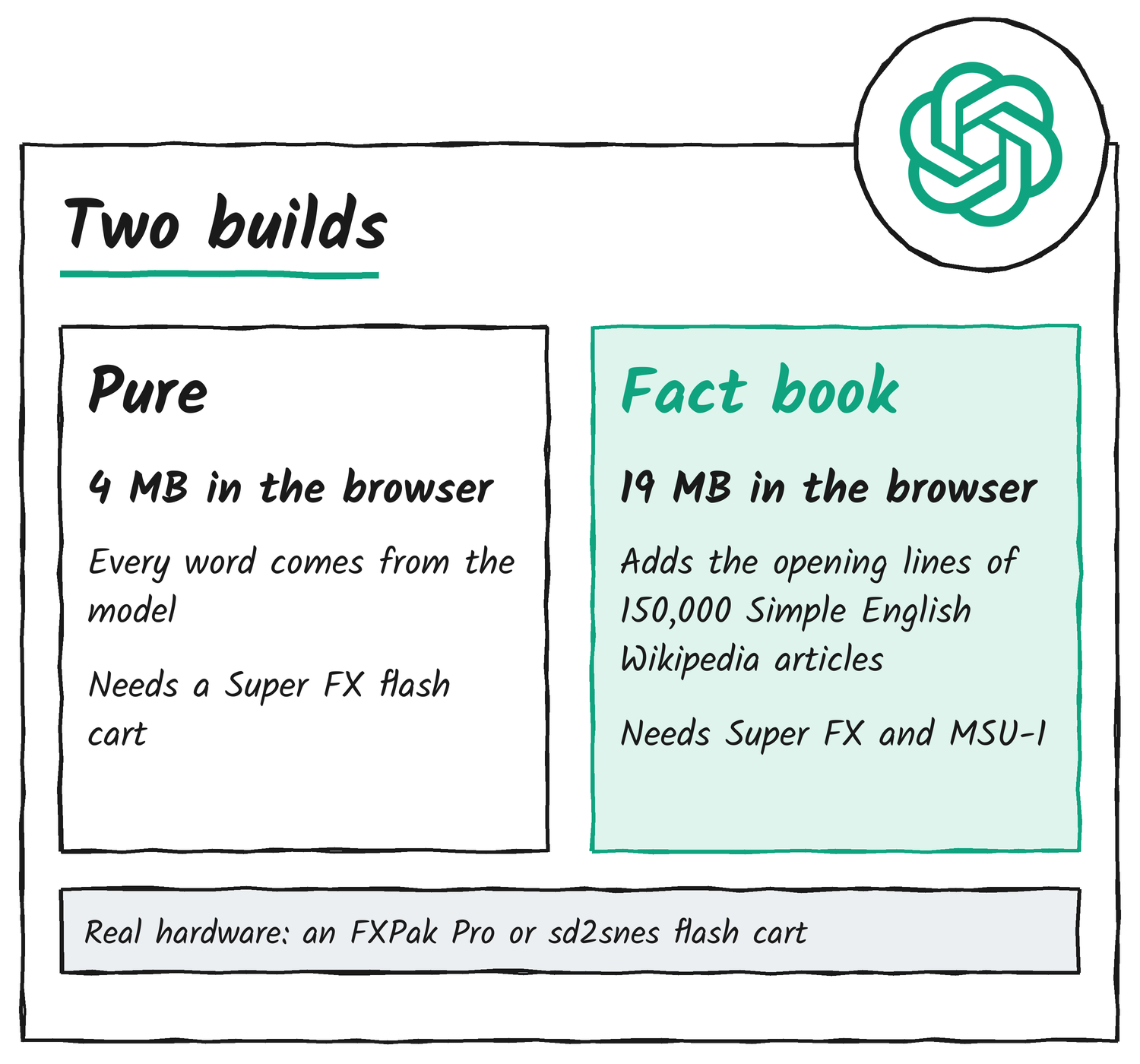
On a real Super Nintendo, both builds need a flash cartridge with Super FX support, such as an FXPak Pro or an sd2snes, with the Super FX speed option left at Normal. The fact book build also needs MSU-1 support.
Trying it
Edwards’s page runs both builds in the Snes9x emulator inside a browser tab. You type on your keyboard, and each letter takes a moment to appear because the page moves the cursor across the game’s own on-screen keyboard. Asked who Mario is, the cartridge answers that he’s a small plumber who jumps and saves a Princess.
The page says the model knows about 8,000 words and is millions of times smaller than the models behind ChatGPT. When it slips up, Edwards said, “it’s almost cute when it does it because of its limited knowledge and its playful interface.”
Who made what
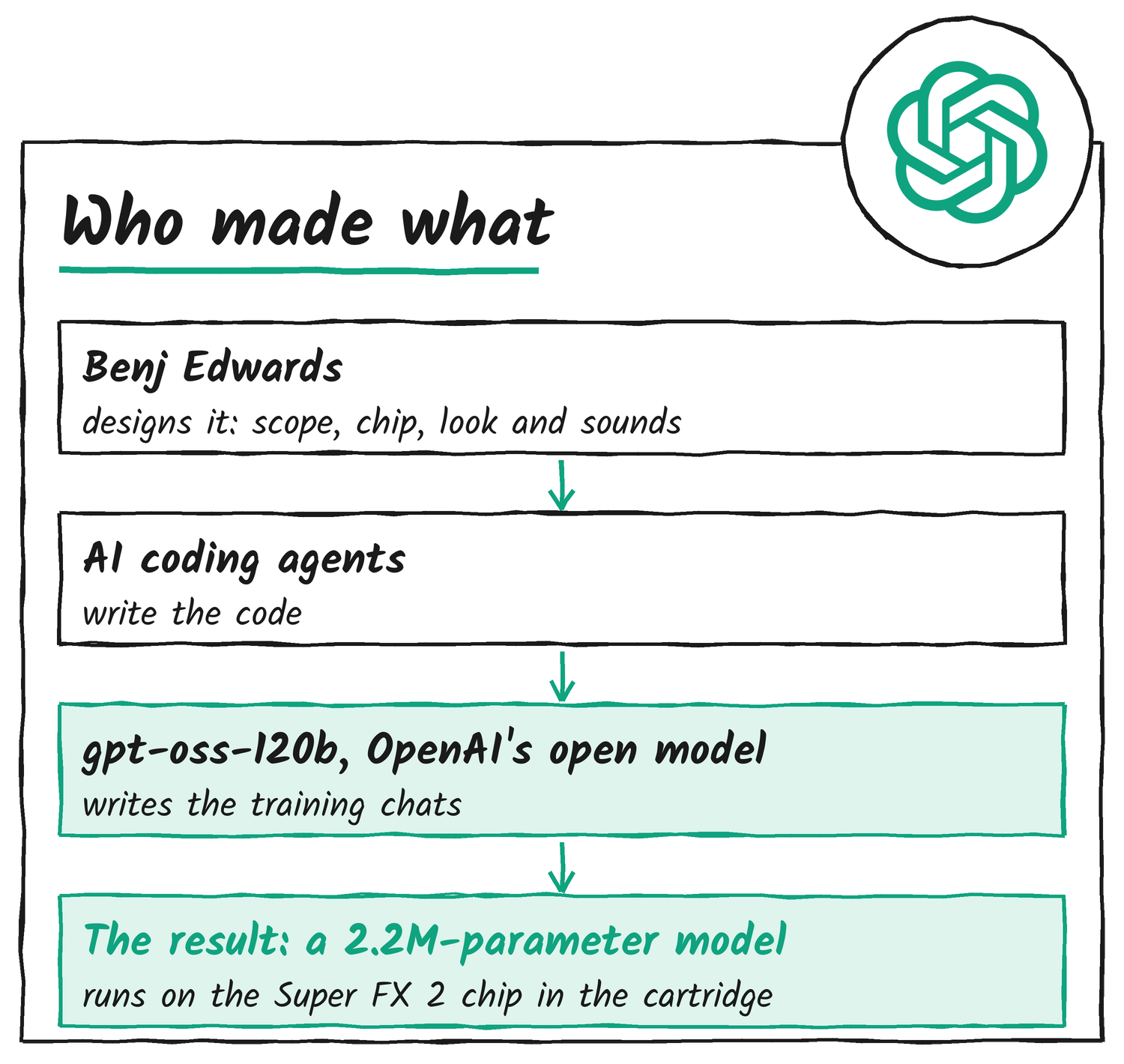
Edwards is a tech journalist who runs the Vintage Computing site. His page says AI coding agents wrote the code, and he described his own part to The Register.
I designed the scope of what the software should be, how it should work broadly, what chip it should use, how the interface should look and work, and the sounds it makes when it types responses.
Benj Edwards, to The Register
He has a second project, Séance, an NES ROM that runs an even smaller model to simulate talking to a ghost in a haunted game cartridge.
The coding agents advise that the model has hit the limit of what the hardware allows, Edwards said. He doesn’t take their word for it, and has new ideas for making a tiny model more coherent that he’s working on now.
Sources
- ChatGPT for SNES, BX Foundry, version 0.7
- Benj Edwards on X, 19 November 2026
- The Register, 21 November 2026
- How-To Geek, 20 November 2026
Disclosure: I’m an OpenAI, Firecrawl and Devin ambassador.
Discover more from Sulat AI & Tech News
Subscribe to get the latest posts sent to your email.