Glenn Gabe has spotted Google’s redesigned Dive Deeper links in AI Mode. The SEO and AI search consultant wrote on X on 21 November (US time) that he’d just seen the new links Google announced in October, and described what he saw: “Blue links, thumbnails and a description. Good to see more links there.”
What the screenshot shows
Gabe’s screenshot is an AI Mode answer about Anthropic stock. Below a row of social posts sits a “Dive Deeper” heading, and under it three links, from CNBC, Bloomberg and TheStreet. Each starts with the publisher’s name as a blue link, followed by a one-sentence summary of the article. A thumbnail sits on the right, an age label such as “16 hours ago” runs underneath, and a three-dot menu button follows it. A pair of follow-up prompts closes the answer.
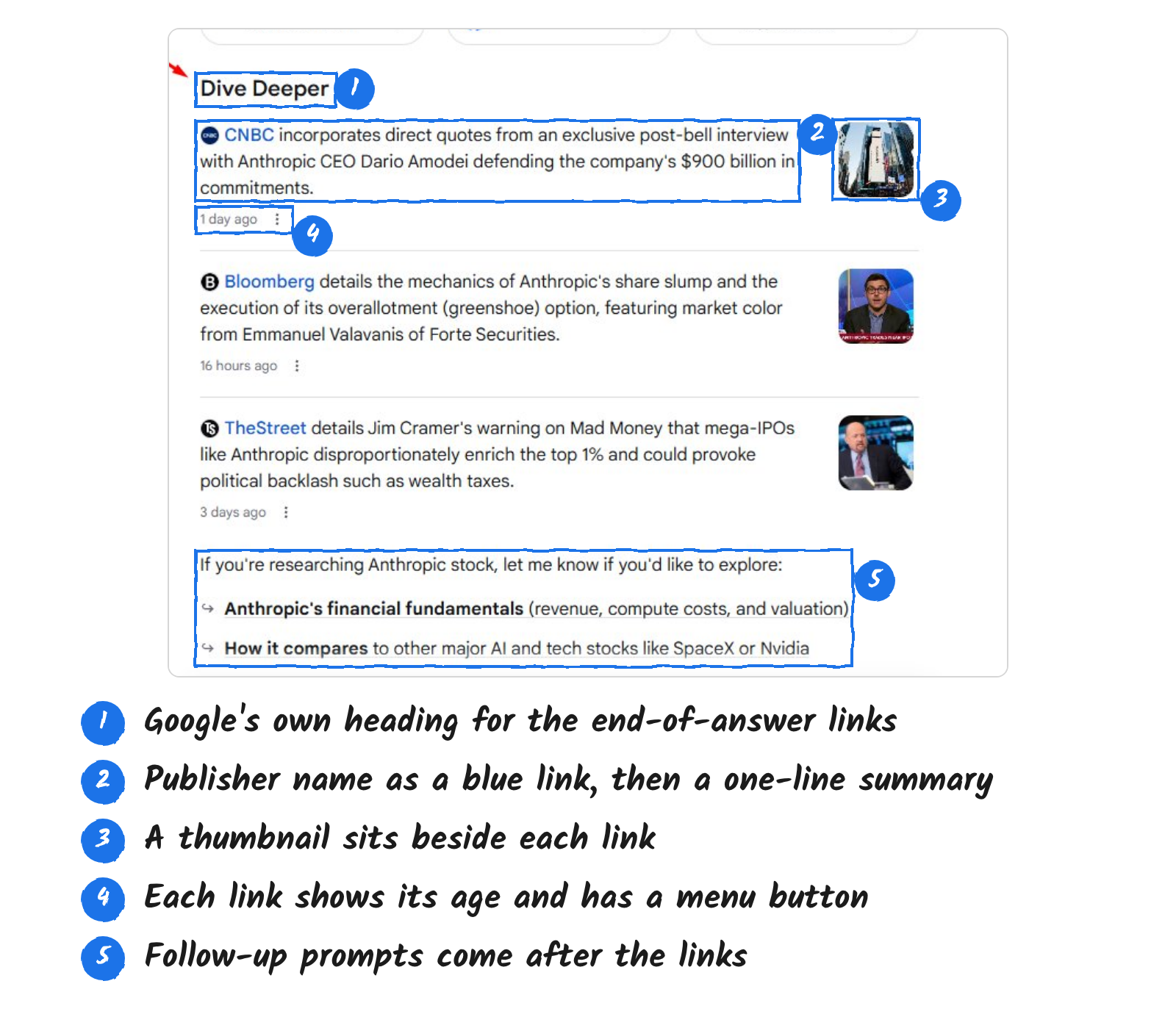
Google’s own post mentions only thumbnails and a more clickable design. The summary line, the age label and the menu button aren’t described in it.
What Google announced on 15 October
Hema Budaraju, Google’s VP of Product Management, set out five changes to AI Mode and AI Overviews in a post titled More ways to connect with the web from Search. Dive Deeper is the fourth.
We’re making the links that we show at the end of some AI responses more engaging and prominent, with image thumbnails and a more clickable design.
Hema Budaraju, Google, 15 October 2026
Google frames the links as the next step for readers who’ve “gotten the lay of the land on a topic” and want to dig into other angles. They appear at the end of some responses, so not every AI Mode answer carries them.
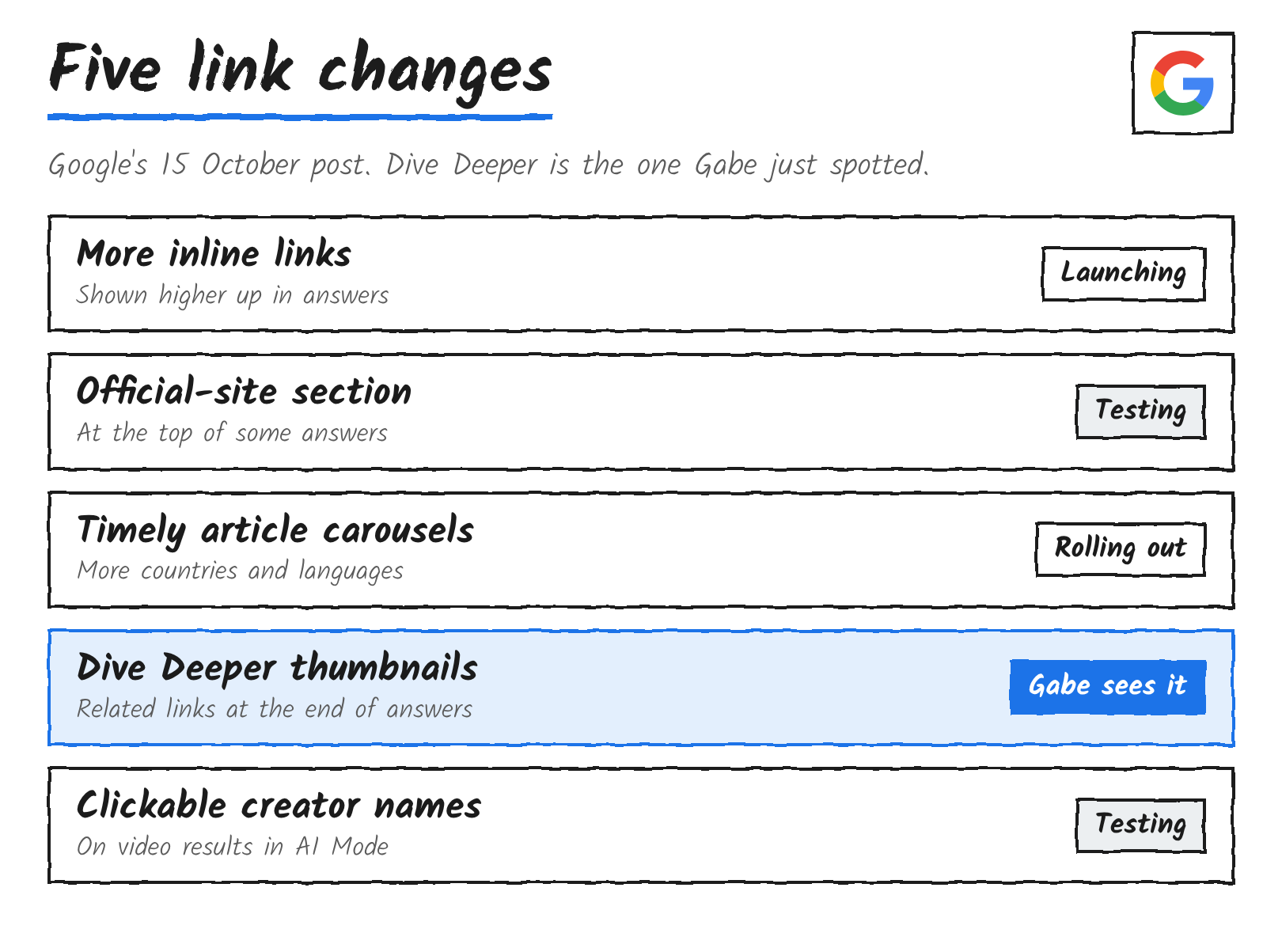
| Change | What Google said | Status in the post |
|---|---|---|
| Inline links | “Continued and substantial increases” in links embedded in the answer, shown higher up more often | Launching |
| Official-site section | A dedicated section at the top of a response for “one or two official places on the web”, with a note on why each link is useful | Testing |
| Article carousels | Prominent carousels for timely articles, highlighting Preferred Sources, in more locations and languages | Starting to roll out |
| Dive Deeper | End-of-answer links with image thumbnails and a more clickable design | No status given |
| Creator and publisher names | Clickable names on video results in AI Mode that open Search profiles | Testing since the week of the post |
Gabe’s first reaction
Gabe reacted on the day Google announced the changes. His post opened with “Long live the link!” and listed all five. Barry Schwartz, whom Gabe credited with the details, wrote in Search Engine Land that he suspects searchers won’t click, “otherwise Google would give us click data broken down in the AI performance reports in Google Search Console, which Google still does not do.”
5
link changes in Google’s 15 October post
7x
growth in Preferred Sources use since the start of 2026, Google says
31 Aug
2026, when the generative AI performance report reached every site
What a site needs to be linked
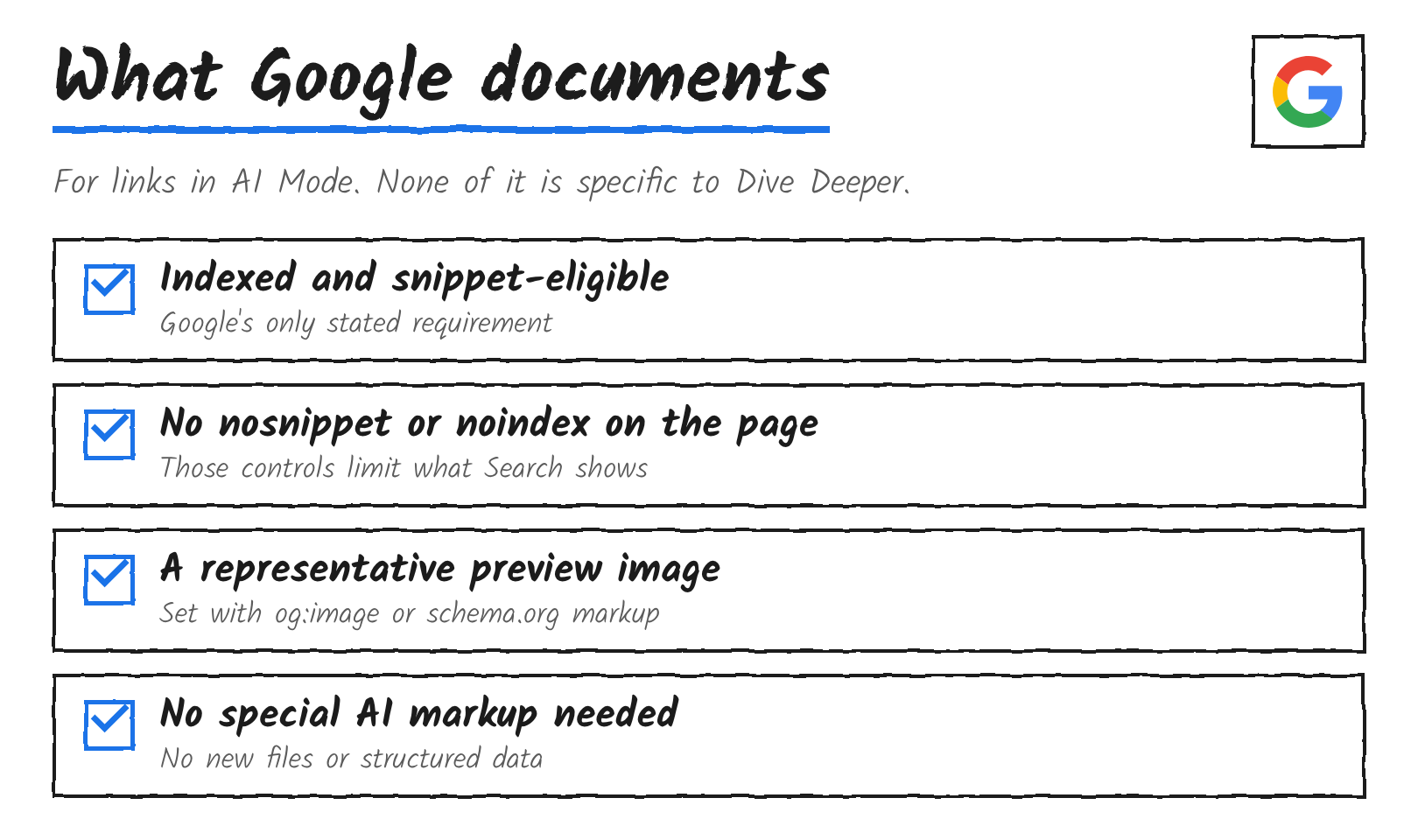
Google’s Search Central guide to AI features says “there are no additional requirements to appear in AI Overviews or AI Mode, nor other special optimizations necessary.” To be shown as a supporting link, a page must be indexed and eligible to appear in Google Search with a snippet. No special markup, AI text files or schema.org structured data are needed. Site owners who want to limit what Search shows from a page can use nosnippet, data-nosnippet, max-snippet or noindex. The guide was last updated on 10 December 2025, so it predates the October post.
Thumbnails are the part readers will notice. Google’s image guidelines say its choice of preview image is “completely automated”, and that you can influence it with the schema.org primaryImageOfPage property, an image property on the main entity, or the og:image tag. Google advises a representative, high-resolution picture, and warns against generic logos, images with text and extreme aspect ratios. Those guidelines cover image previews in Search generally. Google hasn’t said which image Dive Deeper uses.
Counting the traffic
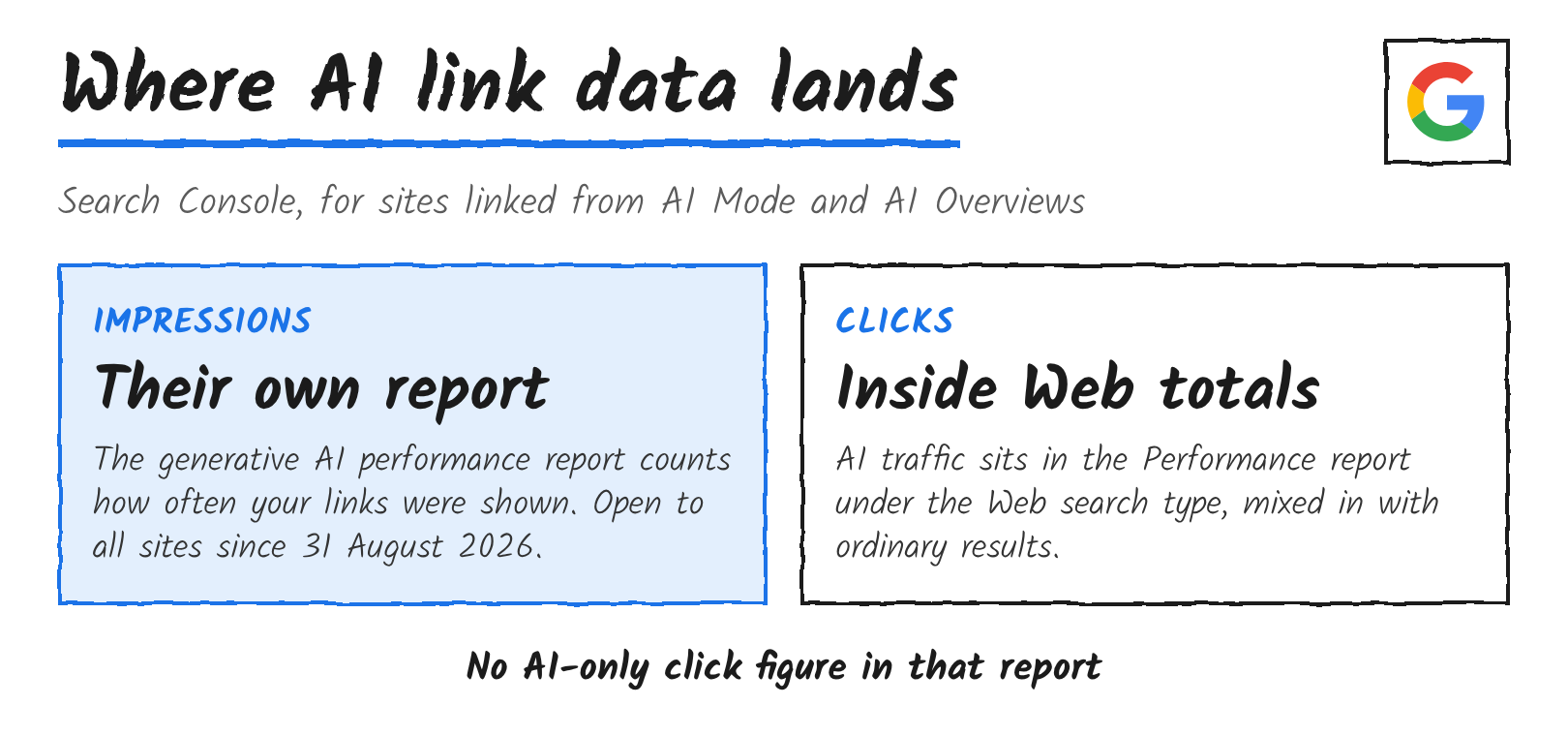
The same guide says sites appearing in AI Overviews and AI Mode are included in overall search traffic in Search Console, reported in the Performance report under the Web search type. Since 31 August 2026 every site can also open a generative AI performance report. It counts impressions, meaning how many times links to your site were shown in AI Overviews or AI Mode, and it groups them by page, country or device. Two results from the same site in one feature count as a single impression in the chart total. The report’s help page describes impressions, not clicks.
For AI Overviews, Search Console gives every link in an overview the same position, Search Engine Journal’s Matt G. Southern wrote on 15 October, so moving an inline link higher doesn’t change its reported position by itself.
What to check on your own site
- Open the generative AI performance report and see which pages already draw impressions.
- Check that the pages you want linked carry no
nosnippet,data-nosnippetornoindex, and thatmax-snippetisn’t set tight. - Look at the preview image each page declares in
og:imageor schema.org markup, and swap generic logos or text-heavy graphics for a representative, high-resolution picture. - Search the topics you cover in AI Mode, and note whether a Dive Deeper block shows up at the end and which publishers it names.
Is Dive Deeper the same as the inline links change?
No. Google describes inline links as links embedded in words or phrases inside an AI response. Dive Deeper links sit at the end of some responses.
Does Google say how Dive Deeper picks its links?
No. The post says only that the links appear at the end of some responses, with image thumbnails and a more clickable design.
Where is Dive Deeper live?
Google’s post names no countries or languages for Dive Deeper, and Gabe’s post doesn’t say where he searched from.
Gabe also questioned uptake of Google’s Connected Apps in AI Mode on the same day, which I covered in Google adds Target, Experian and H&R Block to AI Mode, and Glenn Gabe questions uptake.
Discover more from Sulat AI & Tech News
Subscribe to get the latest posts sent to your email.