Aviator cofounder and CEO Ankit Jain says reviewers who’ve stopped reading AI-written code should read three things instead: the intent behind a change, its acceptance criteria and the decisions made along the way. He makes the case in a New Stack analysis published on 21 November under the headline “If we stop reading the code, what do we read?”
The New Stack marks the piece “Aviator sponsored this post”, and Aviator sells Verify, the review product the post points to. The argument leans on guests from Jain’s own podcast, The Hangar DX, and on a post by Mitchell Hashimoto. I read those sources to see how closely they match what the post says of them.
What the post argues
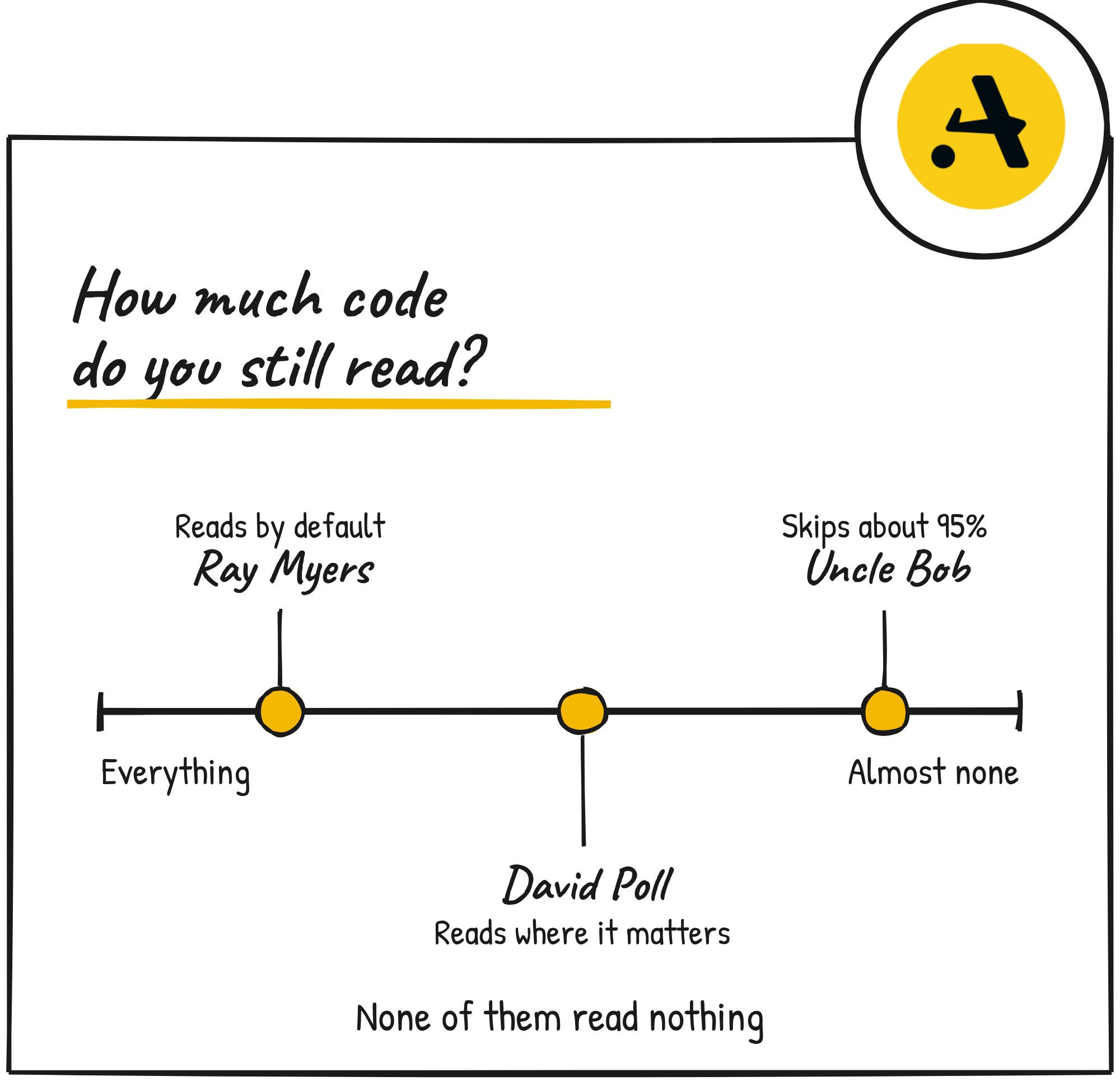
Jain opens with Robert “Uncle Bob” Martin, who wrote Clean Code. Martin told him he never sees 95% of the code his agents write, and gave the reason in a line the post quotes.
Human beings are too slow when dealing with code. So if we’re going to move at the speed of the agents, we’re all going to have to back off a little bit and maintain the high-level supervision, but at the level of code, that’s probably out of our domain now.
Robert C. Martin, as quoted by The New Stack
Martin still reads something, Jain points out. He showed Jain a tool where an agent breaks his project into something close to a UML diagram. Problems show up in red: functions with a high CRAP score, a low mutation-testing score and dependencies pointing the wrong way. CRAP is a 2007 metric that climbs when a function is both complex and poorly tested.
Jain then turns to Ray Myers, who argues against dropping code reading altogether. Myers says most people who tell you not to read code are still reading some of it, and the post lists how: skipping throwaway tasks, leaning on automated checks, reading only for design, or reading at the end.
Jain’s answer is a review built on three things to read:
- Intent. What the change is for, what’s in scope and what’s left out, captured from the prompts and the back-and-forth with the agent.
- Acceptance criteria. The criteria for this change plus standing rules from a team’s “AI slop registry”, checked by a verifying agent that has no context from the agent that wrote the code. It returns a verdict and evidence.
- Decisions. Which library, which data model, what happens when a downstream service times out, what was left unbuilt. Jain says most of what an agent writes is boilerplate, and the decisions are what a human contributed.
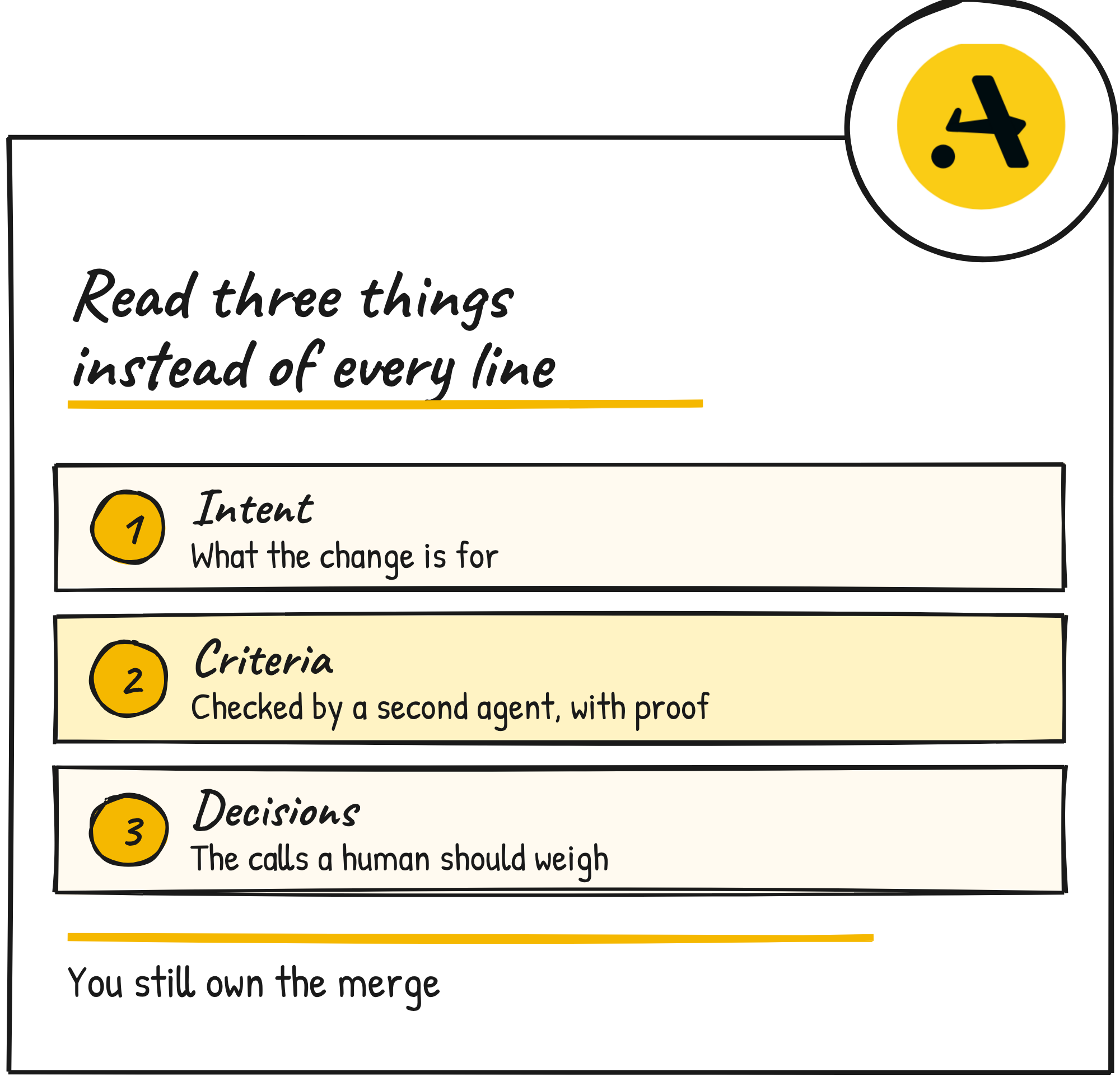
He backs this with Hashimoto’s “whiteboard defense” and with David Poll’s view that reading isn’t a yes-or-no choice. He ends on Martin again: the engineer who merges a change owns it, whether they read every line or none.
What the sources say
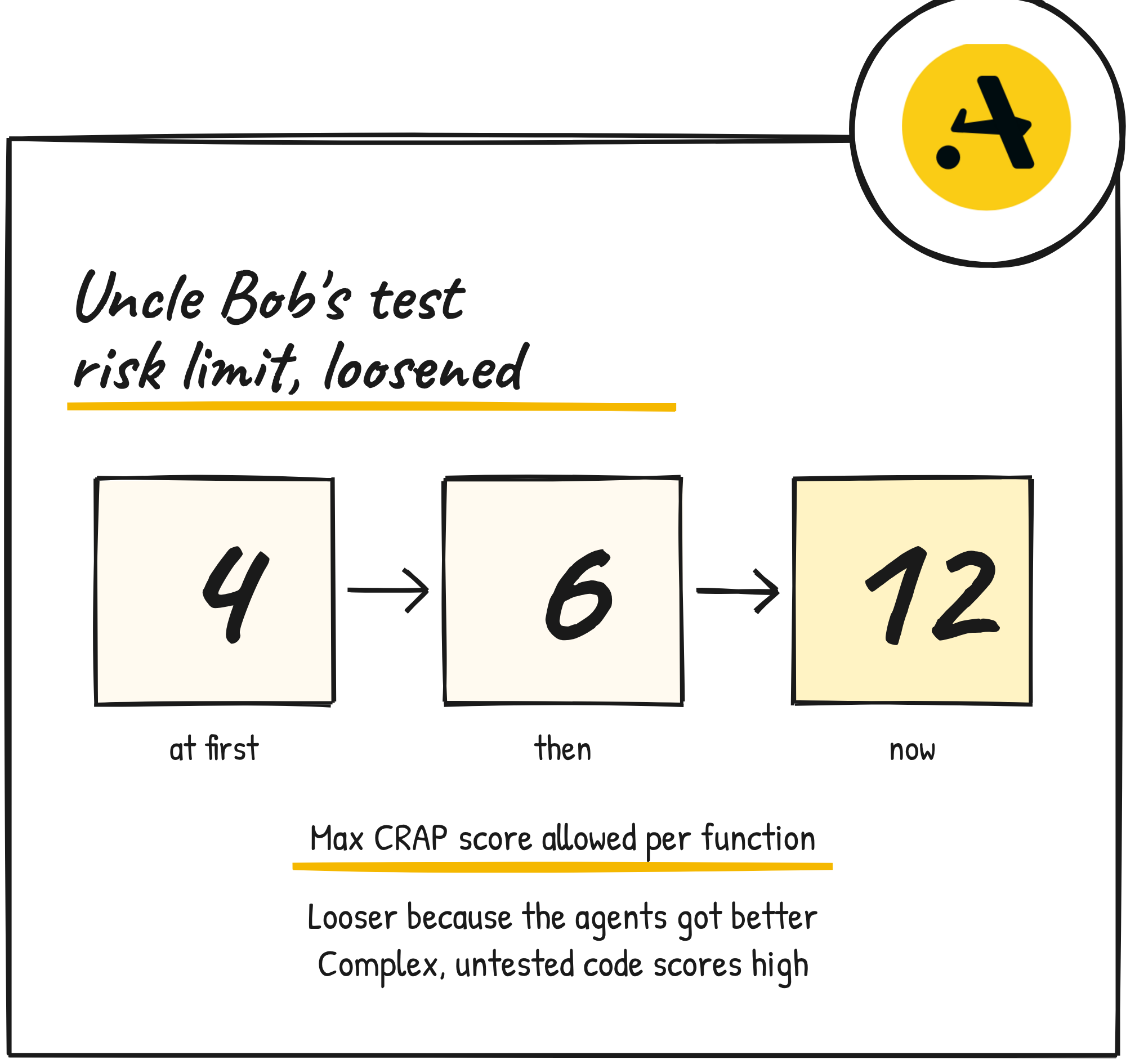
Martin’s episode, released on 24 September, is mostly about guardrails. He names three constraints he puts on his agents: unit tests, the CRAP score and mutation testing, where a tool changes the source and expects every change to break a test. He has loosened the CRAP limit as the agents have improved.
I used to keep CRAP down to four. Then I thought that was probably too restrictive and backed it off to six. At this point I think 12 is probably okay.
Robert C. Martin, The Hangar DX, 24 September 2026
He also runs the software himself in a tight loop and plays with it, and has agents build tools that execute Gherkin, the behaviour specs that humans write or review. Of Jain’s three things, Gherkin is the closest to acceptance criteria. The episode write-up doesn’t describe capturing intent or decisions from agent sessions.
Myers’s episode, released on 22 October, is titled “Dark Factory is a Non-Solution to a Non-Problem”. He calls the dark factory, where nobody reads the code, mostly hypothetical, and says every credible person in the debate backs some reading. He notes that Martin opened with “I don’t read the code” and then said he does read the Gherkin. Myers’s default is to see the code and back off only where there’s evidence the risk is low. He also says nobody needs a 50,000-line pull request.
I think most of the people who are telling you not to read code are actually doing some lowercase form of reading the code
Ray Myers, The Hangar DX, 22 October 2026
David Poll leads GitHub’s Code & Review organisation. He says code review was never mainly about correctness. He lists three jobs: collaborating on what belongs in the product, sharing knowledge and verifying that the change works. How far you back off, he says, depends on how sensitive the product is and what happens if something goes wrong.
The question is not whether I read or not read the code; it’s whether my attention gets directed to where it’s actually useful.
David Poll, as quoted by The New Stack
Hashimoto’s post, from 16 September, sets his bar for customer-facing systems. He doesn’t expect line-level familiarity with the code, but he does expect an engineer to explain how a system works and defend the decisions behind it. For proofs of concept and demos, he says to generate all of it and understand none of it.
Where the sources agree and split
Review is already being skipped. Faros AI reported on 18 September that the rise in pull requests merged without any review had grown from 31.3% six months earlier to 76.3%. Jain’s 6 November post on Aviator’s blog cites the same research, along with its finding that many companies now run AI review on 50% to 80% of pull requests.
None of the sources wants a human reading every line as the only check. They split on what takes its place. Martin points to tests and metrics, with a look at the architecture and the running system. Myers points to continuous-delivery guardrails and reading the code by default. Jain points to intent, criteria and decisions recorded around the change.
On ownership they line up. Martin and Jain both say the person who signs off carries the responsibility, and Martin’s line is the sharpest version.
The agents are not responsible for anything. They’re entirely irresponsible. Only humans can be responsible.
Robert C. Martin, The Hangar DX
The post gives no figures on how many defects reviewing intent, criteria and decisions catches compared with reading the diff. Aviator’s own documentation says AI-drafted rules don’t affect any pull request until someone on the team approves them, and that every waiver of a rule is logged.
Discover more from Sulat AI & Tech News
Subscribe to get the latest posts sent to your email.