
WIRED says the wave of US outages is the start of a pattern: AI finds flaws faster than ever, attackers exploit them faster, and under-resourced IT teams rush out patches that sometimes break things. Its Kernel Panic newsletter also says the outages weren’t a hacking spree and that taken one by one they have routine explanations. I read the primary records behind each outage, and they back one half of that. Only the NSA’s outage is tied to patching by an official, and Microsoft’s final report says its outage had nothing to do with AI tooling.
Here’s what WIRED argues, what each organisation says, and where the numbers sit.
- What WIRED argues
- The record, outage by outage
- Microsoft’s final report
- The NSA and the PHP patches
- The numbers behind the pressure
- The patch clock
- What nobody has confirmed
- Sources
What WIRED argues
Lily Hay Newman and Matt Burgess wrote the piece, headlined “The Outages Are Just Getting Started”, on 21 November US time. Their chain has five steps: AI-assisted discovery floods the world with bugs, attackers use AI to exploit them quickly, vendors and IT teams feel the pressure to patch at once, they push updates onto systems that weren’t built for that pace, and some of those systems fail. Researchers told them AI’s biggest effect is that it speeds everything up.
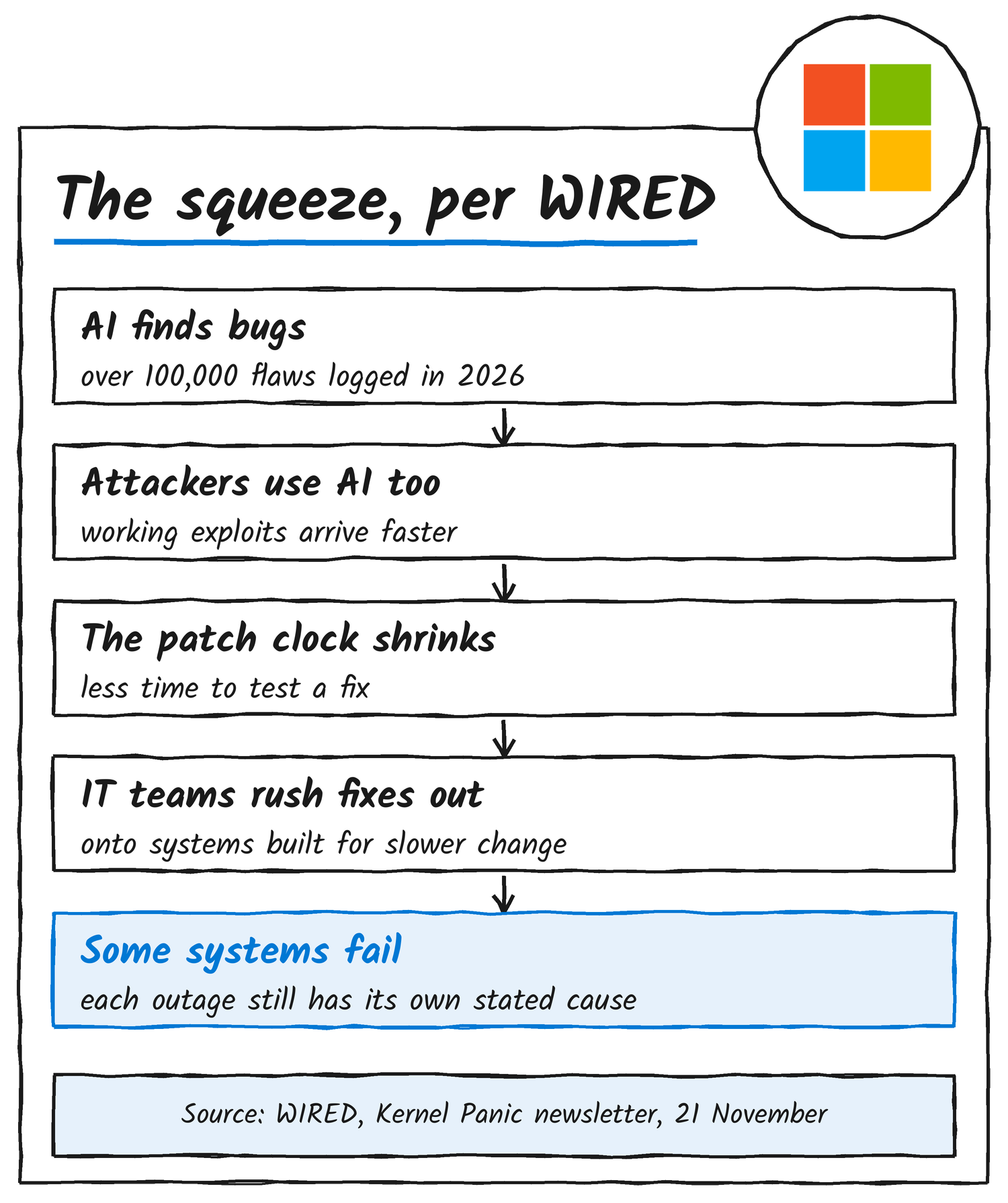
A senator and an executive carry the thesis in the piece. Sen. Mark Warner, the vice chairman of the Senate Intelligence Committee, said AI is putting “tremendous strain on systems that weren’t built to handle that pace of change” in a statement on 17 November. Microsoft chief executive Satya Nadella told the New York Times DealBook Summit on 18 November that more instability could come. The Next Web quotes him:
The patch needs to go instantly from being available to being patched in production, because it’s being exploited in the wild.
Satya Nadella, DealBook Summit, 18 November, as quoted by The Next Web
Nadella didn’t tie Microsoft’s own outage to that pressure. The Next Web reports he called it “a latent bug that was there” that got invoked in “one of those perfect storms”.
The record, outage by outage
The newsletter names the Microsoft 365, NSA and Apple outages. Six incidents ran from 12 to 17 November, and each organisation has given its own account. The table sets out what each has said, and who said it.
| Date | Who | What broke | Stated cause | Source |
|---|---|---|---|---|
| 12 to 14 Nov | Microsoft 365 | Outlook, Teams, Copilot and Exchange Online | A latent Windows gateway defect from a July change, set off by a Teams failover, reduced capacity and peak load. Not a cyberattack, not AI tooling | Microsoft final report, 20 Nov |
| 13 Nov | FAA | Nationwide ground stop | A flood of data from a radio site in El Dorado, Arkansas and a radar site in Amarillo, Texas. No root cause named | FAA, via my report |
| 16 Nov | JPMorgan Chase | Slowed transactions | Chase says a temporary issue related to “a software bug in on-premise hardware systems”, with no evidence of a cyber link | Chase on X |
| 16 Nov | United | Delayed departures | No cause named | United, via my report |
| 17 Nov | NSA | Internal systems degraded | NSA says scheduled routine maintenance. DNI Jay Clayton says patching after a PHP flaw | NSA statement |
| 17 Nov | Apple | Apple Pay, iCloud and apps | An internal update, and not a cyberattack | Apple, via the New York Times |
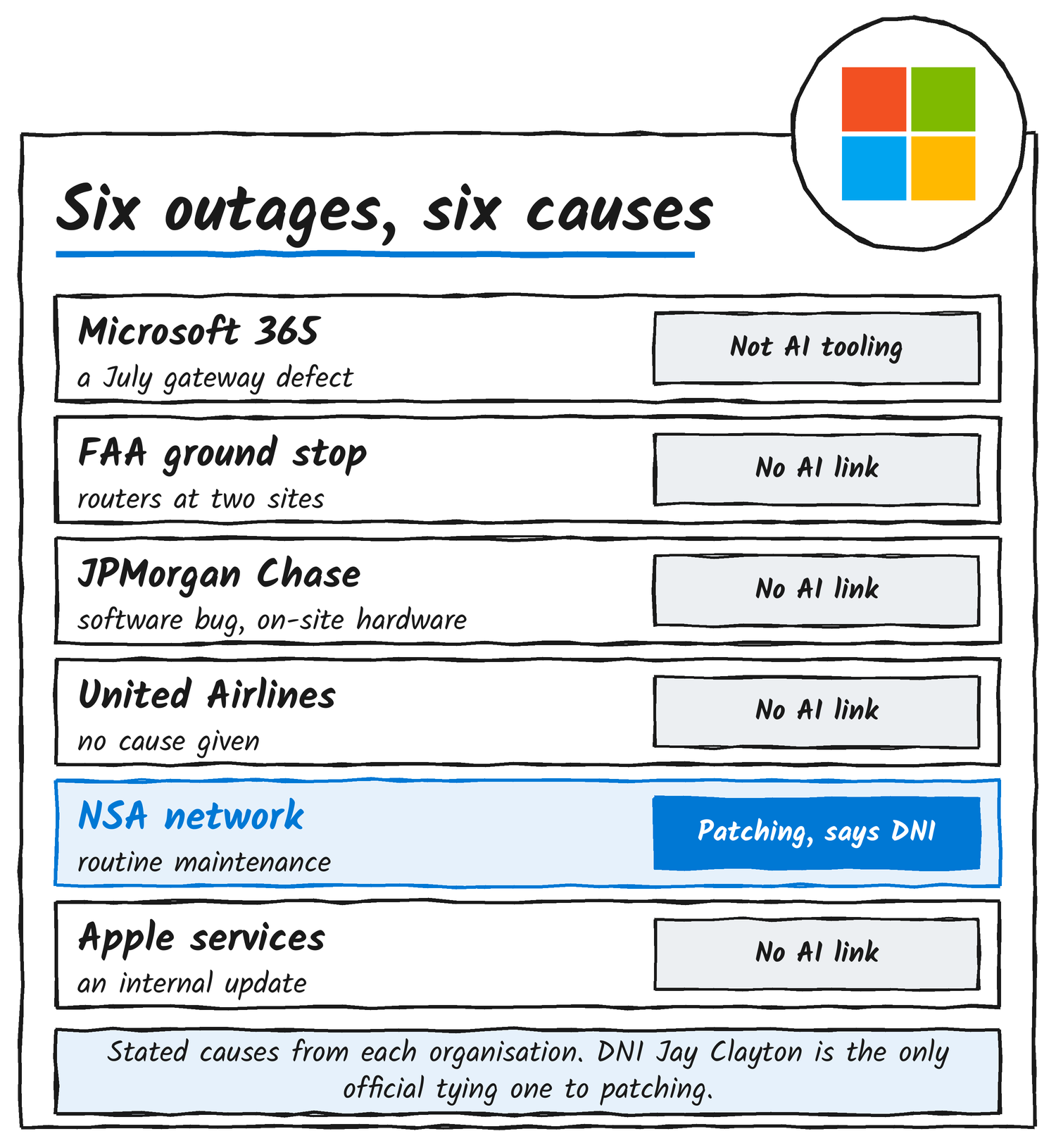
None of the six statements, apart from Clayton’s on the NSA, mentions patching for AI-found flaws. Clayton told the House Homeland Security Committee on 18 November that he has no indication the events are related, and the White House says officials see no sign of a coordinated cyberattack. My earlier reports on the Microsoft, FAA and Apple outages carry the detail.
Microsoft’s final report
Microsoft published its final post-incident report on 20 November, and it’s the most detailed primary record of any of the six. It says a latent Windows defect made gateway servers used by Exchange Online unresponsive. The change that introduced it began deploying in July and ran worldwide for more than three months without trouble. Microsoft’s load tests used older, lower-core hardware, and the defect gets worse on newer machines with more cores.
The report is blunt about the cause: “This incident was confirmed not to be caused by a cyberattack, and we found no evidence of malicious activity. This change was not caused by AI tooling.” So Microsoft’s outage doesn’t support WIRED’s chain, even though the CEO’s remarks sit in the same piece. It was a lurking bug that three ordinary conditions exposed.
14%
of gateway capacity was out of service for routine deployment work
~16 hours
the gateways stayed healthy after Teams traffic shifted at 1:07 AM UTC
80%+
of servers were unresponsive at the lowest point
~20 min
from broad impact to the first customer notification
| Factor | What the report says |
|---|---|
| Connection-processing defect | Lock contention in an internal Windows process exhausted CPU and memory on newer, higher-core gateway servers |
| Reduced capacity | Nearly 14% of gateway capacity was out of service during routine deployment. Spare capacity covered that on its own |
| Teams failover | A routing fault in the US East region sent Teams traffic to the second gateway system, which also serves Exchange Online |
| Peak load | Broad failures in North America began about 4:00 PM UTC as US traffic neared its daily peak |
Traffic management then did what it’s built to do and moved load to healthy capacity units. That pushed the same defect onto them, and in less than two hours it had hit a large share of the North American fleet. Servers also got overwhelmed again when they returned to service, so recovery dragged.
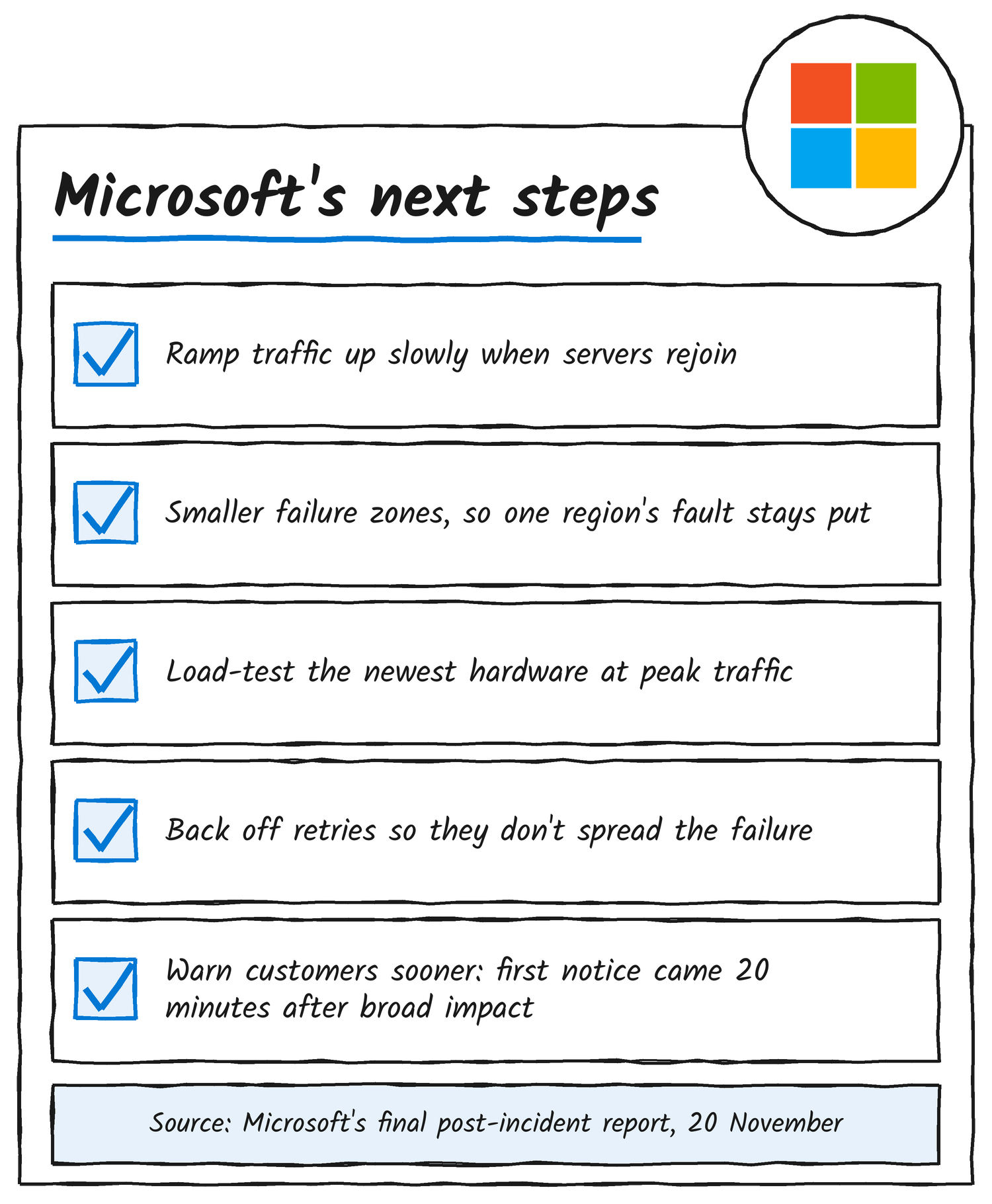
Its fixes target the failure’s shape: smaller fault zones, regional-only Teams failover, a gradual traffic ramp-up when servers rejoin, retry back-off, load testing on the newest hardware at peak limits, and faster customer notices. Dates run from the fourth quarter of calendar 2026 to the first quarter of 2027, and several have no date yet.
The NSA and the PHP patches
The NSA outage is the one that fits WIRED’s chain. The agency warned on 21 October about two critical PHP flaws that could let attackers take over web servers without authentication, and told organisations that couldn’t update at once to take the system offline. CISA tracks them as CVE-2026-109618 and CVE-2026-109619 and added both to its Known Exploited Vulnerabilities catalogue on 26 October.
On 17 November the NSA’s own statement said only that it had “temporary degradation during scheduled routine maintenance”. The patching link comes from Clayton. In the White House’s release of his remarks he said systems taken down for upgrades “are not coming back as expected in all cases”, and that handoffs between systems aren’t coming back as expected either.
And as they upgrade them, they’re not coming back as expected in all cases. And in some cases, systems have to hand off to other systems, and those handoffs are not coming back as expected. But this is just an upgrade in patching, an upgrade in systems.
DNI Jay Clayton, in the White House release, 18 November
Clayton also told Fox Business the PHP patching had caused some systems not to come back up as expected, as I reported earlier. The NSA hasn’t confirmed that account in its own statement. This is one official’s explanation for one outage, and WIRED relays it from officials.
The numbers behind the pressure
The volume is real. The Register reported that VulnCheck counted 100,222 CVEs on 13 November, and WIRED says the total passed 100,000 this week against about 25,000 in 2022, the last year before large language models went mainstream. WIRED puts the 2026 count at double the combined totals of 2024 and 2025. The Register says it’s more than double 2025’s total alone, and that’s the framing I use, because it matches a count of about 100,000.
100,222
CVEs counted by VulnCheck on 13 November
~25,000
recorded in 2022, per WIRED
~1.5%
of this year’s flaws exploited, per VulnCheck via WIRED
300
added to CISA’s exploited-flaw catalogue this year
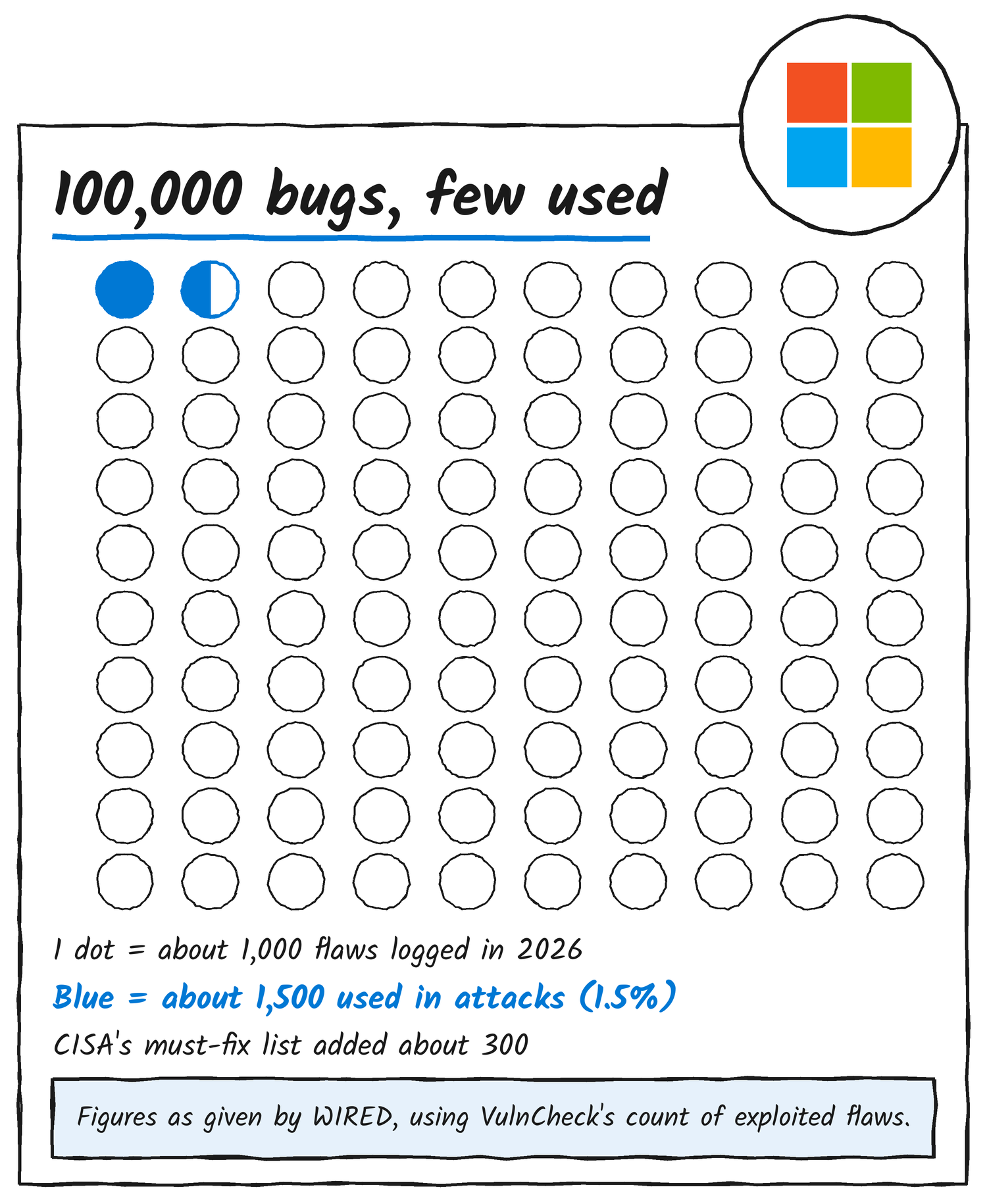
Volume isn’t the same as risk, and WIRED says so. Joe Slowik of Dataminr told it that “the number of vulnerabilities has certainly exploded, but the number of vulnerabilities that you need to care about has remained somewhat constant”. The change is speed: how fast the flaws that matter get weaponised. VulnCheck’s Josh Bressers made the scale point to The Register: 1 percent of 1,000 is a lot different from 1 percent of 100,000.
The patch clock
This is the strongest evidence for WIRED’s thesis. The Register cites VulnCheck data showing the median time from a CVE’s publication to its exploitation fell from 120 days in 2025 to 80 days in the first half of 2026. Bressers says it has closed further since: “It’s often just hours.” CrowdStrike saw 88 percent of exploitation that used public proof-of-concept code happen within 48 hours of the code’s release, and China-linked groups moved within 24 hours.
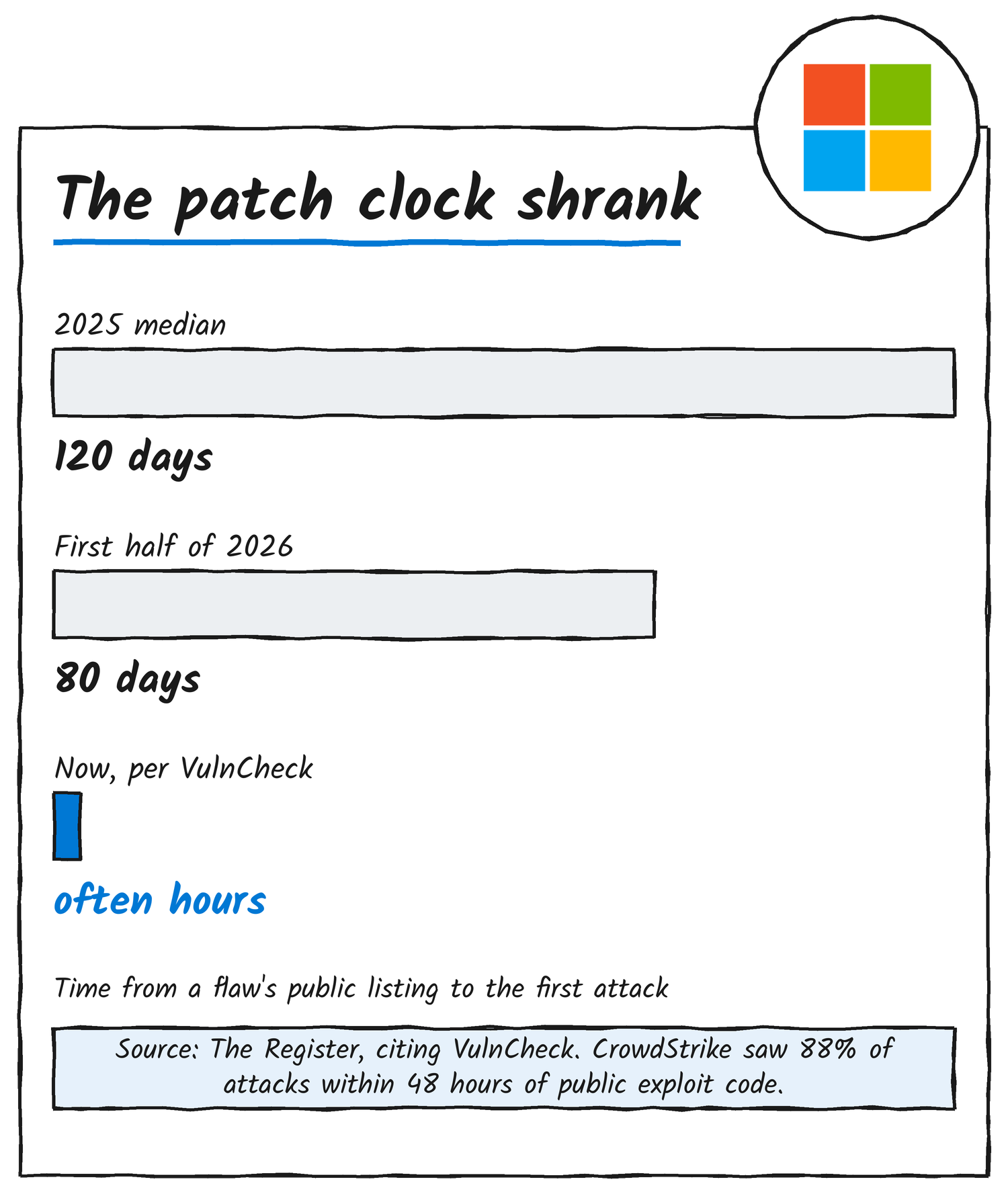
Slowik describes what that does to a patch team: turnaround times now “completely defeat the ability to do patch verification”. Lea Schönherr of the CISPA Helmholtz Center told WIRED that AI can help but people still need to check that a patch addresses the cause. Nadella’s version is the same trade, less testing for more speed.
Where the “hours” figure comes from
The 120 and 80 day medians are VulnCheck figures as The Register reports them. The “hours” line is a quote from Bressers about the second half of 2026, and he gave it as an observation, with the example of 14 flaws VulnCheck disclosed in Copeland refrigeration controllers. The Register doesn’t give a median for it. Treat it as a direction, not a measurement.
New finds this week
WIRED lists three more AI-assisted discoveries. Researchers disclosed critical flaws in PHP for the second time, in NGINX and in Java. CISA urged immediate patching of the Java flaw, CVE-2026-114938, nicknamed Java4Shell, a memory-corruption bug in the HotSpot JVM’s Base64 decoder that could allow unauthenticated remote code execution. Oracle rates it 9.2 under CVSS 4.0, and Datadog Security Labs says an attacker would need extra work for each application they target, because there’s no single exploit that works against all Java apps. Wiz documents two unauthenticated NGINX flaws, CVE-2026-123633 and CVE-2026-123007, and F5 published an advisory for the HTTP/2 one. WIRED also relays a Forbes report of 35 Apple flaws that researchers found with AI.
What nobody has confirmed
Here’s what the record does and doesn’t show, as of 22 November NZ time.
- Only Clayton ties an outage to patching, and only the NSA’s. Chase, Apple, the FAA and United haven’t linked theirs to patching, and Microsoft rules out AI tooling.
- Warner’s statement is about the general pressure. It doesn’t name an outage.
- The Washington Sun’s report that bank chiefs and the NSA told Congress the same thing rests on three unnamed sources. I covered it separately.
- WIRED reports Chase has confirmed a separate theft of marketing data held by third parties, and Chase says it isn’t linked to the outages.
- WIRED itself says the incidents weren’t caused by a coordinated AI hacking spree and that each looks routine on its own.
What matters to me is that we avoid blaming AI when things go wrong. Responsibility lies with the people and companies that choose to use AI and give it access to infrastructure, and there should be consequences and regulations that can be applied.
Lea Schönherr, CISPA Helmholtz Center for Information Security, to WIRED, 21 November
So the thesis is plausible, and it’s partly supported. The pressure is documented. The link from that pressure to a specific outage is documented once. Cloudflare’s Matthew Prince told WIRED it’s “going to feel like the sky is falling for two years”, though he expects AI will eventually help defenders get on top of common flaws. I’ll update this piece if Microsoft, the FAA, Chase, Apple or United tie their outages to patching.
Sources
- Microsoft final post-incident report, MO1550821 and EX1550543, 20 November 2026 (365Fanatic copy)
- NSA statement on network issues, 17 November
- NSA advisory on critical PHP patches, 21 October
- CISA alert on critical PHP vulnerabilities, 21 October
- CISA alert on the critical Java vulnerability, 17 November
- White House release with DNI Clayton and Secretary Rubio, 18 November
- Sen. Mark Warner statement on network outages, 17 November
- Chase on X, 16 November
- WIRED, “The Outages Are Just Getting Started”, 21 November
- The Register, “This year’s bug count just passed 100K”, 13 November
- The Next Web, “Satya Nadella says AI-found bugs will make outages more likely”
- TechCrunch, Nadella on unpatchable infrastructure, 18 November
- CyberScoop on the House Homeland Security hearing, 18 November
- Datadog Security Labs on CVE-2026-114938
- Wiz on the NGINX flaws CVE-2026-123633 and CVE-2026-123007
Discover more from Sulat AI & Tech News
Subscribe to get the latest posts sent to your email.