
States at the UN’s weapons conference in Geneva agreed early on Saturday 21 November to “elaborate” an international instrument on lethal autonomous weapons over the next two years. They didn’t agree to negotiate a legally binding treaty, which is what the International Committee of the Red Cross wanted. The ICRC said it “regrets” the outcome and that there is “no time to lose”.
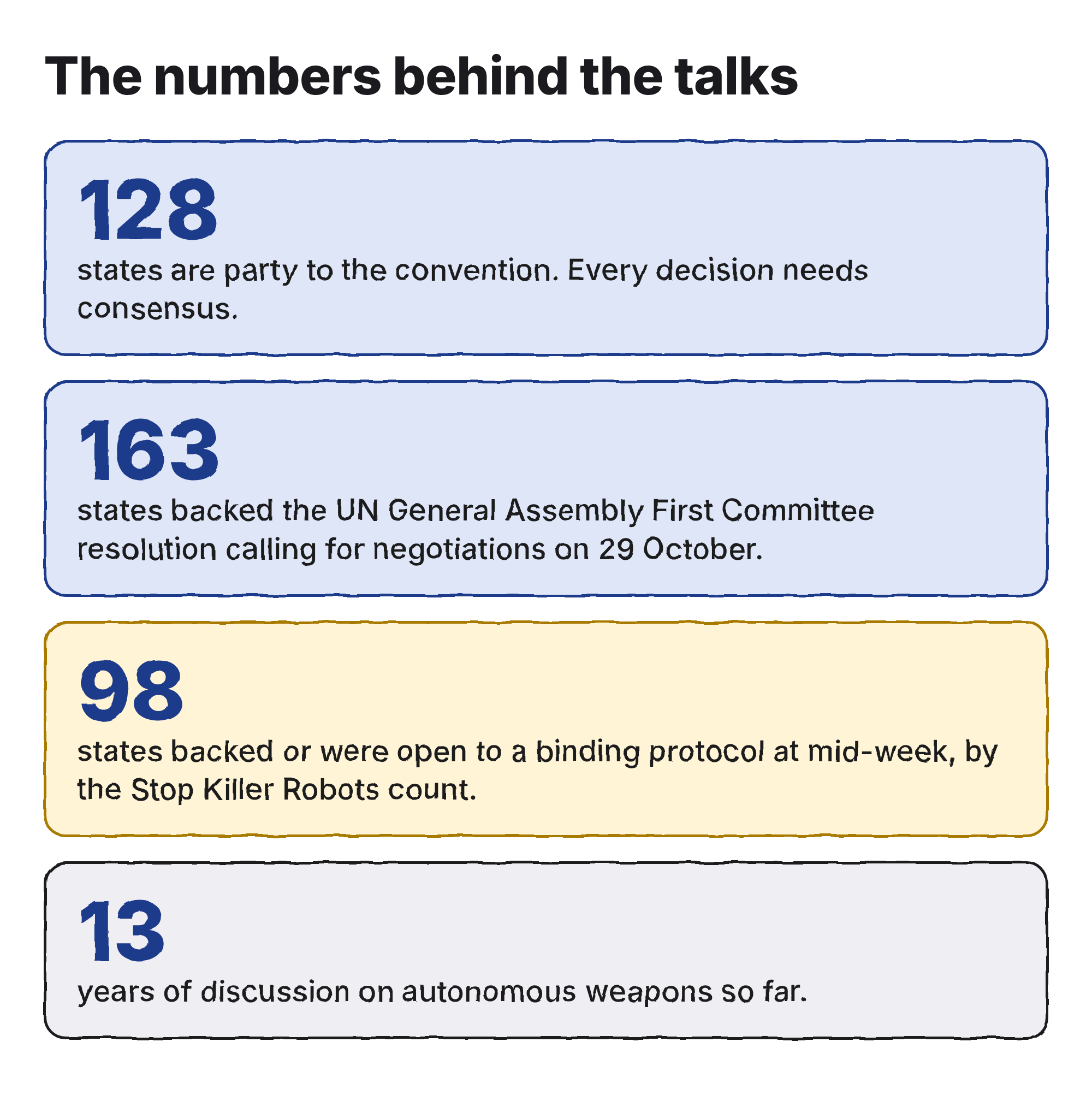
The talks were the Seventh Review Conference of the Convention on Certain Conventional Weapons (CCW), held from 16 to 20 November. The convention has 128 parties and takes decisions by consensus. The conference ran past its scheduled Friday finish, and NPR put the compromise announcement at 4:30am on Saturday.
What states agreed
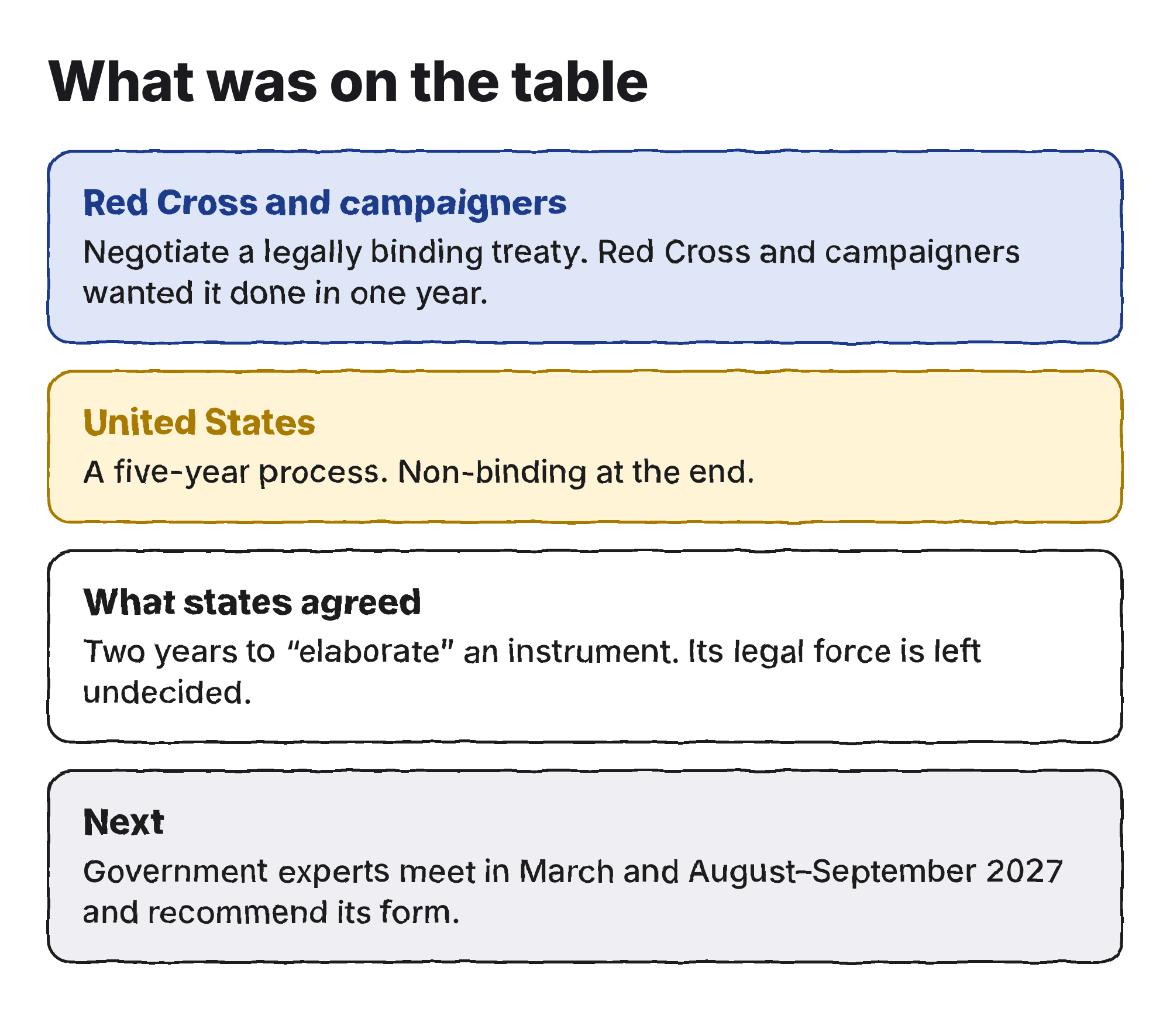
The mandate gives the convention’s Group of Governmental Experts two years to develop an instrument from the elements in its September report, and to recommend its legal nature and form, including whether it becomes a binding protocol. The Science Diplomat lists the group’s meetings as 1 to 5 March and 30 August to 3 September 2027.
Conference president Julien Thöni of Switzerland called it a decision “to launch the elaboration of an international instrument”, and Reuters reporting relayed by Dig.Watch says delegations settled on “elaborate” instead of “negotiate”. UN disarmament chief Izumi Nakamitsu called the result a “significant achievement” and said “the path to or possibility to have a legally binding instrument is still open”, according to Anadolu Agency.
The adopted text isn’t in the UN’s document library yet. The draft final declaration there still shows the autonomous weapons decision as a placeholder, so the wording above comes from the conference president, the UN, the ICRC and wire reports.
What was on the table
A working paper from Austria, Belgium, Brazil, Ireland, New Zealand, Panama and Mexico, dated 18 November, proposed a decision to “negotiate a new Protocol” on lethal autonomous weapon systems. The final mandate says “elaborate”.
According to The Science Diplomat, Peru wanted a two-year process explicitly aimed at a binding protocol. Britain, France and Germany backed negotiations without deciding the legal status in advance. The United States proposed a five-year process leading toward a non-binding agreement, and Russia has also resisted binding restrictions. AFP, via Tech Xplore, reports that the ICRC and campaign groups pushed for a one-year timeline.
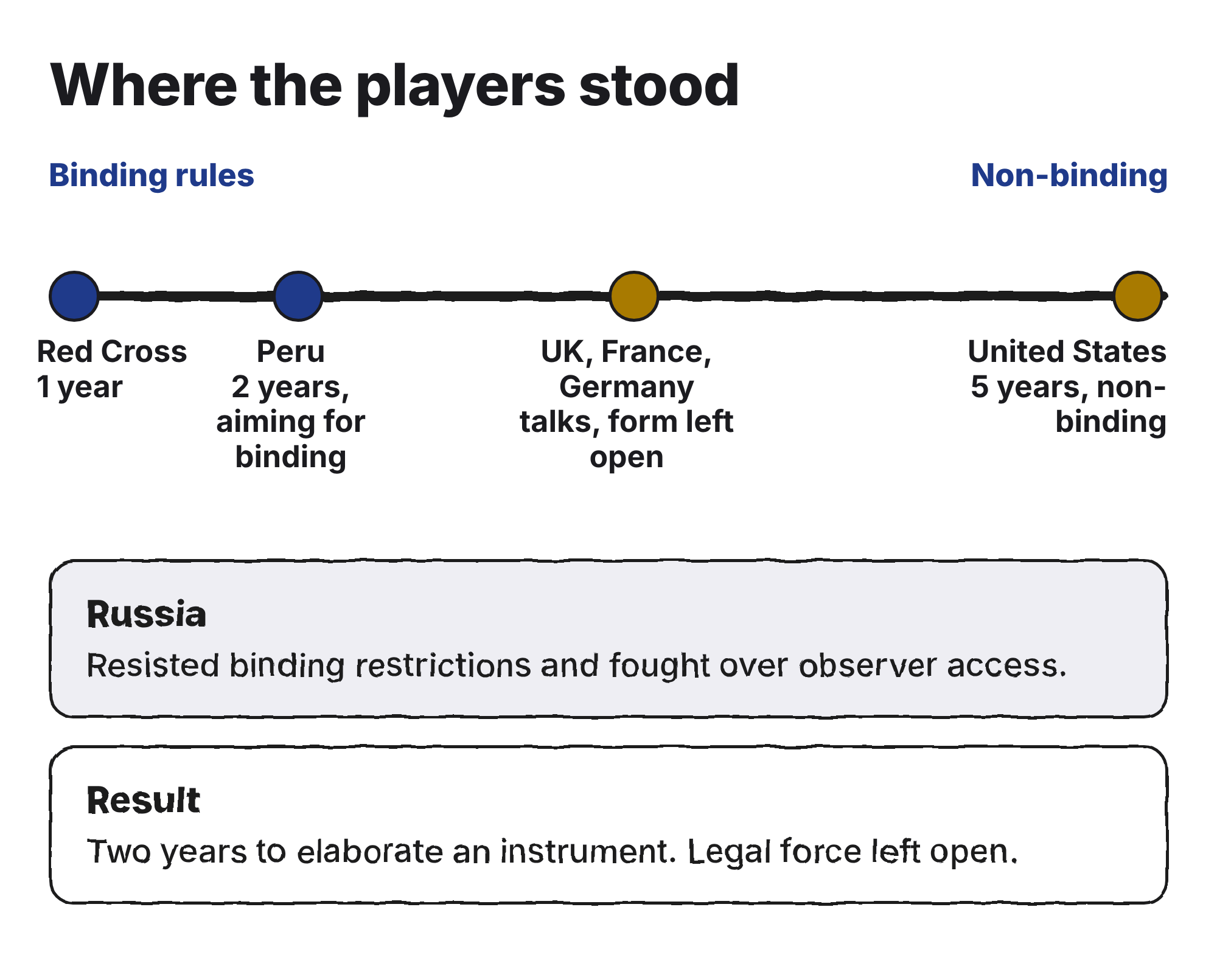
No report credits a single state with the change of wording. German outlet heise, citing dpa, says Russia in particular opposed binding requirements and that the United States, Britain, Israel and Belarus also voiced reservations about a legally binding treaty. Those are press accounts, because Stop Killer Robots says most of the discussion happened behind closed doors.
Why Russia’s observer fight mattered
On the opening day Russia objected to observers, including the European Union and civil society groups, taking part in the debate, which pushed states into an informal format, AFP reports. The Science Diplomat says the dispute stopped agreement on the agenda and rules of procedure, so the conference skipped its five-yearly review of the convention and adopted a narrower final document. Austria cited a 1995 UN legal opinion that the convention’s practice of deciding without votes doesn’t create a binding consensus rule, and Russia rejected that reading.
What the Red Cross says
In its statement on 21 November, the ICRC said the conference “failed to agree to a clear and immediate negotiation mandate for a legally binding instrument”. It added: “While an opportunity has been missed, the imperative to act remains.” It wants a treaty that prohibits unpredictable autonomous weapons and those that target humans directly, and restricts all others.
Once unacceptable systems are widely deployed, the risks to civilians and international security will be far harder to contain.
ICRC statement to the conference, 18 November 2026
Before the conference, the ICRC said the expert group’s work was “a strong and sufficient basis for launching negotiations on a new CCW protocol”. It also pointed to the 163 states that voted on 29 October for a UN General Assembly First Committee resolution calling for negotiations. More than 100 of them are parties to the convention.
Campaigners call it watered down
The Stop Killer Robots coalition said “a small number of states weakened the mandate” in the final hours, introducing “uncertainty about the legal status of the final document”. The coalition counted over 95 states backing a treaty during the week, and 98 as either supportive or open to one at mid-week. Human Rights Watch’s Verity Coyle said: “This mandate introduces uncertainty when clarity is needed.”
Rather than listening to the voices of the majority, the consensus principle of the CCW has led to an empty agreement that will drag out discussions for years with no meaningful solution in sight.
Max Tegmark, Future of Life Institute, 21 November 2026
Tegmark’s statement urged states to “take the issue elsewhere, to an assembly where their voices will be heard”. The 163-state vote came in the General Assembly’s First Committee, which doesn’t operate by consensus.
What happens next
The expert group’s first 2027 session is the next fixed date. Whether its instrument ends up binding is the question the conference left open. Stop Killer Robots says autonomous targeting systems have already been tested or deployed, including in Ukraine.
Sources: ICRC statements of 18 and 21 November 2026; UN document library; Stop Killer Robots; Future of Life Institute; NPR; AFP via Tech Xplore; Anadolu Agency; Dig.Watch; The Science Diplomat; heise.
Discover more from Sulat AI & Tech News
Subscribe to get the latest posts sent to your email.