
Wolters Kluwer Tax & Accounting’s third Future Ready Accountant report says accounting firms are adopting AI quickly and connecting their technology slowly. The company released it on 18 November, and it commissioned the research itself. The survey has 2,602 validated responses from accounting professionals worldwide. Business Insider’s 22 November coverage took the second half of that finding as its headline: most firms lack the infrastructure to make AI work.
What the report found
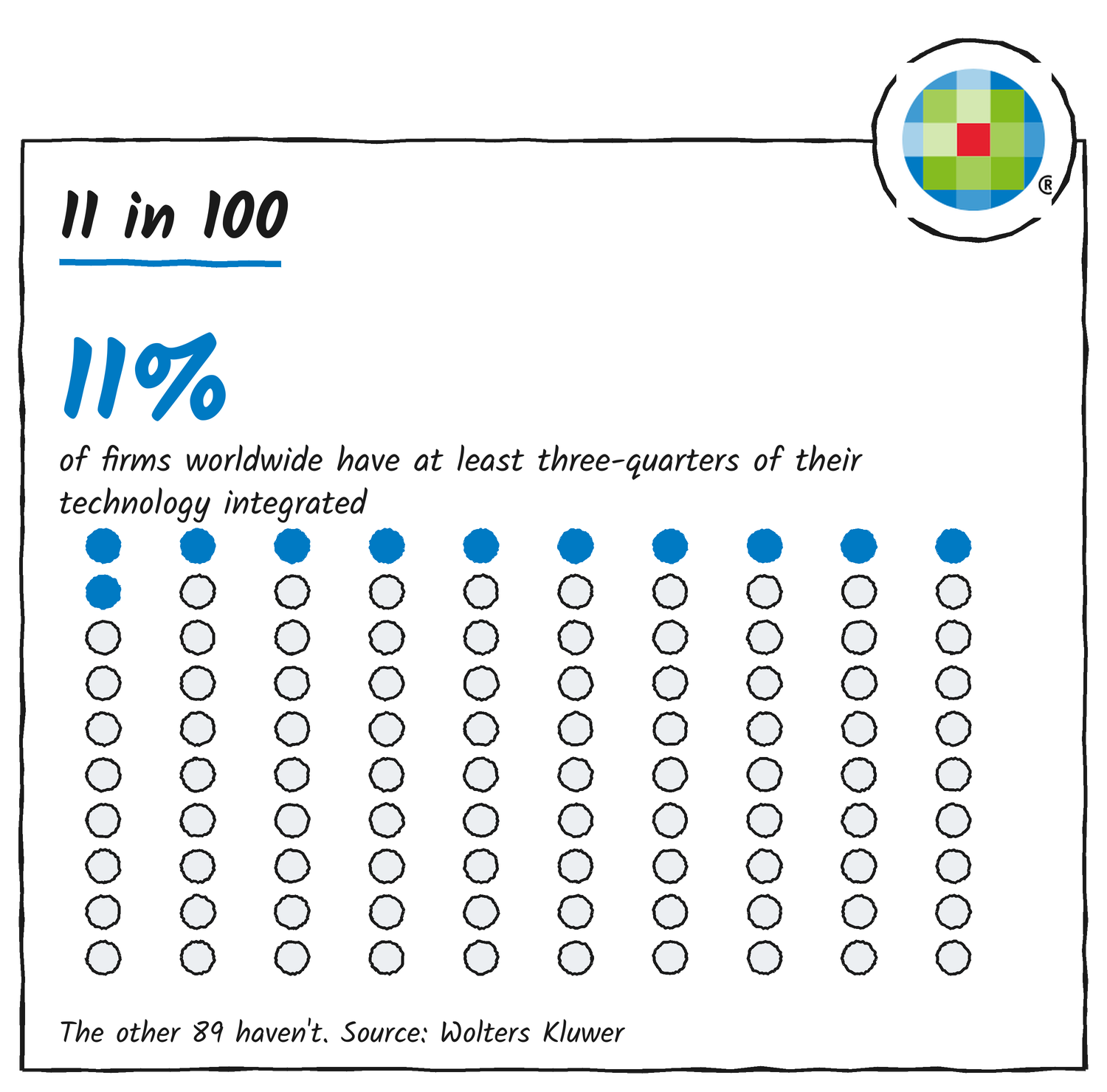
The headline number is narrower than that. Wolters Kluwer says 11% of firms globally report that at least 75% of their technology solutions are integrated.
85%
of firms report increased revenue. 81% report better profitability.
11%
of firms have at least three-quarters of their technology integrated.
36%
of firms have a written, firm-wide AI policy.
AI itself gets good marks. Among firms that expected AI to improve client advisory, 70% say it has beaten expectations there, and just 1% see AI as a threat to their business model. On what comes next, 55% plan to add AI-enabled tools, 52% plan to improve technology integration and 51% plan more workflow automation.
Governance trails adoption
Another 44% of firms give general AI guidance without a formal policy. Among firms with a policy or guidance, 57% require professional review of every AI-generated technical output. The policy isn’t equally visible inside a firm: 40% of owners and directors report a written policy, against 30% of staff. Firms with formal AI governance are also more upbeat, with 95% optimistic about the profession’s future against 77% of firms with none.
Governance cannot stop at a policy document; it has to reach the people doing the work.
Jason Marx, CEO, Wolters Kluwer Tax & Accounting
Where the infrastructure headline comes from
That framing comes from the US edition, and Business Insider is the only outlet I found that reports its numbers. It says the US sample was 746 accounting professionals surveyed between June and July 2026, and that 83% of US firms call themselves technology innovators or early adopters. It also reports that 88% use generative AI and 68% use agentic AI for daily work.
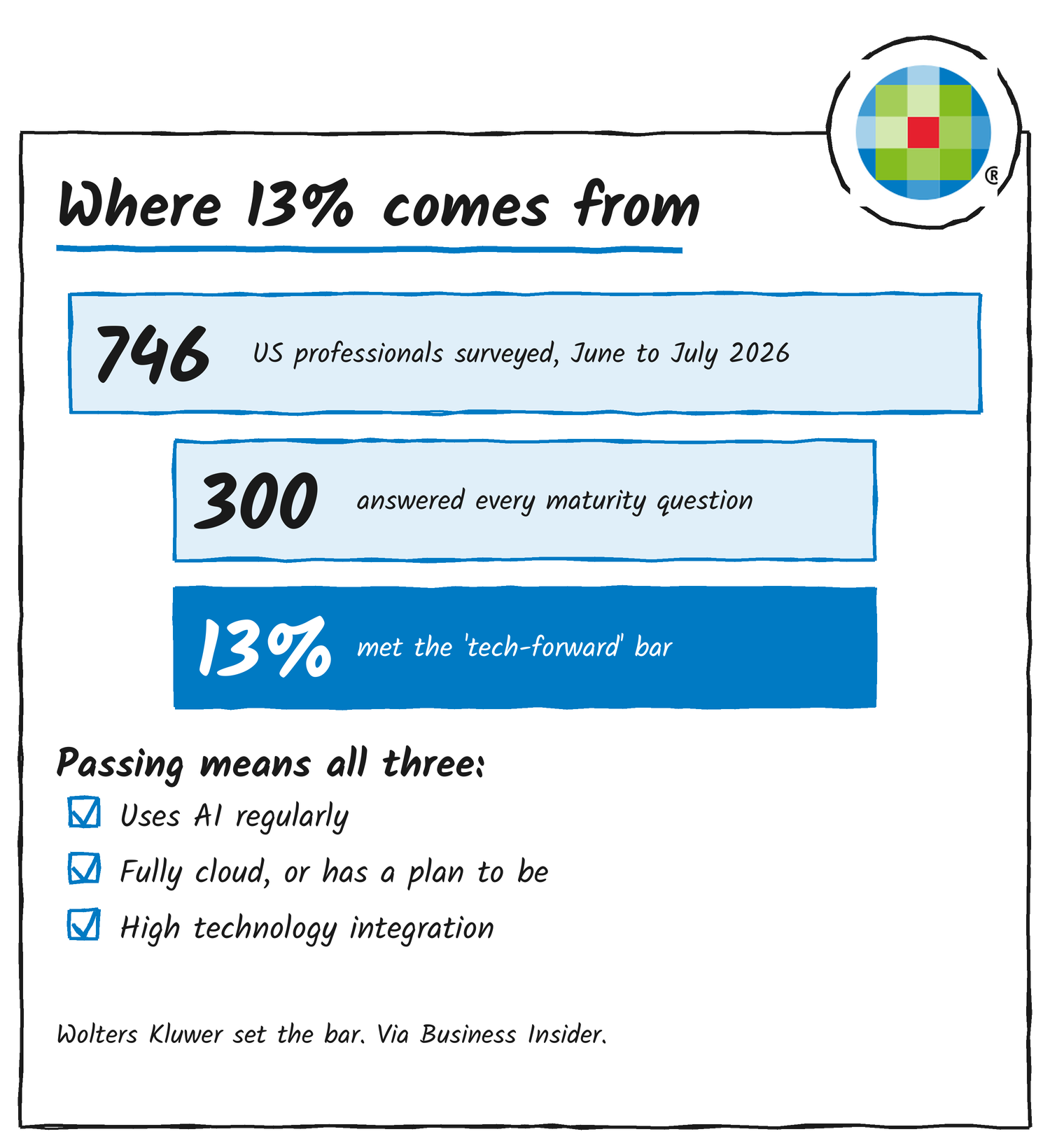
The 13% figure is built differently. Only 300 of the 746 respondents answered every digital-maturity question, and 13% of those met what Wolters Kluwer calls a tech-forward threshold. To pass, a firm has to use AI regularly, be fully cloud-based or have a defined plan to get there, and meet a high technology-integration threshold. Business Insider notes that the 83% and the 13% aren’t directly comparable. A Wolters Kluwer spokesperson told it the gap is about the distinction between adopting technology and integrating it across the business.
So the US finding is a share of 300 respondents measured against a bar the vendor wrote. The global 11% is a different measure: the respondents’ own account of how much of their technology is integrated. Both point the same way. Neither counts firms whose systems fail to support AI.
The regional releases show the same split
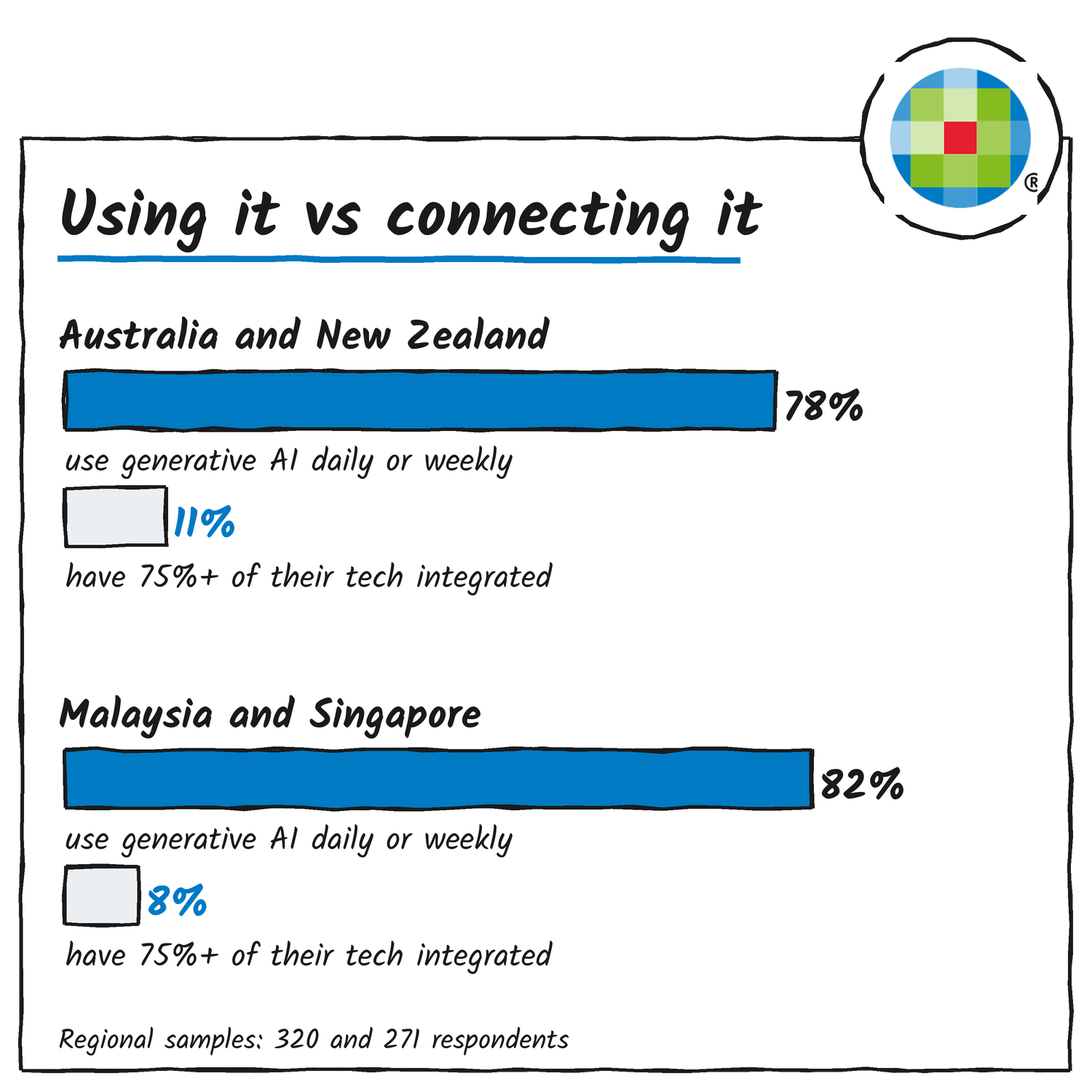
In Australia and New Zealand, counted together as 320 respondents, 78% use generative AI daily or weekly, 68% use AI built into their tax, audit and accounting software, and 64% use agentic AI. Only 11% have integrated at least three-quarters of their technology. In Malaysia and Singapore, counted together as 271 respondents, 82% use generative AI daily or weekly and 8% have integrated that much. Wolters Kluwer says the combined figures shouldn’t be described as single-country findings, and New Zealand isn’t broken out.
Who ran the survey
Wolters Kluwer sells tax, audit and accounting software, including CCH Axcess and CCH iFirm. On 26 October it announced expanded agentic tax and audit capabilities in CCH Axcess, and on 5 November it launched agentic tax preparation in CCH iFirm Taxprep for Canadian firms. Both came in the three weeks before the report. The report’s conclusion is that firms should connect AI to how the whole firm works, and its regional releases describe the research as commissioned by Wolters Kluwer.
What the report doesn’t disclose
The public pages leave out several basics. They don’t give fieldwork dates for the global sample, the research firm, the list of countries, a margin of error, or the sample sizes for Canada and Europe. The 2025 edition was more specific, naming 2,768 professionals across 14 countries surveyed in the second quarter of 2025. The full 2027 PDF sits behind a registration form, so the figures here come from Wolters Kluwer’s public pages, its regional releases and Business Insider’s reading of the US edition.
Discover more from Sulat AI & Tech News
Subscribe to get the latest posts sent to your email.