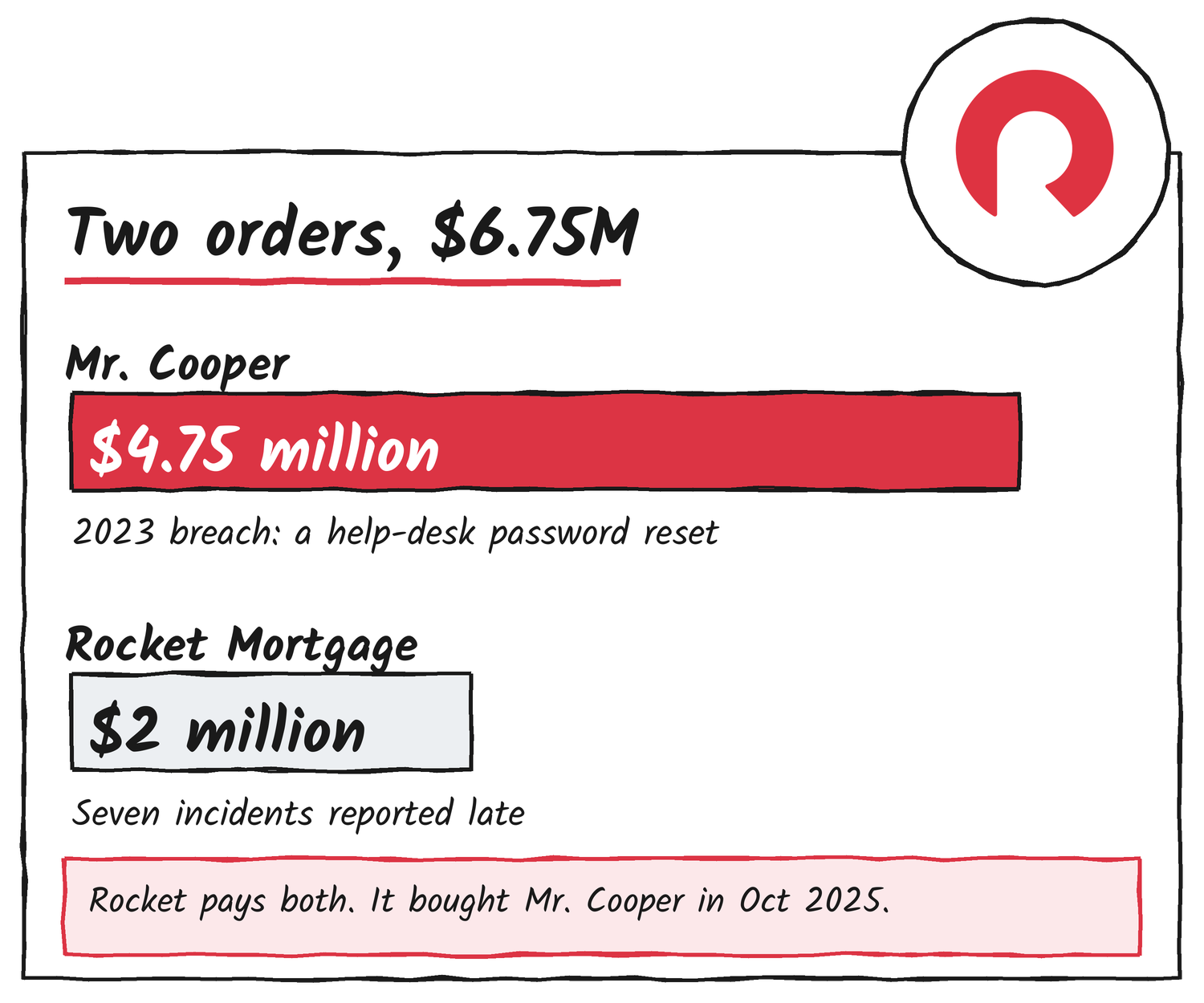
New York’s Department of Financial Services (DFS) said on 19 November, US time, that Rocket Mortgage will pay US$6.75 million across two consent orders for breaking the state’s cybersecurity regulation, 23 NYCRR Part 500. US$2 million covers Rocket Mortgage’s own failures. The other US$4.75 million covers the 2023 breach at Mr. Cooper, the servicer Rocket bought on 1 October 2025.
New York’s cybersecurity regulation requires covered entities to maintain strong safeguards to protect consumer data, understand evolving risks, and report cybersecurity incidents to regulators.
Kaitlin Asrow, DFS Acting Superintendent
The Mr. Cooper order is signed by Rocket Mortgage as successor to Nationstar Mortgage LLC, the company that traded as Mr. Cooper. Nationstar merged into Rocket Mortgage on 2 February 2026 and surrendered its New York licences two days later. DFS’s findings in that order describe conduct from before the merger.
Rocket Mortgage: seven incidents, none reported within 72 hours
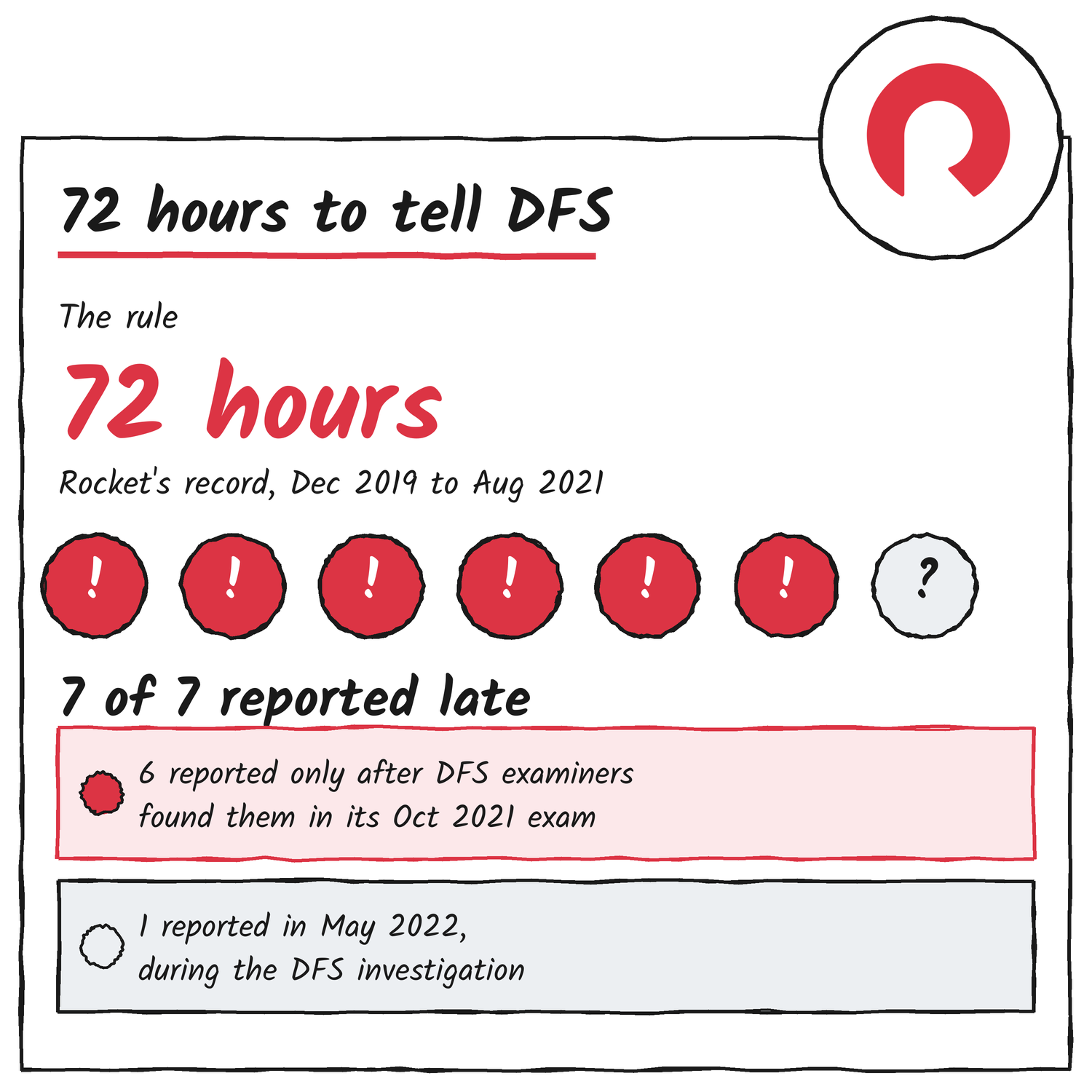
Part 500 gives regulated firms 72 hours to tell DFS after they determine a cybersecurity incident has happened. DFS’s order says Rocket Mortgage had seven incidents between December 2019 and August 2021 and met that deadline for none of them. Each was a business email compromise, where an outside attacker talks employees into handing over their email login details.
DFS examiners began an examination of Rocket Mortgage on 4 October 2021 and asked whether every required notice had been filed. Rocket reported six of the seven for the first time on 26 October 2021, some of them nearly 18 months after they happened. The seventh, which Rocket discovered on 18 December 2019, reached DFS on 23 May 2022, while Rocket was answering the department’s enforcement requests.
The order also explains how the attackers got in. In three incidents they already held employees’ passwords, triggered a push-based multi-factor authentication prompt (MFA, a second check beyond the password) and the employees approved it. In three others they got into email accounts without any MFA at all, because Rocket’s move to Microsoft Office 365, finished in August 2019, left a gap. The order says Rocket Mortgage had no compensating controls during that gap.
DFS also found that Rocket had no written procedures for the periodic, secure disposal of customers’ nonpublic information until December 2020.
Mr. Cooper: a phone call to the Help Desk
Mr. Cooper told DFS on 2 November 2023 that an ongoing incident was disrupting its business. The order dates the start to 30 October 2023, when an attacker rang Mr. Cooper’s IT Help Desk several times, posed as an IT employee and asked for a password reset. A Help Desk worker went ahead after the caller gave that employee’s name and the last four digits of their Social Security number, which Mr. Cooper’s written procedures accepted as proof of identity at the time. The worker then read out a temporary password.
With that password and the employee’s username, a publicly available email address, the attacker logged in to Zscaler, the cloud service Mr. Cooper used to manage remote access. That put the attacker’s traffic on Zscaler IP addresses that Mr. Cooper’s access rules treated as trusted. From there the attacker opened LogMeIn, a remote desktop tool IT staff used to service other employees’ machines, and the impersonated employee’s account had administrator rights on it. Because the address counted as trusted, LogMeIn never asked for MFA.
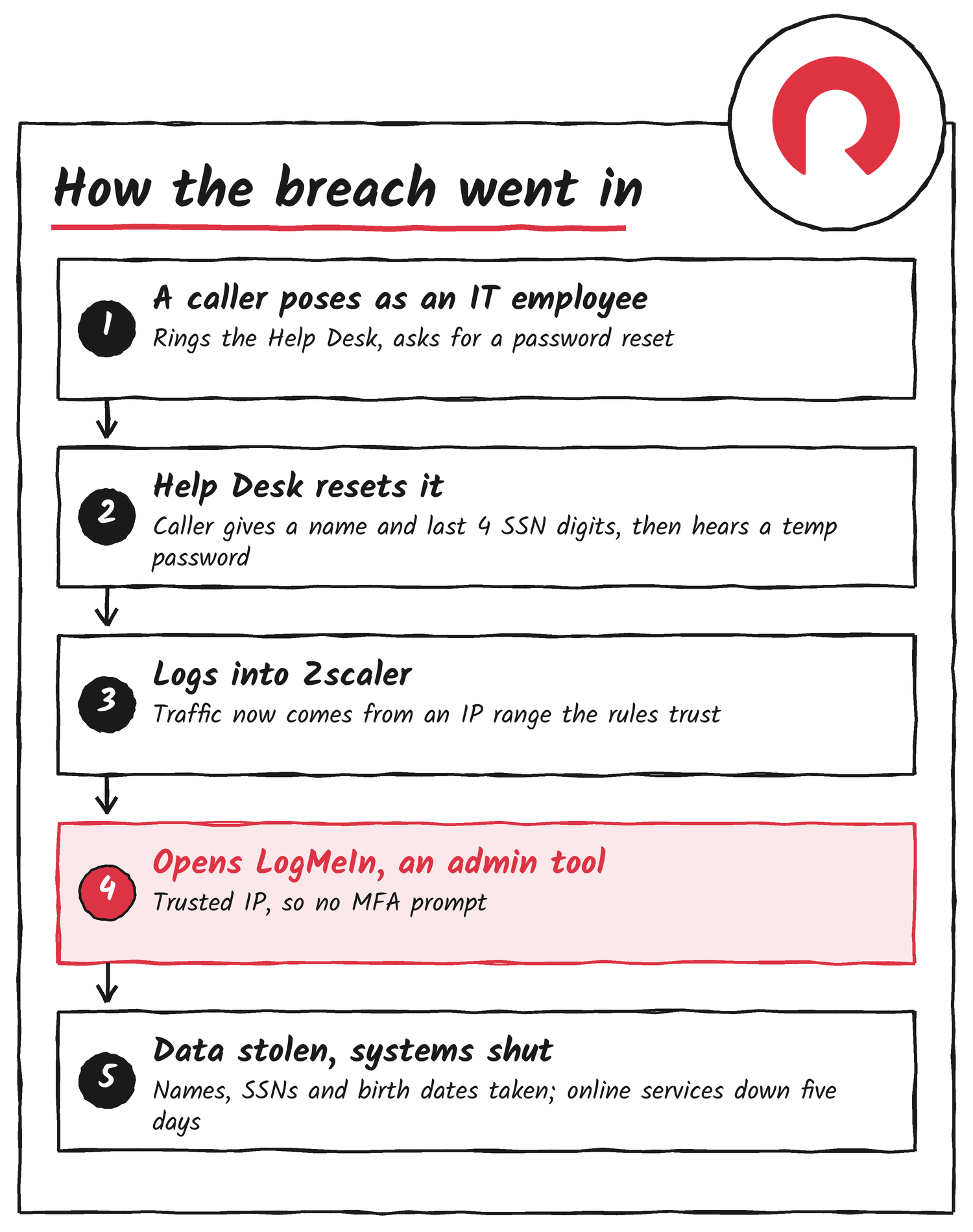
Once inside, the attacker used social engineering and other methods to reach the network and took personal data on substantially all of Mr. Cooper’s current and former customers. The attacker then deployed ransomware, the order says. Mr. Cooper shut down its systems, removed the attacker on 2 November and restored full access on 4 November. DFS says online operations were disrupted for five days and that millions of people’s Social Security numbers and birth dates were exposed, including those of hundreds of thousands of New Yorkers. Mr. Cooper told Maine’s attorney general in December 2023 that 14,690,284 people were affected.
DFS found a second failing at Mr. Cooper. The company completed a cybersecurity risk assessment in 2021, began the next in 2023 and didn’t finish it until 2025. Mr. Cooper attributes the delay to the 2023 incident. The order says a gap of four years between finished assessments isn’t frequent enough for a company of Mr. Cooper’s size.
The order records that Mr. Cooper told all affected people, cooperated with the investigation and worked with law enforcement, and DFS acknowledges that cooperation.
What the orders require
| Order | Penalty | Rules DFS cited | Main requirements |
|---|---|---|---|
| Rocket Mortgage | US$2 million | 500.12 (MFA), 500.13 (data disposal), 500.17 (72-hour reporting) | MFA audit within 90 days; written incident response policy |
| Mr. Cooper, with Rocket as successor | US$4.75 million | 500.2 (security programme), 500.3(d) (policy), 500.9 (risk assessment), 500.12 (MFA) | MFA audit within 90 days |
Both penalties are due by wire within 10 days of the order taking effect. Rocket can’t claim a tax deduction or credit for either payment, and can’t seek reimbursement or indemnification, including through insurance.
Each order also requires an audit of MFA controls within 90 days. The audit covers Rocket’s integrated infrastructure and shared systems such as Office 365, including every MFA exception and the chief information security officer’s written approval of it. Rocket must send the audit report to DFS and fix any material problems on a timeline DFS agrees. The Rocket Mortgage order adds a requirement to keep a written incident response policy that covers reporting to DFS. DFS signed both orders on 19 November, which puts the audit deadline at 17 February 2027.
What Rocket says
Rocket told HousingWire that one order concerns a 2023 incident at Mr. Cooper, two years before Rocket’s acquisition, and the other concerns gaps that a 2021 on-site examination found in Rocket Mortgage’s processes for MFA, secure data disposal and incident notification. A Rocket spokesperson also told HousingWire the company has strengthened its information security programme, adopted a formal data disposal policy and added monitoring, staff training and testing.
Rocket’s audit report goes to DFS, and neither order says it will be published.
Discover more from Sulat AI & Tech News
Subscribe to get the latest posts sent to your email.