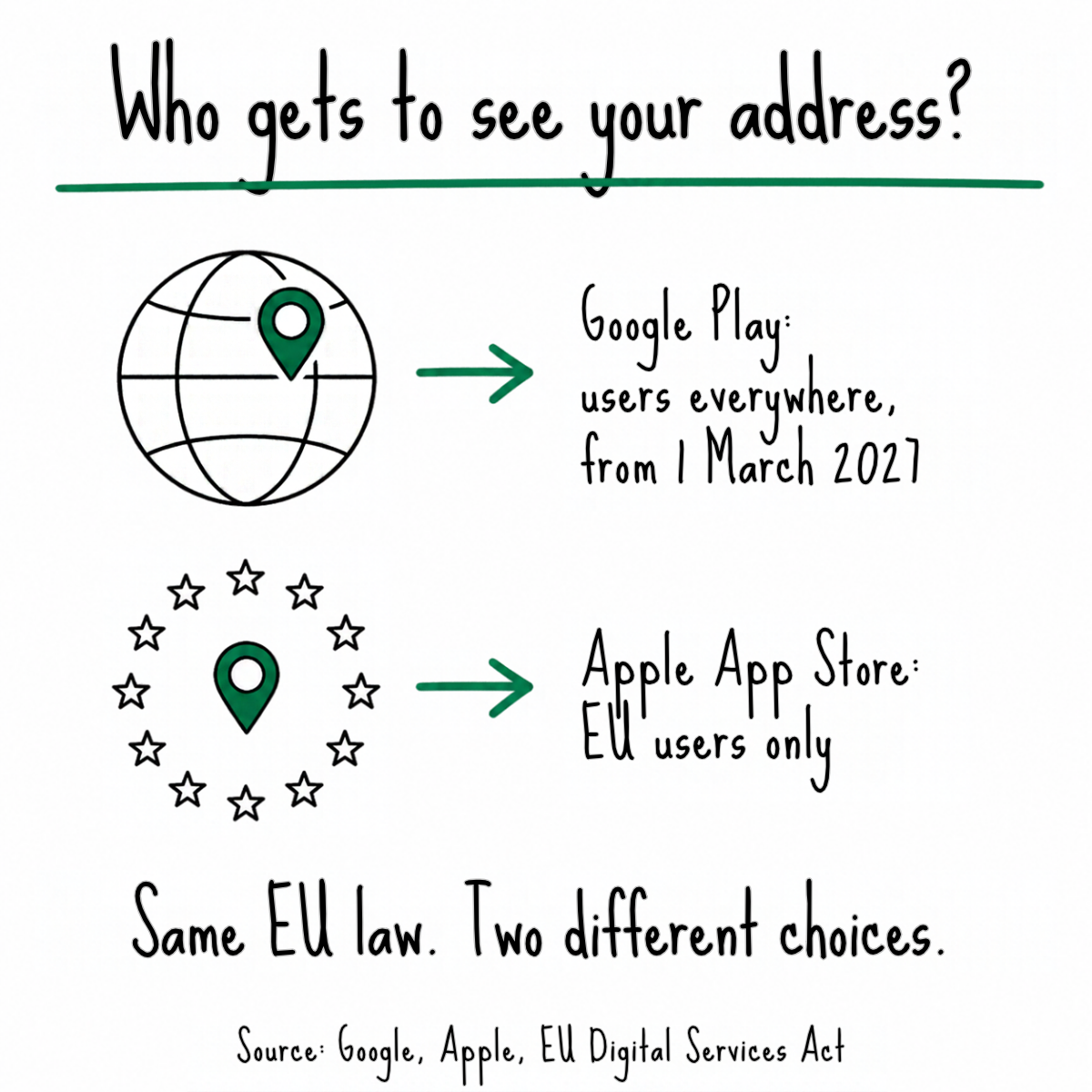
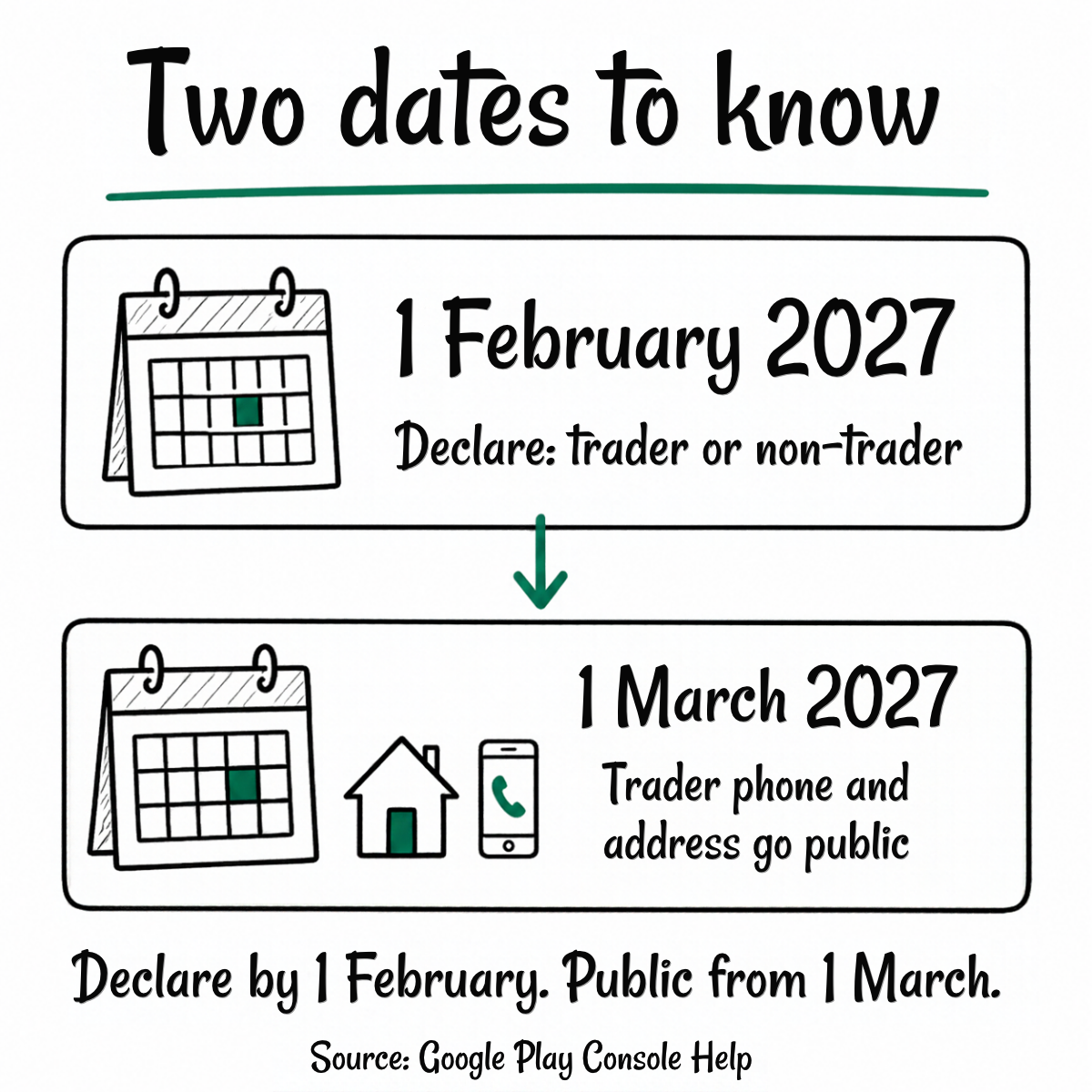
Google Play will put the phone number and address of solo developers who declare as traders on public store listings, and the display isn’t limited to Europe. Google’s trader status declaration page says every active developer account must declare by 1 February 2027. A personal account that declares as a trader must give a phone number, and Google warns that “your address will also be publicly displayed.” The Verge reports the display starts on 1 March 2027, and The Elec reports it reaches users worldwide.
The Digital Services Act is the EU law behind the change. Digital Trends says it doesn’t require disclosure outside Europe. The text of the law bears that out, and it doesn’t forbid it either.
Who counts as a trader on Google Play
Google defines a trader as “any natural or legal person acting for purposes relating to their trade, business, craft or profession.” Its list of signs comes from European Commission guidance: paid apps, in-app purchases or ad-sponsored apps earning on a regular or commercial basis, a high or steady volume of transactions, running app development as a business, and a legal status such as a D-U-N-S number. A personal hobby is unlikely to count.
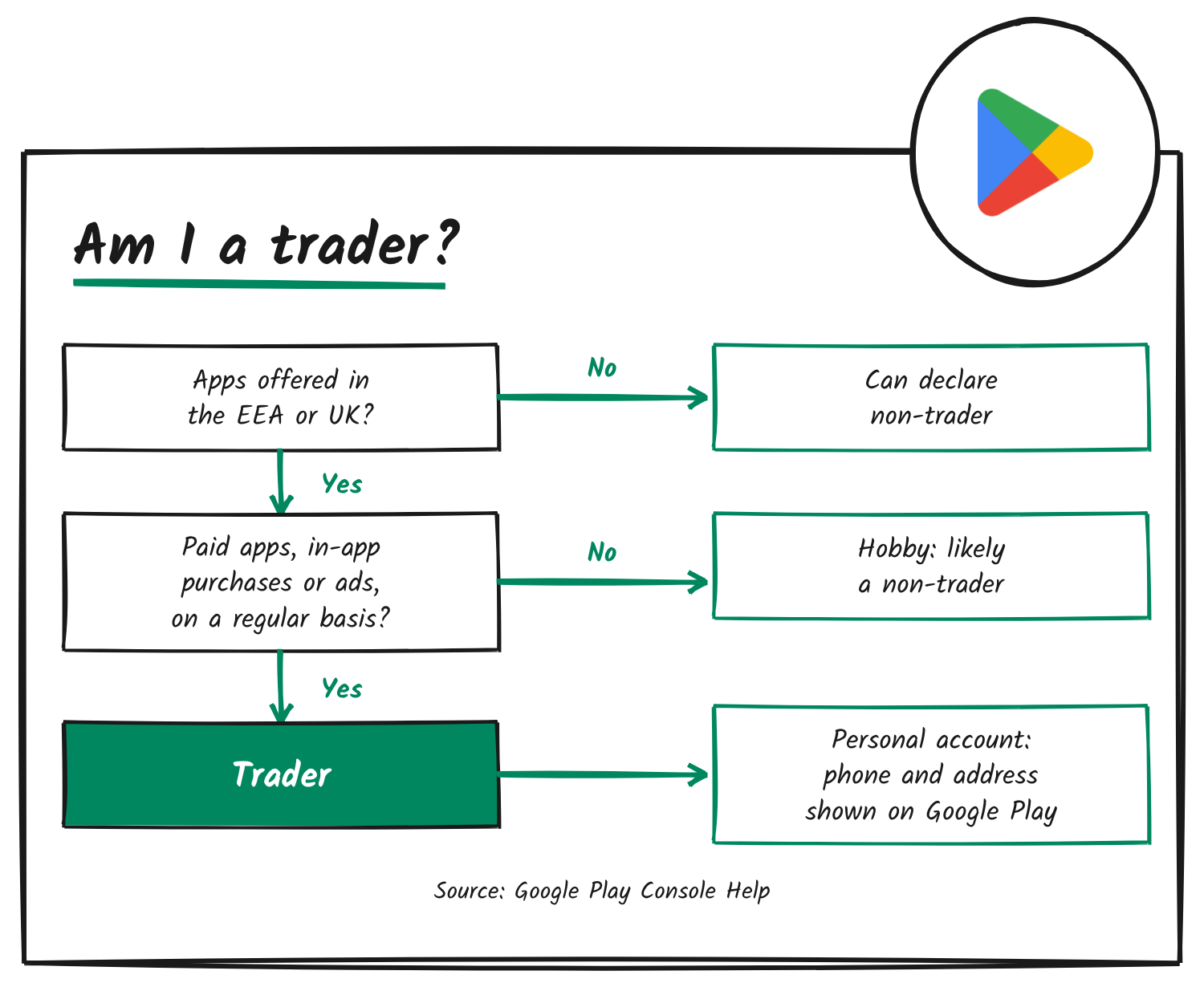
A developer who doesn’t distribute apps in the EEA or UK can declare as a non-trader. That label has a cost: Google tells consumers in those regions that consumer rights don’t apply to contracts with that developer. Google also says falsely claiming to be a non-trader is prohibited under EU and UK law and may lead to removal worldwide.
Traders self-certify that they only offer products or services that comply with applicable laws, and they give a terms of service link for each app. A developer who declared as a non-trader but looks like a trader can be asked to confirm or update the status, and apps may be removed if the developer doesn’t respond in time.
| Date | What happens | Source |
|---|---|---|
| 1 February 2027 | Every active account has declared trader or non-trader, wherever its apps are distributed | Google Play Console Help |
| 1 March 2027 | Trader contact details, including a personal account’s phone and address, go public | The Verge, The Elec |
| 1 March 2027 | Google Play moves to an online marketplace model in the EEA and UK | The Elec |
What’s new, and what isn’t
Google’s account rules already show some of this. Its account information page says a personal account’s legal name, country and developer email appear on Google Play, and that if you monetise on Google Play, Google shows your full address. Organisation accounts already show a legal name, D-U-N-S number, legal address, email and phone number. For developers who charge on Play, the address isn’t new. The trader rule adds a public phone number for personal accounts and a test that names ad-supported apps.
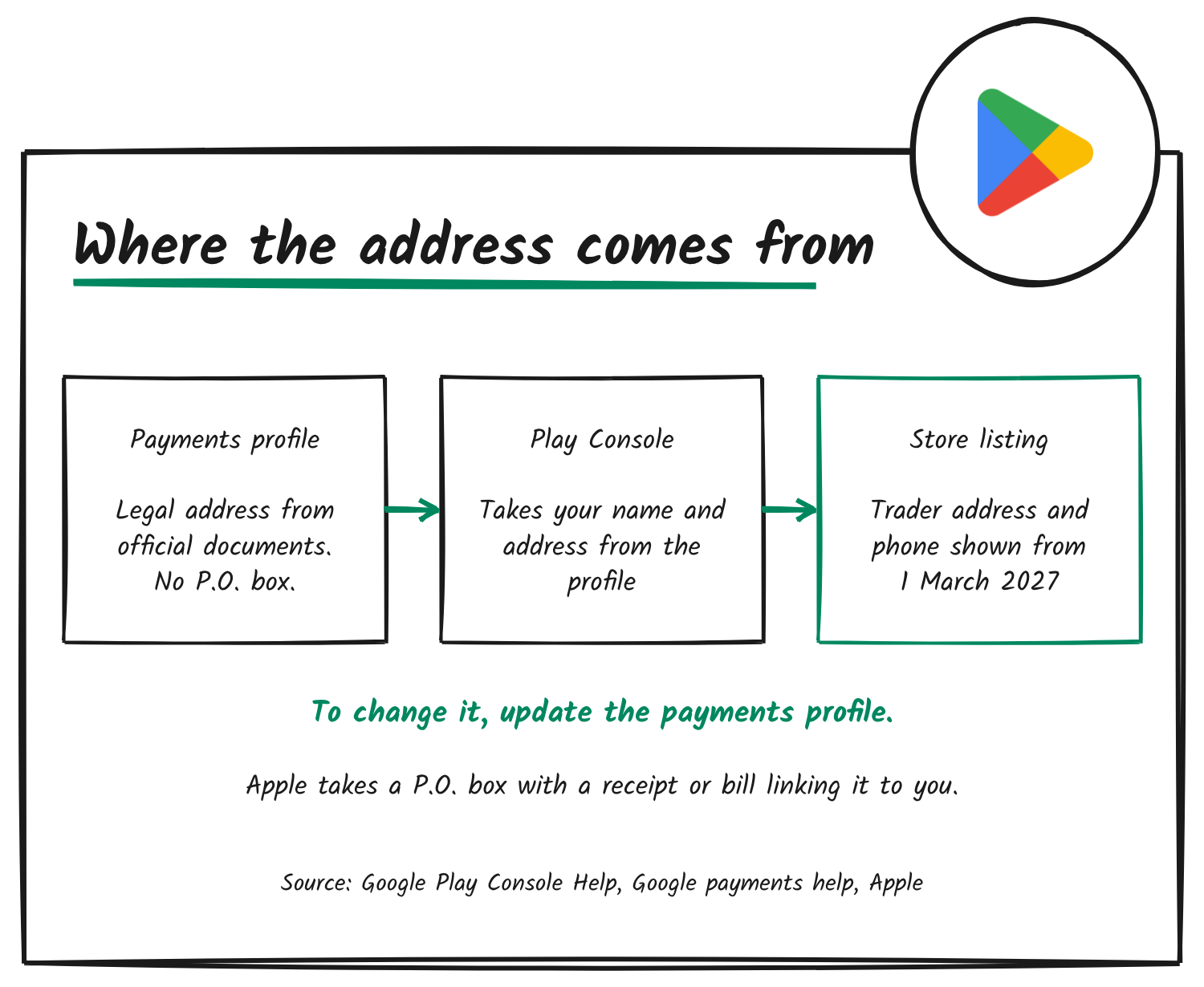
The address comes from the Google payments profile linked to the account. Google’s payments help asks for a legal business address “as it appears on official documents” and says it doesn’t allow a P.O. box. The Verge reads that as leaving many developers without an office with no choice but to share a home address. Changing the address means updating the payments profile, Google says.
What the EU law says
Article 30 of the Digital Services Act covers online platforms where consumers sign contracts with traders. Before a trader can offer anything to consumers in the Union, the platform must collect the trader’s name, address, phone number and email, an ID document, payment details, any trade register entry and a self-certification. Article 30(7) then tells the platform to make the name, address, phone and email, the register details and the self-certification available to “the recipients of the service”, on the page where the product is presented.
Nothing in the article says where those recipients must be. The law’s reach is set by which traders it covers, those offering to consumers in the Union, and not by where the reader sits. That backs Digital Trends: the law doesn’t ask for worldwide display. It doesn’t ban it either, and Google and Apple have read it differently. This check covers the EU text only; Google also cites the UK’s Digital Markets, Competition and Consumers Act.
How Apple and other marketplaces handle it
| Store | Who sees it | What an individual provides | P.O. box |
|---|---|---|---|
| Apple App Store | Product pages in any of the 27 EU territories | Address or P.O. box, phone, email | Allowed with a receipt or bill linking it to you |
| Google Play | Users everywhere from 1 March 2027, per The Verge and The Elec | Legal address from the payments profile, plus phone | Not accepted for the payments profile |
| Chrome Web Store | Bottom of the extension listing; Google names no region | Name, address and an SMS-capable phone number | Not stated |
| Adobe add-on and plugin marketplaces | Listings made available to EU users | Mailing address, phone, email | Not stated |
Apple’s help page says Articles 30 and 31 require it to verify and display trader contact details for apps distributed in the EU, and it asks every developer for a trader status, including those who don’t distribute there. Individuals can enter an address or a P.O. box, and a P.O. box needs a receipt or bill that links it to them. Google’s own Chrome Web Store FAQ asks traders for a phone number and an address, posts them publicly at the bottom of the extension listing, and tells developers to use an address they’re comfortable sharing publicly.
What developers can do
This is what Google’s pages and the reports say, not legal advice.
- If your apps are a hobby, or you don’t distribute in the EEA or UK, Google says you can declare as a non-trader.
- If you’re a trader on a personal account, expect your phone number and address on the listing. Google’s pages don’t say whether a business address can stand in for a home address.
- An organisation account shows the legal address held in its D-U-N-S record, which Google says must match its payments profile.
- One Australian developer wrote on Google’s support forum, as Android Authority quotes, that their only privacy-safe option is to withdraw their app from 31 countries and declare as a non-trader.
- Declaring as a non-trader to dodge the display is risky: Google says a false declaration can lead to removal.
Existing accounts have until 1 February 2027 to declare. The Elec reports Google brought in the policy to move Play to an online marketplace model in the EEA and UK on 1 March 2027.
Discover more from Sulat AI & Tech News
Subscribe to get the latest posts sent to your email.