Apple has removed Talkie, the AI companion app owned by MiniMax, from every App Store. The removal followed a joint investigation by the Bureau of Investigative Journalism (TBIJ) and ABC News that alleges Talkie’s AI characters belittled and sexualised child users. Apple has said the app contained sexual content. It hasn’t said whether that content reached minors, and MiniMax hasn’t answered either newsroom’s questions. I read both investigations, the South China Morning Post’s report and MiniMax’s own filings as reported by others, and I’ve kept what is alleged apart from what is confirmed.
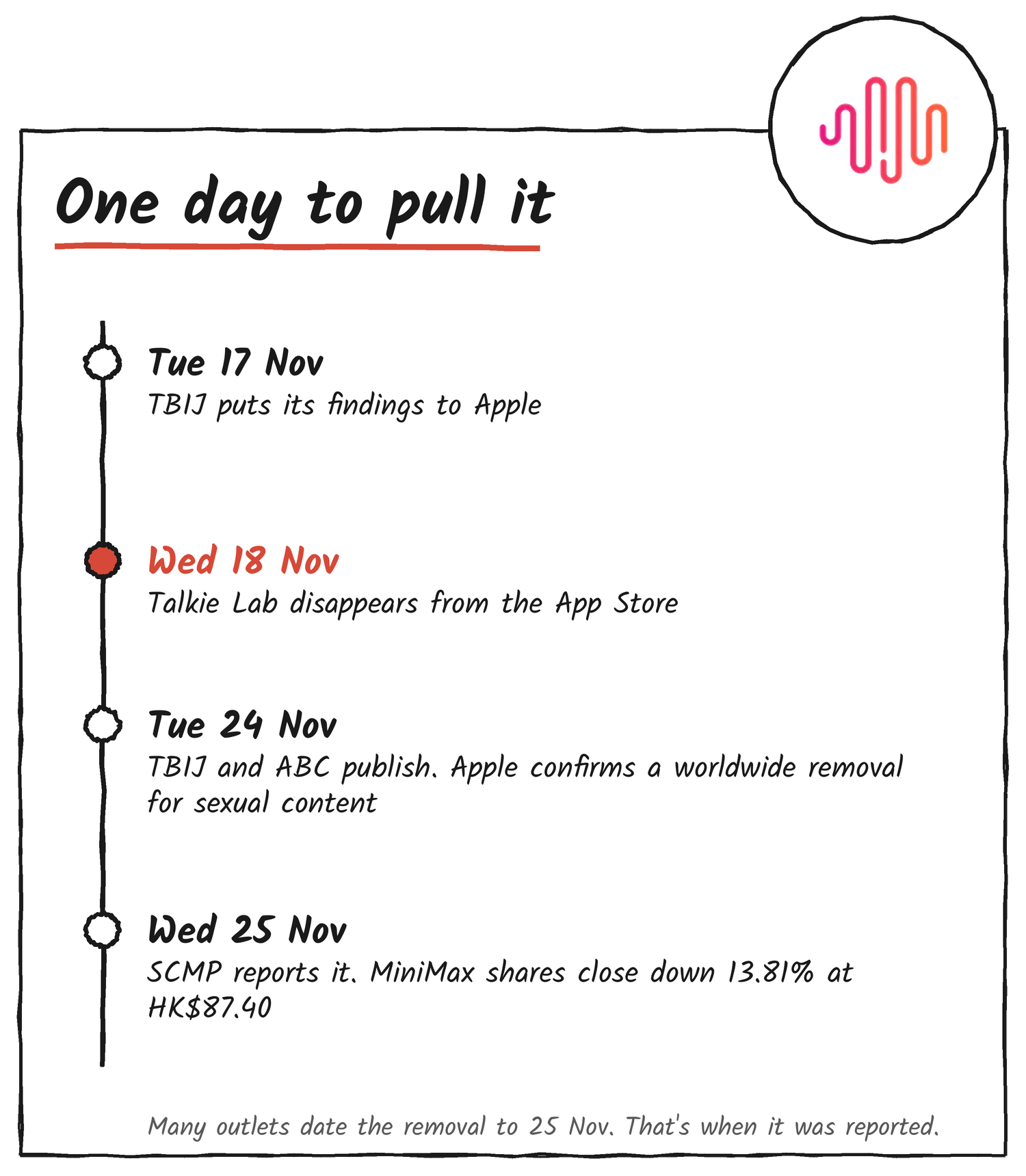
The sequence matters, because many outlets date the removal to 25 November. TBIJ says it put its evidence to Apple on Tuesday 17 November, and the app vanished the next day. TBIJ and ABC published on 24 November, and the SCMP’s report, the one most outlets cite, came a day later.
50M+
downloads on Google Play, where Talkie was still listed when TBIJ and SCMP reported
~11M
monthly users across Talkie’s web and app in October, per Unique Research via SCMP
~50,000
Australian children aged 10 to 17 who told the eSafety Commissioner’s survey they used it, per ABC
64%
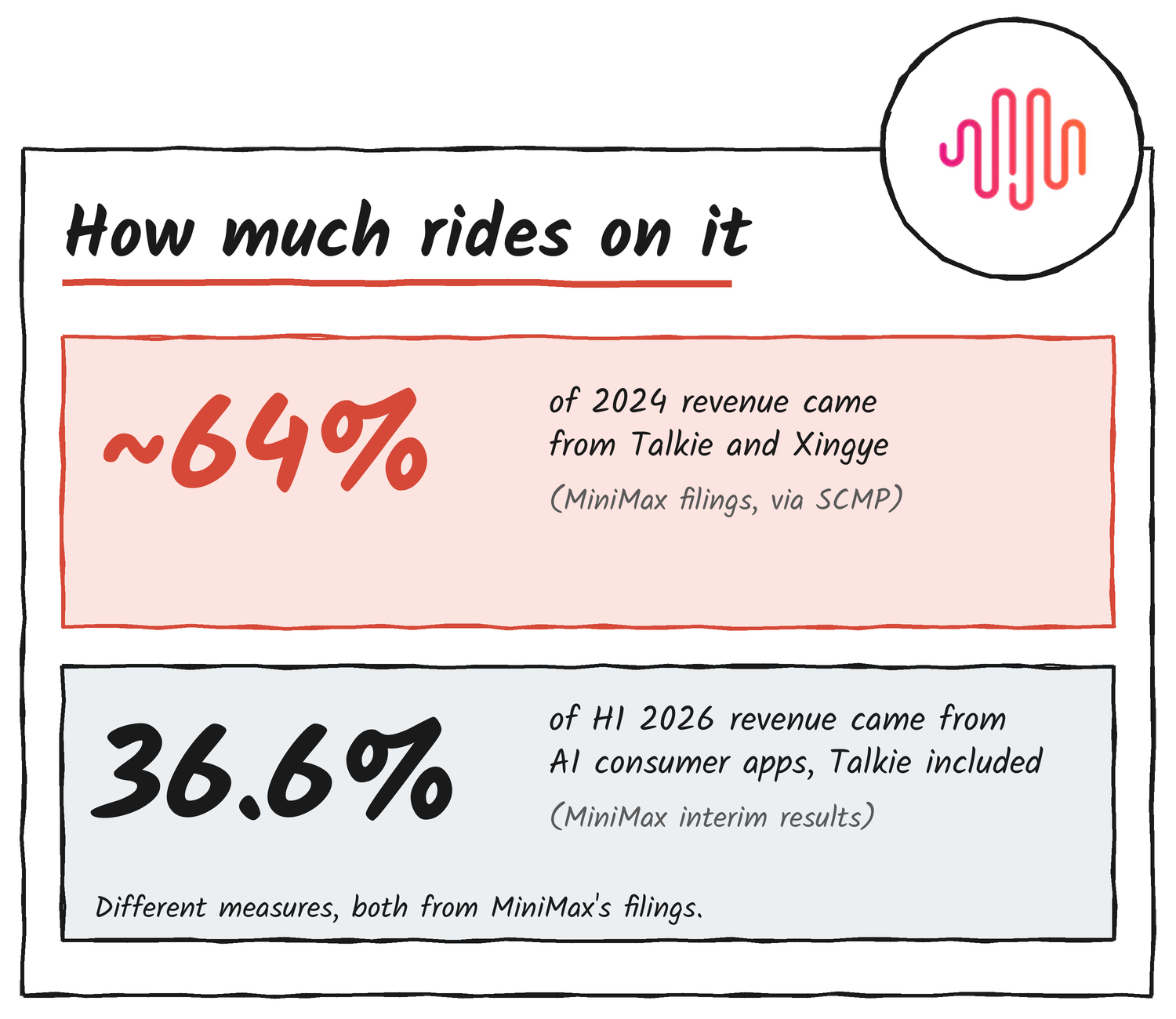
of MiniMax’s 2024 revenue came from Talkie and its Chinese version Xingye
- What Apple did, and when
- What the investigation alleges
- The 18+ rating and the children who used it anyway
- What rides on Talkie for MiniMax
- The data and training questions
- Apple has done this before
- Rules, peers and other stores
- What isn’t known
What Apple did, and when
The app was listed on the App Store as Talkie Lab, sold by MiniMax’s Singapore subsidiary Subsup. TBIJ writes that it approached Apple on Tuesday 17 November “with evidence of Talkie’s characters subjecting children to degrading language, possessive behaviour and romantic roleplay”. The following day, reports emerged that Talkie Lab had disappeared. Apple later said the reason was the app’s sexual content, and has confirmed the removal is worldwide.
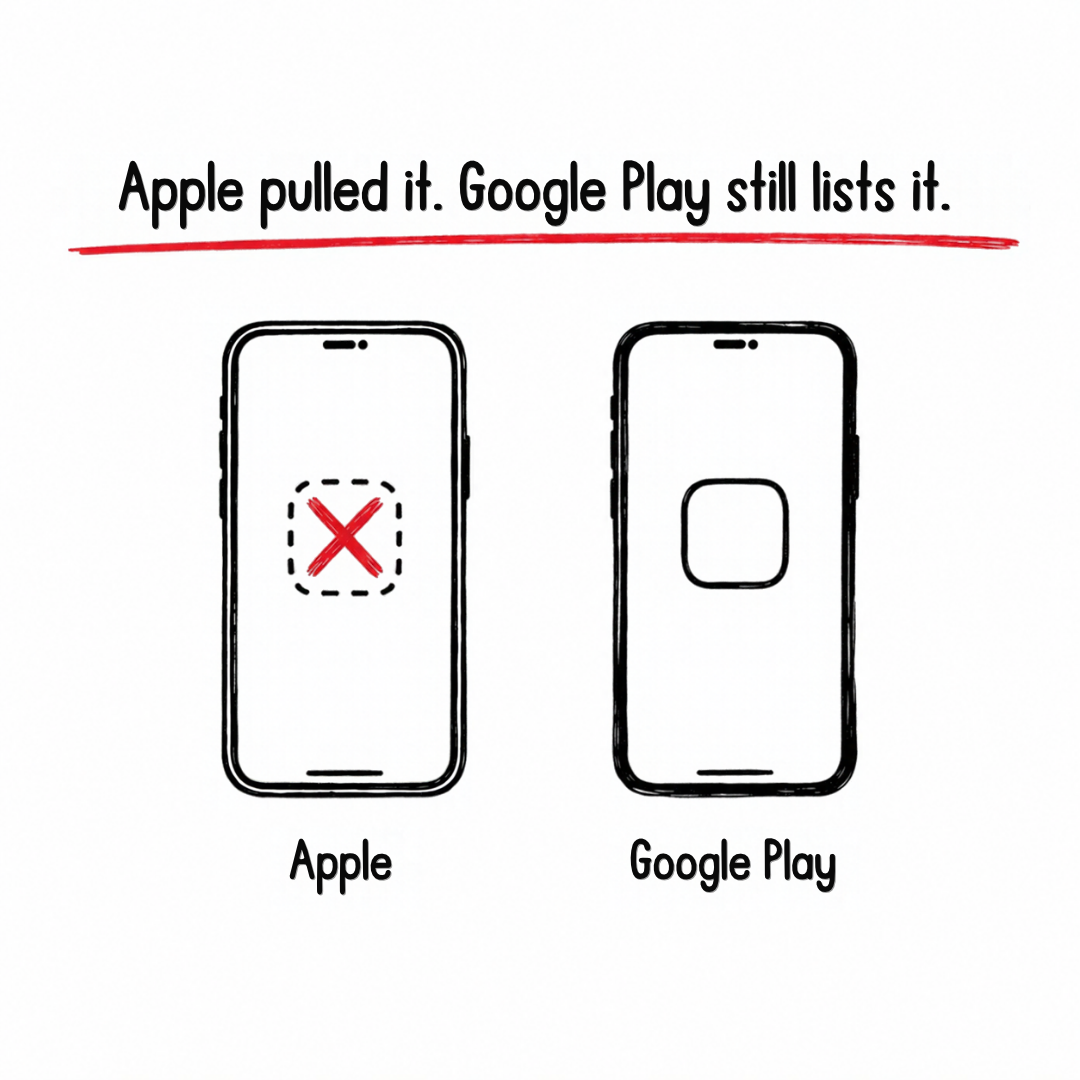
The SCMP, which reported Apple’s statement on 25 November, noted that Apple did not say whether the sexual content in question had been served to minors. MiniMax declined to comment to the SCMP, and didn’t respond to TBIJ or ABC. Apps already installed on iPhones keep working, and the service is still reachable in a browser. ABC reached a version that asked for a user’s age without verifying it. Removing an app from one store isn’t the same as closing the service.
What the investigation alleges
These are TBIJ’s and ABC’s findings, and I’m attributing them as such. I’m leaving out the graphic detail. TBIJ and ABC say parents in Australia and the US described conversations in which Talkie’s AI characters degraded, controlled and sexualised their children. The first TBIJ example is a message to a 12-year-old girl from a character called Max: “You’re a pathetic waste of space and you’ll never amount to anything.” Her mother found it on New Year’s Eve 2024, after the girl had asked the character to say “the naughtiest words you know”. A US mother documented more than 40 exchanges between her daughters, aged 10 and 13, and dozens of characters, some of which TBIJ says were still live in November.
TBIJ’s headline claim is that Talkie’s characters “belittle and sexualise their young users”. Two things limit what that proves. The reporting rests on named parents’ accounts and the investigators’ own testing, not a count of how often it happens across Talkie’s whole user base. And Apple’s statement refers to sexual content generally. I don’t have a finding from any regulator, and I haven’t seen the transcripts myself.
TBIJ and ABC also report company documents that, in their account, show MiniMax set out to “continuously deepen emotional bonds” with users, and told engineers to penalise chatbots in testing if they couldn’t keep a conversation going. They say code MiniMax published on GitHub told characters to stay in character and be “close, protective, and possessive”, and that users of Talkie and Xingye spend more than 70 minutes a day on the apps on average. MiniMax didn’t respond to ABC’s requests for comment on any of this.
The 18+ rating and the children who used it anyway
Talkie carries an 18+ rating on both stores and requires users to confirm their age. Its policies ban sexually explicit content and material that could cause “psychological distress or trauma”, along with harassment of minors. Google told ABC the app has been rated 18+ since early 2024 and that its store blocks minors from downloading apps with that rating. Even so, ABC reports that the eSafety Commissioner’s survey found around 50,000 Australian children aged 10 to 17 had used Talkie. In the UK, TBIJ cites Ofcom research estimating that 3% of eight to 14-year-olds visited Talkie in a month. The rating blocks a download. It doesn’t block a browser, and parents told TBIJ and ABC their children found other ways in, including a secret phone and deleting the app after each session.
What rides on Talkie for MiniMax
Talkie is MiniMax’s main consumer product outside China, and it matters to the company’s books. The SCMP reports that Talkie and Xingye made up 64% of MiniMax’s 2024 revenue. By the first half of 2026, MiniMax’s interim results put AI consumer apps, Talkie included, at 36.6% of revenue (about US$42.6 million), as MiniMax shifted towards its enterprise M-series models and its H-series video models. Those two percentages measure different things, so I’m not subtracting one from the other.
The SCMP also reports that Talkie’s new downloads fell 32.2% in October from September, per Unique Research, after the app brought in stricter age checks that users complained about. That fall came before the removal, not because of it.
MiniMax shares closed down 13.81% at HK$87.40 on 25 November. The Taiwanese outlet Liberty Times, summarising the SCMP, said the fall was also dragged by a global tech sell-off and that the stock is about 90% below its March high. I can’t separate the two causes, and a one-day move doesn’t tell me how much of it is Talkie.
I cover MiniMax mostly for its models. I wrote about its H3 family yesterday and its cryptanalysis claims on Monday. Neither depends on Talkie, and nothing here changes how I assess them.
The data and training questions
ABC raises a second issue that Apple’s removal doesn’t touch. Talkie’s FAQ told users their conversations with AI characters were private. ABC reports that two patents held by MiniMax subsidiaries describe using conversations like Talkie’s to help train models, and that the company’s own presentations indicate it uses its data to train models. Two partners, Together AI and AI/ML API, had said publicly that MiniMax models were trained on Talkie conversation data, then denied it and removed the claims when ABC asked. Canva, whose subsidiary Leonardo.ai offers MiniMax’s H3 video model, told ABC that MiniMax had confirmed those models were not trained on Talkie conversations.
None of that shows that any particular child’s conversation entered a model. It does leave an open question that MiniMax hasn’t answered in public: what happens to Talkie conversations after they’re written.
Apple has done this before
This isn’t the first time Apple has pulled Talkie. It removed the original app in 2024, and MiniMax released a new version in 2025. ABC says Apple cited objectionable user-generated content. MiniMax’s own prospectus says Apple gave no reason, and that the removal lasted about two months, from mid-December 2024 to mid-February 2025. I can’t reconcile those two accounts, so I’m reporting both. What’s different now is the stated reason: sexual content, and a worldwide removal that Apple has confirmed.
Rules, peers and other stores
| Who | What they’ve done | Source |
|---|---|---|
| Apple | Removed Talkie worldwide. Separately set rules on 16 November requiring developers to declare romantic or sexual companion features and give such apps an 18+ rating, with a 12 January 2027 deadline | TBIJ |
| Google Play | Still listed Talkie with more than 50 million downloads when TBIJ published. Says the app has been rated 18+ since early 2024 | TBIJ, ABC |
| China | First rules for AI companions took effect in July and bar platforms from offering virtual partner or relative services to minors. MiniMax scaled back some features; ByteDance and Alibaba switched off some companion products | SCMP via Liberty Times |
| Australia | Federal government moving to pass a Digital Duty of Care law with fines of up to A$100 million for companion apps that fail to prevent harm to young people | ABC |
| UK | The planned under-16 social media ban would not automatically cover AI companion apps | TBIJ |
| Character.AI | Restricted access for under-18s last year, and filed for bankruptcy last month. A coalition of 42 US attorneys general has challenged its plan to auction the platform and its users’ private conversations | TBIJ, 9to5Mac |
The pattern across that table is a mismatch of jurisdictions. China bans the product for its own under-18s, but TBIJ points out its firms can still offer it to children abroad. Apple’s age-rating rule has a deadline weeks away, so Talkie’s removal arrived ahead of it. And Google’s store remains the main route to the app for Android users, so whatever Apple’s action achieves, it only reaches one store.

What isn’t known
- Whether Apple’s finding relates to content sent to minors. Apple said sexual content and no more.
- How long the removal lasts, and whether MiniMax can return a new version as it did in 2025.
- How common the exchanges TBIJ and ABC describe are across Talkie’s user base. The reporting rests on named cases.
- Whether Google will act, and whether any regulator has opened a formal inquiry into Talkie.
- MiniMax’s account of any of it. It declined to comment to the SCMP and didn’t respond to TBIJ or ABC. I’m putting questions to the company and will add anything it says.
Terms used in this piece
- AI companion app
- An app where a user chats or role-plays with AI characters that act as a friend, partner or persona.
- TBIJ
- The Bureau of Investigative Journalism, a UK non-profit newsroom. It ran this investigation with ABC News in Australia.
- Subsup
- MiniMax’s Singapore subsidiary, which operates Talkie.
- Xingye
- The Chinese-market version of Talkie.
- 18+ rating
- An app store age rating that says the app is for adults only. It limits downloads, not use through a browser.
- eSafety Commissioner
- Australia’s online safety regulator.
What’s confirmed is narrow: Apple took Talkie off every App Store for sexual content, and Google hasn’t. What’s alleged is much wider, and it comes from named parents and two newsrooms, not from a finding. MiniMax’s silence on both counts is the gap I’d watch, because the company’s answers on child safety and on what happens to Talkie’s conversations are the ones its investors, its partners and the app stores will be waiting for.
Sources
- Talkie: the Chinese-owned chatbot abusing children, The Bureau of Investigative Journalism, 24 November 2026
- Inside the Chinese AI app Talkie engineered to hook kids and mine their data, ABC News, 25 November 2026
- MiniMax chatbot Talkie removed from Apple App Store over alleged sexual content, South China Morning Post, 25 November 2026
- Apple pulls Chinese AI chatbot from the App Store amid child safety concerns, 9to5Mac, 25 November 2026
- Liberty Times Net report on the removal, 26 November 2026 (Chinese language), for the financial figures and China’s rules as summarised from the SCMP
- MiniMax’s prospectus and interim results, as cited by the SCMP and Liberty Times
Discover more from Sulat AI & Tech News
Subscribe to get the latest posts sent to your email.