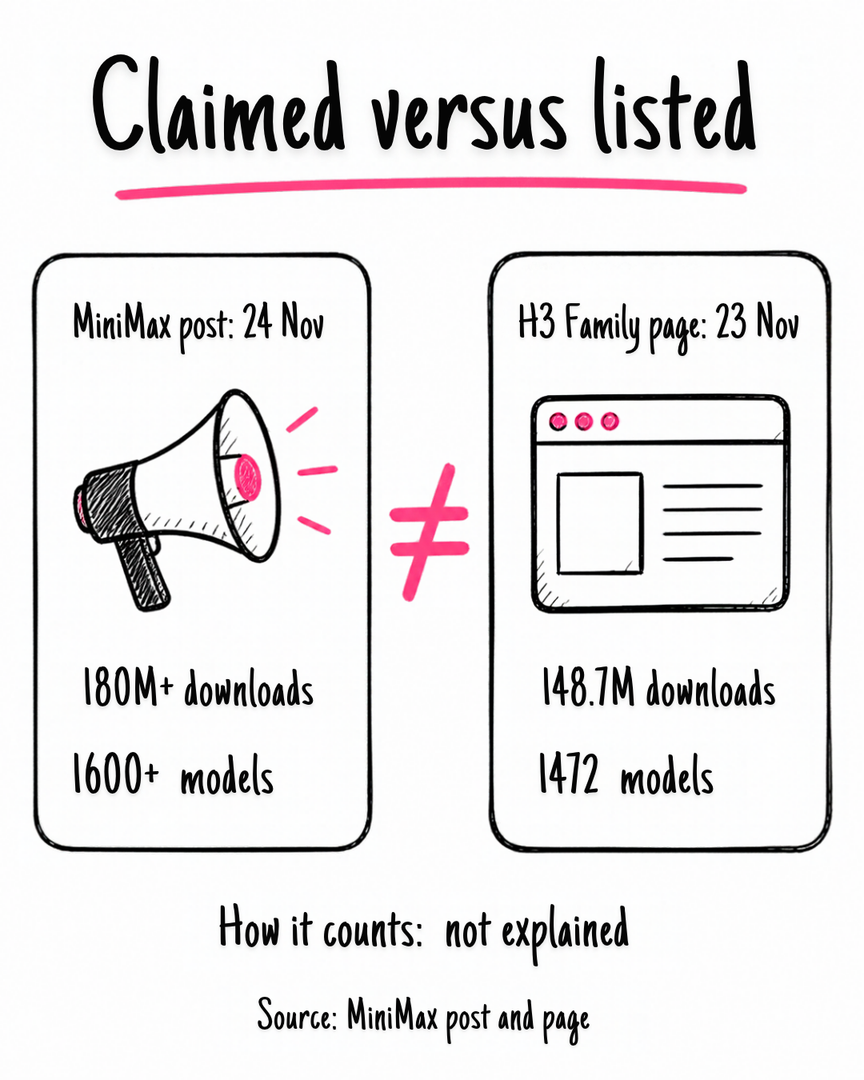
MiniMax says the models built on its open-weight H3 video system have passed 180 million downloads and 1,600 in number, and has put five flagship models and ten partner models under one “H3 Family” banner. The figures are the company’s own. The page it links to lists twelve partner entries from eleven companies, and a copy of that page captured on 23 November showed 1,472 models and about 148.7 million downloads.
The announcement, posted on X on 24 November (16:55 UTC), is the third H3 development Sulat has covered since MiniMax released H3-Image as open weights on 11 November. This one is less about a new model than about how many companies now sell or ship products on top of one.
The five flagship models
MiniMax’s H3 Family page splits its own models into three video tiers and two image tiers. Prices are the “from” prices the page shows.
| Model | Type | What MiniMax says | From |
|---|---|---|---|
| MiniMax H3 | Video | Best quality, built for production; 2K and 768P | US$0.08 per second |
| MiniMax H3 Highspeed | Video | Faster generation; 768P and 480P | US$0.04 per second |
| MiniMax H3 Lite | Video | Most affordable, for trying ideas; 768P and 480P | US$0.025 per second |
| MiniMax H3 Image | Image | Open weights; generation and editing | US$0.022 per image |
| MiniMax H3 Image Highspeed | Image | 4K images in under 10 seconds | US$0.035 per image |
The numbers do not line up
10
partner models, per MiniMax’s post
12
partner entries on MiniMax’s page
11
companies behind them, and 11 tagged in the post
The post tags eleven partner accounts but speaks of ten models. The page lists twelve: two from fal, and one each from MachGen, Nunchux AI, RunningHub, HeyGen, Utopai Studios, Suno, Creatify, Pika, LightX2V with ModelTC, and Akatz Labs. The difference is probably counting, since fal has two entries and LightX2V shares its entry with ModelTC, but MiniMax has not said how it counted.
The headline usage figures are harder to check. The post says 180 million downloads and more than 1,600 models. The page text we could retrieve, dated 23 November, read 1,472 models and 148,704,366 downloads, with a counter saying the project had been open source for 103 days. That is a gap of roughly 31 million downloads and 130 models in a day, so either the counter had moved on, or the post counts something the page does not. The page does not explain what counts as a “model built on H3” or whether downloads are summed across derivatives and quantisations. “All in just 3 months” is also loose: MiniMax launched H3 on 31 July, nearly four months ago.
Who is building on H3
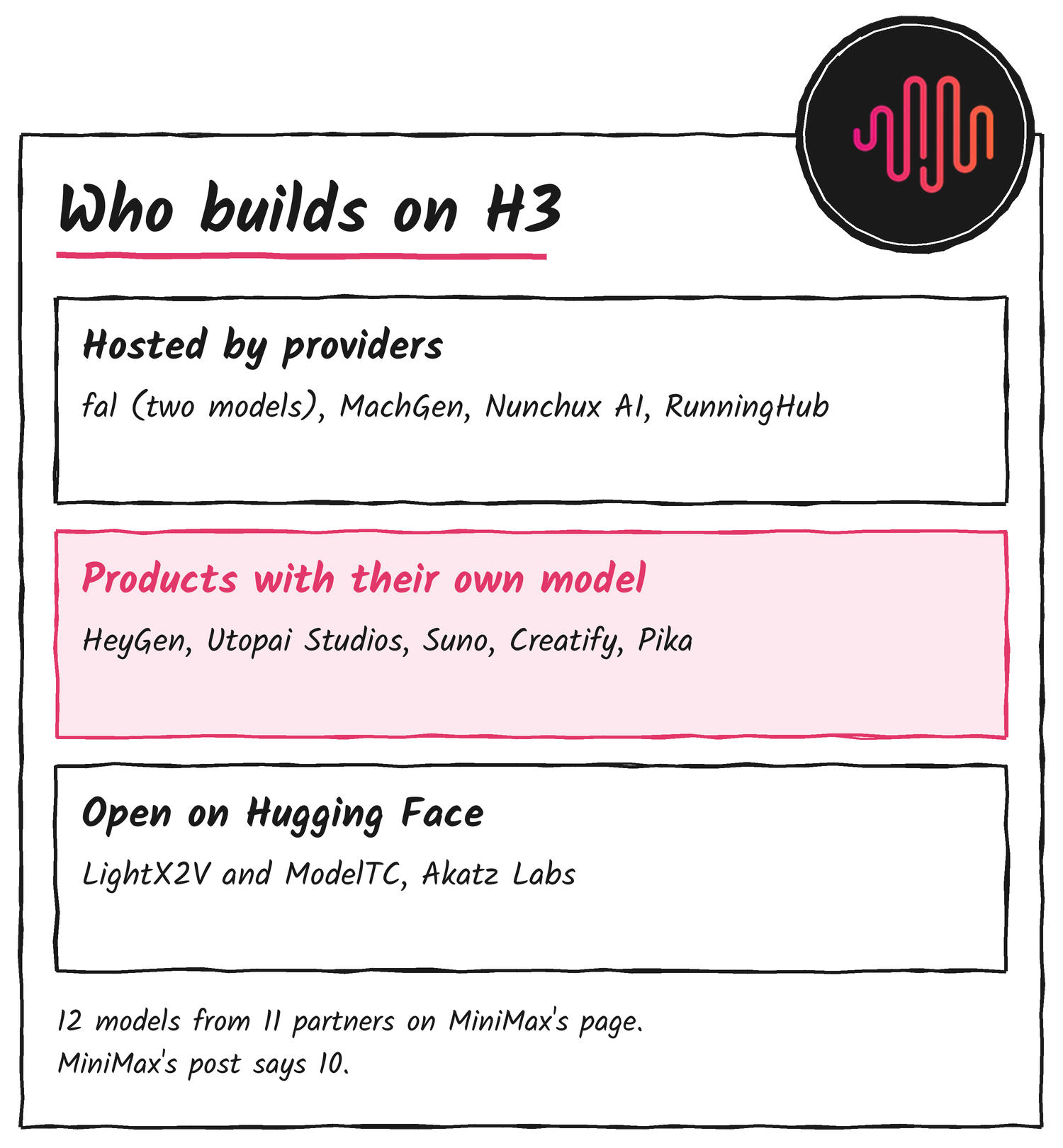
MiniMax sorts the twelve into two groups. Five are hosted by providers: fal’s H3 Max and H3 Max Turbo, MachGen’s hosting of unchanged weights with LoRA support, Nunchux AI’s H3-Fast and RunningHub’s H3 RH. Seven are products with their own model or workflow, and that is where the more interesting claims sit.
| Partner | Model | What the partner says it does |
|---|---|---|
| Pika | Pika H3 Flex | Six-step generation instead of 50, up to 12 reference files, 4K finishing, open weights |
| Utopai Studios | Utopai X | Film model with stronger physics and camera movement, available inside its PAI platform |
| HeyGen | HeyGen Video 1 | Visuals, dialogue and sound while preserving products |
| Suno | H3 Move | Music-video visuals that follow song structure and lyrics, with lip sync; powers Suno Visuals |
| Creatify | Boreal-H3 | Ad briefs with consistent products and characters; opening and ending frame control |
| LightX2V and ModelTC | MiniMax-H3 Turbo | Text, image or reference to video in 4 or 8 steps, on Hugging Face |
| Akatz Labs | Character Swap V1.5 | Swaps video characters while keeping the reference identity, on Hugging Face |
Pika’s account of H3 Flex illustrates how partners describe their own work. Its launch post of 29 October says Flex generates a 15-second clip with synchronised audio in as little as seven seconds of transformer computation, ranks first among open-weight models and seventh overall on DesignArena’s text-to-video board, and exports five separate audio stems. Pika’s product page, though, says up to three stems (dialogue, music and effects). Pika’s technical write-up lists five. Pika has not said which is current.
Creatify’s Boreal-H3 page makes narrower claims, all from its own evaluation: brief success on controlled shots rising from 28 per cent to 50 per cent, identity match from 83 per cent to 94 per cent, and generation time and estimated cost down 20.1 per cent against Creatify’s earlier Boreal model. Suno, for its part, says it “optimized” H3 Move with additional protections and safeguards, and its Chief Product Officer, Jack Brody, wrote that “prompts that work on other video platforms may not work on Suno and that’s by design”, as reported by Music Business Worldwide.
How the H3 builds rank
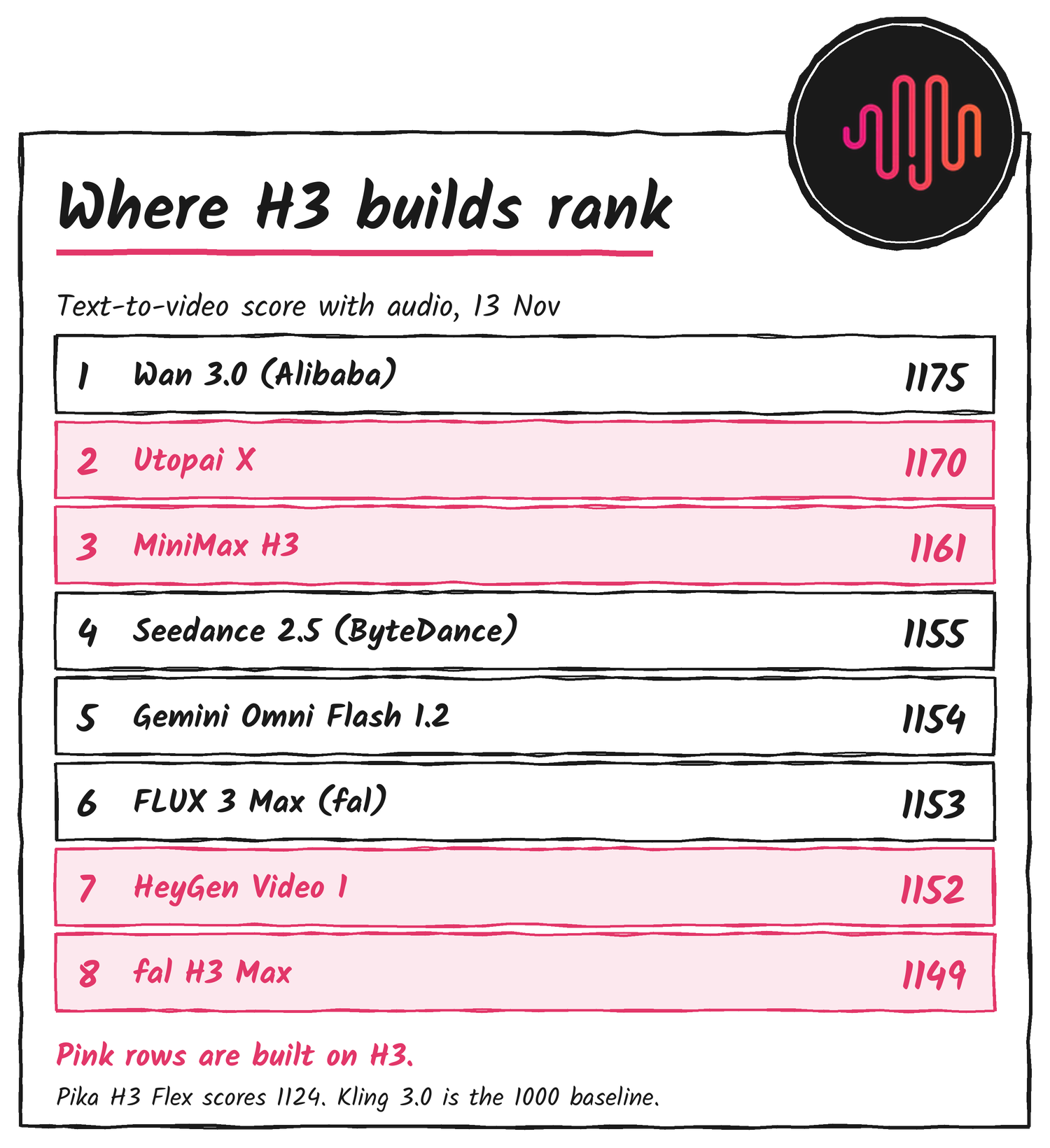
MarkTechPost’s roundup of 13 November, which cites Artificial Analysis’s text-to-video leaderboard with audio, puts four H3-based models in the top eight: Utopai X second at 1170, MiniMax H3 third at 1161, HeyGen Video 1 seventh at 1152 and fal’s H3 Max eighth at 1149. Alibaba’s Wan 3.0 leads at 1175. Pika’s H3 Flex scores 1124 on that list, with Kling 3.0 the 1000-point baseline. Rankings of this kind move daily and are Elo scores from voting, so read them as a snapshot.
Utopai, HeyGen and fal each started from the open H3 base and, according to that roundup, now score near or above it. Utopai X is the highest-scoring of them but has no public API, so only Utopai’s own PAI platform can run it.
The licence and the lawsuit
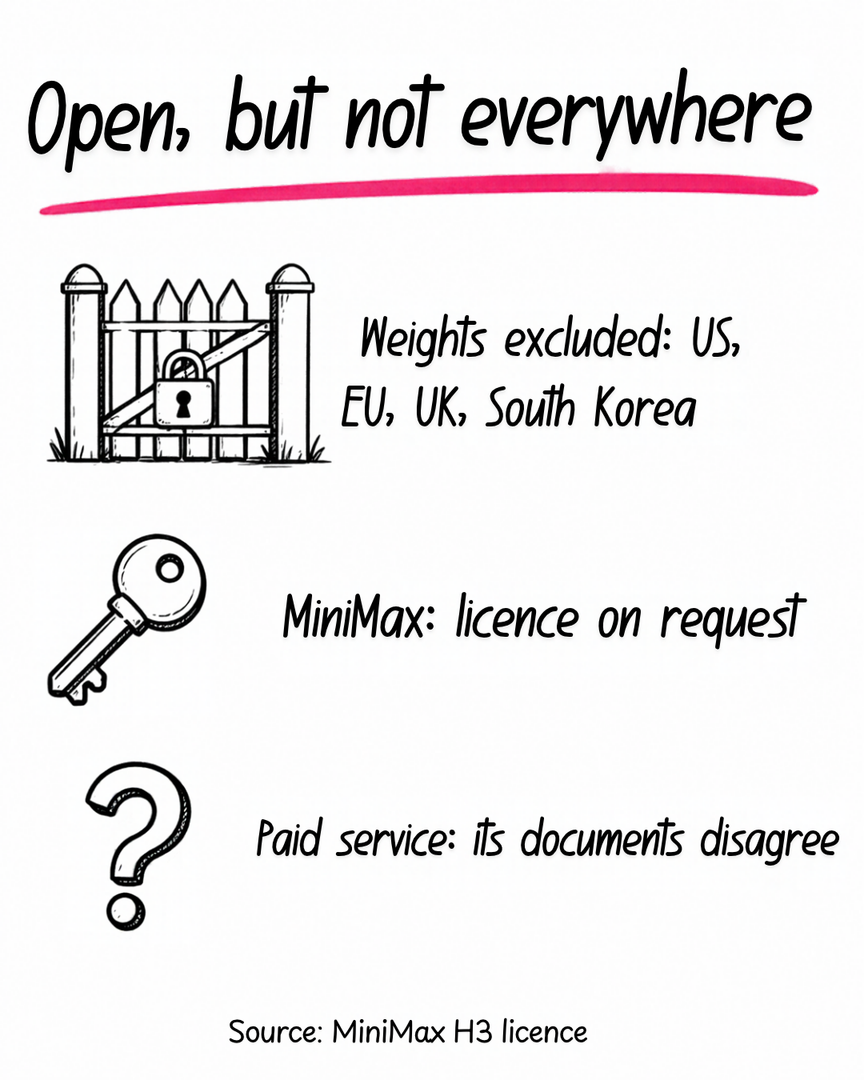
“Open models” comes with a territorial catch. The H3 Community Licence, dated 2 August, defines its applicable territory as worldwide excluding the European Union, the United Kingdom, South Korea and the United States. MiniMax’s licence Q&A says the limit means “not yet”, not “not ever”, and a MiniMax post on X on 4 August says H3 can be licensed for those regions through a formal request form. A MiniMax staff member said at the time that US users face the requirement because of “the ongoing legal situation with Disney”.
Whether the restriction reaches MiniMax’s paid API is disputed by the documents themselves. The Q&A says the API is globally available, while ThePlanetTools, which compared the texts in August, noted that the licence’s clause on outputs and its definition of hosted services appear to cover APIs too. Music Business Worldwide reports the restriction as covering the downloadable weights and not the API. Sulat has not seen MiniMax resolve the difference.
The Disney case is live. Disney, Universal and Warner Bros. Discovery sued MiniMax and affiliated companies over Hailuo AI in the Central District of California in September 2025. Judge Stanley Blumenfeld Jr. denied the motions to dismiss on 22 May, writing that Hailuo AI generates “a near-perfect likeness” of the studios’ characters when prompted with their names, and a trial date of 12 July 2027 appears in the court filings. These are the studios’ allegations, which the defendants contest. The case concerns Hailuo, MiniMax’s earlier service, not H3 as such, though MiniMax says H3 succeeds its Hailuo 01 and 02 video models.
What it means for the wider video market
What follows is Sulat’s reading, not MiniMax’s. The closed leaders, Alibaba’s Wan 3.0 (30-second 1080p clips at US$0.20 per second, according to MarkTechPost), ByteDance’s Seedance 2.5 and Google’s Gemini Omni Flash 1.2, sell one model. MiniMax is trying something different: hand the weights to anyone outside four territories, let them post-train for a niche, and count every derivative towards the family. If the downloads and model counts hold up, it has a distribution advantage the closed labs cannot match. If they do not, the family page is partly marketing.
Several of the best-scoring partners sell commercial products, and Utopai is a Mountain View studio, so the US exclusion is not abstract. Suno’s Visuals is available on the web, iOS and Android. MiniMax has not said publicly whether each has a licence under its authorisation process, and none of the partner pages we read says so. That gap is the open question to put to MiniMax and its partners.
For readers choosing a tool: the hosted providers offer the cheapest ways to try H3-class video, from US$0.022 per second at 480P on Nunchux’s page, against US$0.08 for MiniMax’s own H3. Anyone planning to self-host in the US, EU, UK or South Korea should read the licence first. In New Zealand, the licence’s applicable territory covers use.
Earlier Sulat coverage
- MiniMax releases H3-Image as open weights, with 16-megapixel output and up to 16 reference images
- MiniMax H3-Image GGUF quantisations
- Suno Visuals, built on MiniMax’s H3
Discover more from Sulat AI & Tech News
Subscribe to get the latest posts sent to your email.