GPTZero launched GPTZero 5.0 on 23 November, an AI-text detector it says falsely flags one in 50,000 human-written documents of essay length. The company reports that figure from more than 1.8 million human texts of 300 words or more. It is GPTZero’s own number, it covers longer texts only, and its own model card puts the rate for 50 to 99 word texts at about 1 in 860.
The release has two layers. The launch post is dated 23 November, and the model card carries a release date of 19 November. The detector’s backbone grew from 395 million to 4 billion parameters, roughly 10 times. GPTZero says the model beats Pangram 4 on nine third-party benchmarks, and the headline figures show GPTZero leading or tying on every one. They also show where it doesn’t lead, and nobody outside GPTZero has audited the new false-positive number yet.
- What GPTZero is claiming
- The short-text problem
- How the model was built
- The benchmarks, and where Pangram wins
- Fairness figures
- What outside checks exist
- The market around it
- The patent and the bounties
- What to do with a flag
What GPTZero is claiming
GPTZero’s launch post makes four claims. The false-positive rate on essay-length text is 1 in 50,000 across all writing domains, and fewer than 1 in 10,000 on argumentative essays, financial disclosures and legal briefs. Recall on AI text is above 98.5% for each of the 50 generating models in its table, and at or above 99% for 46 of them. On learner corpora, it reports no false positives on 5,527 texts by writers using English as an additional language. And it reports no false positives across 10,402 US student essays in the PERSUADE 2.0 set, split by disability status, income, grade level and race.
GPTZero also announced a Library of Human Knowledge, a collection of books its detector reads as human, and a false-positive challenge. The launch post offers up to $1,000 for provably human-written text that the detector flags.
the recognition that every false positive has a name
GPTZero, Introducing GPTZero 5.0, 23 November 2026
The short-text problem
The 1 in 50,000 figure holds for texts of 300 words or more. GPTZero’s false-positive table by length shows how quickly it changes below that.
| Words | Human texts tested | GPTZero 5.0 false positives | GPTZero 4.11b | Roughly 1 in |
|---|---|---|---|---|
| 50 to 99 | 255,804 | 0.116% | 0.256% | 860 |
| 100 to 199 | 482,359 | 0.045% | 0.095% | 2,200 |
| 200 to 299 | 361,847 | 0.022% | 0.054% | 4,500 |
| 300 to 499 | 488,329 | 0.0059% | 0.015% | 16,700 |
| 500 to 999 | 696,744 | 0.0003% | 0.0014% | 330,000 |
| 1,000 and over | 628,409 | 0.0005% | 0.0011% | 200,000 |
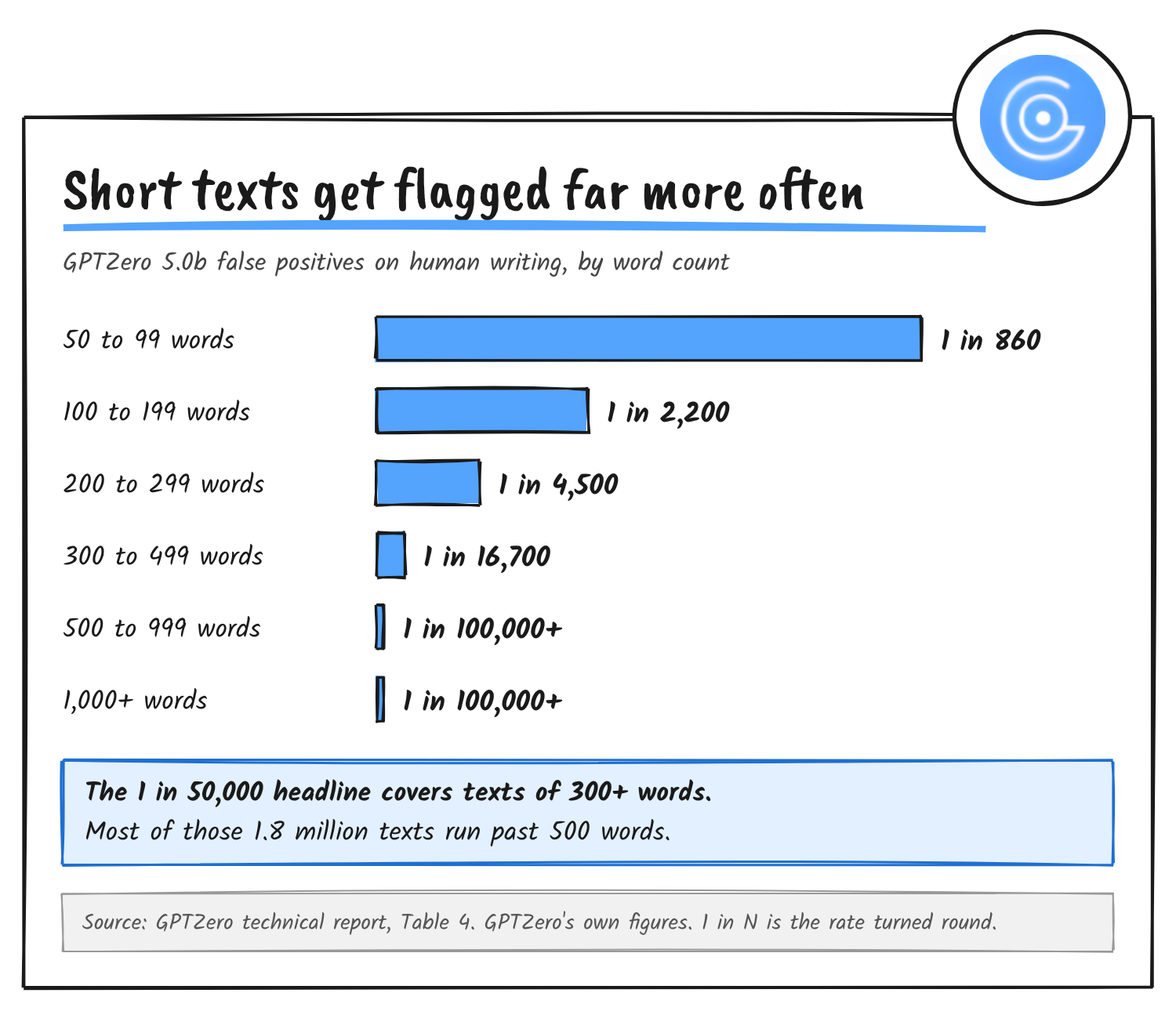
My arithmetic from that table, not a GPTZero figure: the three buckets of 300 words or more add up to about 34 false flags in 1.81 million texts, which is where 1 in 50,000 comes from. The three buckets under 300 words add up to roughly 590 false flags in 1.1 million texts. About 95 in every 100 of the false flags in the table sit in texts shorter than 300 words.
The model card says as much. It lists short texts, bibliographies and URLs the detector doesn’t mask, and specialised formats such as code, tables and isolated bullet points as inputs where results are less reliable. Its safety section is blunt about what a flag is for.
Never use a detector result alone to accuse someone or impose a penalty. Keep a human reviewer responsible and give the writer an opportunity to explain their process and challenge the result.
GPTZero 5.0 model card, AI safety section
How the model was built
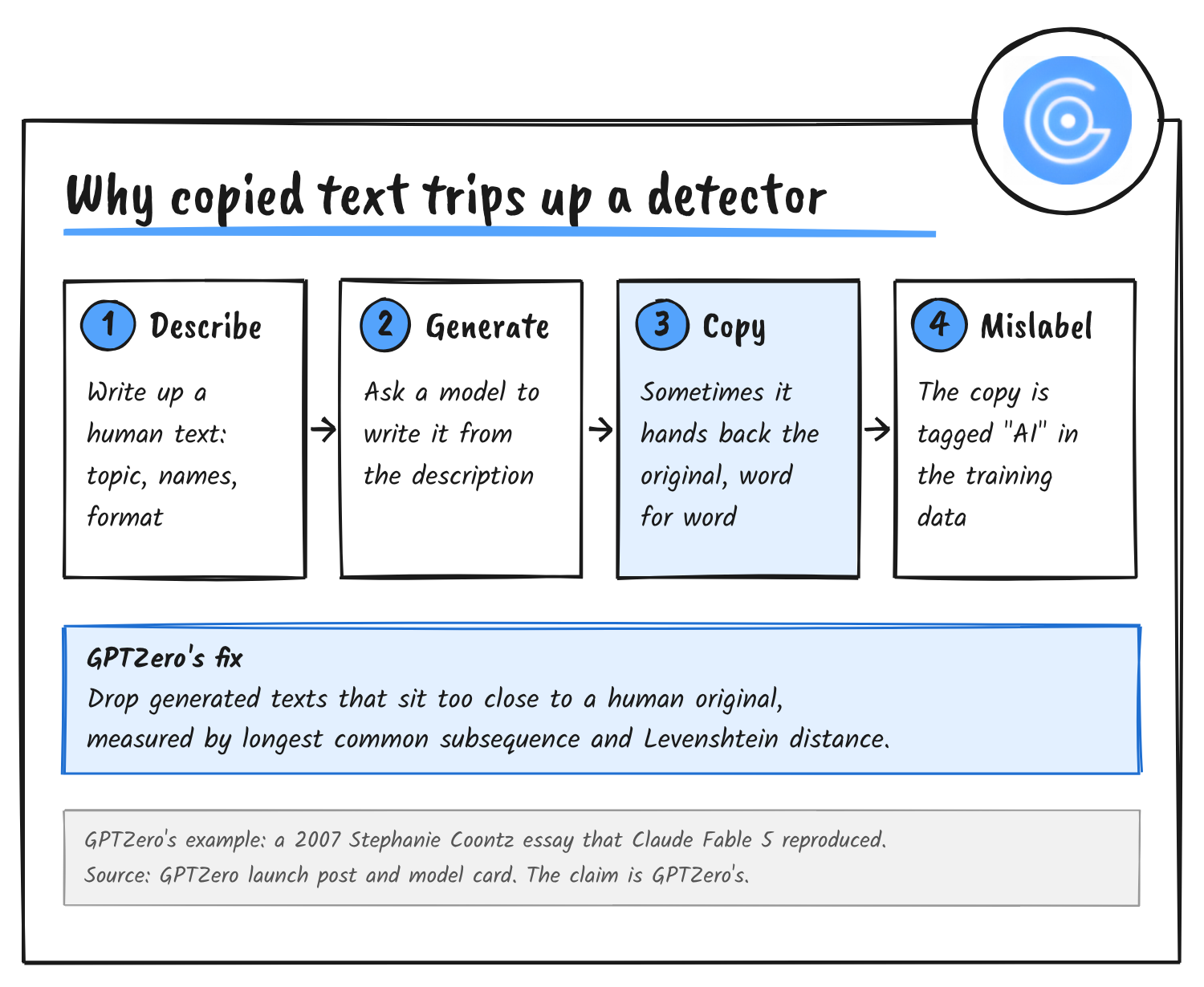
Three changes took 4.11b to 5.0. The first, which the company calls a major contributor to the lower false-positive rate, is about training data. Some of its AI training text was made by describing a human text in detail, then asking a model to write it. Strong models can rebuild substantial passages of the original from that description. Label those copies “AI” and the detector learns to flag human writing. The fix is a filter that drops generated texts sitting too close to a human original, measured by longest common subsequence, Levenshtein distance and other similarity scores.
The second change is preprocessing. Earlier this year GPTZero began stripping em dashes and headers from what the model sees, so punctuation and layout can’t act as shortcuts for “AI”. The model card says plainly that some writers have changed their style to avoid accusations of using AI, and that the model is built to ignore the em dash. The third is size: the backbone went from 395 million to 4 billion parameters, which GPTZero says lifted recall on some models and bypass tools without targeted data.
The human training set is 5.63 million texts with a median length of 541 words. Under 300 words is about a third of it.
The benchmarks, and where Pangram wins
GPTZero’s nine headline benchmarks are third-party datasets that GPTZero ran itself. The comparison is with its own previous version, 4.11b, and with Pangram 4. For some datasets the Pangram figures come from Pangram’s published tables, which use subsets of the full data without saying how the samples were picked. GPTZero says its larger cohorts still show fewer misses than Pangram reports on those subsets.
| Benchmark and metric | GPTZero 5.0 | GPTZero 4.11b | Pangram 4 |
|---|---|---|---|
| AI in Peer Review, AI-edited human reviews, recall | 96.96% | 96.25% | 58.7% |
| AI in Peer Review, humanised AI reviews, recall | 98.20% | 98.90% | 78.5% (200 texts) |
| DetectRL, average F1 | 97.34% | 96.53% | 95.30% |
| UChicago, humanizer set, recall at 1% FPR | 95.99% | 95.53% | 98.93% |
| UChicago, humanizer, under 50 words (331 texts) | 83.08% | 63.44% | 73.32% |
| GEDE, overall, recall at 1% FPR (474 texts) | 95.57% | 91.77% | 94.94% |
| Epoch AI, F1 (594 texts) | 99.41% | 99.16% | 98.55% |
| GRiD, recall at 1% FPR | 99.93% | 97.81% | 99.63% |
| Academic Integrity Abstracts, refined or regenerated, recall | 97.06% | 95.86% | 96.4% |
| MELD, overall, recall at 1% FPR (31,243 texts) | 100.00% | 100.00% | 99.99% |
The table has losses too. Pangram 4 is ahead on the full UChicago humanizer set, 98.93% against 95.99%. GPTZero 4.11b, the older model, beats 5.0 on humanised AI reviews. On humanised text under 50 words, 5.0 catches 83%, so it still misses about one in six. Pangram 4, released in July according to Nature, claims a false-negative rate of 0.34%, a figure I haven’t checked against the benchmark data.
On AI-edited human writing, the hard case for any detector, the gap is the largest in the table: 96.96% against 58.7% on edited peer reviews. Pangram’s number there comes from a sample of 15,118 reviews, GPTZero’s from 16,046.
Fairness figures
Fairness is where the launch leans hardest. GPTZero followed the protocol in Turnitin’s public evaluation, which tests human-written English of at least 300 words and reports false positives for writers using English as a first language (L1) and an additional language (L2).
| Writer group, 300+ words | Human texts | GPTZero 5.0 | GPTZero 4.11b | Pangram 4 | Turnitin |
|---|---|---|---|---|---|
| L2 English | 5,527 | 0.00% | 0.05% | 0.02% | 1.40% |
| L1 English | 4,097 | 0.00% | 0.00% | 0.00% | 1.30% |
The same card reports no false positives on all 249 essays in the Stanford ChatGPT-Detector-Bias set, the 2023 study that found commercial detectors biased against non-native English writers. The older 4.11b model flagged one of the 91 TOEFL essays. Those numbers are small, and zero on a few hundred texts says less than zero on millions.
One outside result points the same way. GPTZero’s launch material cites Tuhin Chakrabarty’s analysis of 187 books by African and diaspora authors published from 2000 to 2026, in which GPTZero scored every book 0.0% AI. The summary doesn’t say which GPTZero version he ran.
A real case shows what a wrong call costs. On 12 November the Caine Prize for African Writing cleared Zimbabwean author Simbarashe Kundizeza of using AI to write this year’s winning story, after The Atlantic raised the allegation, and announced new measures on AI in submissions, according to AP. Commentary at the time said both GPTZero and Pangram had scored the story as fully AI. I haven’t verified those scores, and the prize found against the allegation.
What outside checks exist
GPTZero 5.0 has no independent audit that I could find. The checks that exist are on earlier versions or on different data.
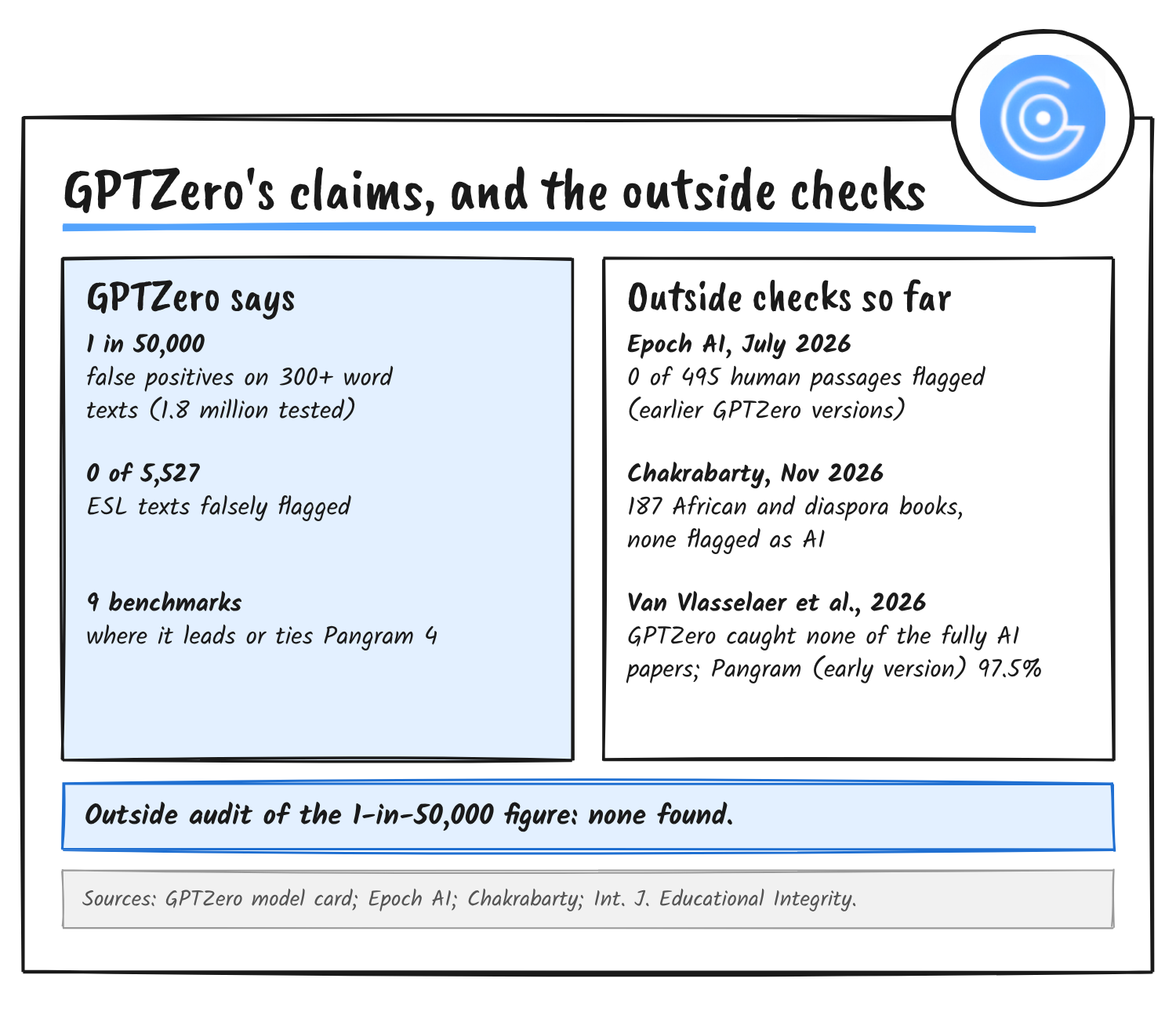
- Epoch AI, July 2026. 495 human passages from 99 authors, all written before ChatGPT. GPTZero and Pangram each flagged none; Originality.ai flagged 19, or 3.84%. Nature reported it in August, so it tested an earlier GPTZero.
- Van Vlasselaer and colleagues, International Journal for Educational Integrity, 2026. 160 papers of at least 3,500 words by non-native English graduate students. Per Pangram’s summary of the study, GPTZero flagged none of 40 human papers and none of the fully AI-written ones, where an early Pangram caught 97.5%. Pangram is a competitor, and the version GPTZero tested isn’t stated.
- Graphite, May 2026. The one outside number that sits far from GPTZero’s claim. On about 15,700 pre-ChatGPT web articles, GPTZero falsely flagged 1.355%, Pangram 1.844% and Copyleaks 1.836%. GPTZero was tested in April, before 5.0. Web articles are a different population from student essays, and GPTZero’s own $100 bounty excludes “boilerplate, low-value SEO content”, which is my reading of one reason the two figures differ.
- huby, 18 November. A software review site that scored nine vendors, put GPTZero second at 3.5 of 5 behind Copyleaks at 3.7, and concluded that none of the nine is reliable enough to be the only evidence behind an academic, employment or contract decision.
Nature reported in August that independent analysts say these detectors flag solely human writing as human almost all the time, and that GPTZero had marketed a 0.08% false-positive rate in February while its technical paper said “sub 1%”. The new claim is 0.002%. That is a 40-fold step from the February figure, resting on a larger test set that GPTZero built.
Pangram called on 6 November for new third-party evaluations of its own detector, saying its largest independent test was the UChicago study, done more than a year earlier on Pangram 3. Claims across the category run ahead of the audits.
The market around it
This isn’t a small outfit making the claim. In June, Superhuman, the company Grammarly became, agreed to acquire it for undisclosed terms. GPTZero co-founder Edward Tian told Business Insider that GPTZero had passed 19 million registered users and $30 million in annual recurring revenue. It had raised $13.5 million in total. Superhuman already had its own AI-detection feature, built to help users revise text so it doesn’t read as AI-written.
| Detector | Backing and reach | Published claim | Outside record |
|---|---|---|---|
| GPTZero | Agreed to be acquired by Superhuman in June; 19M+ registered users (Tian) | 1 in 50,000 false positives, 300+ words (own data) | Epoch AI: 0 of 495 (earlier version); Graphite: 1.355% on web articles |
| Pangram | About $13M raised (huby); NeurIPS rejected 18% of submissions after screening with it (Nature) | Vendor-reported false positives of 1 in 10,000, per a third-party tracker | Epoch AI: 0 of 495; UChicago study on Pangram 3 |
| Turnitin | About 1,400 North American colleges have bought its detector (The Atlantic, September) | Under 1% false positives; 1.40% for L2 writers on its own evaluation, as GPTZero cites it | Not covered in the outside checks above |
| Copyleaks | More than $7M raised (huby); top-rated vendor in huby’s review | No false-positive figure in its docs, per a third-party review | Graphite: 1.836% on web articles |
| Originality.ai | Not covered here | Not covered here | Epoch AI: 19 of 495 flagged (3.84%), version Turbo 3.0.2 |
The Atlantic reported in September that Turnitin’s chief product officer said its detector found at least some AI writing in nearly half of US student submissions in the past academic year. That is Turnitin’s figure, and it is a rate of detection, not of error. The Atlantic also covered a backlash against Pangram on college campuses. A false flag is a bigger problem for a detector sold to universities than a miss.
The patent and the bounties
GPTZero’s launch post says its approach, described in a February 2026 whitepaper, “culminated in the granting of a patent”. I couldn’t find a grant. Google Patents lists US20260023791A1, “Artificial intelligence generated text detector”, as a published application filed on 18 July 2025, with a status of Pending as of this week. Its inventors include Alexander Yuhao Cui, Edward Jingyuan Tian and George Alexandru Adam. A pending application protects nothing yet.
GPTZero runs two bounties. The launch post offers up to $1,000 for provably human-written text that the detector flags, which it calls the final frontier challenge; I haven’t seen the full terms. The model card offers $100 for qualifying false positives on substantive texts demonstrably written before ChatGPT’s release in 2022, with boilerplate, SEO content, gibberish, machine translation and very short excerpts excluded.
What to do with a flag
For teachers, editors and anyone else who gets a flag, the model card and the length table agree on the practical rule: treat the length of the text as part of the result. The detector is strongest where the sample is long, and the evidence is thinnest where it is short.
How to check a flag before acting on it
- Count the words. Under 300 words, treat the score as a weak signal. Under 100, the error rate is tens of times higher than the headline figure.
- Remove bibliographies, URLs and front matter before scanning. GPTZero says it doesn’t mask them, and they can change the result.
- Check the document history, such as drafts, version history and earlier work by the same writer.
- Ask the writer to explain how they produced the text, and give them room to challenge the score. GPTZero’s own guidance says a detector result should never be the only basis for a penalty.
Next to watch: an independent run of 5.0 on human text, ideally on the short and mid-length texts where the false flags cluster. Pangram has invited exactly that kind of study for its own detector. GPTZero’s $1,000 challenge will show whether anyone can find a flagged human text that the company will accept as proof.
Discover more from Sulat AI & Tech News
Subscribe to get the latest posts sent to your email.